

Hello! Daily Hangul Editor here.
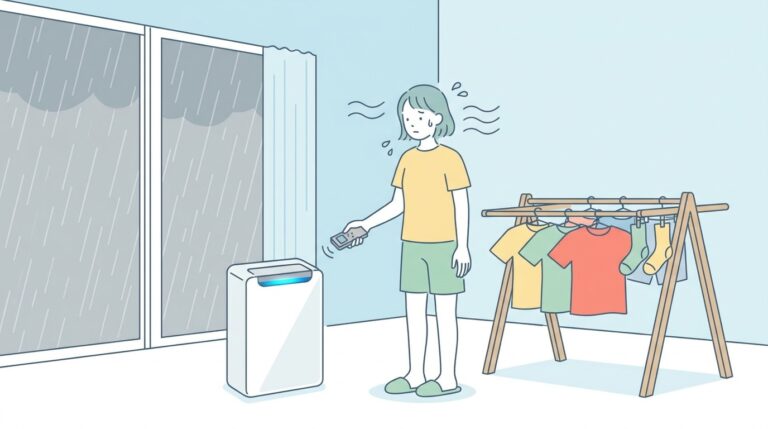
Picture this: You are watching a K-Drama set in the summer. The male lead runs through the pouring rain, rushes into his apartment, and what’s the very first thing he does? Before changing out of his soaked clothes, he aggressively jabs a button on a sleek white machine in the corner of the living room.
Why? Because he knows the true enemy of a Korean summer isn’t just the heat—it’s the humidity. Welcome to Jangma (장마), the Korean monsoon season.
If you are planning to visit Korea in July, or if you are living here right now, you quickly realize that the air feels like warm, heavy soup. In this season, knowing how to express your discomfort and how to operate a dehumidifier (제습기, jeseupgi) is a matter of sheer survival. It’s also the #1 topic for small talk!
This guide is based on real panicked texts I get from my foreign students every summer. Let’s learn the real Korean phrases that will keep you dry, cool, and sounding like a true local!
Phase 2: Core Expressions Deep Dive
1. 너무 습해요 (It’s too humid)
- Pronunciation: Neomu seuphaeyo [neo-mu seup-hae-yo]
- Sound-alike guide for English speakers: ‘seup’ sounds like you are saying “soup” but stopping abruptly before the ‘p’ comes fully out.
- Meaning: It’s too humid.
- K-Culture Moment: This is the ultimate “elevator small talk” in July. When you step into the office elevator with a coworker, wiping sweat from your forehead, this is the exact phrase you sigh out.
- Editor’s Insight: While ‘더워요’ (It’s hot) is common, using ‘습해요’ shows you really understand the Korean climate. It shifts the blame from the sun to the moisture in the air.
- Situation Spectrum:
- 친구 사이 (Casual): ✅ (너무 습해!)
- 직장 동료 (Semi-formal): ✅
- 직장 상사·어른 (Formal): ✅ (날씨가 너무 습하네요.)
- 🤔 Think About It: In Korea, commenting on the weather is the standard icebreaker. Why do you think shared suffering (like complaining about the humidity) is such a common way to build camaraderie in Korean culture?
2. 진짜 꿉꿉해요 (It’s really sticky/muggy)
- Pronunciation: Jinjja kkupkkuphaeyo [jin-jja kkup-kkup-hae-yo]
- Sound-alike guide for English speakers: The ‘kk’ requires you to tense your throat. Imagine the sound of a small hiccup while saying “goop”.
- Meaning: (Literal) It’s damp. / (Real nuance) It’s sticky, muggy, gross, and my clothes are clinging to me.
- K-Culture Moment: You know that feeling when laundry won’t dry during the monsoon season and starts smelling weird? Koreans use ‘꿉꿉하다’ to describe both the weather and that damp laundry feeling.
- Editor’s Insight: This is a fantastic native-sounding word. It captures the physical discomfort of the humidity perfectly. It’s less scientific than ‘습하다’ and much more emotional.
- Situation Spectrum:
- 친구 사이 (Casual): ✅
- 직장 동료 (Semi-formal): ✅
- 직장 상사·어른 (Formal): ⚠️ (A bit colloquial. Stick to ‘습하네요’ for the CEO).
- 🤔 Think About It: Many Korean adjectives vividly describe sensory feelings (mimetic words). Does your native language have a specific word for the feeling of clothes sticking to sweaty skin?
3. 제습기 좀 틀어주세요 (Please turn on the dehumidifier)
- Pronunciation: Jeseupgi jom teureojuseyo [je-seup-gi jom teu-reo-ju-se-yo]
- Sound-alike guide for English speakers: ‘teu’ sounds like the disgusted ‘ugh’ sound, but with a ‘t’ in front.
- Meaning: (Literal) Please turn/twist the dehumidifier. / (Real nuance) Please turn on the dehumidifier.
- K-Culture Moment: You are at a friend’s house or a small cafe, and the air feels heavy. This is how you politely beg for relief.
- Editor’s Insight: Notice the verb 틀다 (teul-da). While 켜다 (kyeo-da) means “to turn on” (like a light switch), Koreans exclusively use 틀다 for appliances that regulate flow—like water faucets, air conditioners, heaters, and dehumidifiers. Adding ‘좀’ (a little) softens the request so you don’t sound bossy.
- Situation Spectrum:
- 친구 사이 (Casual): ⚠️ (Use “제습기 좀 틀어줘” or “제습기 틀자”)
- 직장 동료 (Semi-formal): ✅
- 카페 직원 (To staff): ✅
Phase 3: Textbook vs. Real Korean
[Complaining about the weather]
* 📖 Textbook Korean: 오늘은 습도가 매우 높습니다. (Today the humidity is very high.)
* 🗣️ Real Korean: 아, 오늘 진짜 꿉꿉하다! (Ah, today is so sticky!)
* 💡 Why the difference?: Koreans love descriptive, expressive words in daily conversation. Textbook phrases sound like a TV weather forecast.
[Suggesting turning on the machine]
* 📖 Textbook Korean: 제습기를 켜십시오. (Turn on the dehumidifier.)
* 🗣️ Real Korean: 제습기 좀 틀까요? (Shall we turn on the dehumidifier?)
* 💡 Why the difference?: Direct commands are considered rude in Korean. Using “Shall we?” (~을까요?) and “a little” (좀) makes the suggestion softer and considerate of the other person’s comfort.
Bottom Note: At the B1 level, mastering the softening word ‘좀’ (jom) is your secret weapon. It instantly makes your Korean sound much more polite and native-like!
Phase 4: Cultural Context — K-Culture Deep Dive
4-1. Non-verbal Element: The “Jangma” Sigh
When saying “너무 꿉꿉해요,” it is almost mandatory to lightly fan your face with your hand or grab the collar of your shirt and shake it slightly to let air in. Doing this while letting out a slight sigh before speaking (“하아… 진짜 꿉꿉하네요”) shows true Korean Nunchi (reading the room)—you are acknowledging the shared suffering of the summer heat.
4-2. K-Culture Connection: The “Smell of Jangma” & Survival Tech
In Korea, most people live in apartments without outdoor backyards or mechanical clothing dryers (though dryers are getting more popular!). Traditionally, laundry is hung on drying racks inside the living room.
During the monsoon season, high humidity means clothes take days to dry, resulting in the dreaded “걸레 냄새” (rag smell). In K-Dramas or reality shows like I Live Alone (나 혼자 산다), you will often see celebrities position their dehumidifier directly under their drying rack like a superhero protecting the laundry. Knowing this context makes you realize why the dehumidifier is the MVP of the Korean household!
Phase 5: Practical Roleplay Scenario
Setting: Mid-July in Seoul. You just arrived at the Airbnb you booked with your Korean friend, Min-su. It rained heavily all day. The moment you open the door, the air inside feels like a wet sauna.
Characters:
* YOU: Exhausted from dragging your luggage through the humid streets.
* 민수 (Min-su): Your Korean friend, looking equally sweaty.
Dialogue:
민수: 하아… 밖에 비 진짜 많이 온다. 너 괜찮아?
(Haa… bakke bi jinjja mani onda. neo gwaenchana?)
[Sigh… It’s raining so much outside. Are you okay?]
(🎭 Stage Direction: Min-su drops his bags and wipes his forehead)
YOU: 아니, 너무 더워. 그리고 공기가 좀 무거워.
(Ani, neomu deowo. Geurigo gonggiga jom mugeowo.)
[No, it’s too hot. And the air feels heavy.]
민수: 내 말이! 오늘 날씨 진짜 미쳤어. 너무 꿉꿉해.
(Nae mari! oneul nalssi jinjja micheosseo. neomu kkupkkuphae.)
[Tell me about it! The weather is crazy today. It’s so sticky.]
YOU: 여기 에어컨이나 제습기 없어?
(Yeogi eeokeonina jeseupgi eopseo?)
[Isn’t there an AC or dehumidifier here?]
민수: 아, 저기 방 구석에 제습기 있다! 내가 틀까?
(A, jeogi bang guseoge jeseupgi itda! naega teulkka?)
[Ah, there’s a dehumidifier in the corner of the room! Should I turn it on?]
🔀 Your Turn! How should you respond?
– A) “응, 켜라.” (Eung, kyora.)
– B) “네, 제습기를 켜십시오.” (Ne, jeseupgireul kyeosipsio.)
– C) “응, 제발 당장 틀어줘! 나 숨막혀!” (Eung, jebal dangjang teureojwo! na summakyeo!)✅ Best Choice: C — Reason: Between close friends sharing extreme discomfort, exaggerating playfully (“Please turn it on right now! I’m suffocating!”) is perfectly natural. It uses the correct verb (틀다 -> 틀어줘).
⚠️ Choice A & B Analysis: A is grammatically okay but sounds a bit stiff and uses the less natural verb ‘켜다’. B is extremely formal textbook Korean, totally unnatural for a friend.
Phase 6: 10-Second Shadowing Drill
Let’s practice the most useful phrase. Pay attention to the pauses (/) and the emotion!
😤 (Wiping sweat)
아, / 오늘 날씨 / 진짜 / 꿉~~~꿉하네요.
(A, / oneul nalssi / jinjja / kkup~~~kkuphaeneyo.)
[Ah, the weather today is seriously so sticky.]
🥺 (Looking at your friend)
우리 / 제습기 좀 / 틀까요?
(Uri / jeseupgi jom / teulkkayo?)
[Shall we turn on the dehumidifier?]
Phase 7: K-Culture Mini Dictionary
1. 장마
* Romanization: jangma
* English: Monsoon season / Rainy season
* Context: Usually spanning late June to late July, this season dictates Korean summer fashion (rain boots, sandals) and lifestyle.
2. 제습기
* Romanization: jeseupgi
* English: Dehumidifier
* Context: Often seen as essential as an air conditioner in Korean homes due to the intense humidity.
3. 불쾌지수
* Romanization: bulkwaejisu
* English: Discomfort Index
* Context: A meteorological index you will hear on the evening news every day in summer, indicating how likely people are to get annoyed due to the heat and humidity.
4. 뽀송뽀송하다
* Romanization: pposongpposonghada
* English: Soft and dry (fluffy)
* Context: The exact opposite of ‘꿉꿉하다’. It’s the feeling of freshly dried laundry or your skin after sitting next to a dehumidifier.
Phase 8: Traveler Survival Kit
Surviving a sudden downpour during Jangma is a rite of passage for any traveler in Korea!
🆘 Survival Phrases for the Rainy Season
– 🇰🇷 “우산 하나 주세요.” (usan hana juseyo.)
– 🗣️ English: Please give me an umbrella.
– 📍 Where to use: Convenience stores (CU, GS25, 7-Eleven).
– 💡 Pro Tip: Convenience stores sell transparent vinyl umbrellas (비닐우산) very cheaply. They are lifesavers during sudden Jangma showers!
- 🇰🇷 “에어컨 좀 세게 틀어주시겠어요?”
- 🗣️ English: Could you turn up the air conditioner a bit?
- 📍 Where to use: Inside a taxi or a cafe when you are dripping with sweat.
📌 Editor’s Travel Note
* Cafe Refuge: During July, large cafes in Korea crank the AC so high it feels like winter. If you get soaked in the rain, escaping into a cafe is a great strategy, but you might actually feel chilly after 30 minutes!
* Apps: Use Naver Weather or Windy for highly localized rain radar. The weather changes by the minute during Jangma.
Phase 9: Critical Thinking Corner — “A Step Deeper”
Climate & Life: How the Environment Shapes the Culture
In traditional Korean houses (Hanok), there is a unique heating system called Ondol designed to survive the freezing winters. Conversely, the open wooden floors (Daecheong maru) were built to survive the suffocating summer humidity. Today, modern technology has replaced these with floor heating and dehumidifiers.
The Korean language reflects this intense battle with the elements. Expressions like “날씨가 꿉꿉하다” (the weather is sticky) or “불쾌지수가 높다” (the discomfort index is high) show how deeply the climate affects collective mood and daily conversation. Surviving the seasons is a shared national experience!
💬 Your Turn: Does your country have a specific season that everyone complains about? How do people greet each other during that time? Share it in the comments!
Phase 10: FAQ & Avoiding Misunderstandings
Q: Can I tell a taxi driver “기사님, 너무 꿉꿉해요”?
Yes! ‘꿉꿉하다’ is slightly casual, but adding ‘해요’ makes it perfectly acceptable polite small talk. The driver will likely agree enthusiastically and turn up the AC!
Q: Why do Koreans say “비가 온다” (Rain is coming) instead of “It is raining”?
In Korean, rain and snow are subjects that “come” (오다) or “fall” (내리다). You don’t say “비해요” (doing rain).
❌ Common Mistake #1: Saying “제습기 켜주세요” (jeseupgi kyeojuseyo).
✅ Do this instead: It’s not wrong, but using “제습기 틀어주세요” (teureojuseyo) sounds 100% more natural and fluent.❌ Common Mistake #2: Using “더워요” (deowoyo – it’s hot) when you are actually suffering from the humidity inside a shady room.
✅ Do this instead: Use “습해요” (seuphaeyo) or “꿉꿉해요” (kkupkkuphaeyo). Koreans distinguish strongly between dry heat and wet heat!
Phase 11: Summary & Action Items
- One-Liner Summary: Beat the Korean summer by using “꿉꿉해요” to express the stickiness and “틀어주세요” to command the life-saving dehumidifier!
Action Mission:
* 🥉 Bronze: Say “아, 진짜 꿉꿉하다!” out loud while dramatically fanning yourself.
* 🥈 Silver: Next time it rains where you live, text a Korean friend: “오늘 비가 와서 너무 습해요.”
* 🥇 Gold: When you visit Korea in the summer, successfully ask a cafe staff or your hotel reception to turn on the AC/Dehumidifier using “틀어주세요”.
📺 K-Culture Mission:
Watch an episode of I Live Alone (나 혼자 산다) on YouTube. Look for the white machines sitting next to indoor laundry racks. You now know exactly what they are and why they are there!
Phase 12: Quiz — Interactive Challenge
1. Situational Judgment: You step outside in Seoul in mid-July. You immediately start sweating and your shirt sticks to your back. What is the most natural Korean phrase to mutter to yourself?
* A) 비가 옵니다.
* B) 습도가 높습니다.
* C) 아, 진짜 꿉꿉하다!
2. Fill in the Blank:
“방이 너무 습해요. 제습기 좀 ______________?”
(The room is too humid. Shall we turn on the dehumidifier?)
* Hint: Use the verb ‘틀다’ in the “Shall we?” form.
3. True or False – K-Culture Edition:
In Korea, it is common to dry your laundry indoors right next to a dehumidifier during the summer. (T / F)
🚨 Click here for Answers!
- C (A is “It’s raining,” B is too robotic/textbook).
- 틀까요? (teulkkayo?)
- True! It prevents the dreaded ‘rag smell’ (걸레 냄새) caused by the Jangma humidity.
Frequently Asked Questions (FAQ)
Q: What does "너무 습해요 (It's too humid)" mean in Korean and how do you pronounce it?
A: In Korean, "너무 습해요 (It's too humid)" is pronounced [Neomu seuphaeyo [neo-mu seup-hae-yo] and means: It's too humid.
Q: What does "진짜 꿉꿉해요 (It's really sticky/muggy)" mean in Korean and how do you pronounce it?
A: In Korean, "진짜 꿉꿉해요 (It's really sticky/muggy)" is pronounced [Jinjja kkupkkuphaeyo [jin-jja kkup-kkup-hae-yo] and means: (Literal) It's damp. / (Real nuance) It's sticky, muggy, gross, and my clothes are clinging to me.
Q: What does "제습기 좀 틀어주세요 (Please turn on the dehumidifier)" mean in Korean and how do you pronounce it?
A: In Korean, "제습기 좀 틀어주세요 (Please turn on the dehumidifier)" is pronounced [Jeseupgi jom teureojuseyo [je-seup-gi jom teu-reo-ju-se-yo] and means: (Literal) Please turn/twist the dehumidifier. / (Real nuance) Please turn on the dehumidifier.







