

Phase 1: Empathy
Hello! I’m your editor from Daily Hangul.
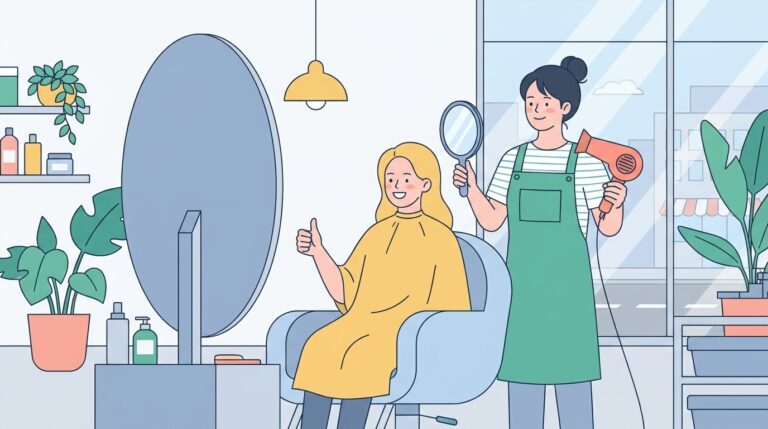
Imagine this: You’re sitting in a sleek, brightly lit K-Beauty salon in Hongdae. You’re sipping an iced Americano they gave you for free. The stylist, who looks like they just stepped out of a K-Pop music video, finishes blow-drying your hair, spins your chair around to face the mirror, and asks with hopeful eyes, “어떠세요?” (How is it?)
You look in the mirror. You feel like the main character in a K-Drama. It’s perfect. You want to say, “Oh my gosh, I absolutely love it! You are a genius!”
But your mind goes blank. You freeze. You just nod awkwardly, give a thumbs up, and mumble, “Yes… good…”
If you don’t know how to properly express your satisfaction in Korean, the stylist might worry they messed up, or worse—they might keep cutting it until it’s too short! On the other hand, knowing exactly what to say will instantly bring a huge smile to their face and make you look like a total local insider.
Note: Everything in this post is based on real SOS messages from our students who panicked in Korean hair salon chairs! Don’t worry, we’ve got you covered.
Phase 2: Core Expressions Deep Dive
Here are the absolute best ways to say “I love it” when getting a haircut or makeover in Korea.
1. 마음에 들어요
- Pronunciation: ma-eu-me deu-reo-yo [ma-eu-me: the ‘eu’ sounds like the disgusted grunt you make when stepping in gum + smooth r]
- Meaning: I like it (Literal: It enters my heart/mind)
- K-Culture Moment: You’ll hear this constantly in K-Dramas when the female lead tries on a beautiful dress and steps out of the fitting room, or when someone views a nice apartment.
- Editor’s Insight: This is the golden standard. In English, we say “I like my hair.” In Korean, we don’t usually say “I like it” (좋아해요) for things someone just made for us. We say “It enters my heart” (마음에 들어요) to show that we are satisfied with the result.
- Situation Spectrum:
- Casual with friends: ✅
- Semi-formal (Service staff/Coworkers): ✅ (Perfect!)
- Formal (Boss/Elders): ⚠️ (A bit too casual for a strict boss, but great for salon staff)
- 🤔 Think About It: Why does the Korean language use an emotional phrase like “enters my heart” instead of a simple “good”? Does your language have a poetic way to express satisfaction?
2. 딱 좋아요
- Pronunciation: ttak jo-a-yo [ttak: sharp tense T, like the ‘t’ in ‘stop’, abruptly ending with a k]
- Meaning: It’s exactly right / It’s perfect (Literal: Exactly good)
- K-Culture Moment: The stylist asks if the water temperature is okay while washing your hair, or if the bangs are too long. You reply with this to say “Don’t change a thing!”
- Editor’s Insight: ‘딱’ (ttak) is a magical sound word in Korean. It means ‘exactly’ or ‘perfectly fitting’. Saying “딱 좋아요” sounds incredibly natural and native-like.
- Situation Spectrum:
- Casual with friends: ✅
- Semi-formal (Service staff/Coworkers): ✅
- Formal (Boss/Elders): 🚫
- 🤔 Think About It: “딱” (ttak) sounds like a snap of the fingers, right? Korean has many words that sound like the feeling they describe.
3. 예뻐요 / 멋있어요
- Pronunciation: ye-ppeo-yo [tense P] / meo-si-sseo-yo
- Meaning: It’s pretty / It’s cool (handsome)
- K-Culture Moment: Looking at your new nail art or fresh haircut and complimenting the style itself.
- Editor’s Insight: If you got a feminine style, use 예뻐요 (It’s pretty). If you got a masculine/cool style, use 멋있어요 (It’s cool). You are complimenting the hair, not yourself!
- Situation Spectrum:
- Casual with friends: ✅
- Semi-formal (Service staff/Coworkers): ✅
- Formal (Boss/Elders): ✅
Phase 3: Textbook vs Real Korean
[Expressing you really, really like it]
* 📖 Textbook Korean: 저는 제 머리 모양이 매우 좋습니다. (I like my hair shape very much.)
* 🗣️ Real Korean: 우와, 완전 마음에 들어요! (Wow, I totally love it!)
* 💡 Why is it different?: Using “완전” (wan-jeon / totally) adds that authentic, dramatic K-Drama flair. Textbooks sound like robots; real Koreans express emotion!
[When asked: “Is this length okay?”]
* 📖 Textbook Korean: 이 길이가 적당합니다. (This length is appropriate.)
* 🗣️ Real Korean: 네, 딱 좋아요! (Yes, it’s perfectly fine!)
* 💡 Why is it different?: Efficiency and friendliness. “딱 좋아요” is upbeat and reassures the stylist immediately.
Bottom Note: At an
A2 (Beginner)level, throwing in words like “완전” (totally) or “딱” (exactly) is the easiest way to sound like an intermediate speaker without learning complex grammar!
Phase 4: Cultural Context — K-Culture Deep Dive
4-1. Non-verbal Cues at the Salon
When the stylist shows you the back of your head with a mirror, make eye contact through the mirror, smile, and nod affirmatively. In Korea, “Nunchi” (reading the room/atmosphere) is huge. If you just stare silently, the stylist’s Nunchi alarms will go off, and they’ll panic thinking you hate it. Be vocally appreciative!
4-2. The K-Beauty Connection
Korean hair salons are world-famous for a reason. It’s not just a haircut; it’s a full 서비스 (seobiseu – service) experience. You get drinks, snacks, and sometimes a head massage while getting shampooed. Because they put so much effort into customer care, loudly expressing your gratitude (“너무 마음에 들어요! 수고하셨습니다!”) makes their hard work feel validated. If you watch K-Pop idols’ Vlogs when they get their hair dyed for a comeback, listen closely—they always thank the staff profusely at the end.
Phase 5: Real-world Roleplay Scenario
Setting: A trendy, brightly lit hair salon in Cheongdam-dong. K-Pop is playing softly in the background. You just got a cut and color inspired by your favorite actor.
Characters:
– YOU: A K-culture fan learning Korean. You want to be polite but natural.
– Stylist Ji-ah (지아): 28 years old. Friendly, a bit of a perfectionist, wants to make sure you are 100% happy.
Dialogue:
지아: 머리 다 됐습니다! 어떠세요?
(meo-ri da dwaet-seum-ni-da! eo-tteo-se-yo?)
[Your hair is all done! How is it?]
(🎭 Stage Direction: Ji-ah spins your chair and holds up a hand mirror so you can see the back)
YOU: 우와…
(u-wa…)
[Wow…]
지아: (A little worried) 색깔 너무 밝은가요?
(saek-kkal neo-mu bal-geun-ga-yo?)
[Is the color too bright?]
YOU: 아니요, 색깔 너무 예뻐요!
(a-ni-yo, saek-kkal neo-mu ye-ppeo-yo!)
[No, the color is so pretty!]
지아: (Smiling in relief) 다행이네요. 길이는 괜찮으세요?
(da-haeng-i-ne-yo. gi-ri-neun gwaen-cha-neu-se-yo?)
[That’s a relief. Is the length okay?]
🔀 Your Turn! How should you answer?
– A) 네, 좋습니다. (Yes, it is good.)
– B) 네, 딱 좋아요! 완전 마음에 들어요.
– C) 대박 사건!✅ Best Choice: B — Why? It’s natural, enthusiastic, and uses our core phrases!
⚠️ Choice C Analysis: “대박 사건” (Daebak sageon – Epic incident) is a fun slang phrase, but you only use it with close friends when gossiping. It’s a bit too silly for a professional stylist.
지아: ㅋㅋㅋ 감사합니다. 예쁘게 관리하세요~ 수고하셨습니다!
(kkk gam-sa-ham-ni-da. ye-ppeu-ge gwan-ri-ha-se-yo~ su-go-ha-syeot-seum-ni-da!)
[Hahaha, thank you. Take good care of it~ Thank you for your effort!]
YOU: 네, 수고하셨습니다!
(ne, su-go-ha-syeot-seum-ni-da!)
[Yes, thank you for your effort!]
Phase 6: 10-Second Shadowing Drill
Let’s practice the flow. Read aloud and follow the slash (/) for pauses.
- 😊 Brightly: 네! / 길이는 / 딱 좋아요!
(ne! / gi-ri-neun / ttak jo-a-yo!) - 😍 Excitedly: 우와, / 완전 / 마음에 들어요. / 감사합니다!
(u-wa, / wan-jeon / ma-eu-me deu-reo-yo. / gam-sa-ham-ni-da!) - 🙇♂️ Politely bowing: 예쁘게 해주셔서 / 감사합니다. / 수고하셨습니다.
(ye-ppeu-ge hae-ju-syeo-seo / gam-sa-ham-ni-da. / su-go-ha-syeot-seum-ni-da.)
Phase 7: K-Culture Mini Dictionary
1. 미용실
* Romanization: mi-yong-sil
* English: Hair salon / Beauty parlor
* Context: The general word for a hair salon in Korea.
2. 앞머리
* Romanization: am-meo-ri
* English: Bangs / Fringe
* Context: A crucial element in K-Beauty! Korean stylists are masters at cutting “see-through bangs” (시스루뱅).
3. 고데기
* Romanization: go-de-gi
* English: Hair straightener / Curling iron
* Context: When stylists ask if you want your hair styled before leaving, they’ll ask if they should do ‘고데기’. Say yes for those perfect K-Drama waves!
4. 수고하셨습니다
* Romanization: su-go-ha-syeot-seum-ni-da
* English: Thank you for your hard work.
* Context: The ultimate polite phrase to say when leaving a salon, clinic, or taxi. It acknowledges the service provider’s effort.
Phase 8: Traveler’s Survival Kit
If you are visiting a salon in Seoul, here are your lifesavers!
🆘 Survival Phrase #1
– 🇰🇷 “조금만 다듬어 주세요.” (jo-geum-man da-deu-meo ju-se-yo.)
– 🗣️ English: Just a trim, please.
– 📍 Where to use: When you sit in the chair and don’t want a drastic change.🆘 Survival Phrase #2
– 🇰🇷 “이 사진처럼 해주세요.” (i sa-jin-cheo-reom hae-ju-se-yo.)
– 🗣️ English: Please do it like this photo.
– 📍 Where to use: Show them a picture of your favorite K-Pop idol!🆘 Survival Phrase #3
– 🇰🇷 “얼마예요?” (eol-ma-ye-yo?)
– 🗣️ English: How much is it?
– 📍 Where to use: Always ask before you start if the price isn’t clear!📌 Editor’s Travel Note
– Useful App: Use Kakao Hairshop (카카오헤어샵) or Naver Map to find highly-rated salons and book appointments in advance.
– Visuals are King: Language barrier? Hand gestures and photos are universal. Bring 2-3 reference photos!
– Tipping Culture: DO NOT TIP! Korea has a strict no-tipping culture. Tipping your stylist will cause confusion and they will chase you down the street to give your money back.
Phase 9: Critical Thinking Corner — “한 발 더 깊이”
🧠 Think Deeper: Media vs Reality (The Makeover Trope)
In K-Dramas, we often see the “Makeover Scene.” The protagonist gets dragged to a salon, a montage plays for 5 seconds, and BAM, they are transformed. But the reality of K-Beauty is meticulous labor. A simple cut and color in Korea might involve 3-4 different assistants, detailed consultations, scalp massages, and precision styling lasting hours. This is why Koreans don’t just say “Thanks” at the end; they say “수고하셨습니다” (You worked hard). The language directly reflects the cultural respect for the intense labor behind “effortless” beauty.💬 Your Turn: Does your culture have a specific phrase to thank service workers for their hard work, or do you just say a simple “thank you”? Share in the comments!
Phase 10: FAQ & Avoiding Common Mistakes
Q: Can I use “사랑해요” (I love you) to say I love my new hair?
A: NO! In English, we say “I love my hair.” In Korean, “사랑해요” is strictly for deep romantic or familial affection towards living things. Saying “제 머리를 사랑해요” sounds like you are romantically involved with the hair on your head. Stick to “마음에 들어요”!
Q: Do I need to bow when I say thank you?
A: Yes, slightly! Since you are sitting down, you don’t need to stand up to bow. Just give a slight nod of the head (about 15 degrees) while making eye contact in the mirror.
❌ Common Mistake #1: Translating “I like it” word-for-word to “좋아해요” (jo-a-hae-yo).
✅ Do this instead: Use “마음에 들어요” to express satisfaction with a result or service.❌ Common Mistake #2: Saying “괜찮아요” (It’s okay) when the stylist asks if you like it.
✅ Do this instead: To a Korean stylist, “괜찮아요” sounds like “It’s mediocre but I guess I’ll live with it.” If you love it, be loud about it: “완전 예뻐요! 딱 좋아요!”
Phase 11: Summary & Action Items
- One-Liner Summary: To say you love your new look, ditch the robotic translations and use “마음에 들어요” (It enters my heart) and “딱 좋아요” (It’s perfectly exactly right)!
-
Action Mission 3 Steps:
- 🥉 Bronze (Solo): Look in the mirror today, point to your own hair, and say “오, 오늘 머리 완전 마음에 들어요!” (Oh, I totally love my hair today!).
- 🥈 Silver (Online): Find a photo of your favorite Korean celebrity’s hairstyle. Save it to your phone so you have it ready for your next salon trip!
- 🥇 Gold (Real World): The next time you get a haircut, even in your home country, whisper “딱 좋아요” to yourself in the chair.
- K-Culture Mission: Go to YouTube and search for “[Your favorite K-Pop idol] Vlog Hair Salon”. Watch them interact with their stylists. Can you catch them saying “수고하셨습니다” at the end?
Did you ever get a haircut in a foreign country? How did it go? Tell us your survival stories in the comments below!
Phase 12: Quiz — Interactive Challenge
1. The stylist asks, “길이는 괜찮으세요?” (Is the length okay?) You think it’s the perfect length. What should you say?
– A) 사랑해요.
– B) 딱 좋아요.
– C) 괜찮아요.
💡 Click to see the answer!
Answer: B. “딱 좋아요” means it’s perfectly right. A means “I love you” (weird!), and C means “It’s just okay” (might hurt their feelings).
2. Fill in the blank: “우와, 결과가 완전 ( )에 들어요!” (Wow, I totally love the result!)
– A) 마음
– B) 심장
– C) 머리
💡 Click to see the answer!
Answer: A (마음). The phrase is “마음에 들어요” (enters the mind/heart). 심장 is a physical beating heart, so “심장에 들어요” sounds like a medical emergency!
3. True or False: In Korea, you should tip your hairstylist 10-15% if you really love the haircut.
💡 Click to see the answer!
Answer: FALSE! Korea does not have a tipping culture. They will genuinely be confused and try to return your money. Just say “수고하셨습니다” (Thank you for your hard work) brightly instead!
Frequently Asked Questions (FAQ)
Q: What does "마음에 들어요" mean in Korean and how do you pronounce it?
A: In Korean, "마음에 들어요" is pronounced [ma-eu-me deu-reo-yo [ma-eu-me: the 'eu' sounds like the disgusted grunt you make when stepping in gum + smooth r] and means: I like it (Literal: It enters my heart/mind)
Q: What does "딱 좋아요" mean in Korean and how do you pronounce it?
A: In Korean, "딱 좋아요" is pronounced [ttak jo-a-yo [ttak: sharp tense T, like the 't' in 'stop', abruptly ending with a k] and means: It's exactly right / It's perfect (Literal: Exactly good)
Q: What does "예뻐요 / 멋있어요" mean in Korean and how do you pronounce it?
A: In Korean, "예뻐요 / 멋있어요" is pronounced [ye-ppeo-yo [tense P] and means: It's pretty / It's cool (handsome)







