

Phase 1: Empathy (Immersive Opening)
Hello! I’m your Daily Hangul Editor.
Picture this: You are watching your favorite K-Drama, and there’s a beautiful wedding scene. The bride and groom look stunning, the hall is covered in flowers, and everyone is smiling. Now, fast forward to real life: You’ve actually been invited to a Korean coworker’s or friend’s wedding! You confidently hand over your white envelope of congratulatory money, smile warmly, and say… wait, what do you say next?
If you just say “Congratulations” in English, they will appreciate it, but wouldn’t it be amazing to ask about their honeymoon like a true local? Asking about the honeymoon is the most natural, polite, and caring way to make small talk with the busy newlyweds. Today, we are going to learn exactly how to ask that, so you can sound like a true ‘insider’ at any Korean wedding buffet!
(Note: This guide is built from the real experiences of our students who panicked at Korean wedding halls!)
Phase 2: Core Expressions Deep Dive
1. 신혼여행 어디로 가세요?
- Pronunciation: sinhon-yeohaeng eodiro gaseyo? (sin-hon-yeo-haeng eo-di-ro ga-se-yo?)
- Sound-alike guide: ‘eo’ sounds like the ‘uh’ in ‘up’. ‘eu’ sounds like the sound you make when you step in something gross (ugh!).
- Meaning: Where are you going for your honeymoon? (Literal: Honeymoon where to do you go?)
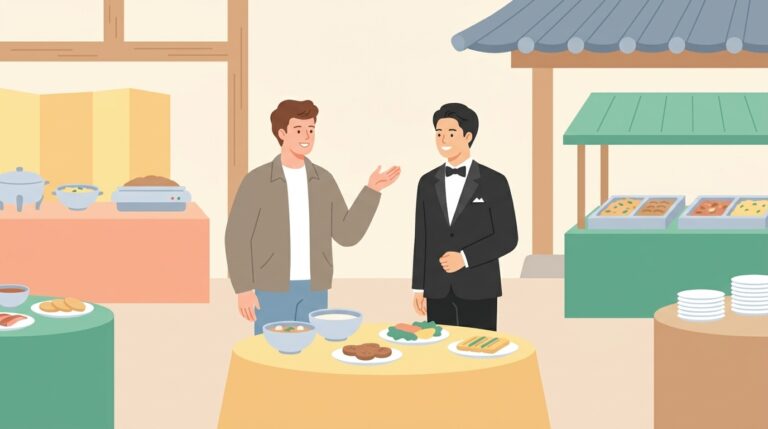
- K-Culture Moment: You are in the bustling wedding buffet hall (뷔페). The bride and groom are walking around table by table to thank the guests. This is your 10-second window to chat! You stand up slightly, smile, and ask this exact question.
- Editor’s Insight: ‘신혼여행’ (sinhon-yeohaeng) literally means ‘new-marriage-travel’. By adding the polite ending ‘-세요’ (-seyo), you are showing high respect to the couple on their special day.
- Situation Spectrum:
- Close Friends (Casual): ⚠️ (Friends usually drop the ‘-요’ and say “어디로 가?”)
- Coworkers (Semi-formal): ✅
- Boss/Elders (Formal): ✅
- 🤔 Think About It: Why do Koreans almost always ask about the honeymoon? In Korea’s fast-paced work culture, a honeymoon is often the longest vacation a person will ever take! Asking about it shows you care about their well-deserved rest.
2. 푹 쉬고 오세요!
- Pronunciation: puk swigo oseyo! (pook shwi-go o-se-yo!)
- Meaning: Have a good rest and come back safely! (Literal: Deeply rest and come)
- K-Culture Moment: After they tell you they are going to Hawaii or Jeju Island, you respond with this. It’s the ultimate warm blessing in Korean culture.
- Editor’s Insight: Notice how we don’t just say “Have fun.” We say “Rest deeply.” This reflects the reality of Korean weddings—planning them is incredibly exhausting!
- Situation Spectrum:
- Close Friends (Casual): ⚠️ (Say “푹 쉬고 와!” puk swigo wa! instead)
- Coworkers (Semi-formal): ✅
- Boss/Elders (Formal): ✅
- 🤔 Think About It: Does your culture focus more on “having fun/partying” or “resting” when wishing someone a good honeymoon?
Phase 3: Textbook vs. Real Korean
[Asking the Destination]
* 📖 Textbook Korean: 신혼여행은 어느 국가로 가십니까? (sinhon-yeohaeng-eun eoneu gukga-ro gasimnikka? – Which country are you traveling to for your honeymoon?)
* 🗣️ Real Korean: 신혼여행 어디로 가세요? (sinhon-yeohaeng eodiro gaseyo?)
* 💡 Why the difference?: The textbook version sounds like an immigration officer interrogating them! In daily life, the ‘-어/아/여요’ and ‘-세요’ endings are much warmer and more natural.
[Wishing them well]
* 📖 Textbook Korean: 즐거운 여행 되시기를 바랍니다. (jeulgeoun yeohaeng doesigireul baramnida. – I hope it becomes a joyful trip.)
* 🗣️ Real Korean: 재밌게 놀다 오세요! (jaemitge nolda oseyo! – Have fun!) or 푹 쉬고 오세요! (puk swigo oseyo! – Get a good rest!)
* 💡 Why the difference?: Real spoken Korean loves using vivid action verbs like 놀다 (to play/have fun) and 쉬다 (to rest) rather than formal noun-based sentences.
Bottom Note: At the A2 level, stick to the polite ‘-요’ or ‘-세요’ forms. They are safe, respectful, and make you sound highly emotionally intelligent!
Phase 4: Cultural Context — K-Culture Deep Dive
4-1. Non-Verbal Elements (Nunchi at the Wedding)
When you greet the couple, don’t hold them in a long conversation! Korean weddings are famous for being fast-paced (sometimes the whole ceremony is just 30 minutes!). The couple has to greet hundreds of people at the buffet. Use your Nunchi (눈치 – the ability to read the room). Ask the question, give a warm smile, say “푹 쉬고 오세요!” and let them move to the next table.
4-2. The Real K-Drama vs. Real Life Wedding
In K-Dramas, weddings are often interrupted by dramatic confessions, or the couple is seen running through the airport in their wedding dress and tuxedo.
In reality? The couple finishes greeting everyone at the buffet, goes home, sleeps for 12 hours, and usually goes to the airport the next day in comfortable sweatpants! Asking “신혼여행 언제 가세요?” (When do you leave for your honeymoon?) is also a great follow-up question because many couples don’t leave on the exact day of the wedding.
Phase 5: Real-Life Roleplay Scenario
Setting: Saturday afternoon at a glamorous wedding hall in Gangnam. You are sitting at a large round table in the buffet area with your coworkers. You have a plate full of delicious Korean food (galbi, sushi, japchae). Suddenly, your coworker (the groom) walks up to your table in a neat suit to greet you.
Characters:
– YOU: A foreigner working in Korea, attending your first Korean wedding.
– Ji-hoon: (30, your Korean coworker). He looks happy but very tired.
Dialogue:
지훈: 와주셔서 감사합니다! 식사는 입에 맞으세요? 😊
(wa-jusyeoseo gamsahamnida! siksaneun ibe majeuseyo?)
[Thank you for coming! Is the food okay?]
(🎭 Stage Direction: Ji-hoon bows politely and looks at your plate)
YOU: 네, 진짜 맛있어요! 결혼 너무 축하해요, 지훈 씨. 🥳
(ne, jinjja masisseoyo! gyeolhon neomu chukhahaeyo, Ji-hoon ssi.)
[Yes, it’s really delicious! Huge congratulations on your wedding, Ji-hoon.]
지훈: 감사합니다. 주말인데 와주셔서 정말 감동했어요.
(gamsahamnida. jumal-inde wajusyeoseo jeongmal gamdong-haesseoyo.)
[Thank you. I’m really touched you came on a weekend.]
🔀 Your Turn! How should you respond?
– A) “빨리 가세요.” (Hurry up and go.)
– B) “신혼여행 어디로 가세요?” (Where are you going for your honeymoon?)
– C) “축의금 많이 냈어요!” (I gave a lot of congratulatory money!)✅ Best Choice: B — Asking about the honeymoon is the perfect, polite small talk.
⚠️ Choice A & C Analysis: Choice A is incredibly rude. Choice C might be said as a joke among extremely close best friends, but to a coworker, it sounds very inappropriate!
(Assuming you chose B)
YOU: 신혼여행 어디로 가세요? ✈️
(sinhon-yeohaeng eodiro gaseyo?)
[Where are you going for your honeymoon?]
지훈: 저희는 내일 모레 하와이로 가요!
(jeohuineun naeil more hawai-ro gayo!)
[We are going to Hawaii the day after tomorrow!]
YOU: 와, 하와이! 푹 쉬고 오세요!
(wa, hawai! puk swigo oseyo!)
[Wow, Hawaii! Have a good rest and come back safely!]
Phase 6: 10-Second Shadowing Drill
Let’s practice the intonation! In Korean questions, the pitch goes up at the end.
- 😊 밝고 친절하게 (Bright and polite)
신혼여행 / 어디로 / 가세요? ↗
(sinhon-yeohaeng / eodiro / gaseyo?) -
😌 따뜻하게 (Warmly)
푹~ / 쉬고 / 오세요! ↘
(puk~ / swigo / oseyo!)
Phase 7: K-Culture Mini Dictionary
1. 축의금
* Romanization: chug-uigeum
* English: Congratulatory money
* Context: In Korea, we don’t usually buy wedding gifts (like toasters or blenders). We give cash in a white envelope. It is the most practical and appreciated gift!
2. 뷔페
* Romanization: bupe
* English: Buffet
* Context: Almost 90% of Korean weddings serve a buffet. The quality of the buffet is often how guests judge the wedding!
3. 식권
* Romanization: sikgwon
* English: Meal ticket
* Context: When you hand in your ‘chug-uigeum’ envelope at the front desk, they will hand you a ‘sikgwon’. You need this ticket to enter the buffet hall.
4. 하객
* Romanization: hagaek
* English: Wedding guest
* Context: The people who attend the wedding to congratulate the couple.
Phase 8: Traveler’s Survival Kit
Even if you aren’t living in Korea, you might be invited to a Korean friend’s wedding during your travels! Here is what you must know.
🆘 Survival Expressions at a Wedding
– 🇰🇷 “식권 주세요.” (sikgwon juseyo.)
– 🗣️ Pronunciation: shik-gwon joo-se-yo.
– 📍 Where to use: At the front desk after giving your money envelope.
– 💡 Pro Tip: If you don’t have time to eat, tell them! They will often exchange the meal ticket for a small gift (답례품 – damnyepum) like wine or salt.📌 Editor’s Wedding Note
– How much to give?: Usually, 50,000 KRW if you are just acquaintances, 100,000 KRW if you are close friends or coworkers, and more if you are best friends.
– Dress Code: Do NOT wear a white dress. White is strictly reserved for the bride. Koreans usually wear neat, dark-colored suits or muted, elegant dresses (often called ‘하객룩’ – guest look).
Phase 9: Critical Thinking Corner — “A Step Deeper”
Language & Power / The Culture of Giving
Have you noticed how much emphasis is put on the “Congratulatory Money” (축의금) in Korea? Some foreigners feel shocked by this “cash-only” culture. But underneath it, there is a deep sense of community (품앗이 – pumasi). Historically, Koreans pooled their resources to help neighbors during major life events (weddings, funerals). When you give money, it’s an unspoken promise: “I am supporting your new start, and when it’s my turn, our community will support me.”
💬 Your Turn: Does your culture give cash for weddings, or do you have a wedding registry (gift list)? Tell us in the comments!
Phase 10: FAQ & Avoiding Mistakes
Q: “Can I ask the couple how much their wedding cost?”
No! Unless you are their absolute best friend, asking about the cost of the wedding hall or the house they bought is considered highly intrusive. Stick to the honeymoon!
Q: “Can I ask when they are having a baby?”
Definitely avoid this. Like in many Western cultures, asking about family planning is a sensitive topic.
❌ Common Mistake #1: Calling the groom or bride “너” (neo – you) if you just met them or if they are your coworkers.
✅ Do this instead: Always use their name + 씨 (ssi) or their job title (e.g., 지훈 씨, 대리님) at the wedding.
Phase 11: Summary & Action Items
- One-Liner Summary: Be the best wedding guest by handing over your envelope, enjoying the buffet, and politely asking, “신혼여행 어디로 가세요?” (Where are you going for your honeymoon?).
-
Action Missions:
- 🥉 Bronze: Look in the mirror, smile warmly, and say “신혼여행 어디로 가세요?” 3 times.
- 🥈 Silver: Search “Korean wedding hall buffet” (한국 결혼식 뷔페) on YouTube and leave a comment in English or Korean about what food you want to try!
- 🥇 Gold: If you know a Korean friend who recently got married or is getting married, send them a message: “결혼 축하해요! 신혼여행은 어디로 가세요?”
Phase 12: Interactive Challenge Quiz
1. Situational Judgment: You gave your congratulatory money at the desk, but the person didn’t give you anything back. You want to eat at the buffet. What should you say?
– A) “뷔페 어디예요?” (Where is the buffet?)
– B) “식권 주세요.” (Please give me a meal ticket.)
– C) “축의금 냈어요.” (I paid the congratulatory money.)
2. True or False – K-Culture Edition:
“It is highly recommended to wear a beautiful, bright white dress to a Korean wedding so you look good in the photos.”
– T / F
3. Fill in the blank:
When the couple tells you they are going to Jeju Island for their honeymoon, you want to wish them a “good rest.”
“푹 ____ 오세요!” (puk ____ oseyo!)
(Answers: 1. B, 2. False – never wear white!, 3. 쉬고)
Frequently Asked Questions (FAQ)
Q: What does "신혼여행 어디로 가세요?" mean in Korean and how do you pronounce it?
A: In Korean, "신혼여행 어디로 가세요?" is pronounced [sinhon-yeohaeng eodiro gaseyo? (sin-hon-yeo-haeng eo-di-ro ga-se-yo?] and means: Where are you going for your honeymoon? (Literal: Honeymoon where to do you go?)
Q: What does "푹 쉬고 오세요!" mean in Korean and how do you pronounce it?
A: In Korean, "푹 쉬고 오세요!" is pronounced [puk swigo oseyo! (pook shwi-go o-se-yo!] and means: Have a good rest and come back safely! (Literal: Deeply rest and come)







