

Hello! I’m the Lead Editor at Daily Hangul.
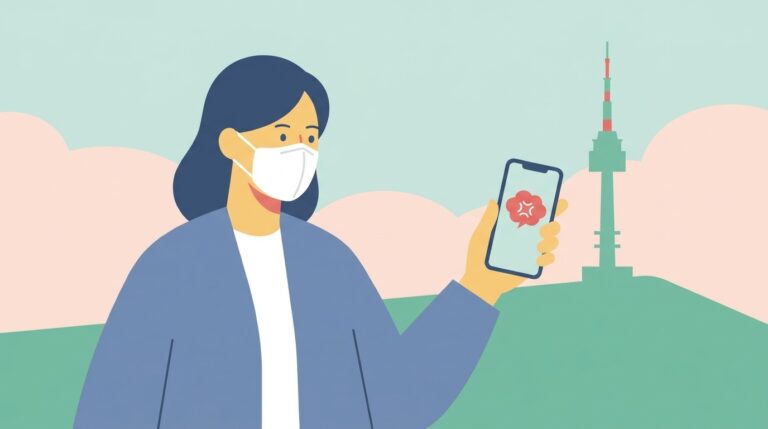
Picture this: You step out of your Airbnb in Hongdae. The sky looks a bit… grey, almost like a vintage movie filter. You check your weather app, and there’s a giant, angry, red face staring back at you. Suddenly, your Korean friend texts you: “마스크 썼어?” (Did you wear a mask?)
If you’re a K-Pop fan, you’ve definitely seen idols rocking black masks at Incheon Airport. You might have thought it was just a cool “airport fashion” statement or a way to hide their bare, makeup-free faces. But in Korea, masks are more than just a celebrity accessory—they are absolute survival gear against 미세먼지 (mise-meonji, fine dust).
If you don’t know how to talk about masks or understand when Koreans warn you about the air quality, you might end up coughing your way through your dream trip! Don’t worry. As a veteran tutor who has seen countless students confused by Korea’s “dust season,” I’m going to teach you exactly what to say to breathe easy and sound like a true local.
Phase 2: Core Expressions – Deep Dive
1. 마스크 쓰세요
- Pronunciation: ma-seu-keu sseu-se-yo
(Tip: The ‘seu’ in sseu-se-yo sounds like the disgusted “ugh” sound you make when you step in wet gum!)- Meaning:
- Literal: Please write/use a mask.
- Real Nuance: Please wear a mask.
- K-Culture Moment: Picture a sweet K-Drama scene where the caring older colleague (선배) scolds the clumsy junior for coming to work on a dusty day. They pull out a fresh, individually wrapped KF94 mask, hand it over, and say, “마스크 쓰세요.” It’s a classic act of Korean “jeong” (정, warm affection) disguised as a light scolding.
- Editor’s Insight: This phrase feels protective. When a Korean tells you this, they aren’t bossing you around; they genuinely care about your lungs! Note that Korean has different verbs for “wearing” clothes, shoes, and hats. For things worn on the face or head, we use 쓰다 (sseuda).
- Situation Spectrum:
- Casual (Friends): ⚠️ (Use ‘마스크 써’ instead)
- Semi-formal (Co-workers): ✅
- Formal (Boss/Elders): 🚫 (Use ‘마스크 쓰세요’ but with extra polite body language, or ‘마스크 쓰셔요’)
- 🤔 Think About It: Why does Korean have completely different verbs for wearing pants (입다), wearing shoes (신다), and wearing masks/hats (쓰다)? How does your native language handle the concept of “wearing” things?
2. 미세먼지 심해요
- Pronunciation: mi-se-meon-ji sim-hae-yo
- Meaning:
- Literal: Micro-dust is severe.
- Real Nuance: The fine dust is really bad today.
- K-Culture Moment: You’re sitting in a Seoul cafe. Someone walks in coughing, tapping their phone screen to show their friend the weather app, sighing, “Ah, today misemeonji simhaeyo…”
- Editor’s Insight: “심하다 (simhada)” is a magical word. It means “severe” or “too much.” You can use it when the dust is bad, a joke goes too far, or a cold is terrible. It’s the perfect word to express your frustration about the grey sky.
- Situation Spectrum:
- Casual: ✅ (Drop the ‘yo’ -> 심해)
- Semi-formal: ✅
- Formal: ✅
- 🤔 Think About It: Koreans check the “fine dust index” just as often as the temperature. How does weather affect daily conversations in your culture?
3. 마스크 있어요?
- Pronunciation: ma-seu-keu i-sseo-yo?
- Meaning:
- Literal/Real Nuance: Do you have a mask?
- K-Culture Moment: You walk into a GS25 convenience store because you forgot yours. You make eye contact with the part-timer and ask this. Simple, direct, and exactly what you need to survive.
- Editor’s Insight: “있어요? (Isseoyo?)” is your ultimate survival tool. Just put ANY noun in front of it. Coffee isseoyo? Water isseoyo? Mask isseoyo?
- Situation Spectrum:
- Casual: ✅ (있어?)
- Semi-formal: ✅
- Formal: ✅
Phase 3: Textbook vs. Real Korean
[Telling a friend to wear a mask]
* 📖 Textbook Korean: 마스크를 쓰세요. (maseukeureul sseuseyo) – A bit stiff!
* 🗣️ Real Korean: 마스크 써! (maseukeu sseo!)
* 💡 Why the difference?: Close friends drop the “yo” (polite ending) and the “reul” (object marker). It makes the sentence punchy and affectionate.
[Complaining about the air quality]
* 📖 Textbook Korean: 오늘 미세먼지가 아주 나쁩니다. (oneul misemeonjiga aju nappeumnida) – Sounds like a news anchor!
* 🗣️ Real Korean: 아, 오늘 먼지 대박. (a, oneul meonji daebak) – “Ah, the dust is crazy today.”
* 💡 Why the difference?: “대박” (daebak) literally means ‘jackpot’ but is used as slang for ‘crazy/awesome/terrible’ depending on the context. Koreans love using short, emotionally charged slang to bond over shared misery!
Phase 4: Cultural Context — K-Culture Deep Dive
4-1. Non-Verbal Cues: The Art of Giving
When a Korean colleague hands you a mask, they will likely use two hands—either holding the mask with both hands or supporting their right elbow with their left hand. This isn’t just about the mask; it’s about respect. If you want to show your appreciation, receive it with both hands and a slight bow.
4-2. K-Culture Connection: Apps & Airport Fashion
The ‘MiseMise’ App (미세미세):
If you travel to Korea in spring, you must download a Korean weather app. The most famous one uses a color-coded face to show air quality. Blue smiling face = perfect! Red angry face = bad. Black demon face with a gas mask = DO NOT GO OUTSIDE.
K-Pop Airport Fashion:
Idols wearing masks at airports started partly for privacy and hiding bare faces (쌩얼, ssaeng-eol), but it became a massive trend. However, during fine dust season, those masks aren’t just for style. You’ll notice idols switching from flimsy cloth masks to heavily structured KF94 masks. (Fun fact: KF stands for “Korean Filter,” and 94 means it blocks 94% of micro-particles!)
Phase 5: Real-World Roleplay Scenario
Setting: Monday morning, 8:50 AM. You are rushing into your office building in Gangnam. The sky is yellowish-grey today. You didn’t check the weather app and came bare-faced.
Characters:
– YOU: A foreign employee in Korea. Eager to fit in but still learning.
– Min-su (30s): Your friendly Korean coworker who acts like the “office mom.”
Dialogue:
Min-su: 어? 마스크 안 썼어요?
(eo? maseukeu an sseosseoyo?)
(Huh? You didn’t wear a mask?)
YOU: 네, 안 썼어요. 왜요?
(ne, an sseosseoyo. waeyo?)
(No, I didn’t. Why?)
Min-su: 헉! 오늘 미세먼지 진짜 심해요!
(heok! oneul misemeonji jinjja simhaeyo!)
(Gasp! The fine dust is really bad today!)
YOU: 아, 그래요? 그냥 하늘이 흐린 줄 알았어요.
(a, geuraeyo? geunyang haneuri heurin jul arasseoyo.)
(Oh, really? I thought the sky was just cloudy.)
Min-su: 흐린 게 아니라 다 먼지예요. 자, 이거 쓰세요.
(heurin ge anira da meonjiyeyo. ja, igeo sseuseyo.)
(It’s not cloudy, it’s all dust. Here, wear this.)
(🎭 Stage Direction: Min-su pulls a brand new KF94 mask from his bag and hands it to you with both hands.)
🔀 YOUR TURN! How do you respond?
– A) “아니요, 괜찮아요.” (No, I’m okay.)
– B) “우와! 대박. 땡큐!” (Wow! Crazy. Thank you!)
– C) “아, 감사합니다! 잘 쓸게요.” (Ah, thank you! I’ll use it well.)✅ Best Choice: C — It perfectly balances gratitude and politeness. Saying “잘 쓸게요” (I will use it well) is a very natural Korean way to accept a small gift.
⚠️ Choice A Analysis: Refusing a small health-related gesture from a coworker can make you seem a bit cold. Korean culture values taking care of each other’s health.
⚠️ Choice B Analysis: Too casual! Min-su is a coworker, not your childhood best friend.
Min-su: 한국에서는 봄에 마스크 필수예요.
(hangugeseoneun bome maseukeu pilsuyeyo.)
(In Korea, masks are essential in spring.)
YOU: 꿀팁 감사합니다! 내일은 꼭 쓸게요.
(kkultip gamsahamnida! naeireun kkok sseulgeyo.)
(Thanks for the great tip! I’ll definitely wear one tomorrow.)
Min-su: 네, 건강 조심하세요!
(ne, geongang josimhaseyo!)
(Yes, take care of your health!)
🌟 Bonus K-Culture Roleplay: Convenience Store Survival
You rush into a GS25 to buy a mask before taking the subway.
– YOU: 안녕하세요! 혹시 KF94 마스크 있어요? (Hello! By any chance, do you have KF94 masks?)
– Clerk: 네, 저기 안쪽에 있어요. (Yes, they are over there in the back.)
– YOU: 감사합니다! (Thank you!)
Phase 6: 10-Second Shadowing Drill
Read these out loud! Pay attention to the pauses (/) and the emotion tags.
- 🥺 Asking for help: 저기요… / 마스크 / 있어요?
(jeogiyo… / maseukeu / isseoyo?) - 😤 Complaining: 아~ / 오늘 / 미세먼지 / 너무 심해요!
(a~ / oneul / misemeonji / neomu simhaeyo!) - 😊 Caring for a friend: 밖에 먼지 많아. / 마스크 / 꼭 써!
(bakke meonji mana. / maseukeu / kkok sseo!)
Phase 7: K-Culture Mini Dictionary
1. 미세먼지 (mise-meonji)
* English: Fine dust
* Context: The microscopic pollution particles that blanket Korea, mostly in Spring and Winter. It’s a major topic of small talk, just like the weather.
2. 황사 (hwang-sa)
* English: Yellow dust
* Context: A seasonal meteorological phenomenon where sand from the deserts blows over to Korea. It literally turns the sky yellow.
3. KF94
* English: Korea Filter 94
* Context: The standard Korean respirator mask. If a Korean tells you to wear a mask for dust, they mean this one, NOT a thin surgical mask (덴탈 마스크, dental mask), which doesn’t block the dust.
4. 쌩얼 (ssaeng-eol)
* English: Bare face (No makeup)
* Context: A slang term. Many Koreans (and K-pop idols!) pop on a large KF94 mask and a cap when they need to run outside without doing their makeup.
Phase 8: Traveler’s Survival Kit
If you’re visiting Korea, the air quality will dictate your travel plans. Keep these phrases in your back pocket!
🆘 Survival Phrases for the Pharmacy/Convenience Store
– 🇰🇷 “이거 얼마예요?” (igeo eolmayeyo?)
– 🗣️ Meaning: How much is this?
– 🇰🇷 “대형 있어요?” (daehyeong isseoyo?)
– 🗣️ Meaning: Do you have a large size? (Tip: Korean masks come in 소형/Small, 중형/Medium, and 대형/Large).
– 🇰🇷 “봉투 하나 주세요.” (bongtu hana juseyo.)
– 🗣️ Meaning: Please give me a plastic bag.📌 Editor’s Travel Note:
– Best App: Download MiseMise (미세미세) before your trip. If the icon is an angry red face, plan indoor activities like Coex Mall or Lotte World!
– Pharmacy vs. Convenience Store: Pharmacies (약국, yak-guk) often sell high-quality KF94 masks in bulk for cheaper than convenience stores.
Phase 9: Critical Thinking Corner — “One Step Deeper”
🧠 Think Deeper: Media vs. Reality
If you watch a lot of K-Dramas, you might notice something strange. Even when the plot clearly states it’s a smoggy, dusty day, the beautiful actors rarely wear masks. Why? Because the producers need you to see their emotional facial expressions! This creates a funny gap between the media’s “crystal clear Seoul” and the reality where 90% of pedestrians are wearing white masks to protect their lungs.
💬 Your Turn: Do movies or TV shows in your country ever ignore practical realities (like weather or protective gear) just to make the actors look better? Let me know in the comments!
Phase 10: FAQ & Avoiding Common Mistakes
Q: Can I use the verb “입다” (to wear clothes) for a mask? Like “마스크 입으세요”?
No! This is the most common mistake for English speakers. “입다” (ipda) is strictly for things you put on your body (shirts, pants). For items on your head or face (hats, glasses, masks), you MUST use “쓰다” (sseuda). If you say “마스크 입으세요,” Koreans will picture you trying to wear a giant mask like a t-shirt!
Q: Is it rude to wear a mask while talking to a cashier or hotel staff?
Not at all! In Korea, especially during fine dust season or winter, wearing a mask indoors is completely normal and socially acceptable. No one will think you are being rude or hiding something.
❌ Common Mistake #1: Pointing to the sky and saying “Cloudy!” (흐려요!) when it’s actually fine dust.
✅ Do this instead: Check your weather app. If it’s dust, say “먼지 심해요” (The dust is bad). Koreans will instantly feel a bond with you!
Phase 11: Summary & Action Items
One-Liner Summary: To survive Korea’s dusty days, remember to use “쓰다 (sseuda)” for masks, and show you care by saying “마스크 쓰세요 (Please wear a mask).”
🎯 Action Missions:
– 🥉 Bronze (Solo): Stand in front of a mirror, pretend to hand yourself a mask, and say “마스크 쓰세요!” 3 times.
– 🥈 Silver (Online): Check the weather app for Seoul right now. Is the fine dust bad? Leave a comment below saying “오늘 미세먼지 심해요!” or “오늘 미세먼지 안 심해요!”
– 🥇 Gold (Real-world): If you are in Korea, go to a convenience store, pick up a KF94 mask, and ask the clerk “이거 얼마예요?” (How much is this?).
🎬 K-Culture Mission:
Next time you watch a K-Drama or look at airport photos of your favorite K-Pop idol, try to spot if their mask says “KF94” on the side!
Phase 12: Interactive Quiz
1. Situational Judgment:
Your Korean friend is coughing because the air is terrible outside. You want to tell them to wear a mask. Which phrase is the most natural to use with a close friend?
– A) 마스크를 쓰십시오.
– B) 마스크 써!
– C) 마스크 입어!
(Answer: B. It drops the formal endings for a close friend. ‘C’ uses the wrong verb!)
2. True or False — K-Culture Edition:
– “In Korea, KF94 masks are only worn when someone is sick with a cold.”
(Answer: False! They are worn primarily to filter out fine dust from the environment.)
3. Fill in the blank:
You walk into a pharmacy and want to ask if they have large masks.
“대형 마스크 ______?”
(Answer: 있어요 / isseoyo)
Ready to breathe easy in Korea? Practice these phrases, and you’ll navigate Seoul’s spring weather like a true local! 😷✨
Frequently Asked Questions (FAQ)
Q: What does "마스크 쓰세요" mean in Korean and how do you pronounce it?
A: In Korean, "마스크 쓰세요" is pronounced [ma-seu-keu sseu-se-yo] and means: Literal: Please write/use a mask.
Q: What does "미세먼지 심해요" mean in Korean and how do you pronounce it?
A: In Korean, "미세먼지 심해요" is pronounced [mi-se-meon-ji sim-hae-yo] and means: Literal: Micro-dust is severe.
Q: What does "마스크 있어요?" mean in Korean and how do you pronounce it?
A: In Korean, "마스크 있어요?" is pronounced [ma-seu-keu i-sseo-yo?] and means: Literal/Real Nuance: Do you have a mask?







