

How to Haggle Like a Local in Korean Traditional Markets
안녕하세요! Daily Hangul Editor here.
Picture this: You are watching your favorite K-Drama. The main character is at a bustling traditional market, eating hot Tteokbokki. Suddenly, she smiles at the vendor and says a magic word. The vendor laughs and throws in an extra piece of fried squid. The subtitles just say, “Thanks!”… but was it really just a thank you?
If you have ever visited a Korean traditional market (전통 시장) like Gwangjang or Namdaemun, you know the vibrant energy, the delicious smells, and… the overwhelming feeling of not knowing how to buy things without feeling like a tourist.
Today, we are going to learn the ultimate survival skill for Korean markets: Haggling (가격 흥정하기). Don’t worry, it’s not about fighting for a lower price. In Korea, haggling is an art of making friends! This guide is based on real questions from my students who successfully survived their Namdaemun shopping sprees.
Phase 2: Core Expressions Deep Dive
1. 좀 깎아주세요 (Please give me a discount)
- Pronunciation: [jom kkakka-juseyo] + ‘Kka’ sounds like the sharp clicking sound you make with your tongue, similar to the ‘caw’ of a crow.
- Meaning: Literal: Please cut it down a bit. / Real nuance: Can you give me a friendly discount?
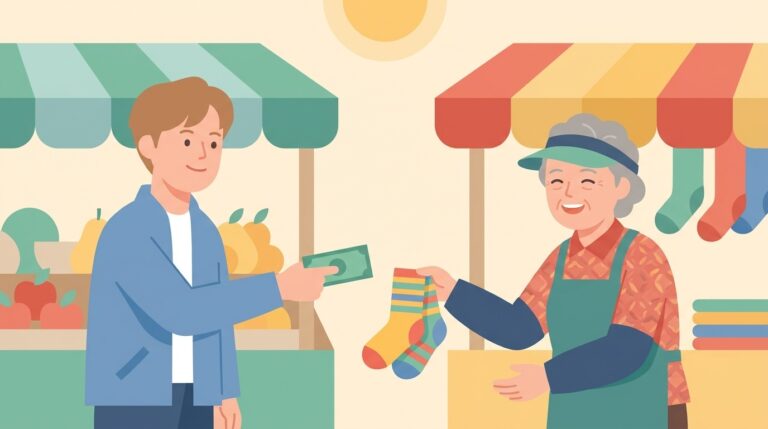
- K-Culture Moment: You are buying 5 pairs of cute K-Pop socks. You look at the vendor, smile, and use this phrase. It instantly breaks the ice!
- Editor’s Insight: The word ‘좀’ (a little) softens the request. Without it, you might sound like you are demanding a discount. Think of it as adding “please” in English.
- Situation Spectrum:
- Market Vendors (Friendly): ✅
- Department Stores (Semi-formal): ⚠️ (Actually, strictly 🚫)
- Chain Cafes (Formal): 🚫
- 🤔 Think About It: In many Western cultures, the price tag is final. Why do you think traditional markets in Korea still keep this flexible pricing culture alive?
2. 덤 좀 주세요 (Please give me a little extra)
- Pronunciation: [deom jom juseyo] + ‘Deom’ sounds like ‘dumb’ but with an ‘oh’ sound mixed in.
- Meaning: Literal: Please give me ‘deom’. / Real nuance: Can I get a freebie since I’m buying a lot?
- K-Culture Moment: You buy a kilo of strawberries. The vendor weighs it, and then you say this phrase playfully. They smile and toss in three more strawberries on top.
- Editor’s Insight: This is the heart of Korean market culture! It’s not about saving money; it’s about sharing generosity.
- Situation Spectrum:
- Market Vendors/Street Food: ✅
- Supermarkets like E-mart: 🚫
- 🤔 Think About It: Is there a concept like ‘Deom’ (free extra items given out of kindness) in your home country?
Phase 3: Textbook vs. Real Korean
[Asking for a Lower Price]
* 📖 Textbook Korean: 가격을 할인해 주시겠습니까? (gageogeul harinhae jusigetseumnikka? – Could you discount the price?)
* 🗣️ Real Korean: 사장님~ 쪼오금만 깎아주세요! (sajangnim~ jjo-ogeumman kkakkajuseyo! – Boss~ just a litttttle discount please!)
* 💡 Why the difference?: Textbook Korean is too formal for the market. Market culture runs on friendly vibes, so stretching the words and using friendly titles like ‘사장님’ works like magic.
[When it’s still too expensive]
* 📖 Textbook Korean: 제 예산보다 비쌉니다. (je yesanboda bissamnida. – It is more expensive than my budget.)
* 🗣️ Real Korean: 헉, 너무 비싸요~ (heok, neomu bissayo~ – Gasp, it’s too expensive~)
* 💡 Why the difference?: Showing a slightly dramatic but cute emotional reaction (‘heok!’) appeals to the vendor’s human side much more than logical budgeting.
Bottom Note: For A2 learners, avoiding heavy slang is best. Sticking to a bright tone with ‘깎아주세요’ is the safest and most sensible choice!
Phase 4: Cultural Context — K-Culture Deep Dive
4-1. Non-Verbal Cues: The Art of Nunchi
When haggling in Korea, body language is everything! Never cross your arms or look stern. The golden rule is to smile and make slightly pleading, friendly eye contact. Using two hands to point at the item or holding your hands together playfully adds a touch of Aegyo (애교 – cute behavior). Read the room (Nunchi) – if the vendor looks really busy with other customers or stressed, it’s best not to haggle!
4-2. K-Culture Connection: K-Travel Survival
Imagine navigating the alleys of Dongdaemun Night Market at 1 AM. The stalls are packed with clothes. Market vendors often use a specific, fast-paced “market Korean.” As a traveler, using these haggling phrases isn’t just about saving 1,000 won; it transforms you from a “passing tourist” to a “savvy local.” Vendors love foreigners who try to speak Korean and understand their market culture. You might even get a free Yakult drink!
Phase 5: Real-Life Roleplay Scenario
Scenario A: The Sock Souvenir Mission
- Setting: Friday afternoon, Namdaemun Market. The alley is lined with colorful stalls. You can hear the buzz of shoppers.
- Characters:
- YOU: A traveler on their last day in Seoul, looking to buy 10 pairs of cute K-food themed socks for friends back home.
- 이모님 (Imonim – Auntie): A 60-year-old vendor with a warm smile and a fast calculator.
이모님: 어서 오세요! 양말 구경하세요~
(eoseo oseyo! yangmal gugyeonghaseyo~)
(English) Welcome! Take a look at the socks~
YOU: 이거 한 켤레에 얼마예요?
(igeo han kyeolle-e eolmayeyo?)
(English) How much is it for one pair?
이모님: 한 켤레에 이천 원! 열 켤레 하면 이만 원이에요.
(han kyeolle-e icheon won! yeol kyeolle hamyeon iman wonieyo.)
(English) 2,000 won for one! 20,000 won for ten.
🔀 Your Turn! How should you respond?
– A) “비싸요. 만 오천 원에 주세요.” (Too expensive. Give it to me for 15,000 won.)
– B) “이모님~ 열 개나 사는데 쪼오금만 깎아주세요~” (Auntie~ I’m buying 10, please give me a litttttle discount~)
– C) “아, 네. 여기 이만 원이요.” (Ah, okay. Here is 20,000 won.)✅ Best Choice: B — Why? You acknowledged the volume you are buying and used a friendly tone.
⚠️ Choice A Analysis: This sounds very rude and aggressive in Korean. Never command a price drop so bluntly!
YOU: 이모님~ 열 개나 사는데 쪼오금만 깎아주세요~
(imonim~ yeol gaena saneunde jjo-ogeumman kkakkajuseyo~)
(English) Auntie~ I’m buying 10, please give me a litttttle discount~
이모님: (Laughs) 아이고, 외국인 학생이 한국말 잘하네! 그래, 천 원 깎아줄게. 만 구천 원만 줘!
(aigo, oegugin haksaengi hangungmal jalhane! geurae, cheon won kkakkajulge. man gucheon wonman jwo!)
(English) Oh my, the foreign student speaks Korean well! Okay, I’ll take off 1,000 won. Just give me 19,000 won!
YOU: 우와! 감사합니다! 많이 파세요~
(uwa! gamsahamnida! mani paseyo~)
(English) Wow! Thank you! Have a great business day~
Scenario B: The Street Food Bonus
- Setting: Gwangjang Market, eating Bindaetteok (mung bean pancake).
YOU: 사장님, 너무 맛있어요! (sajangnim, neomu masisseoyo! – Boss, it’s so delicious!)
사장님: 그래? 많이 먹어~ (geurae? mani meogeo~ – Really? Eat a lot~)
YOU: 혹시 양파 장아찌 좀 더 주실 수 있어요? (hoksi yangpa jangajji jom deo jusil su isseoyo? – By any chance, can you give me a little more pickled onion?)
사장님: 그럼! 덤으로 더 줄게! (geureom! deomeuro deo julge! – Of course! I’ll give you more as an extra!)
Phase 6: 10-Second Shadowing Drill
Take 10 seconds to practice this out loud. Pay attention to the pauses and intonation!
🥺 사장님 / 이거 / 쪼~금만 / 깎아주세요~
(sajangnim / igeo / jjo~geumman / kkakka-juseyo~)
(Boss / this / just a liiiitle / please discount~)
Pro-tip: Drag out the “쪼~” (jjo~) slightly with a pleading, bright tone!
Phase 7: K-Culture Mini Dictionary
1. 정
* Romanization: jeong
* English: Deep emotional connection / Warm-heartedness
* Context: The underlying philosophy of Korean society. When a vendor gives you a discount or extra food, they are sharing ‘Jeong’.
2. 덤
* Romanization: deom
* English: Free extra item
* Context: Buying 5 apples and getting 1 free. It’s a market tactic driven by the culture of Jeong.
3. 이모님
* Romanization: imonim
* English: Aunt (Polite form)
* Context: Used to affectionately address middle-aged women working in markets or restaurants, even if you aren’t related.
4. 현금
* Romanization: hyeongeum
* English: Cash
* Context: The golden key to getting a discount. Market vendors heavily prefer cash over credit cards.
Phase 8: Traveler’s Survival Kit
🆘 Survival Expression #1
– 🇰🇷 “이거 얼마예요?” (igeo eolmayeyo?)
– 🗣️ English Pronunciation Guide: ee-geo uhl-ma-yeh-yo?
– 📍 Where to use: Markets, convenience stores, taxis.
– 💡 Pro Tip: Can’t understand the numbers they are saying? Hand them your phone with the calculator app open. They will happily type the price for you!📌 Editor’s Travel Note
– Useful Apps: Use ‘Naver Map’ or ‘KakaoMap’ to find markets. Google Maps does not work well for walking directions in Korea!
– Cash vs Card: Korea is a cashless society, BUT traditional markets are the exception! Always bring some 10,000 won bills. If you pay in cash, they are much more likely to give you a discount.
– Tipping Culture: Korea has NO tipping culture. If you try to tip a market vendor, they might chase you down the street to give your money back!
Phase 9: Critical Thinking — “One Step Deeper”
🧠 Think Deeper: Food & Identity (The Culture of Jeong)
In English, a business transaction is usually just an exchange of money for goods. In Korea, especially in traditional markets, it is an exchange of Jeong (emotional connection). When a vendor gives you Deom (an extra apple) or accepts your request to Kkakkajuseyo (give a discount), they are not losing money; they are building a relationship with you. They want you to leave with a warm heart and a full stomach.
💬 Your Turn: How do you address store workers or market vendors in your culture? Is it strictly business, or do you treat them like neighbors? Share in the comments!
Phase 10: FAQ & Avoiding Misunderstandings
- Q: Can I use “깎아주세요” at a department store or a franchise cafe?
- A: NO! 🚫 Prices in department stores, supermarkets (E-mart), and franchises (Starbucks, Olive Young) are strictly fixed. If you ask for a discount there, the staff will be very confused.
- Q: What if they say no to my discount request?
- A: Just smile and say “아, 네~ (Ah, okay~)”. Never get angry. Haggling is supposed to be a fun, lighthearted interaction.
❌ Common Mistake #1: Pointing at an item with one finger and demanding, “깎아주세요!” (Discount!) with a serious face.
✅ Do This Instead: Use your whole hand to gesture to the item, use a soft voice, and always add a title like “사장님” (Boss) before you ask.
Phase 11: Summary & Action Items
- One-Liner Summary: To get a discount in a Korean market, politely say “좀 깎아주세요” with a warm smile and a bit of cash!
-
Action Mission 3 Steps:
- 🥉 Bronze (Solo): Look in the mirror, smile your best friendly smile, and say “사장님, 좀 깎아주세요~” 3 times.
- 🥈 Silver (Online): Find a YouTube walking tour of Namdaemun Market and type “깎아주세요!” in the comments.
- 🥇 Gold (Real Life): Visit a traditional market in Korea, buy some souvenirs, and try asking for a small discount!
- K-Culture Mission: Watch an episode of a Korean variety show (like Running Man) where they visit a traditional market. Listen carefully—can you hear the cast members using these exact phrases to survive?
Phase 12: Quiz — Interactive Challenge
1. Situational Judgment: You are buying a 30,000 won Hanbok souvenir at Gwangjang Market. You want to ask for a discount. What should you say?
– A) 너무 비싸요. 안 사요. (Too expensive. I won’t buy it.)
– B) 사장님, 조금만 깎아주세요~ (Boss, please give me a little discount~)
– C) 이거 얼마예요? (How much is this?)
2. True or False – K-Culture Edition: “It is completely normal to ask for a discount on a cup of Americano at a chain cafe in Seoul.”
3. Fill in the Blank: When the vendor gives you an extra free strawberry, this warm-hearted Korean market concept is called ______.
(Answers: 1. B – A is rude, C is just asking the price. 2. False! Haggling is strictly for traditional markets and street vendors, not franchises! 3. 덤 / Deom)
Frequently Asked Questions (FAQ)
Q: What does "좀 깎아주세요 (Please give me a discount)" mean in Korean and how do you pronounce it?
A: In Korean, "좀 깎아주세요 (Please give me a discount)" is pronounced [jom kkakka-juseyo] and means: Literal: Please cut it down a bit. / Real nuance: Can you give me a friendly discount?
Q: What does "덤 좀 주세요 (Please give me a little extra)" mean in Korean and how do you pronounce it?
A: In Korean, "덤 좀 주세요 (Please give me a little extra)" is pronounced [deom jom juseyo] and means: Literal: Please give me 'deom'. / Real nuance: Can I get a freebie since I'm buying a lot?







