

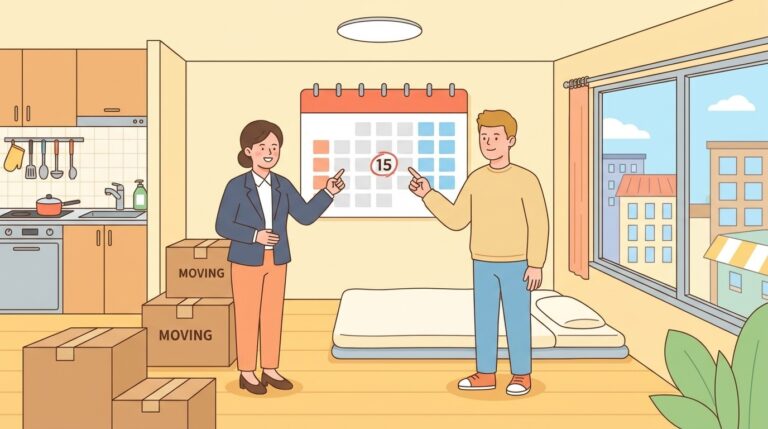
Phase 1: Empathy & The “Moving Day” Chaos
Greeting: Hello! I’m the Lead Editor at Daily Hangul.
Imagine this K-Drama scene: The protagonist, carrying a heavy backpack, finally finds the perfect rooftop apartment (옥탑방) overlooking Seoul. The night view is stunning. But then, the real estate agent drops a bomb: “The current tenant isn’t moving out until next month. Can you wait?” Cue the dramatic music as the protagonist realizes they might be sleeping at a jjimjilbang (Korean sauna) for three weeks.
If you’ve ever tried hunting for a house in Korea, you know this isn’t just a drama trope—it’s real life. In Korea, finding the house is only 50% of the battle. The real boss fight is negotiating the move-in date (입주 가능 날짜). Because of Korea’s unique deposit systems (Jeonse and Wolse), the previous tenant moving out and you moving in often have to happen on the exact same day. It’s like a high-stakes game of dominoes.
If you don’t know how to negotiate dates politely in Korean, you might end up paying double rent or dragging your suitcases through the streets of Hongdae. But don’t worry—I’ve got you covered. Let’s learn how to politely “push and pull” (밀당 – mildang) those calendar dates like a true local!
Phase 2: Core Expression Deep Dive
Here are the top 3 lifesaver expressions you need when negotiating your move-in date at the real estate agency (부동산 – budongsan).
1. 언제 입주 가능해요?
- Pronunciation: eonje ipju ganeunghaeyo? [eon-je sounds like “on Jay”, ip-ju sounds like “eep-joo”]
- Meaning: Literal: When is move-in possible? / Real nuance: What’s the earliest/exact date I can move into this place?
- K-Culture Moment: You walk into a real estate office, take a sip of the sweet instant coffee they always offer, look at the photos of a nice studio, and ask this. It shows you’re serious and ready to talk business.
- Editor’s Insight: The word ‘입주’ (ipju) sounds much more professional than just saying ‘이사’ (isa – moving). It specifically means “entering to reside.”
- Situation Spectrum:
- Casual (Friends): 🚫 (Too formal)
- Semi-formal (Real Estate Agent): ✅
- Formal (Landlord): ✅
- 🤔 Think About It: Why do Koreans prefer saying “Is it possible?” (가능해요?) rather than “When can I move in?” (언제 들어갈 수 있어요?). How does this soften the demand?
2. 혹시 날짜를 조금 당길 수 있을까요?
- Pronunciation: hoksi naljjareul jogeum danggil su isseulkkayo? [dang-gil sounds like “dang-gill”]
- Meaning: Literal: By any chance, is it possible to pull the date a little? / Real nuance: Could we possibly bring the move-in date forward a bit?
- K-Culture Moment: The agent says the 20th, but your current lease ends on the 15th. You tilt your head slightly, use a soft voice, and drop the magic word ‘혹시’ (hoksi – by any chance) to soften the blow.
- Editor’s Insight: ‘당기다’ (danggida) literally means ‘to pull’, but with time, it means bringing it closer to now. If you want to push the date back, use ‘미룰 수 있을까요?’ (mirul su isseulkkayo – can we push it back?).
- Situation Spectrum:
- Casual: ✅ (Using ~당길 수 있어?)
- Semi-formal: ✅
- Formal: ✅
- 🤔 Think About It: Notice the use of ‘조금’ (jogeum – a little). Even if you want to change the date by a month, Koreans often say ‘조금’ to make the request sound less burdensome. Do you do this in your native language?
3. 이사 날짜를 맞춰야 해서요.
- Pronunciation: isa naljjareul matchwoya haeseyo. [mat-chwo-ya sounds like “ma-cho-ya”]
- Meaning: Literal: Because I have to match the moving dates. / Real nuance: I need to align my move-in date with my move-out date (so I’m not homeless).
- K-Culture Moment: This is the ultimate “sympathy card.” When you say this, the real estate agent immediately understands the complex web of deposit transfers happening behind the scenes and will try harder to negotiate with the landlord for you.
- Editor’s Insight: ‘맞추다’ (matchuda) means to match, align, or adjust. It implies a cooperative effort rather than a one-sided demand.
- Situation Spectrum:
- Casual: ⚠️ (Depends on context)
- Semi-formal: ✅
- Formal: ✅
Phase 3: Textbook vs. Real Korean
Let’s upgrade your B1 Korean from “stiff robot” to “smooth local.”
[Telling them the date you want]
* 📖 Textbook Korean: 저는 5월 1일에 들어가고 싶습니다. (jeoneun owol irire deureogago sipseumnida.) – I want to go in on May 1st.
* 🗣️ Real Korean: 5월 1일로 날짜 맞출 수 있을까요? (owol irillo naljja matchul su isseulkkayo?) – Can we align the date for May 1st?
* 💡 Why the difference?: Asserting “I want” sounds aggressive in Korean negotiations. Asking “Can we align it?” invites the agent to solve the problem with you.
[When the date doesn’t work for you]
* 📖 Textbook Korean: 이 날짜는 안 됩니다. (i naljjaneun an doemnida.) – This date is not possible.
* 🗣️ Real Korean: 아, 그 날짜는 좀 빠듯한데요… (a, geu naljjaneun jom ppadeuthandeyo…) – Ah, that date is a bit tight…
* 💡 Why the difference?: ‘빠듯하다’ (tight/barely enough) is a fantastic B1/B2 adjective. It softens the rejection by blaming the ‘tight schedule’ rather than flatly saying “No.”
Bottom Note: Avoid blunt refusals. In Korea, a hesitant “아… (Ah…)” followed by trailing off “좀 빠듯한데요…” is the polite way of screaming, “Absolutely not!”
Phase 4: Cultural Context — K-Culture Deep Dive
4-1. The Non-Verbal “Nunchi” of House Hunting
When negotiating in Korea, body language is just as important as words. Don’t cross your arms or stare intensely into the agent’s eyes—it comes off as confrontational. Instead, use the “apologetic head tilt.” When asking to change a date, tilt your head slightly, inhale a tiny bit through your teeth (the classic Korean “hsss”), and say, “아… 혹시… (Ah… by any chance…)”. This triggers the agent’s protective instinct to help you out.
4-2. The Great Korean Deposit Relay (보증금 릴레이)
Why is the move-in date such a headache in Korea? It’s tied to the Jeonse/Wolse (Key money/Deposit) system. To give you back your $10,000+ deposit, your current landlord usually needs the new tenant to move in and pay their deposit. So, on moving day, money transfers from the new tenant -> your landlord -> you -> your new landlord -> the previous tenant of your new place.
If one person delays their date, five people could end up stranded! This is why moving dates in Korea are rarely flexible, and why the phrase “날짜를 맞춰야 해요 (I have to match the dates)” carries so much weight.
Phase 5: Real-world Roleplay Scenario
Setting: Saturday afternoon. A slightly cramped real estate office (부동산) in Sinchon, Seoul. There’s a giant map of the neighborhood on the wall, and Mr. Kim is furiously typing on two cell phones at once.
Characters:
* YOU: An expat who just found the perfect studio apartment. Your current lease ends on the 15th.
* Mr. Kim (50s): The veteran real estate agent. Friendly, but stressed about matching dates.
Dialogue:
YOU: 사장님, 이 방 마음에 드는데요. 혹시 언제 입주 가능해요?
(sajangnim, i bang maeume deuneundeyo. hoksi eonje ipju ganeunghaeyo?)
[Boss (Agent), I like this room. By any chance, when is move-in possible?]
Mr. Kim: 아, 그 방! 전 세입자가 20일에 나간다고 하네요. 20일 어때요?
(a, geu bang! jeon seipjaga isibile nagandago haneyo. isibil eottaeyo?)
[Ah, that room! The former tenant says they are leaving on the 20th. How is the 20th?]
(🎭 Stage Direction: Mr. Kim taps his pen on the desk, looking hopeful)
🔀 Your Turn! How do you reply?
– A) “안 돼요. 저는 15일에 무조건 들어가야 합니다.” (No. I must unconditionally go in on the 15th.)
– B) “아… 제가 15일에 방을 빼야 해서요. 혹시 날짜 조금 당길 수 있을까요?” (Ah… I have to empty my room on the 15th. Could we possibly pull the date forward a bit?)
– C) “대박! 20일 너무 늦어요. 15일 고고!” (Daebak! 20th is too late. 15th, let’s go!)✅ Best Choice: B — It explains why you need the change using the sympathy card (방을 빼야 해서요) and asks politely to adjust the date.
⚠️ Choice A & C Analysis: ‘A’ is way too aggressive and will make the agent defensive. ‘C’ is slang used only with close friends, completely inappropriate for a business negotiation.
Mr. Kim: (Sighs) 15일이요? 좀 빠듯한데… 집주인한테 한번 물어볼게요.
(isibiriyo? jom ppadeuthande… jipjuinhante hambeon mureobolgeyo.)
[The 15th? That’s a bit tight… I’ll ask the landlord once.]
YOU: 네, 부탁드립니다. 이사 날짜 꼭 맞춰야 해서요.
(ne, butakdeurimnida. isa naljja kkok matchwoya haeseyo.)
[Yes, I’m asking a favor. I really must match the moving dates.]
Mr. Kim: 알겠어요. 보증금 조금 먼저 걸면 설득하기 쉬울 수도 있어요.
(algesseoyo. bojeunggeum jogeum meonjeo geolmyeon seoldeukhagi swiul sudo isseoyo.)
[Understood. If you put down a small deposit first, it might be easier to persuade them.]
Phase 6: 10-Second Shadowing Drill
Let’s practice your polite negotiation tone!
🥺 사장님, / 혹시 / 이사 날짜 / 조금 당길 수 있을까요?
(sajangnim, / hoksi / isa naljja / jogeum danggil su isseulkkayo?)
Coach’s Tip: Pause slightly at the slashes. Emphasize the ‘혹시’ (hoksi) with a slightly higher, softer pitch to show you are asking a delicate favor.
Phase 7: K-Culture Mini Dictionary
Here are 4 keywords you will absolutely hear during your Korean housing journey:
1. 부동산 (budongsan)
* Romanization: budongsan
* English: Real Estate Agency / Property
* Context: You don’t just find houses online; you go to the ‘budongsan’ on the corner and let the ‘사장님’ (agent) guide you.
2. 보증금 (bojeunggeum)
* Romanization: bojeunggeum
* English: Security Deposit
* Context: Unlike in the West where it’s 1-2 months’ rent, Korean deposits can range from $5,000 to hundreds of thousands of dollars. It dictates your whole moving timeline.
3. 방을 빼다 (bangeul ppaeda)
* Romanization: bangeul ppaeda
* English: To move out (Literal: To pull out of a room)
* Context: A very common, slightly colloquial way to say “vacate the apartment.”
4. 짜장면 (jjajangmyeon)
* Romanization: jjajangmyeon
* English: Black Bean Noodles
* Context: The official food of moving day in Korea! Because all your pots and pans are packed, everyone orders delivery Jjajangmyeon to eat amidst the cardboard boxes.
Phase 8: Traveler & Expat Survival Kit
Even if you’re just traveling and not renting an apartment, you’ll need to negotiate dates and times (e.g., booking a tour, changing a hotel reservation).
🆘 Survival Phrases for Changing Schedules
– 🇰🇷 “이거 혹시 내일로 미룰 수 있나요?” (igeo hoksi naeillo mirul su innayo?)
– 🗣️ Pronunciation: [ee-guh hok-shee nae-il-lo mee-rool su in-na-yo?]
– 📍 Where to use: Hotels, Tour agencies, Car rentals.
– 💡 Meaning: Can I push this back to tomorrow?📌 Editor’s Real Estate Note
– Useful Apps: Jikbang (직방) and Dabang (다방) are the go-to apps for looking at apartments. But always visit the local budongsan in person—they have hidden “offline” listings!
– The Contract: Always negotiate the date before you pay the 가계약금 (ga-gyeyakgeum – holding deposit). Once you pay, the date is locked.
Phase 9: Critical Thinking Corner — “한 발 더 깊이”
🧠 Think Deeper: Language & Power (언어와 권력)
In the Korean real estate office, you’ll witness a fascinating display of social hierarchy through language. The real estate agent acts as a middleman. When speaking to you (the tenant), they use standard polite language (해요체 – haeyoche). But watch them call the landlord (임대인). Suddenly, their voice goes up an octave, they bow while holding the phone, and they use extreme honorifics (하십시오체 – hasipsioche). In Korea, the property owner holds immense social and financial power, and the language instantly shifts to reflect who holds the “key” (literally and figuratively).💬 Your Turn: In your home country, is the relationship between landlord and tenant viewed as an equal business transaction, or is there a power dynamic? Tell us in the comments!
Phase 10: FAQ & Mistake Prevention
Q: Is it rude to negotiate the move-in date?
A: Not at all! It’s actually expected. However, it is rude to demand a date aggressively. Always frame it as a request for cooperation (“날짜를 맞출 수 있을까요?”).
Q: Can I just talk to the current tenant to figure out the date?
A: NO. Always communicate through the real estate agent. Bypassing the agent is considered highly suspicious and breaches the unspoken rules of Korean real estate “Nunchi.”
❌ Common Mistake #1: Treating an apartment lease like a hotel booking.
Do not say: “예약할게요” (I will reserve it).
✅ Do this instead: Say “계약하고 싶어요” (I want to sign a contract). A house isn’t reserved; it’s legally contracted with a deposit.
Phase 11: Summary & Action Items
- One-Liner Summary: Soften your negotiations by using “혹시” (by any chance) and asking to “match” (맞추다) or “pull forward” (당기다) the move-in dates politely.
-
Action Mission:
- 🥉 Bronze (Solo): Stand in front of your mirror and practice the 10-second shadowing drill with the “apologetic head tilt.”
- 🥈 Silver (Online): Write down “저는 [Your Date]로 이사 날짜 맞출 수 있을까요?” in your study notebook and post a picture in our community.
- 🥇 Gold (Real World): Next time you need to reschedule an appointment (even with a Korean tutor or friend!), use “시간 좀 당길/미룰 수 있을까요?”
- K-Culture Mission: Watch a modern K-Drama (like Because This Is My First Life). Spot the scene where they talk to the real estate agent. Listen closely—do you hear them mention ‘보증금’ (deposit) or ‘날짜’ (dates)?
Phase 12: Quiz — Interactive Challenge
1. Situational Judgment: The agent says you can move in on the 30th, but you want to move in earlier, on the 25th. What is the most natural B1-level phrase to use?
– A) 25일 원해요. 당장 해주세요.
– B) 혹시 날짜를 조금 당길 수 있을까요?
– C) 혹시 날짜를 조금 미룰 수 있을까요?
(Answer: B. ‘당기다’ means to pull forward. A is rude, C means to push back to a later date.)
2. Fill in the Blank:
“전셋집을 구해서, 이전 집주인과 ________ 날짜를 꼭 맞춰야 해요.”
(I found a Jeonse house, so I absolutely must match the ________ date with the previous landlord.)
(Answer: 이사 / 입주 – moving/move-in)
3. True or False – K-Culture Edition:
In Korea, it is common for the current tenant to move out, the cleaning crew to come in, and you to move in, all on different days spread across a week. (T/F)
(Answer: False. Due to the deposit relay system, moving out and moving in almost always happens on the exact same day!)
Happy House Hunting! (이사 잘 하세요!)
Frequently Asked Questions (FAQ)
Q: What does "언제 입주 가능해요?" mean in Korean and how do you pronounce it?
A: In Korean, "언제 입주 가능해요?" is pronounced [eonje ipju ganeunghaeyo? [eon-je sounds like "on Jay", ip-ju sounds like "eep-joo"] and means: Literal: When is move-in possible? / Real nuance: What's the earliest/exact date I can move into this place?
Q: What does "혹시 날짜를 조금 당길 수 있을까요?" mean in Korean and how do you pronounce it?
A: In Korean, "혹시 날짜를 조금 당길 수 있을까요?" is pronounced [hoksi naljjareul jogeum danggil su isseulkkayo? [dang-gil sounds like "dang-gill"] and means: Literal: By any chance, is it possible to pull the date a little? / Real nuance: Could we possibly bring the move-in date forward a bit?
Q: What does "이사 날짜를 맞춰야 해서요." mean in Korean and how do you pronounce it?
A: In Korean, "이사 날짜를 맞춰야 해서요." is pronounced [isa naljjareul matchwoya haeseyo. [mat-chwo-ya sounds like "ma-cho-ya"] and means: Literal: Because I have to match the moving dates. / Real nuance: I need to align my move-in date with my move-out date (so I'm not homeless).







