

Phase 1: Empathy (Immersive Opening)
Hello! I’m the Lead Editor at Daily Hangul.
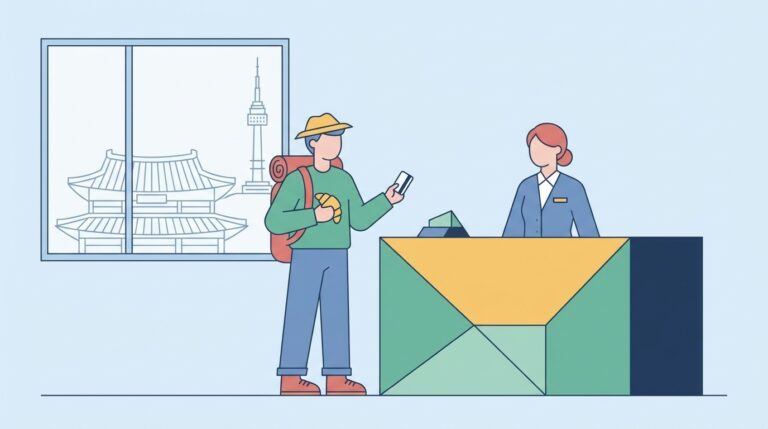
Picture this K-Drama scene: The handsome, perfectly-styled CEO protagonist wakes up in a luxurious Seoul hotel, slips into a crisp white robe, and elegantly sips coffee by the window. But let’s cut back to reality—you’re at the front desk of your hotel in Myeongdong, you’ve just flown 14 hours, and all you can think about is whether you’ll get to eat those fluffy croissants and savory Korean porridge (jeonbokjuk) tomorrow morning.
You want to ask, “Is breakfast included?” but Google Translate gives you a robotic, paragraph-long sentence that feels way too formal. If you don’t ask, you might miss out on the legendary Korean hotel buffet! Don’t worry. As a tutor who has helped hundreds of travelers navigate Korea, I’m going to teach you the absolute easiest, most natural way to secure your morning meal.
This guide is based on real questions from my A1 beginner students who wanted to survive—and thrive—during their Korean staycations (Hocance). Let’s dive in!
Phase 2: Core Expressions Deep Dive
1. 조식 포함인가요?
- Pronunciation: [josik pohamin-gayo?]
- Sound-alike guide: Jo (like the name Joe) + seek / po-ham (like Poe-ham) + in-ga-yo (in-guy-yo?)
- Meaning: Is breakfast included? (Literal: Breakfast included is it?)
- K-Culture Moment: In Korea, staying at a nice hotel just to enjoy the amenities and the morning buffet is a huge trend called 호캉스 (Hocance: Hotel + Vacance). When friends do a Hocance together, this is the first question they ask the front desk!
- Editor’s Insight: ‘조식’ (josik) is a fancy Sino-Korean word specifically used in the hospitality industry for ‘breakfast’. You wouldn’t use this word at home! Just memorize this phrase as a single magical block of sound.
- Situation Spectrum:
- Hotel Staff (Formal/Polite): ✅
- Friends (Casual): 🚫 (Too formal, just use it for staff!)
- 🤔 Think About It: Why do hotels use ‘조식’ (josik) instead of the everyday word ‘아침’ (achim)? In many cultures, formal industries use specialized vocabulary to elevate the customer experience. Does your native language have different words for ‘everyday breakfast’ and ‘hotel breakfast’?
2. 조식은 몇 시예요?
- Pronunciation: [josigeun myeot siyeyo?]
- Sound-alike guide: jo-see-geun / myut (rhymes with hut) + she-yeah-yo?
- Meaning: What time is breakfast?
- K-Culture Moment: Korean hotel buffets often have “waves” of diners. If you watch Korean vloggers, they always review what time is best to go down to avoid the “lunch-rush” level of crowds!
- Editor’s Insight: ‘몇 시예요?’ (What time is it?) is your best friend in Korea. Add anything in front of it! Bus 몇 시예요? Check-out 몇 시예요?
- Situation Spectrum:
- Hotel Staff (Formal/Polite): ✅
- Store/Restaurant staff (Polite): ✅
- 🤔 Think About It: Koreans are known for their “Ppalli Ppalli” (hurry hurry) culture. Time is very important. How might knowing the exact schedule help you fit into the local rhythm?
3. 1명 추가할게요.
- Pronunciation: [hanmyeong chugahalgeyo.]
- Sound-alike guide: han-myung / choo-gah-hal-geh-yo.
- Meaning: I will add one person.
- K-Culture Moment: You booked a room for yourself, but your Korean friend decides to crash on the sofa after a long night of K-Pop karaoke. You need to add them to the breakfast list!
- Editor’s Insight: ‘추가’ (chuga) means ‘addition’. You will hear this everywhere in Korea—especially at K-BBQ restaurants when adding more meat!
- Situation Spectrum:
- Hotel Staff / Restaurants: ✅
- 🤔 Think About It: Being flexible and adding people or items is very common in Korean service culture. It’s rarely a hassle. Why do you think Korean service is so accommodating to sudden additions?
Phase 3: Textbook vs. Real Korean
[Asking About Breakfast]
* 📖 Textbook Korean: 아침 식사가 포함되어 있습니까? (achim siksaga pohamdoeeo isseumnikka? – Extremely rigid, sounds like a military report!)
* 🗣️ Real Korean: 조식 포함인가요? (josik pohamingayo? – Natural, polite, industry-standard.)
* 💡 Why the difference?: Textbooks teach standard nouns (achim siksa) and formal grammar (seumnikka). Real life uses Sino-Korean industry terms (josik) and the softer polite ending (yo).
[Asking the Time]
* 📖 Textbook Korean: 아침 식사는 몇 시에 시작합니까? (achim siksaneun myeot sie sijakhamnikka?)
* 🗣️ Real Korean: 조식 몇 시예요? (josik myeot siyeyo? – Short, sweet, gets the job done.)
* 💡 Why the difference?: Efficiency! Koreans love dropping unnecessary verbs when the context is perfectly clear.
Bottom Note: At an A1 (Beginner) level, your goal isn’t to speak in long paragraphs. Shorter sentences are actually MORE natural in Korea!
Phase 4: Cultural Context — K-Culture Deep Dive
4-1. Non-verbal Nuance: The Two-Handed Handover
When you are at the front desk asking, “조식 포함인가요?”, you will likely be handing over your passport or credit card. Always use two hands, or support your right arm with your left hand. It’s the ultimate sign of respect. Also, don’t forget your Nunchi (눈치)—if the lobby is incredibly busy, keep your questions brief and let the staff guide you!
4-2. The “Hocance” (호캉스) Phenomenon
In many Western cultures, a hotel is just a place to sleep while you explore the city. In Korea, especially for young millennials and Gen Z, the hotel is the destination.
Thanks to busy work lives, Koreans often book a 5-star hotel in their own city for the weekend. This is called Hocance (Hotel + Vacance). And the absolute highlight of a Hocance? The morning buffet! You’ll see locals waking up at 6:30 AM just to get the best window seat, take aesthetic Instagram photos of their food, and eat three full plates ranging from western bacon to spicy Korean noodles. Knowing the word ‘조식’ puts you right in the middle of this local trend!
Phase 5: Real-world Roleplay Scenario
Setting: Friday night, 9:00 PM. You just arrived at a trendy boutique hotel in Hongdae. The lobby smells like expensive sandalwood. You are tired but excited for tomorrow.
Characters:
– YOU: A traveler who just arrived in Korea. You love food.
– Jiwon: The friendly front desk staff member.
Dialogue:
Jiwon: 안녕하세요! 체크인 도와드릴까요?
(annyeonghaseyo! chekeuin dowadeurilkkayo?)
[Hello! Can I help you with check-in?]
YOU: 네, 체크인 부탁합니다. 여권 여기 있어요.
(ne, chekeuin butakhamnida. yeogwon yeogi isseoyo.)
[Yes, check-in please. Here is my passport.]
(🎭 Stage Direction: You hand the passport with two hands)
Jiwon: 감사합니다. 3박 예약 확인되셨습니다. 카드키 여기 있습니다.
(gamsahamnida. sambak yeyak hwagindoesyeotseumnida. kadeuki yeogi itseumnida.)
[Thank you. Your 3-night reservation is confirmed. Here is your room key.]
YOU: 감사합니다. 아, 조식 포함인가요? 🥐
(gamsahamnida. a, josik pohamingayo?)
[Thank you. Oh, is breakfast included?]
Jiwon: 아쉽게도 조식은 불포함입니다.
(asipgedo josigeun bulpohamimnida.)
[Unfortunately, breakfast is not included.]
Jiwon: 내일 아침에 추가하시겠어요?
(naeil achime chugahasigesseoyo?)
[Would you like to add it tomorrow morning?]
🔀 Your Turn! How will you respond?
– A) “아니요, 괜찮아요.” (aniyo, gwaenchanayo. – No, it’s okay.)
– B) “네, 1명 추가할게요!” (ne, hanmyeong chugahalgeyo! – Yes, I’ll add 1 person!)
– C) “대박! 왜요?” (daebak! waeyo? – Awesome! Why?)✅ Best Choice: A or B. If you want to explore local street toast, say A! If you want the buffet, say B!
⚠️ Choice C Analysis: Saying “Daebak” (Awesome) when someone says breakfast is NOT included will make you sound very confused! Keep it polite.
YOU (Choosing B): 네, 1명 추가할게요. 조식은 몇 시예요?
(ne, hanmyeong chugahalgeyo. josigeun myeot siyeyo?)
[Yes, I’ll add 1 person. What time is breakfast?]
Jiwon: 오전 7시부터 10시까지입니다. 1층 레스토랑으로 오세요!
(ojeon ilgopsibuteo yeolsikkajiimnida. ilcheung reseutorangeuro oseyo!)
[It’s from 7 AM to 10 AM. Please come to the 1st-floor restaurant!]
YOU: 네, 감사합니다!
(ne, gamsahamnida!)
[Yes, thank you!]
Phase 6: 10-Second Shadowing Drill
Practice out loud! Pay attention to the pauses (/) and the mood.
- 🥺 Politely asking: 저기요, / 조식 / 포함인가요?
(jeogiyo, / josik / pohamingayo?) - 🤔 Curious: 내일 / 조식은 / 몇 시예요?
(naeil / josigeun / myeot siyeyo?) - 😊 Decisive: 조식 / 한 명 / 추가할게요!
(josik / han myeong / chugahalgeyo!)
Phase 7: K-Culture Mini Dictionary
1. 조식 (josik)
* Romanization: josik
* English: Hotel/Industry Breakfast
* Context: Used almost exclusively in hotels or company cafeterias. It literally means “morning meal” in Chinese characters.
2. 호캉스 (hokangseu)
* Romanization: hokangseu
* English: Staycation (Hotel + Vacance)
* Context: A popular K-trend where people vacation at local luxury hotels to escape stress, utilizing pools and buffets.
3. 프런트 (peureonteu)
* Romanization: peureonteu
* English: Front Desk / Reception
* Context: Konglish for “Front”. If you call from your room phone, there is usually a button that just says “프런트”.
4. 뷔페 (bwipe)
* Romanization: bwipe
* English: Buffet
* Context: Koreans love buffets! But notice the pronunciation is closer to “bwee-peh” rather than the French/English “buff-ay”.
Phase 8: Traveler’s Survival Kit
🆘 Survival Expressions for the Hotel
1. “체크아웃 몇 시예요?” (chekeuaut myeot siyeyo?)
– 🗣️ Meaning: What time is check-out?
– 📍 Where to use: At the front desk upon arrival.2. “짐 보관 되나요?” (jim bogwan doenayo?)
– 🗣️ Meaning: Can I store my luggage?
– 📍 Where to use: Before check-in or after check-out. Lifesaver!3. “수건 좀 더 주세요.” (sugeon jom deo juseyo.)
– 🗣️ Meaning: Please give me more towels.
– 📍 Where to use: Calling the front desk from your room.📌 Editor’s Travel Note
– Tipping: Korea is a strict NO TIPPING culture! Do not leave money on the bed for housekeeping, and do not tip the bellboy. They might run after you thinking you forgot your money!
– Plugs: Korea uses 220V round-pin plugs (Type C/F). If you forgot yours, go to the front desk and ask: “어댑터 빌릴 수 있나요?” (Can I borrow an adapter?)
Phase 9: Critical Thinking Corner — “A Step Deeper”
🧠 Think Deeper: Food & Identity (음식과 정체성)
Why are Koreans so obsessed with whether you’ve eaten breakfast? In Korea, food is the ultimate expression of care. The standard Korean greeting, “밥 먹었어?” (Did you eat?), isn’t just about hunger; it’s a way of saying, “Are you doing well? I care about you.” Historically, going through times of scarcity made sharing a meal a profound act of community. When you ask the hotel staff about ‘조식’ (breakfast), you are participating in a culture that genuinely believes a good day starts with a warm, shared meal.
💬 Your Turn: In your culture, what is the standard greeting that shows you care about someone’s well-being? Let me know in the comments!
Phase 10: FAQ & Avoiding Mistakes
Q: Do I need a physical ticket for the hotel breakfast?
Usually, no! Most modern Korean hotels just ask for your room number at the restaurant entrance. They will ask: “몇 호실이세요?” (What is your room number?).
Q: Can I wear the hotel robe to breakfast?
In K-Dramas, maybe. In real life, absolutely not! It is considered very impolite to wear pajamas, slippers, or the hotel bathrobe to the dining area. Dress casually but neatly.
❌ Common Mistake #1: Just saying “Breakfast?” pointing at the restaurant.
✅ Do this instead: Say “조식 어디예요?” (josik eodiyeyo? – Where is breakfast?). It’s just two words, but it sounds 100x more polite!❌ Common Mistake #2: Trying to tip the omelet chef at the buffet.
✅ Do this instead: A warm “잘 먹었습니다!” (jal meogeotseumnida – I ate well!) with a slight bow is worth more than a tip in Korea.
Phase 11: Summary & Action Items
One-Liner Summary: To secure your hotel morning feast, politely ask the staff, “조식 포함인가요?” (josik pohamingayo?).
Action Mission 3 Steps:
* 🥉 Bronze (Solo): Stand in front of your mirror and say “조식 포함인가요?” three times with a confident smile.
* 🥈 Silver (Online): Comment on this post with the time you usually eat breakfast using “저는 (time)에 조식을 먹어요!”
* 🥇 Gold (Real World): Next time you check into a Korean hotel or guesthouse, ask the front desk about breakfast using today’s phrase!
K-Culture Mission:
Go to YouTube and search “한국 호텔 조식 브이로그” (Korean hotel breakfast vlog). Watch how incredible the spreads are—you’ll see exactly why knowing how to ask for breakfast is so important!
Phase 12: Quiz — Interactive Challenge
1. Situational Judgment:
You walk up to the front desk. You want to know what time the breakfast buffet opens. What do you say?
* A) 조식 포함인가요? (josik pohamingayo?)
* B) 조식은 몇 시예요? (josigeun myeot siyeyo?)
* C) 밥 먹었어? (bap meogeosseo?)
2. Fill in the Blank:
You want to add your friend to the breakfast list.
“조식 1명 ____할게요.” (I will add 1 person for breakfast.)
* A) 추가 (chuga)
* B) 조식 (josik)
3. True or False — K-Culture Edition:
“If the service at the hotel buffet was amazing, you should leave a 10% tip on the table.”
* True or False?
Click here for the answers!
1. B (A means ‘Is it included?’, C is a casual greeting for close friends only!)
2. A (추가 means ‘addition’)
3. False! (Korea is a strict no-tipping culture. Just say “Thank you!”)
Frequently Asked Questions (FAQ)
Q: What does "조식 포함인가요?" mean in Korean and how do you pronounce it?
A: In Korean, "조식 포함인가요?" is pronounced [josik pohamin-gayo?] and means: a key conversational Korean expression covered in this lesson.
Q: What does "조식은 몇 시예요?" mean in Korean and how do you pronounce it?
A: In Korean, "조식은 몇 시예요?" is pronounced [josigeun myeot siyeyo?] and means: a key conversational Korean expression covered in this lesson.
Q: What does "1명 추가할게요." mean in Korean and how do you pronounce it?
A: In Korean, "1명 추가할게요." is pronounced [hanmyeong chugahalgeyo.] and means: a key conversational Korean expression covered in this lesson.







