

Hello! I’m your Daily Hangul editor.
Phase 1: The ‘Naked’ Truth of K-Drama Saunas
Picture this: You are watching your favorite K-Drama. The main characters are sitting in a hot, cozy sauna, wearing those adorable ‘sheep head’ (양머리) towels, drinking sweet rice punch (Sikhye), and cracking hard-boiled eggs on each other’s heads. Inspired, you decide to visit a Jjimjilbang (찜질방) during your trip to Seoul!
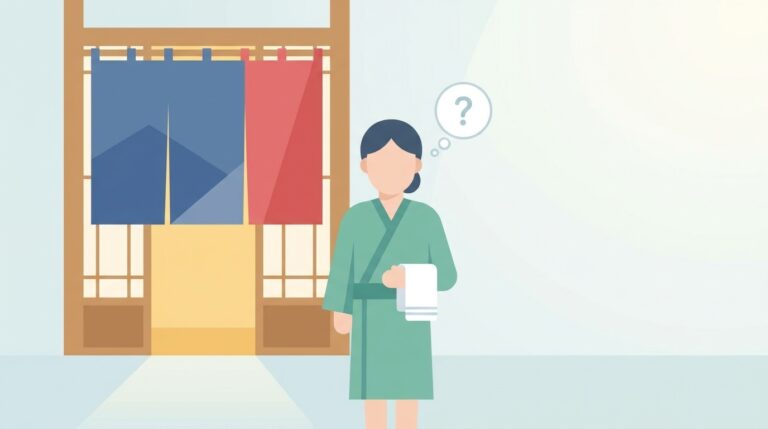
You confidently pay at the counter, receive a uniform and a wristband. You walk down the hall and suddenly—you are faced with two doors. One has a blue curtain, the other has a red one. Which one do you enter? And wait… you peek inside and realize everyone is completely naked?! Panic sets in.
Don’t worry! This is a rite of passage for almost every foreigner visiting Korea. If you don’t know the basic vocabulary and unspoken rules, a relaxing spa day can quickly turn into a hilarious (or embarrassing) survival mission. This guide is based on real SOS messages from my students. Let’s learn how to navigate the Korean bathhouse like a confident local!
Phase 2: Core Expressions Deep Dive
1. 남탕 / 여탕 (Men’s Bath / Women’s Bath)
- Pronunciation: [nam-tang] / [yeo-tang]
(Sound guide: ‘nam’ sounds like the start of ‘nominee’, ‘yeo’ sounds like ‘yuh’, ‘tang’ rhymes with ‘bang’) - Meaning: Men’s public bath (Literal) / Women’s public bath (Literal)
- K-Culture Moment: This is the most critical crossroads in your Jjimjilbang journey. Usually, ‘Nam-tang’ (남탕) has blue signs, and ‘Yeo-tang’ (여탕) has red signs. Entering the wrong one? That’s a K-Drama trope you don’t want to experience in real life!
- Editor’s Insight: The word ‘tang’ (탕) literally means soup or boiling water, which is why Korean stews are called ‘Galbi-tang’ or ‘Maeun-tang’. In this context, it means a hot bath!
- Situation Spectrum:
- Friends (Casual): ✅
- Co-workers (Semi-formal): ✅
- Elders (Formal): ✅ (It’s just a location name!)
- 🤔 Think About It: In many Western cultures, public nudity with strangers is a big taboo. Why do you think Koreans are so comfortable with communal bathing?
2. 신발장 열쇠 (Shoe Locker Key)
- Pronunciation: [sin-bal-jang yeol-soe]
(Sound guide: ‘sin-bal’ = shin-bal, ‘yeol-soe’ = yull-sweh) - Meaning: Shoe locker key
- K-Culture Moment: Before you even reach the baths, you must take off your shoes. You put them in a small locker (신발장), take the key (열쇠), and use that same key to open your clothes locker inside the bath area.
- Editor’s Insight: This key is magical. It has an RFID chip inside! You wear it on your wrist or ankle. Inside the Jjimjilbang, you don’t use cash—you just tap this key to buy snacks and pay everything at the end.
- Situation Spectrum:
- Asking staff: ✅
- Talking to friends: ✅
- 🤔 Think About It: Korea has a strict ‘no shoes indoors’ culture. How does this physical boundary of taking off shoes affect people’s mindset when entering a relaxing space?
3. 수건 두 장 주세요 (Please give me two towels)
- Pronunciation: [su-geon du jang ju-se-yo]
(Sound guide: ‘soo-gun doo jahng joo-seh-yo’) - Meaning: Please give me two towels.
- K-Culture Moment: Here is a funny cultural difference! In most Jjimjilbangs, men have unlimited towels stacked inside the Nam-tang. But women are handed exactly two towels (수건) at the front desk before entering the Yeo-tang.
- Editor’s Insight: Why the difference? Legend says that when women’s baths had unlimited towels, they kept disappearing! So now, women must ask for them at the counter.
- Situation Spectrum:
- To the counter staff: ✅
- To a boss: 🚫 (You wouldn’t ask your boss for a towel!)
Phase 3: Textbook vs. Real Korean
[Situation 1: Asking where the entrance is]
* 📖 Textbook Korean: 남탕은 어디에 있습니까? (Where is the men’s bath located?)
* 🗣️ Real Korean: 남탕 어디예요? (Where’s the Nam-tang?)
* 💡 Why the difference?: Koreans value speed (Palli-palli culture). Dropping the formal “-seumnikka” for the conversational “-yeyo” sounds much more natural and friendly.
[Situation 2: Someone is about to enter the wrong door!]
* 📖 Textbook Korean: 거기는 여탕입니다. 들어가면 안 됩니다. (That is the women’s bath. You must not enter.)
* 🗣️ Real Korean: 어어! 거기 여탕이에요! (Uh-oh! That’s the Yeo-tang!)
* 💡 Why the difference?: In emergencies, Koreans use the exclamation “Eo-eo!” (어어!) to grab attention quickly before politely stating the problem.
(Bottom Note: As an A2 learner, focus on dropping unnecessary grammar particles in casual speech. “수건 주세요” is much better than “수건을 주시겠습니까?”)
Phase 4: Cultural Context — K-Culture Deep Dive
4-1. Non-verbal ‘Nunchi’ in the Bathhouse
Language isn’t everything. In the bathhouse, Nunchi (눈치 – the ability to read the room) is your best friend.
* The Shower Rule: You must shower with soap before stepping into the hot tubs. If you just walk into the tub dry, you will feel the intense, judgmental stares of every Korean grandpa/grandma in the room.
* The Towel Modesty: While walking between tubs, many Koreans use a small towel to cover their front. Once in the water, place the towel on your head or the edge of the tub—never dip the towel in the bathwater!
4-2. The K-Drama Connection: The ‘Yangmeori’
Have you seen the famous ‘Yangmeori’ (양머리 – Sheep Head) towel fold in dramas like Crash Landing on You or My Love from the Star?
While it looks super cute on TV, here is a reality check: Inside the actual wet bath area (Nam-tang/Yeo-tang), no one wears the sheep head. It is strictly reserved for the dry sauna (Jjimjilbang) area where everyone wears uniforms. Don’t be the tourist wearing a sheep head while completely naked in the shower room!
Phase 5: Real-Life Roleplay Scenario
Setting: Saturday afternoon, 2:00 PM. You are at a massive, bustling Jjimjilbang in Yongsan, Seoul. You just paid at the front desk.
Characters:
* YOU: An excited foreigner trying a Korean bathhouse for the first time.
* Ajumma (Staff): A friendly but fast-paced Korean lady in her 50s.
Dialogue:
Ajumma: 결제 되셨어요. 여기 찜질복이랑 수건이요. 👕
(gyeol-je doe-syeot-eo-yo. yeo-gi jjim-jil-bok-i-rang su-geon-i-yo.)
[Payment is complete. Here are your sauna clothes and towels.]
YOU: 감사합니다. 남탕은 어디예요?
(gam-sa-ham-ni-da. nam-tang-eun eo-di-ye-yo?)
[Thank you. Where is the men’s bath? / Note: Replace with ‘yeo-tang’ if female!]
Ajumma: 저기 파란색 커튼 보이죠? 거기로 가세요.
(jeo-gi pa-ran-saek keo-teun bo-i-jyo? geo-gi-ro ga-se-yo.)
[See the blue curtain over there? Go that way.]
(🎭 Stage Direction: You grab your clothes and start walking toward the curtain while still wearing your Nike sneakers.)
Ajumma: 어어! 손님!
(eo-eo! son-nim!)
[Uh-oh! Customer!]
🔀 Your Turn! How do you react?
* A) (Keep walking faster) “안녕히 계세요!” (Goodbye!)
* B) (Stop and look confused) “네? 왜요?” (Yes? Why?)
* C) (Look at your feet, realize your mistake) “아, 신발장! 죄송합니다.” (Ah, the shoe locker! I’m sorry.)✅ Best Choice: C — You must take off your shoes before entering the locker room area! Put them in the small shoe locker first.
⚠️ Choice B Analysis: This is okay, but the Ajumma will likely point at your feet aggressively while saying “신발 벗으세요!” (Take off your shoes!).
Phase 6: 10-Second Shadowing Drill
Practice this essential phrase out loud! Focus on the rhythm.
😊 저기요 / 수건 / 한 장만 더 / 주세요!
(jeo-gi-yo / su-geon / han jang-man deo / ju-se-yo!)
[Excuse me / towel / just one more / please give me!]
Tip: Say it brightly to the staff! Raise your hand slightly when you say “Jeogiyo”.
Phase 7: K-Culture Mini Dictionary
1. 찜질방
* Romanization: jjim-jil-bang
* English: Korean dry sauna/bathhouse
* Context: ‘Jjimjil’ means heating/fomentation, ‘Bang’ means room. It’s a 24-hour complex where you can bathe, sweat, eat, and even sleep!
2. 때밀이 (세신사)
* Romanization: ttae-mil-i (se-sin-sa)
* English: Body scrub (Body scrub professional)
* Context: The famous Korean body scrub. You lie naked on a vinyl table while a professional scrubs away layers of dead skin you didn’t know existed. It hurts, but you’ll feel like a newborn baby afterward.
3. 식혜
* Romanization: sik-hye
* English: Sweet rice punch
* Context: The ultimate Jjimjilbang drink. Served ice-cold, it perfectly balances the heat of the sauna.
4. 눈치
* Romanization: nun-chi
* English: Emotional intelligence / reading the room
* Context: Watching how locals shower before entering the bath is the ultimate use of Nunchi.
Phase 8: Traveler’s Survival Kit
🆘 Survival Phrases for the Bathhouse
* 🇰🇷 “신발장 어디예요?” (sin-bal-jang eo-di-ye-yo?)
* 🗣️ English: Where is the shoe locker?
* 🇰🇷 “때밀이 얼마예요?” (ttae-mil-i eol-ma-ye-yo?)
* 🗣️ English: How much is the body scrub?
* 🇰🇷 “사물함 안 열려요.” (sa-mul-ham an yeol-ryeo-yo.)
* 🗣️ English: My locker won’t open.📌 Editor’s Travel Note
* Tattoos: Unlike Japan, most Korean Jjimjilbangs do not ban tattoos. You can enter freely!
* The Magic Key: Do not lose your locker key! It is literally your credit card inside the facility. If you lose it, there is a hefty penalty fee.
Phase 9: Critical Thinking Corner — “One Step Deeper”
🧠 Think Deeper: Body & Identity in Korea
Communal bathing is a fascinating aspect of Korean culture. In modern society, we wear clothes that show our status, wealth, and occupation. But once you step into the Nam-tang or Yeo-tang, everyone is completely naked. Without designer suits or expensive watches, a CEO and a college student look exactly the same. The bathhouse strips away social hierarchy and creates a space of raw equality. Furthermore, Koreans often scrub each other’s backs (even strangers sometimes offer!), which is a profound physical expression of Jeong (정 – deep communal bonding).
💬 Your Turn: Does your culture have any communal spaces where social hierarchy disappears? Share in the comments below!
Phase 10: FAQ & Avoiding Mistakes
- Q: Do I really have to be completely naked? Can I wear a swimsuit?
- A: No swimsuits allowed! You must be 100% naked in the wet bath areas (Nam-tang/Yeo-tang). Don’t worry, everyone else is naked too. You will get used to it in 5 minutes!
- Q: Can I take my phone into the bath area?
- A: Absolutely NOT. Taking photos or bringing a camera phone into the naked locker room/bath area is strictly prohibited and illegal.
❌ Common Mistake #1: Entering the hot tub without taking a shower first.
✅ Do This Instead: Always wash your body thoroughly with soap and water at the shower stations before dipping into the communal tubs.❌ Common Mistake #2: Splashing water or swimming in the tubs.
✅ Do This Instead: The tubs are for soaking quietly. Keep your head above water and relax.
Phase 11: Summary & Action Items
One-Liner Summary: Look for the Blue (Nam-tang) or Red (Yeo-tang) curtains, take off your shoes first, and remember that Nunchi is your best friend in the bathhouse!
Action Mission:
* 🥉 Bronze (Solo): Stand in front of your mirror and practice saying: “남탕 어디예요? / 여탕 어디예요?”
* 🥈 Silver (Online): Find a K-Drama clip of a Jjimjilbang scene on YouTube and see if you can spot the blue or red curtains in the background.
* 🥇 Gold (Real-Life): Visit a real Jjimjilbang in Korea, successfully navigate your way into the correct bath, and buy a cold Sikhye using your magic wristband!
K-Culture Mission:
Next time you watch a Korean drama, watch how the characters interact in the sauna. Are they eating eggs? Are they talking about serious secrets? The Jjimjilbang is where Koreans go to open their hearts!
Phase 12: Interactive Quiz
1. You are a female traveler. You pay at the counter and receive your clothes. What must you ask the staff?
A) 남탕 어디예요? (Where is the men’s bath?)
B) 수건 주세요. (Please give me towels.)
C) 때밀이 얼마예요? (How much is the scrub?)
Hint: Remember the funny cultural difference about the Yeo-tang! (Answer: B)
2. True or False: It is polite to wear a swimsuit inside the hot tub so you don’t offend others.
Answer: False! Wearing clothes or swimsuits in the bath water is considered dirty in Korea. You must be completely naked!
3. Fill in the blank: Before stepping onto the floor leading to the locker rooms, you must put your shoes in the ________ (신발장).
Drop your quiz answers in the comments! See you in the next Daily Hangul lesson!
Frequently Asked Questions (FAQ)
Q: What does "남탕 / 여탕 (Men's Bath / Women's Bath)" mean in Korean and how do you pronounce it?
A: In Korean, "남탕 / 여탕 (Men's Bath / Women's Bath)" is pronounced [nam-tang] and means: Men's public bath (Literal) / Women's public bath (Literal)
Q: What does "신발장 열쇠 (Shoe Locker Key)" mean in Korean and how do you pronounce it?
A: In Korean, "신발장 열쇠 (Shoe Locker Key)" is pronounced [sin-bal-jang yeol-soe] and means: Shoe locker key
Q: What does "수건 두 장 주세요 (Please give me two towels)" mean in Korean and how do you pronounce it?
A: In Korean, "수건 두 장 주세요 (Please give me two towels)" is pronounced [su-geon du jang ju-se-yo] and means: Please give me two towels.







