

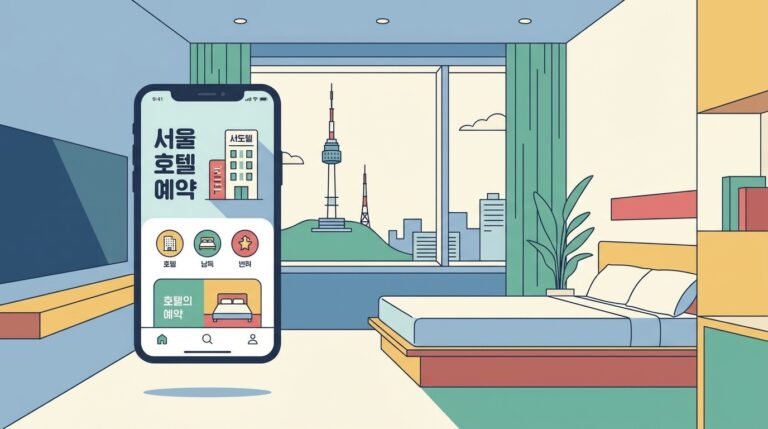
Phase 1: Empathy & The K-Culture Cold Open
Hello! It’s your Daily Hangul Editor.
Picture this: You’ve just finished binge-watching a K-Drama like King the Land or Hotel Del Luna. You saw the main characters sipping champagne in a gorgeous hotel suite overlooking the sparkling Seoul skyline or the majestic Haeundae beach in Busan. Inspired, you decide to treat yourself to a ‘Hocance’ (호캉스 – Hotel + Vacance) for your upcoming trip to Korea.
You excitedly open a Korean travel app, but suddenly, you hit a wall. The package descriptions are a maze of terms! “Is breakfast included? Do I get to sleep in? Wait, why is the ocean view extra?”
Navigating Korean hotel packages at an intermediate (B2) level isn’t just about reading words; it’s about understanding the subtle ‘perks’ culture in Korea. If you don’t know the right expressions, you might miss out on a free late check-out or a beautiful room upgrade. But don’t worry! By the end of this guide, you’ll be comparing hotel packages like a true Seoul local. This guide is built from the real questions my students asked when planning their dream Korean getaways.
Phase 2: Core Expressions Deep Dive
Let’s decode the absolute must-know phrases for comparing Hocance packages.
1. 이 패키지 조식 포함인가요?
- Pronunciation: I paekiji josik pohamingayo? [i pae-ki-ji jo-shik po-ham-in-ga-yo?]
Tip: ‘조’ sounds like ‘Joe’, and ‘식’ sounds like ‘sheek’.- Meaning: (Literal) Is breakfast included in this package? / (Real nuance) Does this deal come with the morning buffet?
- K-Culture Moment: In Korea, hotel breakfast buffets (조식 뷔페) are a huge deal. K-vloggers constantly review hotel breakfasts, rating everything from the abalone porridge to the pastry section. Asking this confirms if you get to join the feast.
- Editor’s Insight: Notice we use the Sino-Korean word ‘조식’ (Josik) instead of ‘아침밥’ (Achimbap – morning meal). In the hospitality industry, formal Sino-Korean vocabulary is the standard.
- Situation Spectrum:
- Casual with friends: ⚠️ (To a friend you’d say “이거 조식 줘?” – Does this give breakfast?)
- Hotel Staff (Formal/Polite): ✅
- 🤔 Think About It: Why do Koreans use different words for “breakfast” at home (아침밥) versus at a hotel (조식)? How does the vocabulary elevate the perceived luxury of the experience?
2. 오션뷰로 변경하면 추가 비용이 어떻게 되나요?
- Pronunciation: Osyeonbyuro byeongyeonghamyeon chuga biyongi eotteoke doenayo? [o-shyun-byu-ro byun-gyung-ha-myun choo-ga bi-yong-i uh-ttuh-keh dweh-na-yo?]
- Meaning: (Literal) If I change to an ocean view, how does the additional cost become? / (Real nuance) How much extra is it for the ocean view?
- K-Culture Moment: Imagine checking into a beachfront hotel in Busan or Jeju. The standard room faces a brick wall (City View / 시티뷰), but you want the K-Drama ocean backdrop. This is the polite, indirect way to ask for the price difference.
- Editor’s Insight: Instead of asking directly “얼마예요?” (How much is it?), saying “비용이 어떻게 되나요?” (How does the cost become?) sounds much softer, more professional, and highly natural for a B2 speaker.
- Situation Spectrum:
- Casual with friends: 🚫
- Hotel Staff (Formal/Polite): ✅
- 🤔 Think About It: Korean culture values indirectness to avoid making conversations about money feel too aggressive. Does your native language have a ‘softer’ way to ask about prices?
3. 혜택이 엄청 좋네요. 완전 가성비 패키지예요!
- Pronunciation: Hyetaegi eomcheong jonneyo. Wanjeon gaseongbi paekijiyeyo! [hye-teg-i um-chung jon-neh-yo. wan-jun ga-sung-bi pae-ki-ji-yeh-yo!]
- Meaning: (Literal) The benefits are very good. It’s a completely cost-performance package! / (Real nuance) The perks are amazing. This is such a steal/great value!
- K-Culture Moment: You’re comparing packages with a Korean friend. One package includes a room, breakfast, a welcome drink, and a late check-out. Your friend will definitely exclaim, “와, 가성비 대박!” (Wow, amazing value!).
- Editor’s Insight: 가성비 (Cost-effectiveness) is a keyword you must know in modern Korea. If a hotel package is slightly expensive but gives you immense psychological satisfaction (like an ultra-luxury infinity pool), we call it 가심비 (Psychological cost-effectiveness).
- Situation Spectrum:
- Casual with friends: ✅
- Hotel Staff: ⚠️ (You can say it, but it sounds a bit too casual for front desk chat. Better used when talking about the hotel with friends.)
Phase 3: Textbook vs. Real Korean
Let’s look at how language changes when you step out of the classroom and up to the hotel counter.
[Situation 1: Asking about what the package includes]
* 📖 Textbook Korean: 이 패키지에는 어떤 서비스가 있습니까? (What services are in this package?)
* 🗣️ Real Korean: 이 패키지 혜택(perks/benefits)이 어떻게 돼요? / 조식 포함이에요?
* 💡 Why the difference?: Hotels use specific marketing terms. They don’t just offer ‘services’; they offer ‘benefits’ (혜택). Real conversations cut straight to the point: “Do I get breakfast?”
[Situation 2: Asking for a later checkout time]
* 📖 Textbook Korean: 늦게 퇴실해도 괜찮습니까? (Is it okay if I leave the room late?)
* 🗣️ Real Korean: 혹시 레이트 체크아웃 되나요? (By any chance, is late check-out available?)
* 💡 Why the difference?: The Korean hospitality industry heavily relies on Konglish (English loanwords). Saying “레이트 체크아웃” (Late check-out) or “얼리 체크인” (Early check-in) is far more natural than using pure Korean translations.
Phase 4: Cultural Context — K-Culture Deep Dive
4-1. Non-verbal Nuances & Nunchi (눈치) at the Front Desk
When asking for upgrades or late check-outs, Nunchi is crucial. If the hotel lobby is chaotic and packed with a huge tour group, it’s not the time to ask for a free upgrade. However, if it’s quiet, asking with a soft tone, a slight bow of the head, and starting your sentence with “혹시…” (By any chance…) works wonders. Do not demand; inquire gracefully.
4-2. The “Flex” & “Small Luxury” Culture
Why is Hocance so popular among young Koreans? In a highly competitive, fast-paced (빨리빨리 – ppalli-ppalli) society where buying a house feels impossible for many youths, they turn to 소확행 (So-hwak-haeng: Small but certain happiness) and 플렉스 (Flex: treating oneself).
Instead of saving for years for a house they might not afford, a Gen Z or Millennial worker might save up to spend $400 on one night at a luxury hotel just to order room service, wear a fluffy white robe, and take aesthetic photos for Instagram. It’s not just a room; it’s an experience, a status symbol, and most importantly, deeply needed ‘healing’ (힐링).
Phase 5: Real-Life Roleplay Scenario
Setting: Friday afternoon, 2:30 PM. The grand, marble lobby of a 5-star beachfront hotel in Haeundae, Busan. You are at the reception desk to check in for your long-awaited weekend Hocance.
Characters:
– YOU: A B2-level Korean learner, excited but slightly nervous about ensuring your package details are correct.
– Jia (지아): The professional, smiling hotel receptionist.
Dialogue:
지아 (Jia): 안녕하십니까, 고객님. 체크인 도와드리겠습니다. 예약자 성함이 어떻게 되시나요?
(Annyeonghasimnikka, gogaengnim. Chekeuin dowadeurigetseumnida. Yeyakja seonghami eotteoke doesinayo?)
[Hello, customer. I will help you with check-in. What is the name on the reservation?]
YOU: 네, 제 이름은 [Your Name]입니다. ‘스위트 힐링 패키지’로 예약했어요.
(Ne, je ireumeun [Your Name]-imnida. ‘Seuwiteu hilling paekiji’ro yeyakhaesseoyo.)
[Yes, my name is [Your Name]. I booked the ‘Sweet Healing Package’.]
지아 (Jia): 네, 확인되셨습니다. 디럭스 더블룸 시티뷰 2박 맞으실까요?
(Ne, hwagindoesyeotseumnida. Dileokseu deobeullum sitibyu ibak majeusi-lkkayo?)
[Yes, confirmed. Deluxe Double Room, City View for 2 nights, is that correct?]
YOU: 네, 맞아요. 그런데 혹시 이 패키지 조식 포함인가요?
(Ne, majayo. Geureonde hoksi i paekiji josik pohamingayo?)
[Yes, that’s right. But by any chance, is breakfast included in this package?]
지아 (Jia): 아, 고객님. 해당 패키지는 조식 불포함입니다. 추가하시겠어요?
(Ah, gogaengnim. Haedang paekijineun josik bulpohamimnida. Chugahasigesseoyo?)
[Ah, customer. That package does not include breakfast. Would you like to add it?]
YOU: 음… 그럼 오션뷰로 변경하면 추가 비용이 어떻게 되나요?
(Eum… geureom osyeonbyuro byeongyeonghamyeon chuga biyongi eotteoke doenayo?)
[Hmm… Then if I change to an ocean view, what is the additional cost?]
지아 (Jia): 1박당 5만 원 추가됩니다. 뷰가 정말 좋아서 가심비가 뛰어납니다. 😊
(Il-bak-dang oman won chugadoemnida. Byuga jeongmal joaseo gasimbiga t뛰eonamnida.)
[It’s an additional 50,000 KRW per night. The view is really good, so it has great psychological value.]
🔀 Your Turn! How do you respond?
– A) “너무 비싸요! 깎아주세요!” (Too expensive! Give me a discount!)
– B) “네, 그럼 오션뷰로 업그레이드할게요. 혹시 레이트 체크아웃도 가능한가요?”
– C) “아, 그냥 시티뷰로 할게요.”✅ Best Choice: B — “Yes, then I’ll upgrade to the ocean view. By any chance, is late check-out also possible?”
Reason: Korean hotels do not haggle on price (A is a big no-no). If you are paying for an upgrade, asking politely for a small perk like a late check-out (레이트 체크아웃) shows excellent Nunchi and negotiation skills!
YOU: (Choosing B) 네, 그럼 오션뷰로 업그레이드할게요. 혹시 레이트 체크아웃도 가능한가요?
지아 (Jia): (Checking computer) 네, 고객님. 오션뷰 업그레이드 시, 내일 1시까지 레이트 체크아웃 무료로 도와드리겠습니다!
(Ne, gogaengnim. Osyeonbyu eopgeureideu si, naeil il-si-kkaji reiteu chekeua-ut muryoro dowadeurigetseumnida!)
[Yes, customer. Upon upgrading to an ocean view, I will help you with a free late check-out until 1 PM tomorrow!]
YOU: 와, 혜택이 정말 좋네요. 감사합니다!
(Wa, hyetaegi jeongmal jonneyo. Gamsahamnida!)
[Wow, the perks are really great. Thank you!]
Phase 6: 10-Second Shadowing Drill
Let’s practice the rhythm of the most useful phrase. Pay attention to the pauses (/) and the intonation!
🥺 Politely asking (with a soft smile):
혹시 / 이 패키지 / 조식 포함 / 인가요~?
(hok-si / i pae-ki-ji / jo-shik po-ham / in-ga-yo~?)😤 Making a confident decision:
오션뷰로 / 업그레이드 / 할게요!
(o-shyun-byu-ro / up-geu-re-i-deu / hal-ge-yo!)
Phase 7: K-Culture Mini Dictionary
Here are the top keywords you’ll encounter when booking your Hocance:
1. 호캉스 (Hocance)
* Romanization: hokangseu
* English: Hotel + Vacance (Vacation)
* Context: A staycation at a luxury hotel, focusing on enjoying the facilities (pools, spas, dining) rather than sightseeing.
2. 뷰맛집 (View-matjib)
* Romanization: byumatjip
* English: A place known for its amazing view (Literal: View restaurant).
* Context: “맛집” usually means a delicious restaurant, but young Koreans attach it to anything excellent. A hotel with a great sunset? It’s a 뷰맛집!
3. 어메니티 (Amenity)
* Romanization: eomeniti
* English: Hotel amenities (shampoo, lotion, etc.)
* Context: In Korean Hocance culture, what brand of amenities the hotel uses (e.g., Le Labo, Byredo) is highly discussed in reviews.
4. 룸온리 (Room-only)
* Romanization: rumonri
* English: A package that only includes the room (no breakfast or extras).
* Context: The cheapest option. If you see this, you know you need to go out to find your breakfast.
Phase 8: Traveler Survival Kit 🆘
If you are planning your trip right now, keep these handy!
🆘 Survival Phrases at the Front Desk
– 🇰🇷 “짐 좀 맡겨도 될까요?” (Jim jom matgyeodo doelkkayo?) – Can I leave my luggage here?
– 🇰🇷 “와이파이 비밀번호가 뭐예요?” (Waipa-i bimilbeonhoga mwoyeyo?) – What is the Wi-Fi password?
– 🇰🇷 “수건 좀 더 주실 수 있나요?” (Sugeon jom deo jusil su innayo?) – Can you give me some more towels?📌 Editor’s Travel Note: Apps & Tips
– Booking Apps: Koreans heavily use ‘야놀자’ (Yanolja) or ‘여기어때’ (Yeogi Eottae) for domestic hotels. They often have secret ‘App-only’ Hocance packages that Agoda or Booking.com don’t show!
– Tipping: 🚫 NO TIPPING! There is absolutely no tipping culture in Korea, not even for hotel housekeeping or bellboys. If you try to hand them a 10,000 KRW bill, they will likely chase you down to return it, thinking you dropped it!
Phase 9: Think Deeper — “One Step Further”
Media vs Reality: The ‘Flex’ Illusion
When you watch K-Dramas, it seems like every character, even the entry-level office worker, effortlessly spends weekends at 5-star hotels drinking imported wine. While Hocance is incredibly popular, the reality is that it’s often a highly calculated financial decision. Many young Koreans use “Installment plans” (할부 – halbu) on their credit cards to pay for a $500 luxury night over 3 months. The K-Drama portrays it as daily life, but for the average Korean, it’s a meticulously planned “Flex” to reward themselves for months of hard work. It’s a fascinating blend of seeking true rest and keeping up appearances on social media.
💬 Your Turn: In your culture, what is the ultimate way young people “treat” themselves after a stressful period of work? Do you have something similar to ‘Hocance’? Share in the comments!
Phase 10: FAQ & Avoiding Mistakes
Q: Can I use 반말 (informal language) if the hotel staff looks much younger than me?
A: NO! Absolutely never. In the service industry, no matter the age difference, formal language (존댓말) is strictly required. Using informal language to staff is considered extremely rude and is known as ‘갑질’ (Gap-jil: abusing power).
Q: If a package is ‘가성비’ (good value), does that mean I can negotiate the price further?
A: No. Prices at hotels, department stores, and most shops in Korea are fixed (정찰제). You only negotiate at traditional markets!
❌ Common Mistake #1: Asking “아침밥 줘요?” (Do you give morning meal?)
✅ Do This Instead: Ask “조식 포함인가요?” (Is Josik included?). Using the proper terminology gets you treated like a seasoned traveler!
Phase 11: Summary & Action Items
One-Liner Summary: To master Korean hotel bookings, don’t just look for a room; look for the hyetaek (benefits) and always ask politely if josik (breakfast) is included!
Action Mission 3 Steps:
– 🥉 Bronze (Solo): Stand in front of your mirror and practice asking for an ocean view upgrade using the shadowing drill.
– 🥈 Silver (Online): Download a Korean travel app (like Yanolja) and try to spot the words “조식” and “가성비” in the hotel listings.
– 🥇 Gold (Real Life): On your next trip to Korea, confidently ask the receptionist at check-in: “이 패키지 조식 포함인가요?”
✈️ K-Culture Special Mission:
Go to YouTube and search for “호캉스 브이로그” (Hocance V-log). Watch a Korean YouTuber review a hotel, and listen closely—I guarantee you will hear the word “가성비” or “조식” within the first 3 minutes!
Phase 12: Interactive Challenge — Quiz Time!
1. Situational Judgment: You arrive at the hotel and want to know if you can stay in your room until 2 PM tomorrow instead of 11 AM. What is the most natural B2 Korean way to ask?
– A) 내일 늦게 집에 가도 돼요? (Can I go home late tomorrow?)
– B) 혹시 레이트 체크아웃 가능한가요? (By any chance, is late check-out available?)
– C) 체크아웃 시간은 언제입니까? (When is check-out time?)
2. True or False – K-Culture Edition:
“If the bellboy brings my luggage to my ocean view room, I should give him a tip of about 5,000 KRW to show my appreciation.”
3. Fill in the Blank:
Wow, this hotel includes breakfast, a pool, and late check-out for only $100! 완전 ________ 최고예요!
(Hint: Cost-effectiveness)
(Answers: 1. B, 2. False – No tipping in Korea!, 3. 가성비)
Did you get them all right? Let me know which hotel you want to visit in Korea in the comments! Happy Travel Planning! 🧳🇰🇷
Frequently Asked Questions (FAQ)
Q: What does "이 패키지 조식 포함인가요?" mean in Korean and how do you pronounce it?
A: In Korean, "이 패키지 조식 포함인가요?" is pronounced [I paekiji josik pohamingayo? [i pae-ki-ji jo-shik po-ham-in-ga-yo?] and means: (Literal) Is breakfast included in this package? / (Real nuance) Does this deal come with the morning buffet?
Q: What does "오션뷰로 변경하면 추가 비용이 어떻게 되나요?" mean in Korean and how do you pronounce it?
A: In Korean, "오션뷰로 변경하면 추가 비용이 어떻게 되나요?" is pronounced [Osyeonbyuro byeongyeonghamyeon chuga biyongi eotteoke doenayo? [o-shyun-byu-ro byun-gyung-ha-myun choo-ga bi-yong-i uh-ttuh-keh dweh-na-yo?] and means: (Literal) If I change to an ocean view, how does the additional cost become? / (Real nuance) How much extra is it for the ocean view?
Q: What does "혜택이 엄청 좋네요. 완전 가성비 패키지예요!" mean in Korean and how do you pronounce it?
A: In Korean, "혜택이 엄청 좋네요. 완전 가성비 패키지예요!" is pronounced [Hyetaegi eomcheong jonneyo. Wanjeon gaseongbi paekijiyeyo! [hye-teg-i um-chung jon-neh-yo. wan-jun ga-sung-bi pae-ki-ji-yeh-yo!] and means: (Literal) The benefits are very good. It's a completely cost-performance package! / (Real nuance) The perks are amazing. This is such a steal/great value!







