

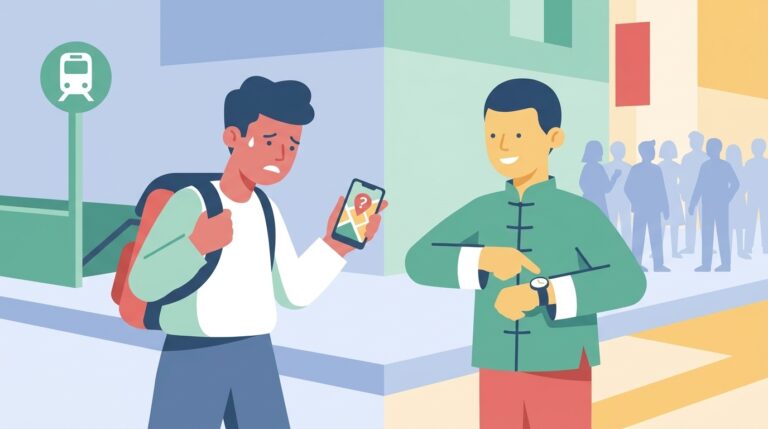
Phase 1: Empathy — The Countdown Begins
Hello! I’m your Daily Hangul Editor.
Imagine this: You finally scored tickets to your favorite K-Pop idol’s concert in Seoul. The venue is about 30 minutes away according to the map app, and the concert starts in an hour. You’re chilling at your hotel, sipping on an iced Americano, thinking you have plenty of time. Suddenly, your Korean friend frantically texts you: “Yah! We need to leave NOW!”
Wait, why? You have 30 minutes to spare!
Welcome to Seoul, where a 30-minute drive can turn into a 90-minute nightmare during 퇴근길 (rush hour). In Korea’s famous 빨리빨리 (Pali-pali / hurry-hurry) culture, being on time actually means arriving 15 minutes early. If you don’t know how to advise someone to leave early, you might end up missing the opening stage of that concert or the first round of pork belly at a team dinner.
Today, based on the frantic real-life experiences of my intermediate (B1) students, we are going to learn how to properly give advice on leaving early. Let’s make sure you never miss a beat in Korea!
Phase 2: Core Expressions Deep Dive
Here are the top three expressions you’ll need to save your friends (and yourself) from being late.
1. 일찍 출발하는 게 좋아요.
- Pronunciation: iljjeek chulbalhaneun ge joayo [Eel-jeek chool-bal-ha-neun geh jo-ah-yo]
- Tutor’s Tip: The ‘일’ (il) sounds like “eel” but cut very short. Make sure to stress the double consonant ‘찍’ (jjeek) like you’re taking a quick picture!
- Meaning: Literal = It is good to leave early. / Real nuance = You’d better leave early (Advice).
- K-Culture Moment: You’ll often hear this from a friendly hotel receptionist or a local friend when you tell them you’re heading to Hongdae on a Friday night.
- Editor’s Insight: This uses the grammar pattern
~는 게 좋다(it is good to do ~), which is the standard, polite way to give advice in Korean. It feels helpful rather than bossy.- Situation Spectrum:
- Close Friends (Casual): ✅ (Say: 일찍 출발하는 게 좋아)
- Co-workers (Semi-formal): ✅
- Boss/Elders (Formal): ⚠️ (Use with caution; advising a boss can seem presumptuous unless they ask).
- 🤔 Think About It: Why does Korean use the phrase “It is good to…” instead of a direct command like “Leave early”? How does this reflect the Korean value of maintaining harmony (기분 – gibun) in conversations?
2. 차 막힐 수도 있으니까 서두르세요.
- Pronunciation: cha makhil sudo isseunikka seodureuseyo [Cha mah-keel soo-doh ee-sseu-nee-kka seo-doo-reu-seh-yo]
- Meaning: Literal = Because the car might be blocked, please hurry. / Real nuance = Traffic might be bad, so hurry up.
- K-Culture Moment: Picture a K-Drama scene where the main character is trying to catch a flight to stop their lover from leaving. The taxi driver looks in the rearview mirror and drops this line.
- Editor’s Insight: “차 막히다” (traffic is blocked/jammed) is a survival phrase in Seoul. The
~(으)니까(because) pattern makes your advice logical, which softens the urgency of “서두르세요” (hurry).- Situation Spectrum:
- Close Friends (Casual): ✅ (Say: 차 막히니까 서둘러!)
- Co-workers (Semi-formal): ✅
- Boss/Elders (Formal): 🚫 (Telling a boss to hurry is a big no-no).
- 🤔 Think About It: In your home country, do people blame the traffic when advising someone to hurry?
3. 시간 여유 있게 가요.
- Pronunciation: sigan yeoyu itge gayo [Shee-gan yeo-yoo eett-geh gah-yo]
- Meaning: Literal = Go with time surplus. / Real nuance = Leave with plenty of time to spare.
- K-Culture Moment: When planning a trip on the KTX (bullet train). Korean trains leave exactly on the minute. If your ticket says 14:00, the doors close at 13:59. Your Korean friend will definitely say this to you.
- Editor’s Insight: “여유” (yeoyu) is a beautiful Korean word meaning “spare, surplus, or a relaxed state.” By saying this, you’re not just telling them to avoid being late; you’re wishing them a stress-free journey.
- Situation Spectrum:
- Close Friends (Casual): ✅ (Say: 여유 있게 가)
- Co-workers (Semi-formal): ✅
- Boss/Elders (Formal): ✅ (Say: 시간 여유 있게 가시는 게 좋겠습니다)
- 🤔 Think About It: Contrast “여유” (relaxed/spare time) with “빨리빨리” (hurry). Korean culture constantly balances these two extremes. Which one do you prefer?
Phase 3: Textbook vs. Real Korean
Let’s see how standard advice transforms in the wild streets of Seoul.
[Situation 1: Telling a friend they need to leave for a dinner appointment]
* 📖 Textbook Korean: 늦지 않기 위해 일찍 가야 합니다. (You must go early in order not to be late.)
* 🗣️ Real Korean: 야, 차 막혀. 지금 당장 출발해! (Hey, traffic’s bad. Leave right now!)
* 💡 Why the difference?: Textbooks focus on formal written logic (기 위해), but real conversations rely on short, punchy reasons and immediate action verbs.
[Situation 2: Advising a younger co-worker about a morning meeting]
* 📖 Textbook Korean: 내일은 일찍 출발하는 것이 좋습니다. (It is good that you leave early tomorrow.)
* 🗣️ Real Korean: 낼 회의 있으니까 좀 넉넉히 와요. (We have a meeting tomorrow, so come with some time to spare.)
* 💡 Why the difference?: Koreans love using “넉넉히” (sufficiently/amply) instead of just saying “일찍” (early) to sound softer and more considerate in the workplace.
Bottom Note: For B1 learners, using “~는 게 좋아요” or “여유 있게 가요” is the perfect sweet spot. It proves you understand the grammar, but still sound like a natural human being!
Phase 4: Cultural Context — K-Culture Deep Dive
4-1. Non-Verbal Cues: The Art of Urgency
When advising someone to leave early in Korea, body language speaks volumes. If a Korean friend is tapping their phone screen, constantly checking their watch, or sighing while looking at the street, their Nunchi (situational awareness) is screaming that you are going to be late. Don’t wait for them to verbally say “Let’s go.” If they start gathering their belongings quickly, that is your cue to stand up!
4-2. The “지옥철” (Hell-Subway) Reality
If you watch K-Dramas, you might notice scenes where characters are sprinting through subway stations. This isn’t just dramatic effect. Line 2 and Line 9 in Seoul during rush hour (usually 8-9 AM and 6-7 PM) are infamously called 지옥철 (Jiokcheol – a blend of ‘Hell’ and ‘Subway’). If you are meeting someone during these hours, advising them with “차 막히니까 지하철 타고 일찍 와요” (Traffic is bad, so take the subway and come early) is not just polite advice; it’s a survival tactic.
Phase 5: Real-Life Roleplay Scenario
Setting: It’s 5:30 PM on a Friday. You are in the lobby of a hotel in Myeongdong with your Korean colleague, Min-su. You both need to get to Gangnam for a very important team dinner (회식 – hoesik). You are casually adjusting your coat, but Min-su is vigorously checking a map app.
Characters:
– YOU: An expat working in Korea for six months. You want to make a good impression at the team dinner.
– Min-su (32): Your friendly Korean colleague. He knows the terror of Friday Gangnam traffic.
Dialogue:
Min-su: 지금 강남역까지 차가 엄청 막히네요. 🚗
(Jigeum gangnamyeokkaji chaga eomcheong makhineyo.)
[Translation: Traffic to Gangnam station is extremely bad right now.]
YOU: 그래요? 예약 시간까지 아직 1시간 남았잖아요.
(Geuraeyo? Yeyak sigankkaji ajik 1sigan namatjanayo.)
[Translation: Really? We still have 1 hour until the reservation time.]
Min-su: 금요일 저녁이잖아요! 여유 있게 출발하는 게 좋을 것 같아요.
(Geumyoil jeonyeok-ijanayo! Yeoyu itge chulbalhaneun ge joeul geot gatayo.)
[Translation: It’s Friday evening! I think it’d be better to leave with time to spare.]
YOU: 아, 맞다. 한국의 금요일 퇴근길을 깜빡했네요.
(Ah, matda. Hangugui geumyoil toegeungireul kkamppakhaenneyo.)
[Translation: Ah, right. I forgot about Korea’s Friday rush hour.]
Min-su: 네, 택시 타면 늦을 수도 있으니까 서두르세요. 지하철 타러 갈까요?
(Ne, taeksi tamyeon neujeul sudo isseunikka seodureuseyo. Jihacheol tareo galkkayo?)
[Translation: Yeah, we might be late if we take a taxi, so please hurry. Shall we go take the subway?]
🔀 Your Turn! How should you respond?
– A) “싫어요. 택시 타고 싶어요.” (I don’t want to. I want to take a taxi.)
– B) “네! 늦으면 안 되니까 지금 당장 출발해요!” (Yes! We can’t be late, so let’s leave right now!)
– C) “천천히 가도 괜찮아요.” (It’s okay to go slowly.)✅ Best Choice: B — This shows you read the room (Nunchi), acknowledge the urgency, and are a proactive team player.
⚠️ Choice A & C Analysis: Saying this to a Korean trying to get you to a team dinner on time will definitely cause them extreme internal panic. Never underestimate Friday traffic!
Min-su: 좋아요! 부장님보다 늦게 도착하면 안 되니까 빨리 갑시다!
(Joayo! Bujangnimboda neutge dochakhamyeon an doenikka ppalli gapsida!)
[Translation: Great! We can’t arrive later than the boss, so let’s go quickly!]
YOU: 제가 앞장설게요. 빨리빨리!
(Jega apjangseolgeyo. Ppallippalli!)
[Translation: I’ll lead the way. Hurry, hurry!]
(🎭 Stage Direction: You both power-walk toward the subway station like you’re in an action movie.)
Phase 6: 10-Second Shadowing Drill
Let’s get your tongue used to the rhythm of Korean advice. Remember, pacing and emotion are key!
- 😬 Anxiously: 차 막힐 수도 있으니까 / 서두르는 게 / 좋아요!
(cha makhil sudo isseunikka / seodureuneun ge / joayo!)
Focus: Pause slightly after ‘으니까’ to emphasize the reason. -
😊 Gently but firmly: 시간 / 여유 있게 / 출발하세요~
(sigan / yeoyu itge / chulbalhaseyo~)
Focus: Drag the ‘~요’ at the end slightly to make it sound friendly rather than bossy.
Phase 7: K-Culture Mini Dictionary
Here are 4 keywords you absolutely must know when navigating time and transport in Korea:
1. 빨리빨리
* Romanization: ppallippalli
* English: Hurry hurry / Quick quick
* Context: The unofficial motto of modern Korea. It applies to internet speed, food delivery, and walking speed.
2. 지옥철
* Romanization: jiokcheol
* English: Hell-subway
* Context: The subway during rush hour. You don’t walk onto the train; you are pushed in by the crowd.
3. 퇴근길
* Romanization: toegeungil
* English: The way home from work / Rush hour
* Context: Usually from 6 PM to 8 PM. Avoid driving or taking buses during this time if possible.
4. 눈치
* Romanization: nunchi
* English: Situational awareness / Reading the room
* Context: If everyone is putting their coats on 10 minutes before an event ends, your nunchi should tell you it’s time to prepare to leave early.
Phase 8: Traveler’s Survival Kit
If you are traveling in Korea, mastering transportation and timing is half the battle. Here is your survival kit.
🆘 Survival Expression #1: Taxis & Time
– 🇰🇷 “여기서 얼마나 걸려요?” (yeogiseo eolmana geollyeoyo?)
– 🗣️ English Pronunciation: [yeo-gi-seo eol-mah-nah geol-lyeo-yo?]
– 📍 Where to use: Asking a taxi driver or a friend how long the trip will take.
– 💡 Pro Tip: If the driver says “차가 많이 막혀요” (Traffic is really bad), buckle up or ask to be dropped off near a subway station!📌 Editor’s Travel Note
– Essential Apps: Google Maps does NOT work well for walking/driving in Korea. You MUST download Naver Map or Kakao T. They will tell you exactly when to leave to catch the bus down to the second.
– KTX & SRT: Korean bullet trains are merciless. They will not wait 30 seconds for you. Always follow the advice: 시간 여유 있게 가요.
Phase 9: Critical Thinking Corner — “A Step Deeper”
🧠 Think Deeper: The Double-Edged Sword of “Pali-Pali” Efficiency
Korea’s Pali-pali culture is world-renowned. It’s the reason why you can get a hot meal delivered to the park along the Han River in 20 minutes, and why the public transport system is incredibly efficient. However, this constant rush means that time is viewed as a strict, unyielding resource. Telling someone “일찍 출발하세요” (leave early) isn’t just about punctuality; it’s a sign of respect for the other person’s time. Arriving late can be seen as a disruption of social harmony.
💬 Your Turn: How is time viewed in your culture? Is being 10 minutes late considered “on time,” or is it a major offense? Share your thoughts in the comments!
Phase 10: FAQ & Avoiding Mistakes
Q: Can I use “빨리 가” (Go quickly) to an older person or my boss?
A: ABSOLUTELY NOT. Using “빨리” as a command to a superior is rude. If you must advise a boss to hurry because of traffic, say: “부장님, 차가 막힐 수 있으니 조금 일찍 출발하시는 게 좋겠습니다.” (Boss, traffic might be bad, so it would be best to leave a little early.)
Q: If an idol has a concert at 6 PM, when do fans usually arrive?
A: Much earlier than you think! Fans often arrive hours early for merchandise, fan events, and photo zones. So if a fellow fan says “일찍 가요”, they might mean 2 PM, not 5:30 PM!
❌ Common Mistake #1: Saying “빨리 출발해” to a stranger or a taxi driver.
✅ Do this instead: Use “서두르는 게 좋을 것 같아요” (I think it would be good to hurry) or simply “조금만 서둘러 주실 수 있나요?” (Could you please hurry a little bit?) if you are in a taxi.
Phase 11: Summary & Action Items
- One-Liner Summary: To smoothly navigate Korea’s fast-paced society without being late, soften your advice by using “~는 게 좋아요” (It’s good to…) or giving a logical reason like “차 막히니까” (Because traffic is bad).
-
Action Mission 3 Steps:
- 🥉 Bronze (Solo): Look at your watch right now and say out loud to yourself: “늦을 수 있으니까 서두르는 게 좋아요!”
- 🥈 Silver (Online): Drop a comment below on this post using the phrase: “저는 내일 [Place]에 가요. 일찍 출발하는 게 좋아요!”
- 🥇 Gold (Real World): Next time you meet your language exchange partner or Korean friend, text them before the meeting: “오늘 차 막힐 수 있으니까 여유 있게 출발해요!”
- K-Culture Mission: Open Naver Map (or download it if you haven’t!), set a route from Incheon Airport to Gangnam Station during a Friday at 6 PM. Check the estimated time and practice saying, “차가 막히니까 서두르세요!”
Phase 12: Quiz — Interactive Challenge
Q1. Situational Judgment:
You are meeting your Korean language tutor in 40 minutes. It’s raining heavily, which means traffic will be terrible. What is the most natural way to text them so they leave early?
A) 선생님, 빨리 출발해.
B) 선생님, 비가 오니까 시간 여유 있게 출발하세요.
C) 선생님, 늦지 않기 위해 일찍 가야 합니다.
👉 Click here for the answer & explanation
Answer: B. It provides a logical reason (비가 오니까 – because it’s raining) and uses the polite, considerate phrase ‘여유 있게 출발하세요’. ‘A’ is banmal (casual language) and rude to a teacher. ‘C’ sounds like a textbook robot.
Q2. True or False – K-Culture Edition:
In Korea, if a map app says walking takes 15 minutes and driving takes 20 minutes during rush hour, you should definitely take a taxi to be faster. (T/F)
👉 Click here for the answer
Answer: False. During Seoul’s intense rush hour (퇴근길), walking or taking the subway is often significantly faster than taking a taxi. Always trust the subway!
Frequently Asked Questions (FAQ)
Q: What does "일찍 출발하는 게 좋아요." mean in Korean and how do you pronounce it?
A: In Korean, "일찍 출발하는 게 좋아요." is pronounced [iljjeek chulbalhaneun ge joayo [Eel-jeek chool-bal-ha-neun geh jo-ah-yo] and means: a key conversational Korean expression covered in this lesson.
Q: What does "차 막힐 수도 있으니까 서두르세요." mean in Korean and how do you pronounce it?
A: In Korean, "차 막힐 수도 있으니까 서두르세요." is pronounced [cha makhil sudo isseunikka seodureuseyo [Cha mah-keel soo-doh ee-sseu-nee-kka seo-doo-reu-seh-yo] and means: Literal = Because the car might be blocked, please hurry. / Real nuance = Traffic might be bad, so hurry up.
Q: What does "시간 여유 있게 가요." mean in Korean and how do you pronounce it?
A: In Korean, "시간 여유 있게 가요." is pronounced [sigan yeoyu itge gayo [Shee-gan yeo-yoo eett-geh gah-yo] and means: Literal = Go with time surplus. / Real nuance = Leave with plenty of time to spare.







