

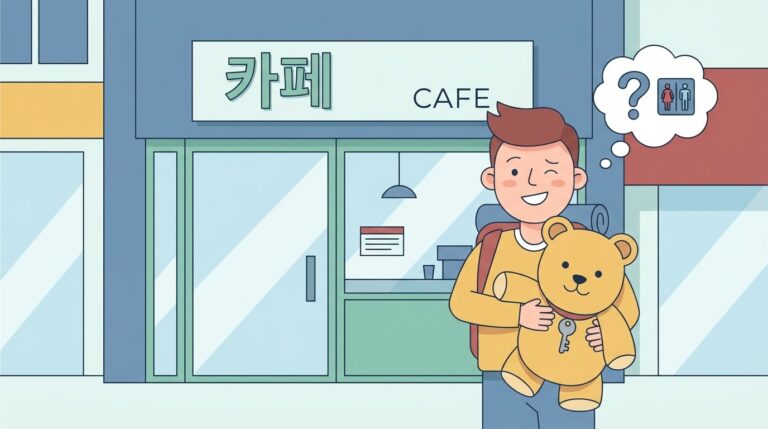
Don’t Panic! How to Confidently Ask Where the Restroom is in Korea
Phase 1: Empathy (The “I Need to Go” Moment)
Hello! I’m your Daily Hangul Editor, your local Korean friend and veteran tutor.
Imagine this: You are exploring the vibrant streets of Myeongdong. You’ve just devoured a massive plate of spicy Tteokbokki and drank a giant cup of iced Americano. Suddenly, nature calls. You rush into a nearby building, but everything is in Hangul. You look left, you look right… no universal toilet icon. You lock eyes with a busy store owner, your heart racing. You want to ask for the restroom, but your mind goes blank.
Sound familiar? We’ve all been there! Not knowing how to ask for the restroom in a foreign country isn’t just an inconvenience; it’s a genuine survival crisis.
But don’t worry! Today, we are going to learn the absolute most important phrase for your Korean trip. This guide is based on real panicked texts I’ve received from my students. By the end of this, you won’t just know how to find the bathroom—you’ll navigate Korean cafes and restaurants like a true insider.
Phase 2: Core Expressions Deep Dive
Let’s break down the magic words you need to memorize.
1. 화장실 어디예요? (Where is the restroom?)
- Pronunciation: [hwajangsil eodiyeyo?] -> Hwa-jang-shil eo-dee-ye-yo?
- hwa sounds like the beginning of “Juan”.
- jang sounds like “John” but with a shorter ‘a’.
- shil sounds like “shield” without the ‘d’.
- Meaning: Literal = Restroom where is it? / Real nuance = “Excuse me, where is the bathroom?”
- K-Culture Moment: You’ll use this in a bustling K-BBQ restaurant when you need to wash your hands before wrapping your samgyeopsal (pork belly) in lettuce. The staff will point you toward a door hidden behind a fridge!
- Editor’s Insight: This phrase is a lifesaver. It’s polite enough for almost any situation but short enough to remember when you’re in a rush. No need to build complex sentences. Just “Item + Where is it?”
- Situation Spectrum:
- Casual (Friends): ⚠️ (Friends just say “화장실 어디야?” – hwajangsil eodiya?)
- Semi-formal (Cafes, Restaurants): ✅
- Formal (Bosses, Elders): ✅ (It’s perfectly acceptable, though you could add “죄송하지만…” – Sorry but… at the beginning).
- 🤔 Think About It: In English, we often ask “Can I use your restroom?” asking for permission. In Korean, we just ask for the location (“Where is it?”). Why do you think Korean communication focuses more on facts and space rather than explicit permission in public businesses?
2. 저기요! (Excuse me!)
- Pronunciation: [jeogiyo] -> Juh-gee-yo!
- jeo sounds like “jaw” or “juh”.
- gi sounds like “gee” (as in geese).
- yo sounds like “yo!”.
- Meaning: Literal = Over there / Real nuance = “Excuse me! (Look over here!)”
- K-Culture Moment: Picture a lively K-Drama scene where the main characters are drinking Soju in a pojangmacha (street tent). They raise their hand high and yell, “Jeogiyo!” to order another bottle.
- Editor’s Insight: You MUST say this before asking where the bathroom is. If you just walk up and say “Where is the bathroom?” it feels abrupt. “Jeogiyo” is the magical attention-grabber.
- Situation Spectrum:
- Casual (Friends): 🚫 (Don’t call your friends “over there”)
- Semi-formal (Waiters, Strangers): ✅
- Formal (Bosses): 🚫
- 🤔 Think About It: Why does a word meaning “over there” get used to mean “excuse me”? It’s a way of creating spatial distance to politely get someone’s attention without being too invasive!
3. 비밀번호 뭐예요? (What’s the password?)
- Pronunciation: [bimilbeonho mwoyeyo?] -> Bee-meel-bun-ho mwo-ye-yo?
- Meaning: Literal = Secret number what is it? / Real nuance = “What is the door code?”
- K-Culture Moment: You finally find the bathroom in the commercial building of your favorite aesthetic cafe, but there’s an electronic keypad on the door. You have to run back and ask this!
- Editor’s Insight: Korea is extremely safe, but commercial restrooms are often locked to keep them clean for paying customers. “Bimil” means secret, and “beonho” means number.
- Situation Spectrum:
- Casual (Friends): ✅
- Semi-formal (Staff): ✅
- Formal: ✅
Phase 3: Textbook vs. Real Korean
Let’s see how what you learn in books differs from what you hear on the neon-lit streets of Seoul.
[Situation 1: Asking the location]
* 📖 Textbook Korean: 화장실이 어디에 있습니까? (hwajangsiri eodie itseumnikka? – Where does the restroom exist?)
* 🗣️ Real Korean: 저기요, 화장실 어디예요? (jeogiyo, hwajangsil eodiyeyo?)
* 💡 Why the difference?: Textbooks teach you formal grammar with subject particles (이/가) and location particles (에). Real Koreans value speed and efficiency, dropping particles completely in everyday speech.
[Situation 2: Getting Directions]
* 📖 Textbook Korean: 오른쪽으로 가세요. (oreunjjogeuro gaseyo – Please go to the right.)
* 🗣️ Real Korean: 쭈욱 가시면 우측에 있어요. (jju-uk gasimyeon ucheuge isseoyo – Go sttraaaaaight and it’s on your right.)
* 💡 Why the difference?: Koreans love using sound symbolism. Stretching the word “쭈욱” (jju-uk) visually and audibly shows you that you have to walk a fair distance straight ahead!
Bottom Note: For A1 beginners, don’t worry about understanding every word the cashier replies with. Just listen for keywords like 오른쪽 (oreunjjok – right), 왼쪽 (oenjjok – left), or 직진 (jikjin – straight) and follow their hand gestures!
Phase 4: Cultural Context — K-Culture Deep Dive
4-1. Non-verbal Nuances
When asking for the bathroom, especially to an older store owner, do not point with one index finger. In Korea, pointing with one finger can be seen as rude or aggressive. Instead, use your whole open hand to gesture toward a direction, or simply nod your head toward the hallway while asking.
Also, use your Nunchi (social awareness). If the cafe worker is carrying three boiling hot bowls of soup, wait a second before shouting “Jeogiyo!”
4-2. K-Travel Connection: The Great Bathroom Key Adventure
Here is a uniquely Korean travel experience: The Cafe Bathroom Key.
In many parts of the world, public bathrooms are either inside the cafe or completely public. In Korea, many cafes and restaurants are located in multi-story commercial buildings. They share a bathroom in the hallway with other businesses.
Because of this, the owner will give you a key. But not just any key. To prevent people from accidentally taking the key home, owners attach them to massive, ridiculous objects. You might ask “화장실 어디예요?” and be handed a key attached to a giant stuffed Ryan bear, a wooden frying pan, or a huge plastic flower! You literally have to walk out of the cafe carrying a giant stuffed animal. Don’t be embarrassed—it’s completely normal here!
Phase 5: Real-life Roleplay Scenario
Setting: Saturday afternoon, 3 PM. A trendy, minimalist cafe in Seongsu-dong (the Brooklyn of Seoul). You just ordered an iced matcha latte, but you urgently need the restroom.
Characters:
– YOU: A traveler who just learned some survival Korean.
– Jihoon (22): The friendly, slightly overworked part-time barista.
Dialogue:
YOU: (Walking up to the counter)
저기요!
jeogiyo!
[Excuse me!]
Jihoon: 네, 주문하시겠어요?
ne, jumunhasigesseoyo?
[Yes, would you like to order?]
YOU: 아, 아니요. 화장실 어디예요?
a, aniyo. hwajangsil eodiyeyo?
[Ah, no. Where is the restroom?]
Jihoon: 아! 건물 밖으로 나가서 오른쪽에 있어요.
a! geonmul bakkeuro nagaseo oreunjjoge isseoyo.
[Ah! Go outside the building and it’s on the right.]
YOU: (Looking confused, catching the word ‘Right’)
오른쪽이요?
oreunjjogiyo?
[To the right?]
Jihoon: 네. 그런데 문이 잠겨 있어요.
ne. geureonde muni jamgyeo isseoyo.
[Yes. But the door is locked.]
🔀 Your Turn! How should you respond?
– A) “열어주세요!” (yeoreojuseyo! – Open it for me!)
– B) “비밀번호 뭐예요?” (bimilbeonho mwoyeyo? – What’s the password?)
– C) “진짜요? 대박!” (jinjjayo? daebak! – Really? Awesome!)✅ Best Choice: B — Asking for the password is exactly what you need to do.
⚠️ Choice A & C Analysis: Choice A is too demanding and unnatural. Choice C means “Awesome!” which makes zero sense when you are told a bathroom is locked!
YOU: 아~ 비밀번호 뭐예요?
a~ bimilbeonho mwoyeyo?
[Ah~ What’s the password?]
Jihoon: 영수증 밑에 써 있어요. 1234 별() 이에요.
*yeongsujeung mite sseo isseoyo. il-i-sam-sa byeol-ieyo.
[It’s written at the bottom of the receipt. It’s 1234 Star.]
(🎭 Stage Direction: Jihoon points to the bottom of your receipt.)
YOU: 아, 알겠습니다. 감사합니다!
a, algetseumnida. gamsahamnida!
[Ah, understood. Thank you!]
Jihoon: 휴지 없으니까 가져가세요!
hyuji eopseunikka gajyeogaseyo!
[There’s no toilet paper in there, so take some with you!]
(🎭 Stage Direction: You grab a handful of napkins from the counter and rush out.)
Phase 6: 10-Second Shadowing Drill
Let’s practice the rhythm! Pay attention to the pauses (/) and the emotion tags.
🥺 (Urgently) 저기요! / 화장실 / 어디예요?
(jeo-gi-yo! / hwa-jang-sil / eo-di-ye-yo?)
🤔 (Curiously) 비밀번호 / 뭐예요?
(bi-mil-beon-ho / mwo-ye-yo?)
😊 (Politely) 아, / 오른쪽이요? / 감사합니다!
(a, / o-reun-jjok-i-yo? / gam-sa-ham-ni-da!)
Phase 7: K-Culture Mini Dictionary
1. 영수증
* Romanization: yeongsujeung
* English: Receipt
* Context: In Korea, the Wi-Fi password and the bathroom password (비밀번호) are almost always printed at the very bottom of your receipt. Never throw it away immediately at a cafe!
2. 휴지
* Romanization: hyuji
* English: Tissue / Toilet Paper
* Context: Some older commercial buildings do not stock toilet paper in the shared bathrooms. You often have to grab a roll or some napkins from the restaurant before walking out to the bathroom.
3. 눈치
* Romanization: nunchi
* English: Situational awareness / Reading the room
* Context: If you see everyone walking out the backdoor of a restaurant grabbing a roll of toilet paper from a specific desk, use your nunchi to realize that the bathroom is outside and you need to bring your own paper!
4. 도어락
* Romanization: doeorak (Door lock)
* English: Digital keypad lock
* Context: Korea is highly digitized. Physical keys are rare. You will punch a 4-digit code and the * (byeol – star) key into a glowing keypad on the bathroom door.
Phase 8: Traveler’s Survival Kit
Since this topic is the ultimate travel survival scenario, here is your essential cheat sheet!
🆘 Survival Phrase #1: The Paper Check
– 🇰🇷 “휴지 있어요?” (hyuji isseoyo?)
– 🗣️ Pronunciation: Hyu-jee iss-eo-yo?
– 📍 Where to use: Asking the cafe staff before leaving for the shared bathroom.
– 💡 Meaning: “Is there toilet paper?”🆘 Survival Phrase #2: The Password Check
– 🇰🇷 “비밀번호 뭐예요?” (bimilbeonho mwoyeyo?)
– 🗣️ Pronunciation: Bee-meel-bun-ho mwo-ye-yo?
– 📍 Where to use: When the door is locked.🆘 Survival Phrase #3: Seeking Public Restrooms
– 🇰🇷 “지하철역 어디예요?” (jihacheollyeok eodiyeyo?)
– 🗣️ Pronunciation: Jee-ha-chul-yeok eo-dee-ye-yo?
– 📍 Where to use: When you are lost on the street and desperately need a bathroom.
– 💡 Meaning: “Where is the subway station?”📌 Editor’s Travel Note
– The Ultimate Bathroom Hack: In Seoul, every single subway station has free, clean, public restrooms. If you are on the street and can’t find a cafe, open Naver Maps or KakaoMap and find the nearest subway entrance!
– Flushing rule: Modern buildings allow you to flush toilet paper. However, in some older buildings or small markets, plumbing is weak. If you see a large trash can next to the toilet and a sign that says “휴지는 휴지통에” (Toilet paper in the trash can), please throw the paper in the bin, not the bowl!
Phase 9: Critical Thinking Corner — “A Step Deeper”
Public Space vs. Private Boundaries in Korea
🧠 Think Deeper:
Have you noticed the contrast? Korea has some of the world’s most accessible, free, and incredibly clean public restrooms in subway stations and parks. Yet, if you go to a private cafe, the bathroom is often strictly locked with a digital keypad, requiring a password from a receipt.This reflects a unique aspect of modern Korean urban life. The government invests heavily in public infrastructure (like the subway system) for everyone’s convenience. However, because cities like Seoul are incredibly densely populated, private business owners must fiercely protect their facilities from being overwhelmed by foot traffic. The keypad lock isn’t about being unfriendly; it’s a necessary boundary to maintain cleanliness for paying guests in a high-density mega-city.
💬 Your Turn: Are public restrooms easy to find in your country? Do cafes lock their doors for customers only? Share your culture in the comments!
Phase 10: FAQ & Mistake Prevention
Q: “Can I just walk into a random cafe and use their restroom without buying anything?”
No. Unless it’s a massive chain store like Starbucks (and even then, some have codes now), it’s considered very rude to use a small cafe’s restroom without making a purchase. If it’s an absolute emergency, buy a cheap bottled water or ask very politely: “죄송한데, 화장실 좀 써도 될까요?” (Sorry, but could I use the restroom?).
Q: “Is it okay to use this phrase to an older person?”
Yes! “화장실 어디예요?” ends in “~요” (yo), which makes it polite. It is perfectly fine to use with a 70-year-old restaurant owner or a 20-year-old barista.
❌ Common Mistake #1: Forgetting to bring your belongings.
✅ Do this instead: In Korea, nobody will steal your laptop or phone left on a cafe table. Leave your bag at the table to “reserve” your spot, take the bathroom key (or receipt), and go!❌ Common Mistake #2: Walking out without asking for toilet paper.
✅ Do this instead: Always look around the door area of the restaurant. If there’s a big roll of toilet paper hanging on the wall, pull some off before you walk out to the shared hallway bathroom!
Phase 11: Summary & Action Items
One-Liner Summary: To survive any bathroom emergency in Korea, grab their attention with “Jeogiyo!” and ask “Hwajangsil Eodiyeyo?”
Action Mission:
– 🥉 Bronze (Solo): Say “화장실 어디예요?” out loud 3 times fast.
– 🥈 Silver (Online): Find an image of a Korean receipt on Google Images. Can you spot where the password (비밀번호) is written?
– 🥇 Gold (Real Life): The next time you visit a Korean restaurant or cafe in your city, test it out! Ask the waiter “Jeogiyo, hwajangsil eodiyeyo?”
K-Culture Mission:
Next time you watch a K-Drama, look closely at the cafe or restaurant scenes. Can you spot the giant, ridiculous bathroom key hanging near the counter?
Phase 12: Quiz — Interactive Challenge
Test your survival skills!
1. Situational Judgment:
You are at a busy street food tent. You really need to go. How should you get the busy owner’s attention?
– A) “Hello! Bathroom?”
– B) Raise your hand and say “저기요!” (Jeogiyo!)
– C) Point your index finger at her and wait.
2. Fill in the Blank:
You finally found the bathroom door, but it has a keypad. You run back inside and ask:
“_________ 뭐예요?” (What is the password?)
3. True or False – K-Culture Edition:
If you are exploring Seoul and can’t find a cafe, the best place to find a free, clean restroom is inside any subway station. (True/False)
Click here for the answers!
1. B – “Jeogiyo” is the perfect way to get attention politely. “A” uses English which might panic them, and “C” (pointing with one finger) is rude.
2. 비밀번호 (Bimilbeonho) – The magical word for password!
3. True – Korean subway stations are lifesavers for travelers!
Keep practicing, and you’ll never be lost in Korea again! See you in the next Daily Hangul lesson. 😊
Frequently Asked Questions (FAQ)
Q: What does "화장실 어디예요? (Where is the restroom?)" mean in Korean and how do you pronounce it?
A: In Korean, "화장실 어디예요? (Where is the restroom?)" is pronounced [hwajangsil eodiyeyo?] and means: a key conversational Korean expression covered in this lesson.
Q: What does "저기요! (Excuse me!)" mean in Korean and how do you pronounce it?
A: In Korean, "저기요! (Excuse me!)" is pronounced [jeogiyo] and means: a key conversational Korean expression covered in this lesson.
Q: What does "비밀번호 뭐예요? (What's the password?)" mean in Korean and how do you pronounce it?
A: In Korean, "비밀번호 뭐예요? (What's the password?)" is pronounced [bimilbeonho mwoyeyo?] and means: Literal = Secret number what is it? / Real nuance = "What is the door code?"






