

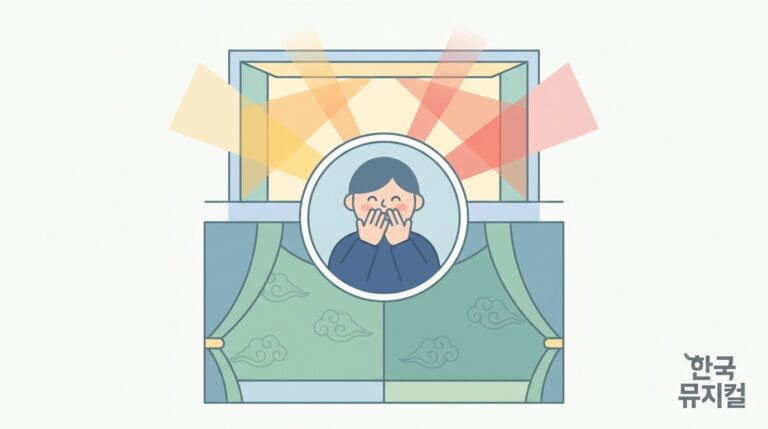
Speechless After a Korean Musical? How to Express ‘Goosebumps’ Like a True Local Fandom
Phase 1: Empathy (Immersion Open)
Hello! I’m the Senior Editor of Daily Hangul.
Picture this: You are standing in the lobby of the Blue Square Theater in Seoul. The curtain just dropped for the intermission of a mega-hit K-Musical. The actor playing the lead just belted out an absolutely impossible high note that rattled the chandeliers. The audience is dead silent for a split second, then erupts into roaring applause.
You turn to your Korean friend, wanting to express that your mind is completely blown. But all you can conjure from your C1 textbook is, “노래를 아주 잘 부릅니다” (They sing very well).
Doesn’t that feel… painfully dry?
If you are engaging with Korean arts—especially the booming K-Musical scene where K-Pop superstars and legendary theater veterans share the same stage—you need the vocabulary to match the passion. Today, we’re going beyond basic compliments. We’re going to learn how to sound like a true 연뮤덕 (Theater/Musical nerd) in Korea. Let’s upgrade your expressions so you can share your genuine awe without sounding like a robotic language app!
Phase 2: Deep Dive into Core Expressions
1. 무대를 찢어놓다
- Pronunciation: mudaereul jjijeonota [moo-dae-reul jji-jeo-no-ta]
- Meaning: (Literal) To tear the stage apart. (Real Nuance) They absolutely killed it / They dominated the stage.
- K-Culture Moment: This is the ultimate compliment in modern Korean performing arts. Whether you’re watching a musical actor hit a spectacular climax or a K-Pop idol executing a flawless dance break, fans use this to say the performance was so powerful, it practically destroyed the venue.
- Editor’s Insight: Think of it like the English phrase “brought the house down,” but with a more visceral, aggressive energy. It shows that you didn’t just watch the performance; you felt its raw power.
- Situation Spectrum:
- Casual friends: ✅
- Semi-formal (colleagues): ⚠️ (Okay if they are also fans, but a bit slangy)
- Formal (boss/elders): 🚫
- 🤔 Think About It: Why do Koreans often use destructive metaphors (like “tear” 찢다 or “smash” 부수다) to describe something incredibly positive? Does your native language also use aggressive words for amazing performances?
2. 소름 돋게 잘해
- Pronunciation: soreum dotge jalhae [so-reum dot-ge jal-hae] (The ‘으’ in soreum sounds like the disgusted groan you make when stepping in gum!)
- Meaning: (Literal) Good enough to give me goosebumps. (Real Nuance) Crazy good / Chillingly talented.
- K-Culture Moment: You’ll hear this non-stop during the 퇴근길 (Toegungil – waiting for actors on their way off work after the show). Fans whisper to each other, “Did you hear that vibrato? 진심 소름 돋았어 (I seriously got goosebumps).”
- Editor’s Insight: At the C1 level, you want to express physical reactions to art. “잘해” (good) is subjective, but “소름 돋아” (goosebumps) is an involuntary, universal proof of brilliance.
- Situation Spectrum:
- Casual friends: ✅
- Semi-formal (colleagues): ✅
- Formal (boss/elders): ⚠️ (Use the polite form: 소름 돋을 정도로 훌륭했습니다)
- 🤔 Think About It: Koreans love expressing emotions through physical symptoms (e.g., “I’m dying of joy,” “My stomach hurts from laughing”). How does this reflect the highly expressive nature of casual Korean conversations?
3. 여운이 가시질 않네
- Pronunciation: yeouni gasijil anne [yeo-oo-ni ga-si-jil an-ne]
- Meaning: (Literal) The afterglow/lingering imagery won’t go away. (Real Nuance) The performance is still resonating with me / I can’t shake off the emotion.
- K-Culture Moment: This is exactly what you say when sitting in a quiet cafe after a deeply emotional show like Death Note or Hero. You’re staring blankly into your Americano because the tragic final number is still echoing in your head.
- Editor’s Insight: Use this when you want to sound deeply poetic and thoughtful. It shows a highly advanced command of Korean emotional vocabulary.
- Situation Spectrum:
- Casual friends: ✅
- Semi-formal (colleagues): ✅
- Formal (boss/elders): ✅ (Add ‘요’: 가시질 않네요)
- 🤔 Think About It: “여운” (lingering emotion) is a highly valued concept in Korean storytelling and movies. Why is the “aftertaste” of art sometimes more important than the climax itself?
Phase 3: Textbook vs. Real Korean
Here is how you transition from an advanced learner to a natural speaker when reviewing a musical:
[Praising Vocal Power]
* 📖 Textbook Korean: 목소리가 아주 큽니다. (Their voice is very loud.)
* 🗣️ Real Korean: 와, 성량 장난 아니다! (Wow, their vocal resonance is no joke!)
* 💡 Why the difference?: “장난 아니다” (is no joke) is the ultimate Korean way to express extreme awe without sounding academic. “성량” (vocal volume/resonance) is a must-know term for musical fans.
[Expressing Emotional Immersion]
* 📖 Textbook Korean: 너무 감동적이었습니다. (It was very touching.)
* 🗣️ Real Korean: 완전 과몰입하게 되네요. (I got completely overly immersed in it.)
* 💡 Why the difference?: “과몰입” (over-immersion) stems from modern K-Pop and internet culture. It means you didn’t just watch the character’s tragedy; you practically lived it with them.
[Describing an Outstanding High Note]
* 📖 Textbook Korean: 높은 음을 잘 부릅니다. (They sing high notes well.)
* 🗣️ Real Korean: 고음에서 완전 미쳤어! (They completely went crazy on the high note!)
* 💡 Why the difference?: In modern slang, “미쳤다” (crazy) is overwhelmingly used as the highest tier of praise. (Just keep it among friends!)
Bottom Note: At the
C1 (Upper-Intermediate)level, using words like 성량 (vocal resonance) and 과몰입 (over-immersion) instantly signals that you have a sophisticated grasp of contemporary Korean culture, far beyond textbook grammar.
Phase 4: Cultural Context — K-Culture Deep Dive
4-1. Non-verbal Elements & ‘Nunchi’
When Koreans are blown away by a musical number, they often don’t cheer mid-song. Instead, you’ll see people covering their mouths with both hands, eyes wide, leaning forward.
But here is where 눈치 (Nunchi – the ability to read the room) is crucial: the infamous “시체관극” (Corpse-like Viewing) culture. Unlike Broadway, where humming or soft reactions are sometimes tolerated, Korean theater audiences demand absolute, pin-drop silence during the performance. You must remain as still as a corpse. If you gasp too loudly or shift in your seat during a quiet, emotional number, you will immediately feel the piercing nunchi glares from everyone around you. Save the explosive cheers for the curtain call!
4-2. The K-Pop & K-Musical Crossover
Why is the Korean musical industry so massive? It’s heavily driven by Idol Casting. Legendary K-Pop vocalists (like Kyuhyun, Xia Junsu, or Solar) frequently take lead roles. This blends traditional theater with fierce K-Pop fandom culture. Buying a ticket isn’t just a transaction; it’s a bloody war called 피켓팅 (Blood Ticketing). When you use expressions like “무대를 찢어놓다,” you are speaking the shared language of K-Pop fans and theater lovers alike.
Phase 5: Real-world Roleplay Scenario
Scenario A: The Post-Show Debrief
- Setting: Friday, 10 PM. A lively Samgyeopsal restaurant in Hannam-dong, right down the street from Blue Square. Smoke is rising from the grill, and Soju bottles clink around you. You just watched a breathtaking musical with your Korean colleagues.
- Characters:
- YOU: An expat working in Seoul, a big fan of K-Arts, eager to show off your advanced Korean.
- Min-su (32): Your humorous Korean coworker, a hardcore musical fan.
Min-su: 야, 오늘 1막 마지막 넘버 진짜 대박 아니었어요? 🥩
(Ya, oneul il-mak majimak neombeo jinjja daebak anieosseoyo?)
[Hey, wasn’t the final number of Act 1 absolutely insane today?]
(🎭 Stage Direction: Min-su flips the pork belly with tongs, looking at you excitedly.)
YOU: 제 말이요! 저 진짜 보면서 입을 다물 수가 없었어요.
(Je mariyo! Jeo jinjja bomyeonseo ibeul damul suga eopseosseoyo.)
[That’s what I’m saying! I literally couldn’t close my mouth while watching.]
Min-su: 그 배우 진짜… 와, 고음 올라갈 때 어땠어요?
(Geu baeu jinjja… wa, goeum ollagal ttae eottaesseoyo?)
[That actor is just… wow, how was it when they hit that high note?]
🔀 Your Turn! How do you respond?
– A) “노래를 정말 잘 부르시더라고요!” (Textbook, safe, but a bit boring)
– B) “진짜 소름 돋았어요. 무대를 완전 찢어놓던데요!” (Perfect local fan reaction)
– C) “너무 시끄러웠어요.” (You completely missed the vibe!)✅ Best Choice: B — By combining ‘소름’ (goosebumps) and ‘찢어놓다’ (tore up), you match Min-su’s high energy perfectly.
⚠️ Choice A Analysis: While grammatically flawless for a C1 learner, it lacks the emotional punch expected at a late-night post-show Soju session.
YOU: (Choosing B) 진짜 소름 돋았어요. 무대를 완전 찢어놓던데요!
(Jinjja soreum dodasseoyo. Mudaereul wanjeon jjijeonotdeondeyo!)
Min-su: 크~ 맞아요! 표현력 최고네요. 자, 삼겹살 익었다. 드세요!
(Keu~ majayo! Pyohyeollyeok choegoneyo. Ja, samgyeopsal igeotda. Deuseyo!)
[Cheers to that~ You’re exactly right! Great expression. Here, the pork is done. Eat up!]
Scenario B: Bonus Roleplay – The Ticketing Struggle
(Discussing ticket reservations at the office water cooler)
Ji-yoon: 이번 주말에 레베카 보러 간다면서요? 티켓 어떻게 구했어요?
(Ibeon jumare rebeka boreo gandamyeonseoyo? Tiket eotteoke guhaesseoyo?)
[I heard you’re going to see Rebecca this weekend? How did you get tickets?]
YOU: 와, 말도 마세요. 완전 피켓팅이었어요.
(Wa, maldo maseyo. Wanjeon piketing-ieosseoyo.)
[Wow, don’t even get me started. It was total blood-ticketing.]
Ji-yoon: 대박! 취소표 주우신 거예요? 금손이시네요!
(Daebak! Cwisopyo juusin geoyeyo? Geumsonisineyo!)
[Awesome! Did you pick up a canceled ticket? You have golden hands!]
Phase 6: 10-Second Shadowing Drill
Let’s practice the intonation to sound authentically amazed. Pay attention to the pauses (/) and stretch the highlighted vowels!
🥺 와... / 방금 고음에서 / 진~~~짜 소름 돋았어요!
(wa... / banggeum goeumeseo / jin~~~jja soreum dodasseoyo!)
Emotion Tag: Utterly awestruck, wide-eyed, emphasizing ‘진’.
Phase 7: K-Culture Mini Dictionary
Here are 4 essential K-Musical fandom keywords you MUST know:
1. 넘버
* Romanization: neombeo
* English: Number (Musical Song)
* Context: True fans rarely say “노래” (song) when referring to musicals. They exclusively use “넘버”. (e.g., “What’s your favorite number from this show?”)
2. 시체관극
* Romanization: sichegwangeuk
* English: Corpse-like viewing
* Context: The ultra-strict Korean audience culture where you must remain completely still and silent to avoid disturbing others’ immersion.
3. 피켓팅
* Romanization: piketing
* English: Blood Ticketing
* Context: A portmanteau of ‘피’ (Blood) and Ticketing. It refers to the fierce, competitive nature of booking tickets for popular shows, often selling out in 3 seconds.
4. 회전문
* Romanization: hoejeonmun
* English: Revolving Door
* Context: Watching the exact same musical multiple times during its run. Fans “revolve” in and out of the theater because they want to see every subtle change in the actor’s performance.
Phase 8: Traveler’s Survival Kit
Are you heading to Seoul Arts Center or Blue Square? Here are the survival phrases you need before the curtain rises.
🆘 Survival Expression #1: Renting Opera Glasses
– 🇰🇷 “오페라 글라스 대여 가능한가요?” (opera geullaseu daeyeo ganeunghangayo?)
– 🗣️ Pronunciation: [o-pe-ra geul-la-seu dae-yeo ga-neung-han-ga-yo?]
– 📍 Where to use: The lobby rental desk.
– 💡 Pro Tip: They sell out fast! Arrive at least 45 minutes before the show to secure yours.🆘 Survival Expression #2: Finding Your Seat
– 🇰🇷 “제 자리가 이쪽 방향 맞나요?” (je jariga ijjok banghyang mannayo?)
– 🗣️ Pronunciation: [je ja-ri-ga i-jjok bang-hyang man-na-yo?]
– 📍 Where to use: Speaking to an usher inside the theater.📌 Editor’s Travel Note
– Navigation App: Google Maps often fails inside Korea. Use Naver Map or KakaoMap to find theaters without getting lost.
– Curtain Call Etiquette: Do NOT pull out your phone to take photos unless there is a specific sign saying “오늘 커튼콜 촬영 가능” (Curtain Call Photo Allowed Today). You will be stopped by ushers instantly!
Phase 9: Critical Thinking — “One Step Deeper”
Media vs Reality: The ‘Idol-ization’ of Musical Theatre
🧠 Think Deeper:
The casting of K-Pop idols in major musical roles has revolutionized the Korean theater industry, injecting massive capital and global fandoms into the scene. However, this creates an interesting cultural friction. Hardcore theater purists sometimes criticize the “idol-ization” of musicals, arguing that acting depth is sacrificed for ticket sales. On the flip side, many idols (like Ock Joo-hyun or Xia Junsu) have proven to possess jaw-dropping theatrical talent, completely blurring the line between pop star and stage actor. This dynamic has shaped the unique, hyper-passionate (and somewhat expensive) ecosystem of Korean musicals today.💬 Your Turn: Does your country cast mainstream pop stars in theatrical productions? How does the traditional theater audience react to it? Let us know in the comments!
Phase 10: FAQ & Avoiding Common Mistakes
Q: “Can I tell an older actor or a senior colleague that the performance ‘미쳤다’ (was crazy)?”
No! While “미쳤다” is a massive compliment among millennials and Gen Z, it contains the literal word for “crazy” and is inappropriate for formal settings. Stick to “정말 훌륭했습니다” (It was truly magnificent) for elders.
Q: “Can I sing along if I know the K-Pop idol’s musical number?”
Absolutely Not. Due to the 시체관극 (corpse-viewing) culture, singing along (떼창) is strictly forbidden in musicals, unlike at K-Pop concerts.
❌ Common Mistake #1: Saying “노래가 좋아요” (The song is good) to a hardcore fan.
✅ Do This Instead: Say “넘버가 너무 좋아요” (The number is so good). Using the word “넘버” instantly proves you respect the genre.
Phase 11: Summary & Action Items
- One-Liner Summary: To praise a phenomenal musical performance in Korean, ditch the boring textbook phrases and tell them the actor literally “tore up the stage” (무대를 찢어놓다) and gave you goosebumps (소름 돋다).
Your 3-Step Action Mission:
– 🥉 Bronze (Solo): Stand in front of your mirror and practice the 10-second shadowing drill with maximum drama.
– 🥈 Silver (Online): Find a YouTube clip of a Korean musical number (like Rebecca or Frankenstein) and leave a comment: “와… 고음 진짜 소름 돋아요!”
– 🥇 Gold (Real World): The next time you watch a movie or show with a Korean friend, use “여운이 가시질 않네” as the credits roll.
K-Culture Mission: Go to YouTube and search “한국 뮤지컬 커튼콜” (Korean Musical Curtain Call). Watch how the audience reacts and try to spot the Nunchi dynamics we talked about!
Phase 12: Interactive Challenge — Quiz
1. Situational Judgment: You are talking to your Korean boss about a musical you saw over the weekend. Which is the safest and most natural way to express how good it was?
A) 무대를 완전 찢어놓던데요!
B) 노래 진짜 미쳤어요!
C) 무대가 정말 인상적이었습니다. 여운이 깊네요.
(Answer: C. A and B are great for friends, but too casual/slangy for a boss!)
2. True or False – K-Culture Edition:
“It is highly encouraged to softly hum along to your favorite musical numbers in Korean theaters to show support for the actors.”
(Answer: FALSE. Remember the ‘시체관극’ (corpse-viewing) rule. Pin-drop silence is mandatory!)
3. Fill in the Blank:
“Wow, their vocal resonance is no joke!”
“와, ( ____ ) 장난 아니다!”
(Answer: 성량)
Frequently Asked Questions (FAQ)
Q: What does "무대를 찢어놓다" mean in Korean and how do you pronounce it?
A: In Korean, "무대를 찢어놓다" is pronounced [mudaereul jjijeonota [moo-dae-reul jji-jeo-no-ta] and means: (Literal) To tear the stage apart. (Real Nuance) They absolutely killed it / They dominated the stage.
Q: What does "소름 돋게 잘해" mean in Korean and how do you pronounce it?
A: In Korean, "소름 돋게 잘해" is pronounced [soreum dotge jalhae [so-reum dot-ge jal-hae] and means: (Literal) Good enough to give me goosebumps. (Real Nuance) Crazy good / Chillingly talented.
Q: What does "여운이 가시질 않네" mean in Korean and how do you pronounce it?
A: In Korean, "여운이 가시질 않네" is pronounced [yeouni gasijil anne [yeo-oo-ni ga-si-jil an-ne] and means: (Literal) The afterglow/lingering imagery won't go away. (Real Nuance) The performance is still resonating with me / I can't shake off the emotion.






