

Phase 1: Empathy (Immersive Open)
Hello! Daily Hangul Editor here. 👋
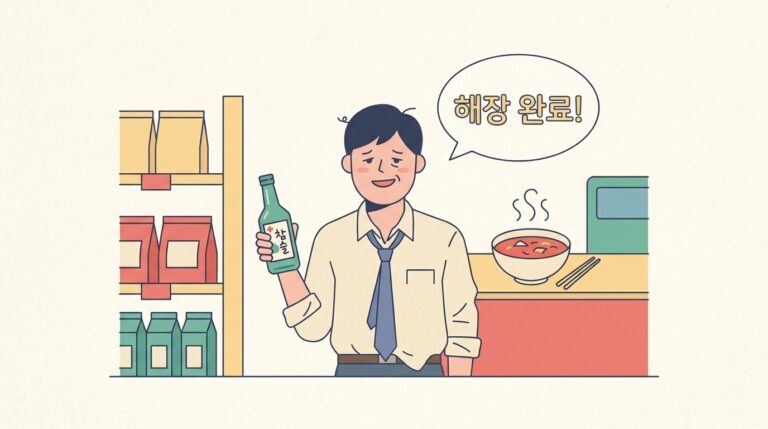
Picture this classic K-Drama scene: It’s 9:00 AM. The fluorescent office lights are aggressively bright. The main character slumps into their chair, clutching a small glass bottle they just bought from the convenience store. Later, at lunch, the entire team is sweating over boiling bowls of red, spicy soup, collectively letting out a deep sigh of “Aah, siwonhada!” (Ah, that’s refreshing!).
Did you just have your first real Korean Hoesik (company dinner)? If you successfully navigated the endless rounds of Soju and Somaek last night, congratulations! But in Korea, the Hoesik doesn’t truly end until the next morning. Knowing how to talk about your hangover and participating in the sacred ritual of Haejang (curing the hangover) is a massive part of Korean workplace bonding. If you only know how to say “I’m sick” or “I have a headache,” you’re missing out on a golden opportunity to connect with your coworkers like a true insider.
This guide is based on real SOS messages I’ve received from expat students who woke up after a team dinner wondering, “Why is my boss trying to feed me boiling lava soup when my stomach is already on fire?” Let’s dive into the ultimate B2-level survival guide for the morning after!
Phase 2: Core Expressions Deep Dive
1. 해장(을) 하다 (To cure a hangover)
- Pronunciation: haejang(-eul) hada [Sounds like: heh-jahng ha-da]
- Meaning: Literal: “To relieve the intestines.” / Real nuance: “To cure a hangover (usually by eating hot soup).”
- K-Culture Moment: Around 11:30 AM after a company dinner, your manager will rub their belly and ask the team, “오늘 해장하러 갈까요?” (Shall we go cure our hangovers today?). This is the official signal that it’s soup time.
- Editor’s Insight: Haejang isn’t just an action; it’s a culture. When you say you need to do haejang, it implies you played hard with the team last night and are now sharing in the collective recovery. It shows camaraderie!
- Situation Spectrum:
- Casual (Friends): ✅
- Semi-formal (Coworkers): ✅
- Formal (Bosses/Elders): ⚠️ (Use politely: “해장하셔야죠?” – You should cure your hangover, right?)
- 🤔 Think About It: Why does Korean culture have a specific, highly-used verb just for “curing a hangover”? What does this tell you about the relationship between work, socializing, and drinking in Korea?
2. 속이 쓰려요 (My stomach is burning / irritated)
- Pronunciation: sogi sseuryeoyo [so-gi sseu-ryuh-yo]
- Meaning: Literal: “My inside is sore/burning.” / Real nuance: “My stomach is upset (from drinking/spicy food).”
- K-Culture Moment: You’ll see office workers holding their stomachs by the water cooler, groaning “아… 속 쓰려…” (Ah… my stomach burns…).
- Editor’s Insight: In English, you might say “I’m hungover.” In Korean, it’s much more natural to describe the physical symptom. Focusing on the “속” (inside/stomach) sounds much more native than mechanically saying “I have a hangover.”
- Situation Spectrum:
- Casual (Friends): ✅
- Semi-formal (Coworkers): ✅
- Formal (Bosses/Elders): ⚠️ (Better to say: “속이 좀 안 좋습니다” – My stomach isn’t feeling too good.)
- 🤔 Think About It: The word “속” means “inside.” Koreans use it for physical stomachs (속이 아파요) and emotional states (속이 상해요 – my feelings are hurt). How do physical and emotional feelings overlap in your native language?
3. 숙취해소제 (Hangover relief drink/pill)
- Pronunciation: sukchwihaesoje [sook-chwee-heh-so-jeh]
- Meaning: Hangover cure medicine/drink.
- K-Culture Moment: A junior employee secretly handing out these little bottles to the team before the first glass of Soju is poured, or quietly leaving one on the boss’s desk the next morning. It’s the ultimate power move for office politics!
- Editor’s Insight: If you learn to buy these at the convenience store (like Condition or Dawn 808), your Korean coworkers will treat you like an absolute local.
- Situation Spectrum:
- Casual (Friends): ✅
- Semi-formal (Coworkers): ✅
- Formal (Bosses/Elders): ✅
- 🤔 Think About It: Walk into any Korean convenience store, and there’s a massive, dedicated section just for these drinks. What does a multi-million dollar hangover cure industry reveal about the societal pressure of the Hoesik?
Phase 3: Textbook vs. Real Korean
[Suggesting Lunch the Day After]
* 📖 Textbook Korean: 우리 숙취가 있으니까 국을 먹을까요? (Since we have hangovers, shall we eat soup?)
* 🗣️ Real Korean: 오늘 점심은 해장 가시죠. / 국물 당기네요. (Let’s go for hangover food today. / I’m craving soup.)
* 💡 Why the difference?: Koreans rarely explicitly state “because I have a hangover.” The word Haejang already implies the context, and “가시죠” (Let’s go) builds a sense of team solidarity.
[Checking on a Coworker’s Condition]
* 📖 Textbook Korean: 오늘 머리가 아픕니까? (Does your head hurt today?)
* 🗣️ Real Korean: 어제 많이 달리셨죠? 속 괜찮아요? (You ran hard yesterday, huh? Is your stomach okay?)
* 💡 Why the difference?: “달리다” (to run) is a B2-level slang for “drinking a lot/partying hard.” It frames the drinking as a marathon the team endured together, softening the question.
Bottom Note: For B2 learners, using words like “달리다” (to run/drink hard) or “당기다” (to crave) elevates your Korean from a textbook student to a culturally fluent local.
Phase 4: Cultural Context — K-Culture Deep Dive
4-1. Non-Verbal Elements & Nunchi (눈치)
When it comes to hangovers, Nunchi (the subtle art of reading the room) is everything. If the boss is nursing a massive hangover, the Nunchi move is to keep office noise to a minimum, avoid bringing up complex stressful reports until the afternoon, and definitely be the first to suggest Haejang-guk (hangover soup) for lunch. Also, if you buy hangover drinks for the team, always hand them out with two hands!
4-2. K-Food Connection: The Paradox of Haejang-guk
Why do Koreans cure an irritated, alcohol-soaked stomach with boiling hot, spicy soup? Whether it’s Kongnamul-gukbap (bean sprout soup), Ppyeo-haejang-guk (pork bone soup), or spicy Jjamppong (seafood noodle soup), the logic is uniquely Korean: Sweating it out.
When Koreans eat this boiling, spicy soup, they will inevitably say, “아~ 시원하다!” (Ah~ it’s refreshing/cool!). As a foreigner, this is mind-boggling. How can boiling lava be “cool”? In Korea, “시원하다” isn’t just about temperature; it’s about the feeling of relief—like releasing a knotted muscle or flushing toxins out of your body. Mastering the use of “시원하다” while sweating over soup is the ultimate badge of K-Culture integration.
Phase 5: Real-Life Roleplay Scenario
Setting: It’s 9:15 AM on a Thursday. The office pantry. Yesterday was the end-of-quarter team Hoesik. The lights feel too bright. You are making your third cup of black coffee.
Characters:
– YOU: Expat employee. You mixed Soju and Beer (Somaek) and are deeply regretting your life choices.
– Minsu (32): Your friendly Korean senior coworker. He looks surprisingly fresh.
Dialogue:
Minsu: 뫄뫄 씨, 좋은 아침… 이 아니네요. 얼굴이 반쪽이 됐어요! 😲
(Mwa-mwa ssi, joeun achim… i anineyo. Eolguri banjjogi dwaesseoyo!)
[Mwa-mwa, good morning… or not. Your face has become half its size! (You look terrible!)]
(🎭 Stage Direction: Minsu chuckles and opens the fridge)
YOU: 아, 민수 대리님. 저 진짜 죽을 것 같아요. 속이 너무 쓰려요. 🤢
(A, Minsu daerinim. Jeo jinjja jugeul geot gatayo. Sogi neomu sseuryeoyo.)
[Ah, Assistant Manager Minsu. I feel like I’m going to die. My stomach is burning so much.]
Minsu: 어제 회식 때 너무 달리시더라고요. 자, 이거 마셔요.
(Eoje hoesik ttae neomu dallisideoragoyo. Ja, igeo masyeoyo.)
[You were really running hard (drinking a lot) at the dinner yesterday. Here, drink this.]
(🎭 Stage Direction: Minsu hands you a small bottle of Sukchwihaesoje)
YOU: 헐, 숙취해소제! 대박. 진짜 감사합니다. 생명의 은인이세요. 🙏
(Heol, sukchwihaesoje! Daebak. Jinjja gamsahamnida. Saengmyeong-ui eunin-iseyo.)
[Omg, a hangover drink! Amazing. Thank you so much. You’re a lifesaver.]
Minsu: 하하. 이따가 점심에 우리 팀 다 같이 해장하러 갈 건데, 뭐 먹을래요?
(Haha. Ittaga jeomsime uri tim da gachi haejanghareo gal geonde, mwo meogeullaeyo?)
[Haha. Later for lunch, our whole team is going to cure our hangovers. What do you want to eat?]
🔀 Your Turn! How should you reply?
– A) “전 도저히 못 먹겠어요. 굶을게요.” (I absolutely can’t eat. I’ll starve.)
– B) “기름진 거 어때요? 피자나 햄버거요!” (How about something greasy? Pizza or hamburgers!)
– C) “뜨끈한 국물 좋죠! 콩나물국밥 어때요?” (Hot soup sounds great! How about bean sprout soup?)✅ Best Choice: C — In Korea, Haejang is a communal activity. Even if you don’t feel like eating, going together for hot soup (국물) is part of the bonding process. Bean sprout soup is a classic!
⚠️ Choice B Analysis: While Westerners love greasy food for hangovers, suggesting pizza to a group of hungover Korean salarymen might cause a minor cultural shock. They need their spicy broth!
[Bonus Roleplay: Convenience Store Survival]
You barely made it to the GS25 near your office. You need a hangover drink, but you can’t find it.
YOU: 사장님, 혹시 숙취해소제 어디 있어요?
(Sajangnim, hoksi sukchwihaesoje eodi isseoyo? – Boss, where are the hangover drinks?)
Clerk: 아, 냉장고 맨 위칸에 있어요. 지금 2+1 행사 중이에요.
(A, naengjanggo maen wikan-e isseoyo. Jigeum tu-peulleoseu-won haengsa jung-ieyo. – Ah, top shelf of the fridge. They’re on a Buy 2 Get 1 Free promo right now.)
YOU: 아, 그럼 세 병 가져갈게요!
(A, geureom se byeong gajyeogalgeyo! – Ah, then I’ll take three bottles!)
Phase 6: 10-Second Shadowing Drill
Practice this until it flows naturally. Imagine you are leaning back in your office chair, rubbing your temples.
😩 아휴 / 속 쓰려… / 오늘 점심은 / 무조건 / 해장하러 가요!
(Ahyu / sok sseuryeo… / oneul jeomsimeun / mujogeon / haejanghareo gayo!)
[Sigh / My stomach burns… / For lunch today / unconditionally (absolutely) / let’s go cure our hangovers!]
Phase 7: K-Culture Mini Dictionary
1. 눈치
* Romanization: nunchi
* English: Social situational awareness / Reading the room.
* Context: Knowing when to offer a hangover drink to your boss without them asking is peak nunchi.
2. 회식
* Romanization: hoesik
* English: Company dinner.
* Context: Not just eating, but a mandatory extension of work. It builds trust and hierarchy simultaneously.
3. 해장국
* Romanization: haejang-guk
* English: Hangover soup.
* Context: Usually involves pork bones, congealed ox blood (Seonji), or bean sprouts. It’s soul food for tired workers.
4. 시원하다
* Romanization: siwonhada
* English: Refreshing / Relieving.
* Context: Used for cold water, cool breezes, AND boiling hot soup or a good massage. It means physical/mental relief.
Phase 8: Traveler’s Survival Kit
Even if you’re just traveling to Korea and partying in Hongdae instead of a corporate office, you will need these phrases the next morning!
🆘 Survival Phrases: Convenience Store Hangover Cures
– 🇰🇷 “숙취해소제 어디 있어요?” (sukchwihaesoje eodi isseoyo? – Where are the hangover drinks?)
– 🇰🇷 “이거 교차로 2+1 (투플러스원) 돼요?” (igeo gyocharo tu-peulleoseu-won dwaeyo? – Can I mix and match for the 2+1 promo?)
– 📍 Where to use: CU, GS25, 7-Eleven, Emart24.
– 💡 Pro Tip: Look for brands like Condition (컨디션), Yeomyeong 808 (여명808), or Hutgae (헛개) tea. They are usually kept in a small warmer in winter, or the main fridge in summer.📌 Editor’s Travel Note
– If you can’t handle spicy hangover soups, look for 황태해장국 (Hwangtae Haejang-guk), which is a mild, non-spicy dried pollock soup. It’s incredibly soothing!
– Korean pharmacies (약국) also sell strong, liquid hangover medicine. Just walk in and say “숙취약 주세요” (sukchwiyak juseyo – Hangover medicine please).
Phase 9: Critical Thinking Corner — “One Step Deeper”
Food & Identity: The Communal Suffering
🧠 Think Deeper:
In many Western cultures, a hangover is an individual mistake. You hide it, quietly eat a greasy burger, and pop an Aspirin. In Korea, the Hoesik hangover is a collective battle wound. By eating Haejang-guk together, sweating, and saying “Siwonhada,” Korean coworkers are silently saying, “We suffered together for the company, and now we recover together.” Food here isn’t just nutrients; it’s a social tool that reinforces the identity of the group over the individual.💬 Your Turn: How does your culture view hangovers at work? Is it a taboo topic, or something people joke about? Tell me in the comments!
Phase 10: FAQ & Mistake Prevention
Q: Can I say “나 숙취 있어” to my boss?
No! Never use plain form (반말) with your boss. Even saying “숙취가 있습니다” sounds a bit too direct, like a medical diagnosis. The most natural, polite way is: “속이 좀 안 좋습니다” (My stomach isn’t feeling well).
Q: Is it okay to leave the Haejang lunch early to rest?
Maybe, but use Nunchi. Usually, the lunch is part of the bonding. It’s better to stay, drink the soup, and show you’re part of the team. Once you’re back at your desk, you can secretly nap for 10 minutes.
❌ Common Mistake #1: Saying “나는 해장이에요.” (I am hangover.)
✅ Do This Instead: “숙취가 있어요” (I have a hangover) or “해장해야 돼요” (I need to do a hangover cure).❌ Common Mistake #2: Refusing a hangover drink from a senior because “you don’t like the taste.”
✅ Do This Instead: Drink it! It’s a gesture of care. Accept it with two hands and say “감사합니다!”
Phase 11: Summary & Action Items
- One-Liner Summary: To survive a Korean company hangover, remember to complain about your “속” (stomach), buy “숙취해소제” (hangover drinks), and eat spicy soup together for “해장” (recovery).
-
Action Mission 3 Steps:
- 🥉 Bronze (Solo): Look in the mirror, clutch your stomach, and say “아… 속 쓰려…” with deep regret.
- 🥈 Silver (Online): Post a picture of your favorite hangover food on social media and caption it “오늘의 해장!”
- 🥇 Gold (Real World): Go to a Korean convenience store or market and successfully buy a “숙취해소제.”
- K-Culture Mission: Next time you watch a K-Drama, spot the scene where characters are eating at a restaurant after a drinking scene. Watch how they drink the soup and listen for the magical word: “시원하다!”
Engagement: Have you ever tried a Korean hangover drink or soup? Which one actually worked for you? Let’s discuss below! 👇
Phase 12: Quiz — Interactive Challenge
1. Situational Judgment: Your manager walks in looking pale after yesterday’s company dinner. What is the most Nunchi-appropriate thing to say?
A) 대리님, 어제 너무 많이 마셔서 숙취가 심합니까? (Assistant Manager, did you drink too much so your hangover is severe?)
B) 대리님, 피자 드실래요? (Assistant Manager, want some pizza?)
C) 대리님, 오늘 점심에 해장하러 가시죠! (Assistant Manager, let’s go cure our hangovers at lunch today!)
2. Fill in the Blank:
You take a sip of boiling hot, spicy seafood soup. To sound like a true Korean, you exhale and say: “아~ ____________!”
3. True or False – K-Culture Edition:
If you buy hangover relief drinks for the team, you should give the boss theirs first, using two hands. (T/F)
(Answers: 1. C – A is too direct/medical, B is culturally jarring. 2. 시원하다! 3. True – Hierarchy and respect remain, even when everyone is hungover!)
Frequently Asked Questions (FAQ)
Q: What does "해장(을) 하다 (To cure a hangover)" mean in Korean and how do you pronounce it?
A: In Korean, "해장(을) 하다 (To cure a hangover)" is pronounced [haejang(-eul] and means: Literal: "To relieve the intestines." / Real nuance: "To cure a hangover (usually by eating hot soup)."
Q: What does "속이 쓰려요 (My stomach is burning / irritated)" mean in Korean and how do you pronounce it?
A: In Korean, "속이 쓰려요 (My stomach is burning / irritated)" is pronounced [sogi sseuryeoyo [so-gi sseu-ryuh-yo] and means: Literal: "My inside is sore/burning." / Real nuance: "My stomach is upset (from drinking/spicy food)."
Q: What does "숙취해소제 (Hangover relief drink/pill)" mean in Korean and how do you pronounce it?
A: In Korean, "숙취해소제 (Hangover relief drink/pill)" is pronounced [sukchwihaesoje [sook-chwee-heh-so-jeh] and means: Hangover cure medicine/drink.







