

Phase 1: Empathy (Immersive Opening)
Hello! I’m your Daily Hangul editor.
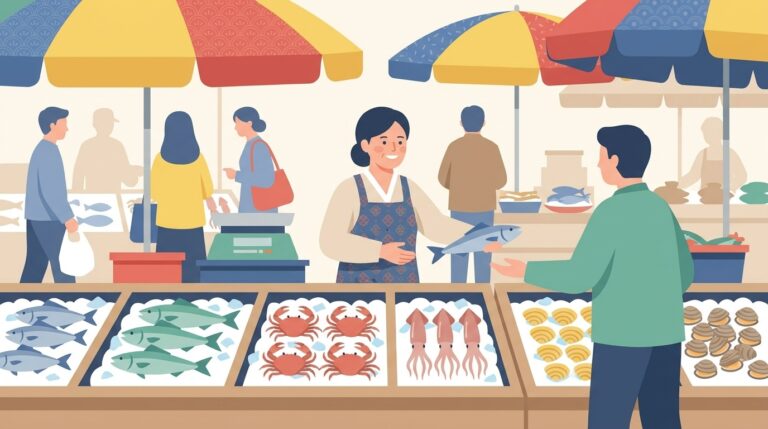
Imagine this: You are walking through the vibrant, wet aisles of Noryangjin Fish Market in Seoul. The neon lights are reflecting off the puddles on the floor, and energetic vendors are calling out to you. “학생, 이리 와! (Student, come here!)” You’ve seen this exact scene in countless K-Dramas where the protagonist goes to the market to buy a hearty meal for their family. But as you stand in front of a colorful array of flapping fish, a moment of panic sets in.
You want to buy a fresh fish for dinner, but how do you make sure it’s actually fresh? And more importantly, how do you ask them to clean it so you don’t end up having to descale a fish in your tiny studio apartment?
If you just rely on textbook Korean, you might get a confused look. But if you know the exact expressions the locals use, you won’t just get the freshest catch—you might even get a little extra fish thrown in for free (that legendary Korean Service!). This guide is based on real questions from expats who have braved the Korean fish markets. Let’s dive in and make you a local market insider!
Phase 2: Core Expressions Deep Dive
1. 이거 싱싱해요?
- Pronunciation: igeo singsinghaeyo? [ee-guh sing-sing-heh-yo?] (‘sing-sing’ sounds exactly like singing a song twice with a bouncy rhythm!)
- Meaning: Literal: “Is this fresh?” / Real nuance: “Give me your honest word this is a good catch.”
- K-Culture Moment: You point at a shiny mackerel. The vendor might slap the fish to show how firm it is, proudly declaring, “오늘 아침에 들어온 거야! (It came in this morning!)”
- Editor’s Insight: The word ‘싱싱하다 (singsinghada)’ has a vibrant, bouncy feeling to it. We use it specifically for fresh seafood or vegetables. It feels much more lively and conversational than the formal textbook word for fresh.
- Situation Spectrum:
- Casual with friends: ⚠️ (Friends don’t sell you fish!)
- Market Vendors (Semi-formal): ✅
- High-end Sushi Chef (Formal): 🚫 (Trust the chef!)
- 🤔 Think About It: Korean language loves using reduplicated sounds to describe sensory experiences (like sing-sing for freshness, or jjol-git for chewiness). Does your native language have sound-mimicking words that describe how food feels or tastes?
2. 제일 좋은 걸로 주세요.
- Pronunciation: jeil joeun geollo juseyo. [je-eel jo-eun gull-low ju-seh-yo]
- Meaning: Literal: “Give me the best one.” / Real nuance: “I trust your expertise, give me the premium stuff.”
- K-Culture Moment: This is the ultimate ‘trust’ phrase. Whether you are buying fish, picking out strawberries, or getting beef for Korean BBQ, saying this hands the power over to the vendor’s pride.
- Editor’s Insight: Market vendors take immense pride in their goods. By saying this, you stroke their ego and build rapport. They will usually pick the fattest, best-looking fish for you because you trusted them.
- Situation Spectrum:
- Casual: ⚠️
- Semi-formal: ✅
- Formal: ✅
- 🤔 Think About It: In many Western markets, the customer strictly picks out their own produce. In Korea, asking the merchant to pick the “best one” is a sign of building Jeong (정, emotional connection). How does the dynamic between buyer and seller differ in your country?
3. 구이용으로 손질해 주세요.
- Pronunciation: guiyong-euro sonjilhae juseyo. [goo-ee-yong-eu-ro sohn-jeel-heh ju-seh-yo]
- Meaning: Literal: “Please prep it for grilling.” / Real nuance: “Please descale, gut, and cut this so I can throw it straight into my frying pan.”
- K-Culture Moment: You buy the fish, and in a flash of a massive knife, the vendor cleans it, salts it, and bags it. It’s like watching a culinary magic show.
- Editor’s Insight: 손질하다 (sonjilhada) means to prep or clean ingredients. You must add what you are using it for: 구이용 (gui-yong: for grilling), 찌개용 (jjigae-yong: for stew), or 횟감 (hoet-gam: for raw sashimi).
- Situation Spectrum:
- Casual: 🚫
- Semi-formal: ✅
- Formal: ✅
- 🤔 Think About It: Korean markets offer full preparation services for free. This reflects a culture of extreme convenience and efficiency (Palli-Palli culture). Do markets in your hometown charge extra for prepping food?
Phase 3: Textbook vs. Real Korean
[Situation 1: Asking if the fish is fresh]
* 📖 Textbook Korean: 이 생선은 신선합니까? (i saengseoneun sinseonhamnikka? – Is this fish fresh?)
* 🗣️ Real Korean: 사장님, 이거 싱싱해요? (sajangnim, igeo singsinghaeyo? – Boss, is this fresh?)
* 💡 Why the difference?: ‘신선하다’ is mostly used in writing or formal news reports. ‘싱싱하다’ is the everyday, spoken word that captures the lively, bouncy energy of the market.
[Situation 2: Asking them to cut the fish]
* 📖 Textbook Korean: 이 생선을 잘라 주십시오. (i saengseoneul jalla jusipsio. – Please cut this fish.)
* 🗣️ Real Korean: 먹기 좋게 손질해 주세요. (meokgi joge sonjilhae juseyo. – Please prep it nicely to eat.)
* 💡 Why the difference?: ‘자르다’ (to cut) sounds like you just want them to blindly chop it into pieces with scissors. ‘손질하다’ implies professional culinary preparation (removing guts, bones, etc.).
Phase 4: Cultural Context — K-Culture Deep Dive
4-1. Non-verbal Nuances in the Market
In a bustling Korean market, your body language speaks volumes. When picking a fish, don’t just stand far away. Lean in, point decisively at the fish you want, and look the Ajumma or Ajeossi in the eye. However, never touch the fish yourself! Always use your finger to point, and let the vendor pick it up. Also, remember the concept of Nunchi (reading the room): if the vendor is currently wielding a massive cleaver to prep another customer’s order, wait a moment before shouting your question.
4-2. The “Chojang-jib” (초장집) Culture
If you’ve watched K-Travel vlogs, you’ve probably seen this: people buy live seafood on the first floor of Noryangjin or Jagalchi market, and then they carry a dripping black plastic bag up to the second floor. Why?
Korean fish markets have a unique system called Chojang-jib (literally, “Red Chili Paste House”). These are dine-in restaurants that don’t sell fish themselves. Instead, you bring the fish you just bought, and for a small table fee (상차림비), they provide side dishes, lettuce wraps, sauces, and will cook your fish or serve it raw. If you want this, just tell the first-floor vendor: “먹고 갈 거예요 (meokgo gal geo-yeyo – I am going to eat here)”, and they will usually guide you to an affiliated restaurant upstairs!
Phase 5: Real-Life Roleplay Scenario
Setting: Friday 5 PM, Noryangjin Fish Market, Seoul. The floor is wet, bright bulbs hang from the ceilings, and the air smells strongly of sea salt. You are planning to cook dinner at your Airbnb.
Characters:
– YOU: A foreigner who loves Korean food, determined to buy fresh mackerel (고등어 – godeung-eo).
– Ajumma (50s): A tough but warm-hearted market vendor wearing a waterproof apron and rubber boots.
Dialogue:
Ajumma: 학생! 뭐 찾아? 싸게 줄게! 🐟
(haksaeng! mwo chaja? ssage julge!)
[Student! What are you looking for? I’ll give it to you cheap!]
YOU: 고등어 있어요? 이거 싱싱해요?
(godeung-eo isseoyo? igeo singsinghaeyo?)
[Do you have mackerel? Is this fresh?]
Ajumma: 그럼! 오늘 아침에 와서 눈이 반짝반짝하잖아.
(geureom! oneul achime waseo nuni banjjakbanjjakhajana.)
[Of course! It came this morning, look at its eyes shining.]
YOU: 오, 좋네요. 그럼 제일 좋은 걸로 두 마리 주세요.
(o, jonneyo. geureom jeil joeun geollo du mari juseyo.)
[Oh, nice. Then please give me the best ones, two of them.]
Ajumma: 그래, 내가 진짜 크고 좋은 걸로 줄게. 어떻게 해줄까?
(geurae, naega jinjja keugo joeun geollo julge. eotteoke haejulkka?)
[Okay, I’ll give you really big and good ones. How should I prep them?]
YOU: 구이용으로 손질해 주세요. 소금도 뿌려주세요.
(guiyong-euro sonjilhae juseyo. sogeumdo ppuryeojuseyo.)
[Please prep them for grilling. Sprinkle some salt, too.]
Ajumma: 알았어! (🎭 Ajumma expertly cleans the fish in 30 seconds) 자, 다 됐어. 학생 예뻐서 멍게도 조금 서비스로 넣었어!
(arasseo! … ja, da dwaesseo. haksaeng yeppeoseo meonggedo jogeum seobiseuro neoeosseo!)
[Got it! … Here, all done. You’re cute so I threw in some sea squirts as “service” (for free)!]
🔀 Your Turn! How do you reply to this unexpected freebie?
– A) “얼마예요?” (How much?)
– B) “우와! 진짜요? 사장님 최고! 감사합니다!” (Wow! Really? You’re the best! Thank you!)
– C) “아, 저는 멍게 안 먹어요.” (Ah, I don’t eat sea squirt.)✅ Best Choice: B — Reason: In Korean markets, “Service” (서비스) is an expression of affection. Reacting with high energy and gratitude makes the vendor extremely happy!
⚠️ Choice C Analysis: Even if you don’t like it, bluntly refusing a gift can dampen the Jeong (warmth). It’s better to accept it graciously, or very politely say “마음은 감사하지만 제가 못 먹어서 괜찮습니다 (Thank you for the thought, but I can’t eat it so it’s okay).”
Phase 6: 10-Second Shadowing Drill
Let’s practice your market ordering like a true local. Pay attention to the pauses!
😊 밝게 (Brightly):
사장님, / 이거 / 제일 좋은 걸로 / 손질해 주세요!
(sajangnim, / igeo / jeil joeun geollo / sonjilhae juseyo!)
Phase 7: K-Culture Mini Dictionary
1. 서비스
* Romanization: seobiseu
* English: Freebie / On the house
* Context: In Korea, “service” doesn’t mean customer service. It means free food or items given by the vendor as a token of appreciation.
2. 덤
* Romanization: deom
* English: Extra / Bonus
* Context: Similar to seobiseu, this is the traditional market concept of giving a little extra over what you paid for (e.g., throwing in an extra apple or a handful of shrimp).
3. 초장집
* Romanization: chojang-jib
* English: Dine-in prep restaurant (in fish markets)
* Context: The restaurants on the upper floors of fish markets where you bring your purchased seafood to be cooked and eaten for a table fee.
4. 단골
* Romanization: dangol
* English: Regular customer
* Context: If you visit the same market vendor often, you become their dangol. You will definitely get more deom and seobiseu!
Phase 8: Traveler’s Survival Kit
Heading to a Korean traditional market soon? Here is your survival kit!
🆘 Survival Expression #1
– 🇰🇷 “이거 얼마예요?” (igeo eolmayeyo?)
– 🗣️ English guide: [ee-guh ull-mah-yeh-yo?]
– 📍 Where to use: Literally everywhere (Markets, convenience stores, underground malls).🆘 Survival Expression #2
– 🇰🇷 “포장해 주세요.” (pojanghae juseyo.)
– 🗣️ English guide: [po-jahng-heh ju-seh-yo.]
– 📍 Where to use: When you want to take the food “to-go”.🆘 Survival Expression #3
– 🇰🇷 “조금만 깎아주세요~” (jogeumman kkakkajuseyo~)
– 🗣️ English guide: [jo-geum-mahn kka-kka-ju-seh-yo~]
– 📍 Where to use: Traditional markets ONLY. Use a slightly cute/friendly tone to ask for a small discount!📌 Editor’s Travel Note
– Cash vs Card: While Korea is a cashless society, traditional markets are the one place where carrying physical cash (won) is highly recommended. You can negotiate better prices with cash!
– Proper Footwear: Fish markets like Noryangjin have constantly wet, slippery floors. Do not wear your favorite white sneakers or high heels!
– Tipping: Korea is strictly a NO-TIP culture. Do not tip the vendor for cleaning your fish; it will just cause confusion.
Phase 9: Critical Thinking Corner — “One Step Deeper”
Food & Identity: The Culture of ‘Jeong’ (정) in Markets
In Korean traditional markets, transactions are rarely just about exchanging money for goods. When an Ajumma throws an extra fish into your bag, or gives you a handful of clams for your soup, she is expressing Jeong (정)—a uniquely Korean concept of warmth, connection, and unspoken affection. It stems from a historical community mindset where sharing food meant survival and solidarity. The market isn’t just a place of commerce; it’s a living ecosystem of human relationships.
🧠 Think Deeper:
Because of modern supermarkets and delivery apps, this traditional haggling and Jeong culture is slowly fading among younger generations who prefer silent, digital transactions.💬 Your Turn: How do people in your culture interact at local farmers’ markets compared to big supermarkets? Do you have a concept similar to Jeong? Share in the comments!
Phase 10: FAQ & Preventing Misunderstandings
Q1: Can I just point at a fish and say “이거 줘 (igeo jwo – give me this)”?
No! That is banmal (informal speech). Unless you are a 70-year-old grandpa talking to a younger vendor, always use “~주세요 (juseyo)”. Using banmal to a vendor is considered extremely rude.
Q2: Should I ask them to “kill” the fish?
Please don’t!
❌ Common Mistake: Saying “이 생선 죽여주세요 (i saengseon jugyeojuseyo – Please kill this fish).” This sounds like you are ordering a hitman!
✅ Do this instead: Always use “손질해 주세요 (sonjilhae juseyo – Please prep it).”
Q3: Can I haggle everywhere in Korea?
No. Haggling (asking to lower the price) is ONLY acceptable in traditional markets or underground shopping centers. Never try to haggle in department stores, convenience stores, or franchise restaurants.
Phase 11: Summary & Action Items
One-Liner Summary:
Skip the formal textbook words; use “싱싱해요?” (Is it fresh?) and “손질해 주세요” (Please prep it) to sound like a true Korean market insider!
Action Mission:
– 🥉 Bronze (Solo): Stand in front of your mirror and practice saying “제일 좋은 걸로 주세요” 3 times with a confident smile.
– 🥈 Silver (Online): Find a YouTube walking tour of Noryangjin Fish Market, and see if you can hear vendors yelling out words you learned today!
– 🥇 Gold (Real-Life): The next time you visit a Korean market (or a local Korean grocery store), ask the staff “이거 싱싱해요?” when buying produce!
K-Culture Mission:
Open Google Maps or KakaoMap Street View, drop your little yellow man right in the middle of Noryangjin Fish Market (노량진 수산시장) or Jagalchi Market (자갈치시장). Imagine exactly which stall you’d walk up to and practice your lines!
Let me know in the comments: What is your absolute favorite seafood to eat?
Phase 12: Quiz — Interactive Challenge
1. You want to buy fish to make a spicy stew (찌개 – jjigae). What should you say?
A) 생선 죽여주세요.
B) 찌개용으로 자르세요.
C) 찌개용으로 손질해 주세요.
2. True or False — K-Culture Edition:
“If a market vendor gives you extra shrimp for free, you should leave a 10% tip as a thank you.”
3. Fill in the Blank:
When you want the vendor to give you their highest quality item, you say: “제일 ( ) 걸로 주세요.”
🚨 Click here for the Answers!
1. C (A is asking for an assassination. B uses the blunt word ‘자르다’ and sounds slightly demanding. C uses the correct culinary term ‘손질하다’.)
2. False. Tipping is not practiced in Korea! Instead of a tip, just say a very bright “감사합니다! (Thank you!)” and promise to come back (단골 되겠습니다!).
3. 좋은 (joeun – good/best)
Frequently Asked Questions (FAQ)
Q: What does "이거 싱싱해요?" mean in Korean and how do you pronounce it?
A: In Korean, "이거 싱싱해요?" is pronounced [igeo singsinghaeyo? [ee-guh sing-sing-heh-yo?] and means: Literal: "Is this fresh?" / Real nuance: "Give me your honest word this is a good catch."
Q: What does "제일 좋은 걸로 주세요." mean in Korean and how do you pronounce it?
A: In Korean, "제일 좋은 걸로 주세요." is pronounced [jeil joeun geollo juseyo. [je-eel jo-eun gull-low ju-seh-yo] and means: Literal: "Give me the best one." / Real nuance: "I trust your expertise, give me the premium stuff."
Q: What does "구이용으로 손질해 주세요." mean in Korean and how do you pronounce it?
A: In Korean, "구이용으로 손질해 주세요." is pronounced [guiyong-euro sonjilhae juseyo. [goo-ee-yong-eu-ro sohn-jeel-heh ju-seh-yo] and means: Literal: "Please prep it for grilling." / Real nuance: "Please descale, gut, and cut this so I can throw it straight into my frying pan."







