

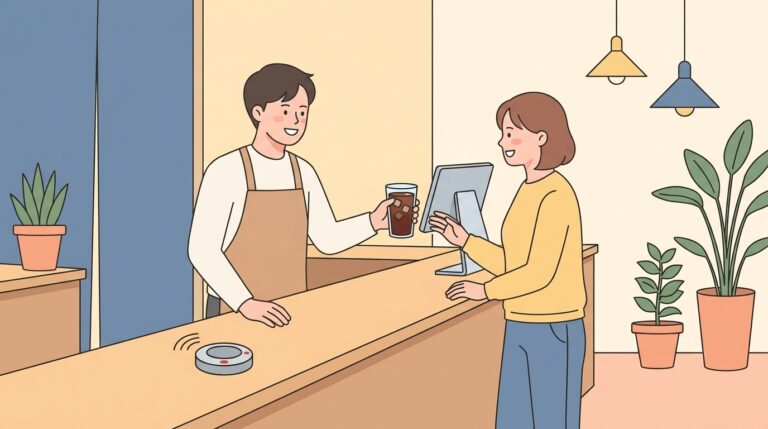
Phase 1: Empathy (The Coffee Shop Panic!)
Hello! I’m your Daily Hangul editor.
Picture this: You are standing in a trendy cafe in Seongsu-dong, Seoul. It looks exactly like the one from your favorite K-Drama. You finally make it to the counter, ready to say “Coffee, please.” But suddenly, the barista fires a series of rapid questions at you: “Ttatteut-han geollo deurilkkayo? Deusigo gasinayo? Yeongsujeung piryohasingayo?”
Panic sets in. You just wanted a cup of coffee, but suddenly you feel like you’re taking a pop quiz!
Don’t worry, you are not alone. Almost every foreigner experiences this “Cafe Panic” in Korea. Korean cafes are an essential part of the culture—they are where friends meet, students study, and K-Drama characters dramatically break up. Today, I’ll teach you exactly how to navigate this situation smoothly. By the end of this post, you’ll be ordering like a true Seoul local!
Phase 2: Core Expressions Deep Dive
Let’s break down the 3 most crucial expressions you’ll hear and use when visiting a cafe.
1. 드시고 가시나요? (Are you having it here?)
- Pronunciation: [deu-si-go ga-si-na-yo?] (The ‘eu’ sounds like the disgusted sound you make when stepping in gum: uhh)
- Meaning: Literal: “Will you eat and go?” / Real nuance: “For here or to go?”
- K-Culture Moment: Due to environmental laws in Korea, cafes cannot give you a disposable plastic cup if you are staying inside. That’s why they will always ask you this before making your drink!
- Editor’s Insight: This is polite, formal Korean. ‘드시다’ is the honorific version of ‘먹다’ (to eat/drink). The barista is treating you with high respect.
- Situation Spectrum:
- Friends (Casual): 🚫 (Too formal)
- Coworkers (Semi-formal): ⚠️
- Cafe staff to customer (Formal): ✅
- 🤔 Think About It: Why does Korean have a completely different vocabulary word for “eating” just to show respect? Does your native language change the actual verb to show politeness?
2. 테이크아웃 할게요 (I will take it out)
- Pronunciation: [te-i-keu-a-ut hal-gge-yo]
- Meaning: “To go, please.”
- K-Culture Moment: Koreans love borrowing English words (Konglish), but sometimes they are used differently. While Americans might say “to go,” Koreans almost exclusively use the word “take-out” for coffee and food.
- Editor’s Insight: This is your magic shield. If the barista asks you a long question and you just want to grab your coffee and leave, simply smile and say this!
- Situation Spectrum:
- Friends (Casual): ✅ (테이크아웃 하자 – Let’s get takeout)
- Service staff (Formal): ✅
- 🤔 Think About It: Can you spot other English words that Koreans have adopted into their daily life?
3. 진동벨 (Vibration Bell / Pager)
- Pronunciation: [jin-dong-bel] (‘bel’ sounds exactly like the English ‘bell’)
- Meaning: The coaster-sized buzzer they give you that vibrates when your order is ready.
- K-Culture Moment: You will hear: “진동벨 울리면 가지러 오세요” (When the vibration bell rings, please come get it). In Korea, you rarely wait standing at the counter. You grab your buzzer, find a cozy seat, and wait for the aggressive buzz!
- Editor’s Insight: This perfectly reflects Korea’s ‘빨리빨리’ (Palli-palli / Hurry-hurry) culture. It’s an efficient system so people don’t crowd the counter.
- Situation Spectrum:
- Universal noun: ✅
Phase 3: Textbook vs. Real Korean
Let’s see how textbooks teach it versus how real people talk in Hongdae or Gangnam.
[Ordering Iced Coffee]
* 📖 Textbook Korean: 차가운 커피 한 잔 주세요. (Please give me one cup of cold coffee.)
* 🗣️ Real Korean: 아아 한 잔 주세요. (One “Ah-Ah” please.)
* 💡 Why is it different?: “아아” (Ah-Ah) is a wildly popular abbreviation for 아이스 아메리카노 (Iced Americano). Koreans love shortening long words for efficiency!
[Getting it to go]
* 📖 Textbook Korean: 포장해 주세요. (Please pack it for me.)
* 🗣️ Real Korean: 테이크아웃이요. (Take-out, please.)
* 💡 Why is it different?: ‘포장’ is usually used for restaurant food (like dumplings or fried chicken), whereas ‘테이크아웃’ is the standard for cafes.
Bottom Note: For A2 (Beginner) learners, using “아아” (Ah-Ah) will instantly make you look like a local! It’s casual but perfectly acceptable to use with cafe staff.
Phase 4: Cultural Context — K-Culture Deep Dive
4-1. Non-verbal Cue: The Two-Handed Card Handoff
When paying for your drink, it is polite to hand your credit card over using two hands, or by supporting your right elbow with your left hand. This is deeply rooted in Korean etiquette. Even if the barista is younger than you, handing over the card with two hands shows mutual respect.
4-2. K-Food Connection: The “Eol-Juk-Ah” Phenomenon 🧊☕
Have you noticed in K-Dramas that even in the freezing winter, characters are walking outside holding iced coffees? This is a massive cultural trend in Korea known as 얼죽아 (Eol-juk-ah), which stands for “Even if I freeze to death, Iced Americano!”
Korean food culture is often very hot and spicy (think of boiling stews). So, grabbing a freezing cold, refreshing Iced Americano after lunch is the ultimate palate cleanser. Try ordering an “Ah-Ah” in December, and the barista will give you a silent nod of respect!
Phase 5: Real-Life Roleplay Scenario
Setting: Saturday afternoon, 2 PM. A minimalist cafe in Yeonnam-dong. The smell of roasted coffee beans fills the air. You finally step up to the register.
Characters:
* YOU: An A2 Korean learner, determined to order without speaking English.
* Barista (Ji-hoon): A friendly local barista wearing a neat black apron.
Let’s begin!
Ji-hoon: 어서 오세요. 주문하시겠어요? 😊
(eoseo oseyo. jumunhasigesseoyo?)
[Welcome. Would you like to order?]
(🎭 Stage Direction: Ji-hoon smiles and points to the menu)
YOU: 안녕하세요. 아메리카노 한 잔 주세요.
(annyeonghaseyo. amerikano han jan juseyo.)
[Hello. One Americano, please.]
Ji-hoon: 네, 따뜻한 걸로 드릴까요, 아이스로 드릴까요?
(ne, ttatteuthan geollo deurilkkayo, aiseuro deurilkkayo?)
[Yes, would you like it hot or iced?]
YOU: 아이스로 주세요.
(aiseuro juseyo.)
[Iced, please.]
Ji-hoon: 드시고 가시나요?
(deusigo gasinayo?)
[Are you having it here?]
🔀 Your Turn! How should you reply?
* A) 아니요, 밖으로 갈게요. (No, I will go outside.)
* B) 테이크아웃 할게요. (I will take it out.)
* C) 안 먹어요. (I don’t eat.)✅ Best Choice: B — It’s the most natural, commonly used phrase.
⚠️ Choice A & C Analysis: Choice A sounds a bit awkward (like you are reporting your location). Choice C sounds like you are refusing the coffee entirely!
(You chose B!)
YOU: 테이크아웃 할게요.
(teikeuaut halgeyo.)
[Take-out, please.]
Ji-hoon: 네, 4,500원입니다. 카드 꽂아주세요.
(ne, sacho-obaegwonimnida. kadeu kkojajuseyo.)
[Yes, that’s 4,500 won. Please insert your card.]
(🎭 Stage Direction: You hand your card with two hands!)
Ji-hoon: 영수증 필요하신가요?
(yeongsujeung piryohasingayo?)
[Do you need a receipt?]
YOU: 아니요, 괜찮습니다. 감사합니다!
(aniyo, gwaenchanseumnida. gamsahamnida!)
[No, it’s okay. Thank you!]
Ji-hoon: 네, 음료 나오면 진동벨로 알려드릴게요!
(ne, eumnyo naomyeon jindongbello allyeodeurilgeyo!)
[Yes, I’ll let you know with the vibration bell when your drink is ready!]
Phase 6: 10-Second Shadowing Drill
Let’s practice the flow and intonation so you sound perfectly natural!
😊 밝게 (Brightly):
아아 / 한 잔 / 테이크아웃 할게요!
(a-a / han jan / te-i-keu-a-ut hal-gge-yo!)
[One Iced Americano to go, please!]
Tip: Pause slightly at the slashes (/). Say it with a polite smile!
Phase 7: K-Culture Mini Dictionary
1. 아아 (Ah-Ah)
* Romanization: a-a
* English: Iced Americano
* Context: The soul drink of modern Koreans. A must-know abbreviation.
2. 카공족 (Kagong-jok)
* Romanization: kagong-jok
* English: Cafe-study tribe
* Context: People who sit in cafes for hours to study or work. A massive part of Korean cafe culture.
3. 1인 1음료 (1-in 1-eumnyo)
* Romanization: ir-in ir-eumnyo
* English: 1 person, 1 drink rule
* Context: If you visit a cafe with 3 people, you must order at least 3 drinks. It’s the standard etiquette in Korea.
4. 눈치 (Nunchi)
* Romanization: nunchi
* English: Situational awareness / Reading the room
* Context: If the cafe is packed with people waiting for seats, having ‘nunchi’ means packing up your laptop so others can sit.
Phase 8: Traveler Survival Kit
🆘 Survival Phrases for Cafes
* 🇰🇷 “와이파이 비밀번호가 뭐예요?” (waipai bimilbeonhoga mwoyeyo?)
* 🗣️ Pronunciation Guide: [wa-i-pa-i bi-mil-beon-ho-ga mwo-ye-yo?]
* 📍 When to use: When you need the Wi-Fi password (almost all Korean cafes have free, lightning-fast Wi-Fi!)
* 💡 Pro Tip: Look at the receipt first! The Wi-Fi password is often printed at the very bottom.📌 Editor’s Travel Note
* Kiosks: Many cafes now use self-ordering screens (Kiosks). Don’t panic! Most of them have an “English” button at the top right corner.
* Card vs. Cash: Korea is a cashless society. Cafes strongly prefer credit cards (T-money or international cards like Visa/Mastercard usually work fine).
* Tipping: There is NO tipping culture in Korea! If you leave coins on the table, the barista might run down the street to return them to you.
Phase 9: Critical Thinking — “One Step Deeper”
Food & Identity: The Cafe as a Second Living Room
🧠 Think Deeper:
Why are there so many cafes in Korea? In a densely populated country where many young people live in small studio apartments, cafes serve as an extension of their living space. It’s not just about drinking coffee; it’s about renting a comfortable “third space” to chat, study, and relax. Buying a coffee is seen as paying for the temporary use of this shared communal room.💬 Your Turn: Do people in your country study or work in cafes for hours? Or are cafes strictly just for quick meet-ups? Share in the comments!
Phase 10: FAQ & Avoiding Misunderstandings
- Q: Can I just order a slice of cake instead of a drink?
- A: Maybe, but usually No. Due to the “1인 1음료” (1 person 1 drink) rule, drinks are mandatory. Desserts are usually considered extras, not replacements for drinks.
- Q: Is it rude to say “아아 주세요” to an older barista?
- A: Not at all! “아아” has become so mainstream that it’s just a regular noun now. Just make sure to attach “주세요” (Please give me) at the end!
❌ Common Mistake #1: Saying “너 (You)” to the barista.
✅ Do this instead: In Korean, you generally avoid using the word “You.” Just look at them, smile, and say “주세요” (Please give me…). Omitting the subject is totally natural!
Phase 11: Summary & Action Items
- One-Liner Summary: Remember to choose Hot or Iced, decide between “For here” or “Take-out,” and wait for your magic vibrating bell!
Action Mission 3 Steps:
* 🥉 Bronze (Solo): Stand in front of your mirror and practice saying “아아 한 잔 테이크아웃 할게요” three times.
* 🥈 Silver (Online): Drop a comment below sharing your favorite cafe drink using Korean! (e.g., 저는 라떼를 좋아해요!)
* 🥇 Gold (Real-world): Go to a Korean cafe (or a Korean-owned cafe in your city) and order your drink entirely in Korean!
🌟 Special K-Culture Mission:
Next time you watch a modern K-Drama, pay close attention to the cafe scenes. Can you spot the giant iced americanos? Can you hear the word “테이크아웃”?
Phase 12: Quiz — Interactive Challenge
Let’s test what you’ve learned!
1. Situational Judgment:
The barista asks: “드시고 가시나요?” But you want to grab your coffee and run to catch the subway. What do you say?
* A) 네, 드시고 가요.
* B) 테이크아웃 할게요.
* C) 영수증 주세요.
2. True or False – K-Culture Edition:
* “If the service is excellent at a Korean cafe, you should leave a 10% tip on the counter.” (T / F)
3. Fill in the Blank:
The barista gives you a small device and says, “When the _______ rings, please come get your drink.”
* A) 진동벨 (Jindong-bel)
* B) 영수증 (Yeongsu-jeung)
* C) 와이파이 (Wi-Fi)
(Answers: 1. B / 2. False – No tipping in Korea! / 3. A)
You did great today! See you in the next Daily Hangul post! 화이팅 (Fighting)!
Frequently Asked Questions (FAQ)
Q: What does "드시고 가시나요? (Are you having it here?)" mean in Korean and how do you pronounce it?
A: In Korean, "드시고 가시나요? (Are you having it here?)" is pronounced [deu-si-go ga-si-na-yo?] and means: Literal: "Will you eat and go?" / Real nuance: "For here or to go?"
Q: What does "테이크아웃 할게요 (I will take it out)" mean in Korean and how do you pronounce it?
A: In Korean, "테이크아웃 할게요 (I will take it out)" is pronounced [te-i-keu-a-ut hal-gge-yo] and means: "To go, please."
Q: What does "진동벨 (Vibration Bell / Pager)" mean in Korean and how do you pronounce it?
A: In Korean, "진동벨 (Vibration Bell / Pager)" is pronounced [jin-dong-bel] and means: The coaster-sized buzzer they give you that vibrates when your order is ready.







