

Phase 1: Empathy (The K-Culture Cold Open)
Hello! I’m the Lead Editor of Daily Hangul, your personal guide to not just speaking Korean, but feeling it.
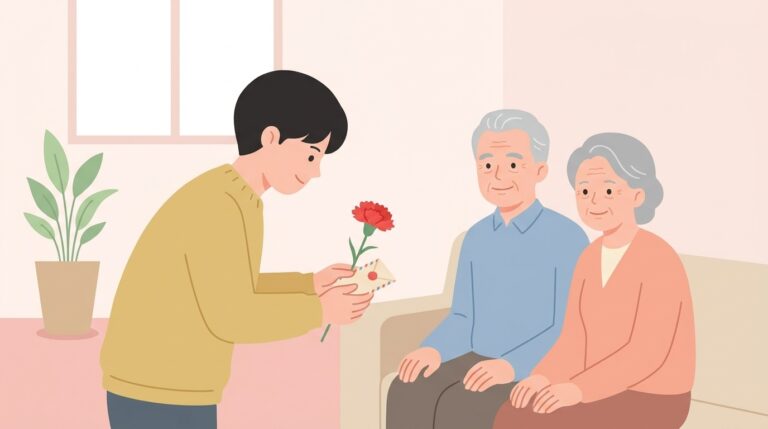
Imagine this classic K-Drama scene: It’s May. The usually stern, traditional father is sitting on the sofa. His child hands him a small, beautiful red carnation and a white envelope. Suddenly, the camera zooms in, dramatic music plays, and the father’s eyes fill with tears.
What is going on here? Why a red carnation? And what’s inside that envelope? (Spoiler: It’s usually cash!)
In Korea, May 8th is Eobeoinal (어버이날 – Parents’ Day). Unlike many Western cultures that celebrate Mother’s Day and Father’s Day separately, Korea combines them into one mega-anniversary of filial piety. Whether you are dating a Korean, living with a Korean host family, or simply want to impress your older Korean friends, knowing how to navigate Parents’ Day will instantly elevate you from ‘tourist’ to ‘family insider.’
Many of our Daily Hangul students have asked: “Can I just say ‘Happy Parents’ Day’?” Actually… saying the direct translation might sound incredibly awkward. Let’s find out what you should really say!
Phase 2: Core Expressions Deep Dive
Here are the top expressions you need to know when giving a carnation to a Korean parent or elder.
1. 키워주셔서 감사합니다 (Thank you for raising me)
- Pronunciation: kiweojusyeoseo gamsahamnida [key-wo-joo-shuh-suh gam-sa-ham-nee-da]
- Meaning: Literal = Thank you for raising me. / Real nuance = I deeply appreciate all the sacrifices you made for me.
- K-Culture Moment: This is the absolute classic phrase written on almost every Parents’ Day card attached to a carnation basket. When a K-Pop idol posts a heartfelt letter to their parents on Instagram, you will 100% see this phrase.
- Editor’s Insight: This phrase carries the heavy, beautiful weight of Korean ‘Hyodo’ (filial piety). It’s not just a casual ‘thanks’; it acknowledges the sheer effort of parenting.
- Situation Spectrum:
- Close Friends (Casual): 🚫 (You didn’t raise your friend!)
- Co-workers (Semi-formal): 🚫
- Parents/Elders (Formal): ✅
- 🤔 Think About It: Why do Koreans focus specifically on the act of ‘raising’ (키우다) rather than just saying ‘I love you’? Does your native language have a similar expression that acknowledges a parent’s sacrifice?
2. 늘 건강하세요 (Always stay healthy)
- Pronunciation: neul geonganghaseyo [null gung-gang-ha-seh-yo]
- Meaning: Literal = Always be healthy. / Real nuance = Wishing you a long, healthy, and happy life.
- K-Culture Moment: You hand over the carnation, look the elder in the eye (briefly!), bow slightly, and say this. It’s the perfect magic sentence that melts any Korean parent’s heart.
- Editor’s Insight: In Korean culture, health is the ultimate blessing. You’ll notice Koreans often ask “Have you eaten?” as a greeting. Wishing for someone’s health is the highest form of caring.
- Situation Spectrum:
- Close Friends (Casual): 🚫 (A bit too serious)
- Co-workers (Semi-formal): ⚠️ (Okay for older mentors)
- Parents/Elders (Formal): ✅
Phase 3: Textbook vs. Real Korean
[Wishing a Happy Parents’ Day]
* 📖 Textbook Korean: 어버이날 축하합니다. (Happy Parents’ Day / Congratulations on Parents’ Day)
* 🗣️ Real Korean: 엄마 아빠, 낳아주셔서 감사합니다! (Mom and Dad, thank you for giving birth to me!)
* 💡 Why the difference?: Koreans rarely use the word ‘축하하다’ (congratulate) for Parents’ Day. Congratulations are for birthdays or weddings. For Parents’ Day, the focus is entirely on gratitude (감사).
[Addressing the Parents]
* 📖 Textbook Korean: 부모님 (Parents)
* 🗣️ Real Korean: 어머니, 아버지 (Mother, Father)
* 💡 Why the difference?: ‘부모님’ is a descriptive noun used when talking about your parents to someone else. When talking directly to them, you call them 어머니 (Mother) and 아버지 (Father).
Bottom Note: At the A2 (Beginner) level, just mastering “어머니, 건강하세요!” (Mother, stay healthy!) is more than enough to impress!
Phase 4: Cultural Context — K-Culture Deep Dive
4-1. Non-verbal Communication: The “Two-Hand” Rule
Language is only half the battle! When handing over that red carnation, you must use two hands. Offer the flower with your right hand, and lightly support your right elbow or wrist with your left hand. Pair this with a slight bow. If you hand a gift to a Korean elder with one hand while looking away, all the perfect Korean grammar in the world won’t save you!
4-2. K-Culture Connection: The “Yongdon Box” (용돈박스)
If you watch K-Dramas or follow Korean vloggers, you’ll see that a simple carnation isn’t the end of the story. The modern K-Culture trend is the Yongdon Box (Pocket Money Box). It’s a beautiful floral arrangement of carnations, but hidden inside (or wrapped around the flowers) are crisp 50,000 KRW bills! In Korean family culture, giving cash to parents on Eobeoinal is considered the most practical and appreciated form of Hyodo (filial piety).
Phase 5: Real-Life Roleplay Scenario
Setting: May 8th, 7:00 PM. A lively, upscale Korean BBQ restaurant (Hanjeongsik) in Seoul. You are attending a Parents’ Day dinner with your Korean partner’s family. You’ve prepared a beautifully wrapped carnation and a small gift.
Characters:
– YOU: A foreigner trying to make a great impression.
– Eomeoni (Mother): Your partner’s mother. Warm, but holds traditional values.
– Abeoji (Father): Your partner’s father. Quiet, but loves a good meal.
Dialogue:
YOU: 어머니, 아버지! 이거 받으세요. 🌷
(eomeoni, abeoji! igeo badeuseyo.)
[Mother, Father! Please accept this.]
(Stage Direction: You bow slightly and hand the carnation with TWO hands)
Eomeoni: 어머! 카네이션이네? 너무 예쁘다. 고마워요~
(eomeo! kaneisyeonine? neomu yeppeuda. gomawoyo~)
[Oh my! It’s a carnation? It’s so pretty. Thank you~]
Abeoji: 하하, 뭘 이런 걸 다 준비했어요.
(haha, mwol ireon geol da junbihaesseyo.)
[Haha, you didn’t have to prepare all this.]
🔀 YOUR TURN! How should you respond?
– A) “네, 비싼 거예요!” (Yes, it was expensive!)
– B) “어머니, 아버지 늘 건강하세요!” (Mother, Father, always stay healthy!)
– C) “어버이날 축하해요!” (Congratulations on Parents’ Day!)✅ Best Choice: B — Wishing for their health is the most natural and heartwarming response.
⚠️ Choice A & C Analysis: Saying it’s expensive (A) is considered bragging and slightly rude. Using “축하해요” (C) is culturally unnatural for this specific holiday.
Eomeoni: 아이고, 말도 참 예쁘게 하네. 자, 고기 많이 먹어요!
(aigo, maldo cham yeppeuge hane. ja, gogi mani meogeoyo!)
[Aww, you speak so beautifully. Now, eat lots of meat!]
YOU: 네! 잘 먹겠습니다!
(ne! jal meokgetseumnida!)
[Yes! I will eat well!]
Phase 6: 10-Second Shadowing Drill
Practice speaking out loud! Pay attention to the pauses (/) and the emotional tags.
- 🥺 Deeply Grateful: 어머니, / 키워주셔서 / 정~말 감사합니다.
(eomeoni, / kiweojusyeoseo / jeong~mal gamsahamnida.) -
😊 Bright & Warm: 아버지, / 오래오래 / 건강하세요!
(abeoji, / ore-ore / geonganghaseyo!)
Phase 7: K-Culture Mini Dictionary
1. 어버이날 (Eobeoinal)
* Romanization: eobeoinal
* English: Parents’ Day (May 8th)
* Context: A combined holiday for Mother’s and Father’s Day in Korea.
2. 효도 (Hyodo)
* Romanization: hyodo
* English: Filial piety
* Context: The Confucian virtue of respecting, honoring, and caring for one’s parents. It’s a core pillar of Korean society.
3. 카네이션 (Kaneisyeon)
* Romanization: kaneisyeon
* English: Carnation
* Context: The official flower of Parents’ Day and Teachers’ Day in Korea.
4. 용돈 (Yongdon)
* Romanization: yongdon
* English: Pocket money / Cash gift
* Context: Often given by parents to children, but on Parents’ Day, adults reverse the roles and give “Yongdon” to their aging parents.
Phase 8: Traveler’s Survival Kit (Flower Shop Edition)
Are you traveling in Korea during May? You’ll see flower shops overflowing with carnations! Here is how you can buy one.
🆘 Survival Expressions TOP 3
– 🇰🇷 “카네이션 한 송이 주세요.” (kaneisyeon han song-i juseyo.) — One carnation, please.
– 🇰🇷 “이거 얼마예요?” (igeo eolmayeyo?) — How much is this?
– 🇰🇷 “예쁘게 포장해 주세요.” (yeppeuge pojanghae juseyo.) — Please wrap it beautifully.📌 Editor’s Travel Note
– Beware the May Surge: May is known as ‘Family Month’ (가정의 달) in Korea. Flower prices spike in early May.
– Restaurant Reservations: If you want to eat at a nice Korean BBQ or traditional restaurant on May 8th, you must book weeks in advance!
Phase 9: Critical Thinking — “One Step Deeper”
Language & Power (Confucian Roots in Modern Times)
Korean language is deeply tied to Confucian values, where respecting your elders is paramount. Expressions like “Thank you for raising me” reflect a society that views the parent-child relationship as a lifelong debt of gratitude. However, in modern Korea, this tradition has evolved. While the linguistic respect remains strict, the way it’s celebrated has become more commercialized (like the trendy cash boxes!). It’s a fascinating blend of ancient respect and modern capitalism.
💬 Your Turn: Does your culture celebrate Mother’s Day and Father’s Day separately, or together like Korea? What is the traditional gift? Share in the comments!
Phase 10: FAQ & Mistake Prevention
Q: “Can I give white carnations instead of red?”
A: NO! Never! In Korea, white flowers (especially chrysanthemums, but white flowers in general) are strictly used for funerals and grieving. Always choose red or bright pink carnations for Parents’ Day.
Q: “I am close with my host parents. Can I drop the ‘요’ (yo) and speak casually?”
A: Mostly No. Even if you are close, Parents’ Day is a formal occasion honoring them. Using formal language (존댓말 – Jondaetmal) shows you respect the cultural boundaries.
❌ Common Mistake: Handing over the flower with one hand while looking at your phone.
✅ Do This Instead: Put the phone away, look at them, smile, use both hands, and say “어머니, 건강하세요!”
Phase 11: Summary & Action Items
- One-Liner Summary: On May 8th, use two hands to give a red carnation and say “건강하세요” (Stay healthy) to win the hearts of Korean elders.
-
Action Mission:
- 🥉 Bronze: Stand in front of a mirror and practice saying “어머니, 건강하세요” while doing a slight bow.
- 🥈 Silver: Leave a comment below with “키워주셔서 감사합니다” dedicated to your own parents!
- 🥇 Gold: If you are in Korea in May, go to a flower shop and buy a carnation using the survival phrases!
- K-Culture Mission: Search for “용돈박스” (Yongdon box) on Instagram and check out how creative Koreans get with gifting cash to their parents!
Phase 12: Interactive Quiz
1. Situational Judgment: You are buying flowers for your Korean mother-in-law on Parents’ Day. The florist offers you a beautiful bouquet of pristine WHITE carnations on discount. What should you do?
– A) Buy it! A discount is always great.
– B) Politely decline and ask for RED or PINK carnations.
– C) Buy it, but paint them red yourself.
(Answer: B. White flowers symbolize funerals in Korea!)
2. Fill in the Blank:
어머니, 아버지 오래오래 [ _____ ]하세요!
(Mother, Father, stay [ _____ ] for a long time!)
– A) 피곤 (Tired)
– B) 건강 (Healthy)
– C) 배고파 (Hungry)
(Answer: B. 건강하세요 – Stay healthy)
3. True or False – K-Culture Edition:
“Koreans celebrate Mother’s Day and Father’s Day on completely different months.”
(Answer: FALSE. Both are combined into Eobeoinal on May 8th!)
Frequently Asked Questions (FAQ)
Q: What does "키워주셔서 감사합니다 (Thank you for raising me)" mean in Korean and how do you pronounce it?
A: In Korean, "키워주셔서 감사합니다 (Thank you for raising me)" is pronounced [kiweojusyeoseo gamsahamnida [key-wo-joo-shuh-suh gam-sa-ham-nee-da] and means: Literal = Thank you for raising me. / Real nuance = I deeply appreciate all the sacrifices you made for me.
Q: What does "늘 건강하세요 (Always stay healthy)" mean in Korean and how do you pronounce it?
A: In Korean, "늘 건강하세요 (Always stay healthy)" is pronounced [neul geonganghaseyo [null gung-gang-ha-seh-yo] and means: Literal = Always be healthy. / Real nuance = Wishing you a long, healthy, and happy life.






