

Phase 1: Empathy & K-Culture Cold Open
Hello! I’m your Daily Hangul Editor. 👋
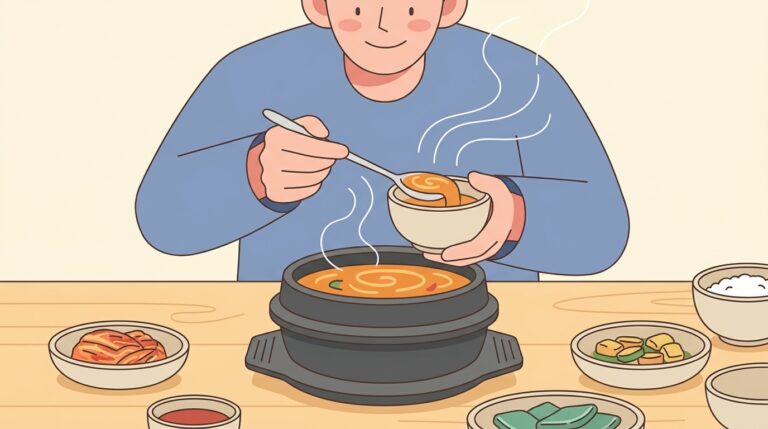
Have you ever watched a K-Drama where friends are gathered around a bubbling pot of Kimchi Jjigae (kimchi stew)? Suddenly, someone grabs a ladle and starts scooping the stew into smaller bowls for everyone else before taking any for themselves. Or maybe you’ve seen the heartwarming scene where a Korean mom places a perfectly grilled piece of meat right on top of her child’s rice bowl.
In Korea, cooking and serving food isn’t just about feeding someone. How you plate it, how you share it, and how you serve it is the ultimate expression of Jeong (정 – warmth, affection).
But here is the real struggle: When you go to a Korean restaurant, or when you invite your Korean friends over for dinner, how do you say, “Let me plate this for you,” or “Can I get a small plate to share?” If you don’t know these phrases, you might end up eating soup straight out of a shared boiling pot, which can be… quite hot and awkward!
Today, we are going to learn exactly how to talk about plating and serving food (그릇에 담기) in a way that will make you sound like a true local. Let’s dive in!
Phase 2: Core Expressions Deep Dive
1. 그릇에 담아주세요 (Please put it in a bowl/plate)
- Pronunciation: geureuse damajuseyo [geu-reu-se da-ma-ju-se-yo]
(‘으’ (eu) sounds like the disgusted sound you make when stepping in gum. ‘담’ (dam) sounds like ‘Tom’ but with a ‘d’.)*- Meaning: Please plate it / Please put it in the bowl.
- K-Culture Moment: You cooked Ramyeon, but your friend brought the pot to the living room. You want them to serve it nicely into a bowl rather than eating straight from the pot.
- Editor’s Insight: The verb 담다 (damda) is the magic word for “plating” or “putting things into a container.” We don’t just “put” food on a plate; we gently damda it. It sounds much more caring!
- Situation Spectrum:
- Close Friends (Casual): 그릇에 담아줘 (geureuse damajwo) ✅
- Coworkers (Semi-formal): 그릇에 담아주세요 ✅
- Boss/Elders (Formal): 그릇에 담아주시겠어요? ⚠️
- 🤔 Think About It: Why does Korean have a specific word for “putting something gently into a container”? Do you use a specific word for “plating” in your native language, or do you just say “put”?
2. 앞접시에 덜어 먹을까요? (Shall we share it on small plates?)
- Pronunciation: apjeopsie deoreo meogeulkkayo? [ap-jeop-shi-e deo-reo meo-geul-kka-yo?]
(‘덜어’ (deoreo) has a soft ‘d’ and a rolling ‘r’.*)- Meaning: Literal: Shall we scoop and eat on front plates? / Real: Shall we use small plates to share the food?
- K-Culture Moment: You are at a spicy Tteokbokki restaurant with your coworkers. The giant pan arrives. Instead of diving in with your chopsticks, you politely suggest using small individual plates.
- Editor’s Insight: 덜다 (deolda) means “to scoop out a portion.” Because Korean food culture is highly communal (sharing from one big pot), knowing how to suggest using an 앞접시 (apjeopsi – personal sharing plate) shows you have great Nunchi (social sense)!
- Situation Spectrum:
- Close Friends (Casual): 앞접시에 덜어 먹자! ✅
- Coworkers (Semi-formal): 앞접시에 덜어 먹을까요? ✅
- Boss/Elders (Formal): 앞접시에 덜어 드릴까요? (Shall I serve it to your plate?) ✅
- 🤔 Think About It: Sharing from one pot was traditionally a sign of closeness in Korea. Nowadays, people prefer individual plates. How do you share food in your culture?
3. 많이 드세요! (Please eat a lot!)
- Pronunciation: mani deuseyo! [ma-ni deu-se-yo!]
- Meaning: Literal: Please eat a lot! / Real: Enjoy your meal! Please help yourself!
- K-Culture Moment: You just finished plating the beautiful Korean BBQ you cooked. You place it on the table and announce this to your guests with a big smile.
- Editor’s Insight: In Western cultures, you might say “Bon appétit” or “Enjoy!” In Korea, the warmest thing you can say when serving food is to tell them to eat a large quantity. It shows generosity!
- Situation Spectrum:
- Close Friends (Casual): 많이 먹어! (mani meogeo!) ✅
- Coworkers/Guests (Semi-formal): 많이 드세요! ✅
- Boss/Elders (Formal): 많이 드십시오! ✅
- 🤔 Think About It: Why is “eating a lot” considered a blessing or a good greeting in Korea? (Hint: It relates to Korea’s history where food was once scarce!)
Phase 3: Textbook vs. Real Korean
[Situation 1: Giving food to a friend]
* 📖 Textbook Korean: 음식을 접시에 놓으세요. (Put the food on the plate.)
* 🗣️ Real Korean: 예쁘게 담아줄게! (I’ll plate it beautifully for you!)
* 💡 Why is it different?: ‘놓다’ means to physically drop/put something down. ‘담다’ emphasizes the care and aesthetic of placing food inside a dish.
[Situation 2: Telling a guest to eat]
* 📖 Textbook Korean: 식사하세요. (Please have a meal.)
* 🗣️ Real Korean: 차린 건 없지만 많이 드세요~ (I haven’t prepared much, but please eat a lot~)
* 💡 Why is it different?: Koreans love to be humble. Even if they cooked a 10-course Michelin-star feast, they will traditionally say “I haven’t prepared much” to show humility.
(Bottom Note: Since you are at the A2 Beginner level, you don’t need to memorize the humble phrases perfectly yet, but hearing them will make you say, “Ah, I know why they said that!”)
Phase 4: Cultural Context — K-Culture Deep Dive
4-1. Non-Verbal Cues: The Art of Serving
When plating or serving food in Korea, your hands speak as loudly as your words!
– Two Hands Rule: If you are handing a bowl of rice or soup to someone older, always use both hands (or place your left hand lightly under your right elbow).
– Keep the Bowl Grounded: In some Asian countries, it’s polite to lift your rice bowl to your mouth. In Korea, NEVER lift your rice bowl or soup bowl off the table while eating. Leave it on the table and use your spoon to scoop the food. Lifting the bowl is historically considered poor manners.
4-2. K-Food Connection: The “Apjeopsi” Culture
If you go to a Korean restaurant to eat Dakgalbi (spicy stir-fried chicken) or Jeongol (hot pot), the food arrives in a massive pan.
This is where the magic of the 앞접시 (apjeopsi) comes in. ‘앞’ means front, and ‘접시’ means plate. It’s the small plate placed in front of you. Plating your own food from the main pot to your apjeopsi is a fundamental part of dining in Korea. And if you are the one holding the ladle (국자 – gukja) to serve others first, you will instantly win the hearts of your Korean friends!
Phase 5: Real-Life Roleplay Scenario
Setting: Saturday evening, 7 PM. You invited your Korean friend Minho over to your apartment. You successfully cooked your first Tteokbokki and it’s still bubbling in the pan. You carry the pan to the dining table.
Characters:
– YOU: An expat in Korea, proud of your cooking skills but a bit nervous.
– Minho (28): Your Korean friend who loves food and is very encouraging.
Dialogue:
Minho: 우와! 냄새 진짜 좋다! 요리 진짜 잘하는데요?
(Uwa! Naemsae jinjja jota! Yori jinjja jalhandeyo?)
(Wow! Smells really good! You are really good at cooking!)
YOU: 고마워요. 제가 직접 만들었어요. 앉으세요!
(Gomawoyo. Jega jikjeop mandeureosseoyo. Anjeuseyo!)
(Thanks. I made it myself. Sit down!)
(🎭 Stage Direction: You place the hot pan in the middle of the table)
Minho: 앞접시 있어요? 제가 덜어 드릴게요.
(Apjeopsi isseoyo? Jega deoreo deurilgeyo.)
(Do you have small plates? I’ll scoop some for you.)
YOU: 아, 네! 여기 앞접시랑 국자 있어요.
(A, ne! Yeogi apjeopsirang gukja isseoyo.)
(Ah, yes! Here are the small plates and a ladle.)
Minho: (Plating the food) 자, 여기요. 먼저 드세요!
(Ja, yeogiyo. Meonjeo deuseyo!)
(Here you go. You eat first!)
🔀 YOUR TURN! How should you respond when Minho hands you the plated food?
– A) “싫어요. 냄비에서 먹을래요.” (No. I want to eat from the pot.)
– B) “고마워요! 민호 씨도 많이 드세요!” (Thank you! Minho, please eat a lot too!)
– C) “내가 최고야!” (I am the best!)✅ Best Choice: B — It acknowledges his kindness and uses the essential serving phrase “많이 드세요” (Eat a lot) to return the warmth.
⚠️ Choice A Analysis: Eating straight from the pot when there are guests and plates provided is considered bad manners. Plus, “싫어요” (I hate it/No) is too direct!
Phase 6: 10-Second Shadowing Drill
Let’s practice how to compliment someone’s plating skills! Read aloud following the pauses and intonation.
😊 우와~ / 그릇에 / 너~무 / 예쁘게 담았어요!
(u-wa~ / geu-reu-se / neo~mu / ye-ppeu-ge da-ma-sseo-yo!)
[Wow~ / in the bowl / sooo / beautifully you plated it!]
Tip: Stretch out the “너~무” (neo~mu) to show genuine amazement!
Phase 7: K-Culture Mini Dictionary
1. 앞접시 (apjeopsi)
* Romanization: ap-jeop-shi
* English: Small individual sharing plate.
* Context: The lifeline of Korean dining. You ask for this at restaurants when sharing a large dish.
2. 국자 (gukja)
* Romanization: guk-ja
* English: Ladle.
* Context: Used alongside the apjeopsi to transfer soups and stews.
3. 정 (jeong)
* Romanization: jeong
* English: Affection, deep connection, warmth.
* Context: Serving the best piece of meat or scooping soup for someone else is a physical manifestation of Jeong.
4. 덜어 먹다 (deoreo meokda)
* Romanization: deo-reo meok-da
* English: To scoop and eat (onto one’s own plate).
* Context: The polite way to eat a shared meal without double-dipping your spoon.
Phase 8: Traveler’s Survival Kit
Even if you aren’t cooking, you will definitely need to know how to ask for plating tools at a Korean restaurant!
🆘 Survival Phrases for Restaurants
– 🇰🇷 “여기 앞접시 두 개만 주세요.” (yeogi apjeopsi du gaeman juseyo.)
– 🗣️ English: “Please give us two small plates here.”
- 🇰🇷 “국자 하나 더 주시겠어요?” (gukja hana deo jusigesseoyo?)
- 🗣️ English: “Could you give us one more ladle?”
🇰🇷 “남은 거 포장해 주세요.” (nameun geo pojanghae juseyo.)
- 🗣️ English: “Please pack up the leftovers to go.”
📌 Editor’s Travel Note
– Bells on Tables: Most Korean restaurants have a call button on the table. Press it (Ding-dong!), wait for the server to look at you, and politely ask for your apjeopsi.
– Self-Service: In many casual spots (like Tteokbokki shops), plates, water, and side dishes are “Self” (셀프). You just walk up and grab the plates yourself!
Phase 9: Critical Thinking Corner — “One Step Deeper”
🧠 Think Deeper: Food & Identity (The Communal Pot)
Traditionally, Koreans shared stews directly from one boiling pot, dipping their own spoons in together. This “eating from the same pot” culture deeply reflects the Korean concept of 우리 (Uri – “We”), where collective identity is prioritized over individualism. Sharing saliva was historically seen as the ultimate sign that you are “family” (식구 – meaning ‘mouths that eat together’).
However, modern Koreans (especially post-COVID) highly prefer using an apjeopsi (individual plate) for hygiene. Society is shifting from “extreme sharing” to “hygienic sharing,” yet the spirit of serving others first remains unchanged.
💬 Your Turn: Does your culture have a tradition of sharing food from a central dish? Or do people strictly eat from their own plates? Let us know in the comments!
Phase 10: FAQ & Avoiding Misunderstandings
Q: If I serve food to my older boss, can I say “많이 먹어”?
A: NO! “많이 먹어” is casual (banmal). For anyone older, or your boss, you MUST say “많이 드세요” (mani deuseyo) or “많이 드십시오” (mani deusipsio).
Q: Is it rude to ask for more side dishes?
A: Not at all! In Korea, side dishes (반찬 – banchan) are universally free and refillable. Just say “반찬 좀 더 주세요” (Please give me more side dishes).
❌ Common Mistake #1: Sticking your chopsticks vertically into your bowl of rice after plating it.
✅ Do this instead: Lay your chopsticks flat on the table or horizontally across the bowl. Sticking them upright looks like incense burned at a funeral and is considered terrible luck!
Phase 11: Summary & Action Items
One-Liner Summary: Use 담다 (damda) to plate beautifully, 덜다 (deolda) to scoop into small plates (앞접시 – apjeopsi), and always wish others to “eat a lot” (많이 드세요 – mani deuseyo).
Action Mission 3 Steps:
– 🥉 Bronze (Solo): Stand in your kitchen, hold a bowl, and say out loud: “그릇에 예쁘게 담을게요!” (I will plate it beautifully!)
– 🥈 Silver (Online): Comment below with your favorite Korean dish you want to plate and serve to a friend.
– 🥇 Gold (Real World): The next time you are at a Korean restaurant, press the call button and confidently ask, “앞접시 좀 주세요!”
🎬 K-Culture Mission:
Watch one episode of any K-Drama featuring a dinner scene today. Pay close attention to whether the characters eat straight from the soup pot or if they use an apjeopsi. Notice how the younger person often pours drinks or serves the soup first!
Phase 12: Quiz — Interactive Challenge
1. Situational Judgment: You are eating Kimchi Jjigae with your Korean coworker at a restaurant. It arrives in one big pot. What is the most polite and natural thing to say?
– A) 제 그릇에 다 넣어 주세요. (Put it all in my bowl.)
– B) 앞접시에 덜어 먹을까요? (Shall we scoop it onto small plates to eat?)
– C) 저는 혼자 먹을게요. (I will eat alone.)
2. True or False – K-Culture Edition:
In Korea, it is polite to hold your rice bowl up near your mouth so you don’t drop food.
(Answers: 1. B / 2. False – Always leave your rice bowl on the table!)
Frequently Asked Questions (FAQ)
Q: What does "그릇에 담아주세요 (Please put it in a bowl/plate)" mean in Korean and how do you pronounce it?
A: In Korean, "그릇에 담아주세요 (Please put it in a bowl/plate)" is pronounced [geureuse damajuseyo [geu-reu-se da-ma-ju-se-yo] and means: Please plate it / Please put it in the bowl.
Q: What does "앞접시에 덜어 먹을까요? (Shall we share it on small plates?)" mean in Korean and how do you pronounce it?
A: In Korean, "앞접시에 덜어 먹을까요? (Shall we share it on small plates?)" is pronounced [apjeopsie deoreo meogeulkkayo? [ap-jeop-shi-e deo-reo meo-geul-kka-yo?] and means: Literal: Shall we scoop and eat on front plates? / Real: Shall we use small plates to share the food?
Q: What does "많이 드세요! (Please eat a lot!)" mean in Korean and how do you pronounce it?
A: In Korean, "많이 드세요! (Please eat a lot!)" is pronounced [mani deuseyo! [ma-ni deu-se-yo!] and means: Literal: Please eat a lot! / Real: Enjoy your meal! Please help yourself!






