

Phase 1: Empathy (The K-Culture Cold Open)
Hello! I’m your Daily Hangul editor, your personal guide to the hidden rules of Korean culture.
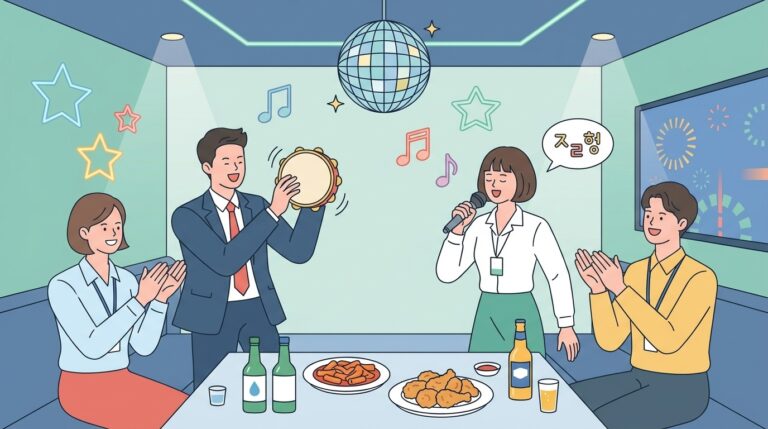
Picture this: You are watching a classic office K-Drama. The team just finished eating greasy pork belly and drinking soju (Round 1), and someone shouts, “Let’s go to the 2nd round (2차)!” Cut to a neon-lit Noraebang (karaoke room). The strict boss grabs the microphone to sing an old Trot song. Suddenly, a coworker thrusts a plastic, blinking tambourine into your hands. The music starts. Everyone is looking at you. What do you do?
For many expats and travelers in Korea, the Hoesik (company dinner) Noraebang experience is both thrilling and terrifying. You might think, “I just need to sing well, right?” Wrong! In Korea, being the one in charge of the tambourine is an art form. It is the ultimate test of your Nunchi (social sense).
This article is inspired by my real B1-level students who panicked at their first Korean company party. Don’t worry! By the end of this guide, you won’t just survive the Noraebang; you’ll be the MVP (Most Valuable Player) of the night.
Phase 2: Core Expressions Deep Dive
Here are the essential B1-level expressions you need to master the Noraebang atmosphere.
1. 분위기를 띄우다 (To hype up the mood)
- Pronunciation: bunwigi ttiuda [boon-wee-gee ttee-oo-dah]
(Tip: ‘으’ sounds like the disgusted sound you make when stepping in gum: ‘uh’)- Meaning: Literal: To float the atmosphere / Real: To hype up the room, to make the vibe energetic.
- K-Culture Moment: You’ll hear this when the team enters the Noraebang. The manager might pat the youngest employee on the back and say, “Hey, float the atmosphere today!” It’s a cue to grab that tambourine and dance.
- Editor’s Insight: This isn’t just about being loud. It’s about breaking the awkward tension and making everyone feel comfortable enough to let loose.
- Situation Spectrum:
- Casual (Friends): ✅
- Semi-formal (Co-workers): ✅
- Formal (Boss/Elders): 🚫 (You wouldn’t tell your boss to hype up the room!)
- 🤔 Think About It: Why is maintaining the group’s “mood” (분위기) so critical in Korean culture? Does your culture put this much emphasis on collective energy at a party, or is it more individualistic?
2. 탬버린 쳐주세요 (Please play the tambourine)
- Pronunciation: taembeorin chyeojuseyo [tam-buh-rin chyuh-joo-seh-yo]
- Meaning: Literal: Please hit the tambourine / Real: Give us a beat / Back me up!
- K-Culture Moment: The boss is about to sing the climax of a 90s rock ballad. He looks at you and gestures toward the tambourine. He wants you to be his personal backup dancer and percussionist.
- Editor’s Insight: The verb used here is 치다 (to hit/strike), not 연주하다 (to play an instrument). You are literally “hitting” it to create a rhythm.
- Situation Spectrum:
- Casual (Friends): ✅ (Usually just “탬버린 쳐!”)
- Semi-formal (Co-workers): ✅
- Formal (Boss/Elders): ⚠️ (Use polite form if asking a senior, but usually, juniors do the hitting!)
- 🤔 Think About It: Teamwork in Korea extends even to singing. The singer and the tambourine player are a team. Do you have a designated “cheerleader” role in your culture’s parties?
3. 센스 있네요! (You have great sense!)
- Pronunciation: senseu inneyo! [sen-seu een-neh-yo!]
- Meaning: Literal: You have sense / Real: You are so witty, tactful, and great at reading the room!
- K-Culture Moment: The song ends. You perfectly timed a tambourine drum-roll and shouted “Encore!” The boss laughs and points at you: “Wow, 센스 있네요!”
- Editor’s Insight: This is the highest compliment you can get in a Korean social or workplace setting. It means you understand the unspoken rules and executed them perfectly.
- Situation Spectrum:
- Casual (Friends): ✅ (센스 있다!)
- Semi-formal (Co-workers): ✅
- Formal (Boss/Elders): 🚫 (It can sound condescending to judge a boss’s “sense”.)
- 🤔 Think About It: “Konglish” (Korean-English) words like ‘Sense’ take on a whole new cultural meaning in Korea. What does it say about Korean society that being “tactful” is praised so highly?
Phase 3: Textbook vs. Real Korean
Let’s see how textbook Korean differs from the raw, energetic language used in a Noraebang.
[Situation 1: Asking someone to sing]
* 📖 Textbook Korean: 노래를 한 곡 불러 주시겠습니까? (Would you please sing a song?)
* 🗣️ Real Korean: OOO(Name)! OOO(Name)! (Chanting their name while clapping rhythmically)
* 💡 Why the difference?: In a Noraebang, energy matters more than grammar. Chanting someone’s name applies fun peer pressure to get them to the mic.
[Situation 2: Reacting to a great performance]
* 📖 Textbook Korean: 노래를 정말 잘 부르십니다. (You sing very well.)
* 🗣️ Real Korean: 무대를 찢었다! (You tore up the stage!) or 대박! (Awesome!)
* 💡 Why the difference?: Slang expresses raw excitement better. “찢었다” (tore it) is a popular Gen Z slang used when someone totally crushes a performance.
Bottom Note: For B1 learners, shouting “대박!” (Daebak) or “최고예요!” (You’re the best!) is the perfect balance of polite and enthusiastic.
Phase 4: Cultural Context — K-Culture Deep Dive
4-1. The Non-Verbal Art of the Tambourine (Nunchi in Action)
Playing the tambourine isn’t just about rhythm; it’s pure non-verbal communication.
– The Rule of Volume: Never shake the tambourine louder than the boss’s singing voice. You are the supporting actor, not the main character!
– The Rule of Genre: If it’s a fast, upbeat K-Pop or Trot song, stand up, smile, and shake it vigorously. If it’s a slow, sad ballad, sit down and gently tap it against your thigh to the beat.
4-2. K-Drama Connection: The Office Survival Trope
If you’ve watched K-Dramas like Misaeng (미생) or My Mister (나의 아저씨), you’ve definitely seen this scene. The exhausted protagonist is at a Noraebang. They are tired and want to go home. But the moment the boss starts singing, they put on a massive fake smile, grab the tambourine, and dance like their life depends on it.
Critical View: While dramas exaggerate this for comedic or dramatic effect, the reality is shifting. Nowadays, many young Koreans dislike forced Hoesik culture, and the pressure to “entertain” the boss is fading in modern startups. However, in traditional companies, it’s still a well-known ritual of team bonding.
Phase 5: Real-Life Roleplay Scenario
Setting: Friday night, 9 PM. A loud, neon-lit Noraebang in Gangnam. It’s Round 2 of your team’s Hoesik. The room smells of stale beer and dried squid. You are sitting with your Korean coworkers.
Characters:
– YOU: A foreign employee in Korea, attending your first Hoesik. You want to make a good impression.
– Minsu (32): Your friendly Korean coworker who is trying to help you survive.
Dialogue:
Minsu: 부장님 노래 시작하십니다! 분위기 좀 띄워 볼까요? 🎤
(bujangnim norae sijakhasimnida! bunwigi jom ttiwo bolkkayo?)
[The boss is starting his song! Shall we hype up the mood?]
(🎭 Stage Direction: Minsu points at the tambourine on the table.)
YOU: 아, 제가 탬버린 칠게요!
(a, jega taembeorin chilgeyo!)
[Ah, I will play the tambourine!]
Minsu: 오~ 센스 있는데요? 자, 들어갑니다!
(o~ senseu inneundeyo? ja, deureogam니다!)
[Oh~ you have great sense! Here we go!]
(🎭 Stage Direction: The boss starts singing a very slow, emotional ballad.)
🔀 Your Turn! How should you react with the tambourine?
– A) Stand up on the sofa and shake it as hard and fast as possible!
– B) Sit quietly, smile softly, and gently tap the tambourine against your leg to the slow beat.
– C) Put the tambourine down and start texting on your phone.✅ Best Choice: B — Reason: Nunchi is about matching the vibe! A ballad requires a respectful, slow rhythm.
⚠️ Choice A Analysis: You will ruin the boss’s emotional moment, and everyone will think you lack “Nunchi”!
Phase 6: 10-Second Shadowing Drill
Practice this sentence to praise your boss after their song. Pay attention to the pauses (/) and the intonation!
🤩 부장님! / 노래가 / 정~~~말 / 최고였어요!
(bujangnim! / noraega / jeong~~~mal / choegoyeosseoyo!)
[Boss! Your song was the absolute best!]
Voice tip: Stretch the “정” (jeong) to sound genuinely impressed! Give a big thumbs up while saying it.
Phase 7: K-Culture Mini Dictionary
1. 눈치
* Romanization: nunchi
* English: Social sense / Reading the room
* Context: The core social skill in Korea. It’s the ability to gauge others’ moods and act appropriately without being told.
2. 회식
* Romanization: hoesik
* English: Company dinner
* Context: A crucial part of Korean corporate culture used for team bonding, usually involving lots of food and alcohol.
3. 2차
* Romanization: icha
* English: Round 2
* Context: Korean parties rarely stay in one location. 1차 (Round 1) is dinner, 2차 (Round 2) is often drinks or Noraebang, and it can go up to 3차 or 4차!
4. 코노 (코인 노래방)
* Romanization: kono (koin noraebang)
* English: Coin Karaoke
* Context: A modern, cheaper version of Noraebang popular with young people. You pay per song (usually with a coin or card) rather than per hour. Great for solo singing!
Phase 8: Traveler’s Survival Kit
Even if you aren’t at a company dinner, visiting a Noraebang is a must-do for travelers! Here is your survival kit.
🆘 Survival Phrases for Noraebang
– 🇰🇷 “한 시간 추가해 주세요.” (han sigan chugahae juseyo.)
– 🗣️ English: Please add one hour.
– 📍 Where to use: At the Noraebang front desk.
- 🇰🇷 “서비스 많이 주세요!” (seobiseu mani juseyo!)
- 🗣️ English: Please give us a lot of ‘service’ (free extra time)!
- 💡 Pro Tip: In Korean Noraebangs, the owner often gives “Service” (free extra minutes) if they like you or if it’s not too busy. Don’t be surprised if your 60 minutes magically turns into 90 minutes!
📌 Editor’s Travel Note
– Finding a Noraebang: Just look up at the neon signs on any busy street. You will see “노래방” or “노래연습장” everywhere!
– Payment: Regular Noraebangs charge by the hour (approx 20,000~30,000 KRW). “Coin Noraebangs” (코노) charge per song (approx 1,000 KRW for 3 songs) and are perfect for quick fun.
Phase 9: Critical Thinking Corner — “A Step Deeper”
The Hierarchy of Fun (Language & Power)
🧠 Think Deeper:
In many Western cultures, a party is a place where hierarchy disappears. However, in traditional Korean Hoesik culture, the hierarchy of the office moves right into the karaoke room. The youngest employees (막내) are often expected to grill the meat at the restaurant and play the tambourine at the Noraebang. It reveals how Korean society values collective harmony and respect for elders even during “playtime.” It’s not just about having fun; it’s an extension of teamwork and dedication to the group.💬 Your Turn: Does your culture mix business hierarchy with social parties? How do you feel about having to “entertain” your boss after work? Share your thoughts in the comments!
Phase 10: FAQ & Avoiding Misunderstandings
Q: Do I HAVE to sing if they pass me the mic?
A: Not necessarily! If you really hate singing, you can politely decline by saying, “저는 노래를 잘 못해서 탬버린을 칠게요!” (I’m not good at singing, so I’ll play the tambourine!). They will appreciate your willingness to contribute to the vibe.
Q: Can I sing English pop songs?
A: Yes, absolutely! But if you want to become an instant legend, memorize just one easy 90s K-Pop song or a Korean Trot song. The room will go wild!
❌ Common Mistake #1: Shaking the tambourine out of rhythm or much louder than the singer.
✅ Do this instead: Treat it like an acoustic performance. Match the singer’s volume and beat. You are the backup, not the star!
Phase 11: Summary & Action Items
One-Liner Summary: Shaking the tambourine at a Korean Noraebang isn’t about musical talent; it’s the ultimate test of your Nunchi and team spirit!
Your Action Missions:
– 🥉 Bronze (Solo): Stand in front of a mirror, pretend to hold a tambourine, and say, “제가 분위기 띄울게요!” (I’ll hype up the mood!)
– 🥈 Silver (Online): Find a K-Pop music video and practice shaking an imaginary tambourine to the beat while matching the energy.
– 🥇 Gold (Real Life): Next time you are in Korea, grab your friends, go to a Noraebang, and actively volunteer to be the tambourine master!
🎬 K-Culture Mission:
Search YouTube for “회식 노래방” (Hoesik Noraebang) or watch a K-Drama office scene. Observe closely: Who is holding the tambourine? How are they shaking it? You’ll notice the Nunchi immediately!
Phase 12: Quiz — Interactive Challenge
1. Situational Judgment:
Your manager is singing a very upbeat, fast K-Pop song. What is the most “Sense” (센스 있는) thing to do?
A) Sit quietly and clap politely once the song is over.
B) Stand up, shake the tambourine to the beat, and shout “Encore!” at the end.
C) Interrupt him and ask if you can sing the next part.
(Answer: B! Hype up the room!)
2. True or False — K-Culture Edition:
“If the Noraebang machine says ‘Service 20 mins’ (서비스 20분), it means you have to pay extra for those 20 minutes.”
(Answer: False! Service (서비스) in Korea means it’s on the house/free! Enjoy your extra singing time!)
Frequently Asked Questions (FAQ)
Q: What does "분위기를 띄우다 (To hype up the mood)" mean in Korean and how do you pronounce it?
A: In Korean, "분위기를 띄우다 (To hype up the mood)" is pronounced [bunwigi ttiuda [boon-wee-gee ttee-oo-dah] and means: Literal: To float the atmosphere / Real: To hype up the room, to make the vibe energetic.
Q: What does "탬버린 쳐주세요 (Please play the tambourine)" mean in Korean and how do you pronounce it?
A: In Korean, "탬버린 쳐주세요 (Please play the tambourine)" is pronounced [taembeorin chyeojuseyo [tam-buh-rin chyuh-joo-seh-yo] and means: Literal: Please hit the tambourine / Real: Give us a beat / Back me up!
Q: What does "센스 있네요! (You have great sense!)" mean in Korean and how do you pronounce it?
A: In Korean, "센스 있네요! (You have great sense!)" is pronounced [senseu inneyo! [sen-seu een-neh-yo!] and means: Literal: You have sense / Real: You are so witty, tactful, and great at reading the room!







