

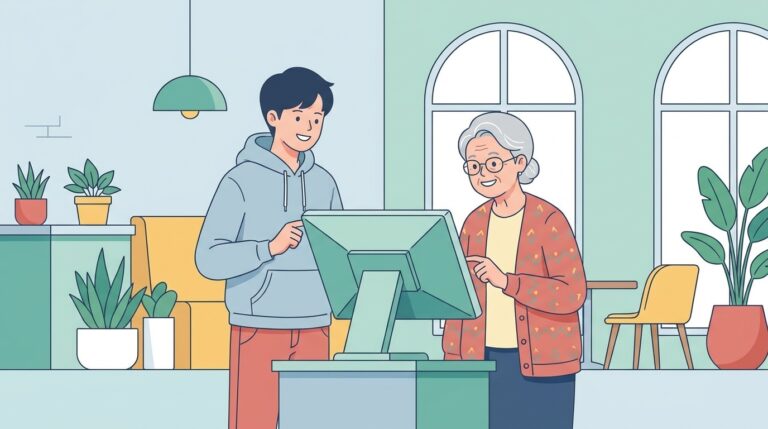
Phase 1: Empathy
Hello! I’m your lead editor at Daily Hangul.
Imagine this: You walk into a bustling fast-food joint or a trendy cafe in Seoul, craving an iced Americano. But there’s a hold-up. An elderly man is standing in front of a glowing, towering machine—the infamous Kiosk. He’s tapping the screen hesitantly, squinting at English loanwords like “Take-out” or “Beverage,” looking completely overwhelmed. A line is forming behind him, and the infamous Korean Ppali-ppali (hurry, hurry) pressure is building up.
You’ve probably seen a scene like this in a heartwarming indie K-Movie or a slice-of-life K-Drama. But in real-life Korea, where the digital shift is happening at lightning speed, this digital divide (디지털 격차) is a daily reality. The older generation is struggling with apps, touchscreens, and digital slang.
As a foreigner learning Korean, you might think, “I’m just a learner myself, how can I help?” But knowing how to gently offer assistance in proper, polite Korean not only saves the day but instantly earns you massive respect. In this lesson, we will master B2-level expressions to bridge the digital gap respectfully. Let’s dive in!
Phase 2: Core Expressions Deep Dive
1. 제가 좀 도와드릴까요?
- Pronunciation: je-ga jom do-wa-deu-ril-kka-yo? (The ‘으/eu’ in ‘deu’ sounds like the disgusted groan you make when stepping in gum!)
- Meaning: Shall I help you a little? (Literal) -> Would you like some help with that? (Real nuance)
- K-Culture Moment: You see a grandmother struggling to scan a barcode at a self-checkout counter in a convenience store. Approaching with a warm smile and this phrase completely diffuses her stress.
- Editor’s Insight: The word ‘좀’ (a little) is the magic dust here. It softens the offer, making it sound less like a grand intervention and more like a casual, friendly gesture. We use ‘도와주다’ (to give help) but elevate it to ‘도와드리다’ (to humbly offer help) because we are speaking to an elder.
- Situation Spectrum:
- Close Friends (Casual): 🚫 (Too formal, just use “내가 도와줄까?”)
- Strangers/Seniors (Formal): ✅
- 🤔 Think About It: Why does Korean have a specific verb (‘드리다’) for giving to someone older? How does this reflect the Confucian value of respect? Does your native language change vocabulary based on age?
2. 천천히 하셔도 돼요.
- Pronunciation: cheon-cheon-hi ha-syeo-do dwae-yo. (‘cheon’ rhymes with ‘yawn’)
- Meaning: You may do it slowly. (Literal) -> Please take your time, no rush. (Real nuance)
- K-Culture Moment: The elder looks back at the long line, apologizing nervously. You, the cool foreigner next in line, say this. Boom. You’re the main character of a K-Drama.
- Editor’s Insight: This phrase is the ultimate antidote to Korea’s Ppali-ppali culture. Adding the honorific infix ‘-시-‘ (하+시+어 -> 하셔) shows deep respect while comforting them.
- Situation Spectrum:
- Strangers/Seniors (Formal): ✅
- Coworkers (Semi-formal): ✅
- 🤔 Think About It: Have you ever felt the pressure of moving quickly in a fast-paced society? How much power does a simple “take your time” hold in such cultures?
3. 여기를 한 번 눌러 보시겠어요?
- Pronunciation: yeo-gi-reul han beon nul-leo bo-si-ges-seo-yo?
- Meaning: Would you try pressing here once? (Literal) -> Why don’t you try tapping right here? (Real nuance)
- K-Culture Moment: Instead of taking their phone or tapping the screen for them (which can be invasive), you gently guide them on a KTX ticket machine.
- Editor’s Insight: Using “~아/어 보다” (to try doing) combined with “~시겠어요?” (would you politely…) empowers them to learn the digital skill rather than just doing it for them.
- Situation Spectrum:
- Strangers/Seniors (Formal): ✅
- 🤔 Think About It: Is it better to do something for someone, or teach them how to do it? How does language reflect empowerment?
Phase 3: Textbook vs Real Korean
[Situation 1: Pointing out a button on an app]
* 📖 Textbook Korean: 이 버튼을 클릭하십시오. (Click this button.)
* 🗣️ Real Korean: 여기 화면 한 번 터치해 보실래요? (Would you like to try touching the screen here?)
* 💡 Why the difference?: “클릭하십시오” sounds like an automated robot. Using “터치하다” (touch) and the soft suggestion “~해 보실래요?” makes you sound like a caring human.
[Situation 2: Suggesting they use an app next time]
* 📖 Textbook Korean: 다음에는 스마트폰 애플리케이션을 이용하세요. (Use the smartphone application next time.)
* 🗣️ Real Korean: 어르신, 앱 깔면 줄 안 서도 돼서 엄청 편해요! (Sir/Ma’am, if you install the app, you don’t have to wait in line, it’s super convenient!)
* 💡 Why the difference?: Koreans rarely say “애플리케이션”. We shorten it to “앱” (App) or “어플” (App-le). Using “어르신” (respectful term for an elder) creates an instant bond.
Bottom Note: At the
B2level, aim for phrases that sound empathetic and fluid. Overly rigid textbook Korean can inadvertently sound cold or impatient.
Phase 4: Cultural Context — K-Culture Deep Dive
4-1. Non-verbal Nuances (Body Language is Key!)
When helping an older Korean person with a touchscreen, never point with just one index finger. In Korean culture, pointing with one finger can be seen as rude or dictatorial. Instead, use your whole hand with fingers kept together, palm facing up, to gesture towards the screen. Add a slight bow of your head when offering help. This combination of polite language and humble body language shows incredible Nunchi (social awareness).
4-2. The K-Food Connection: The Rise of “Table Orders”
If you visit a Korean BBQ restaurant or a bustling pub nowadays, you’ll rarely hear the iconic shout of “이모님!” (Auntie!). Instead, every table has a tablet (often called ‘테이블 오더’ – Table Order). You swipe through menus and tap to order.
While this is super convenient for younger people and introverts, it’s a huge hurdle for the older generation who loved the warm, human interaction of chatting with the restaurant owner. When you see an older couple struggling to order their Soju through a tablet, stepping in with “제가 대신 주문해 드릴까요?” (Shall I order it for you instead?) is a beautiful way to bridge the digital and generational divide in a classic K-Food setting.
Phase 5: Real-life Roleplay Scenario
Setting: A brightly lit MEGA Coffee branch near a subway station. It’s 1 PM, right after the lunch rush. There is only one kiosk. An elderly man (할아버지 – Harabeoji) is staring at the screen, looking stressed as it loudly beeps: “Please select your payment method.”
Characters:
– YOU: An intermediate Korean learner who just wanted a quick iced vanilla latte.
– 할아버지 (Harabeoji, 70s): Trying to buy a hot citron tea (유자차) but completely lost.
Dialogue:
할아버지: (Sighs) 아이고, 뭐가 이리 복잡해…
(aigo, mwoga iri bokjaphae…)
[Oh my, why is this so complicated…]
(🎭 Stage Direction: He taps the screen randomly and the menu resets)
YOU: 어르신, 기계가 좀 어렵죠? 제가 좀 도와드릴까요?
(eoreusin, gigyega jom eoryeopjyo? jega jom dowadeurilkkayo?)
[Sir, the machine is a bit difficult, right? Shall I help you?]
할아버지: 어유, 외국인 같은데 한국말을 잘하네. 미안해서 어쩌지…
(eoyu, oegugin gateunde hangungmareul jalhane. mianhaeseo eojjeoji…)
[Oh my, you look like a foreigner but speak Korean so well. I feel bad for bothering you…]
YOU: 괜찮습니다. 천천히 하셔도 돼요. 뭐 드시고 싶으세요?
(gwaenchanseumnida. cheoncheonhi hasyeodo dwaeyo. mwo deusigo sipeuseyo?)
[It’s okay. You can take your time. What would you like to drink?]
할아버지: 따뜻한 유자차 한 잔 마시고 싶은데, 도통 안 보이네.
(ttatteuthan yujacha han jan masigo sipeunde, dotong an boine.)
[I want to drink a cup of hot citron tea, but I can’t see it at all.]
YOU: 아, 여기 ‘Tea’ 메뉴에 있어요. 여기를 한 번 눌러 보시겠어요?
(a, yeogi ‘Tea’ menyue isseoyo. yeogireul han beon nulleo bosigesseoyo?)
[Ah, it’s here under the ‘Tea’ menu. Would you like to try pressing here?]
할아버지: (Taps the screen) 오, 나왔네. 고마워요 학생.
(o, nawanne. gomawoyo haksaeng.)
[Oh, it appeared. Thank you, student.]
YOU: 결제는 카드로 하시겠어요?
(gyeoljeneun kadeuro hasigesseoyo?)
[Will you be paying by card?]
할아버지: 응, 카드 여기 있어.
(eung, kadeu yeogi isseo.)
[Yes, the card is right here.]
🔀 Your Turn! The screen asks for “포장 (Takeout)” or “매장 (Dine-in)”. How do you ask him?
– A) “여기서 먹어요, 아니면 집에 가요?” (Are you eating here or going home?)
– B) “드시고 가실 건가요, 아니면 포장해 드릴까요?” (Will you be drinking it here, or shall I pack it to go?)
– C) “테이크아웃 할래?” (Wanna do takeout?)✅ Best Choice: B — It perfectly uses the B2 level honorifics (‘드시다’ instead of ‘먹다’, ‘가시다’ instead of ‘가다’).
⚠️ Choice C Analysis: Never use casual Banmal (할래?) with an elder, even if you are trying to be friendly. It is considered highly disrespectful!
Phase 6: 10-Second Shadowing Drill
Practice these sentences out loud to get the rhythm and emotion right!
- 😊 친절하게 (Kindly): 어르신, / 제가 좀 / 도와드릴까요? (eoreusin, / je-ga jom / do-wa-deu-ril-kka-yo?)
- 🥺 안심시키며 (Reassuringly): 뒤에 사람 없으니까 / 천~~~천히 하셔도 돼요. (dwi-e sa-ram eop-seu-ni-kka / cheon~~~cheon-hi ha-syeo-do dwae-yo.)
- 😊 부드럽게 (Softly): 여기 화면을 / 살짝 / 터치해 보시겠어요? (yeo-gi hwa-myeon-eul / sal-jjak / teo-chi-hae bo-si-ges-seo-yo?)
Phase 7: K-Culture Mini Dictionary
1. 키오스크
* Romanization: ki-o-seu-keu
* English: Kiosk / Self-ordering machine
* Context: They are literally everywhere in Korea now—from subways and cafes to tiny ramen shops. A massive source of the digital divide.
2. 어르신
* Romanization: eo-reu-sin
* English: Sir / Ma’am (respectful term for the elderly)
* Context: Much safer and more respectful than calling a stranger “할아버지” (Grandpa) or “할머니” (Grandma), which some might find too familiar or aging.
3. 빨리빨리
* Romanization: ppal-li-ppal-li
* English: Hurry hurry / Fast-paced
* Context: The core operating speed of Korean society. It makes the elderly feel incredibly pressured when using slow technology in public.
4. 테이블 오더
* Romanization: te-i-beul o-deo
* English: Table Order (Tablet ordering system)
* Context: Restaurants now use tablets on tables for ordering. It replaces the traditional calling of the staff, changing dining culture.
Phase 8: Traveler Survival Kit
What if you are the traveler struggling with Korean digital apps, and you need to ask for help?
🆘 Survival Phrases for the Digital Traveler
– 🇰🇷 “이 앱 어떻게 쓰는지 혹시 아세요?” (i aep eotteoke sseuneunji hoksi aseyo?)
– 🗣️ English: Do you happen to know how to use this app?
– 📍 Where to use: Train stations (KTX app), Bus stops (KakaoBus), Map navigation.
– 💡 Pro Tip: If you’re lost, sometimes older Koreans are the best people to ask! They might not know the app, but they know the physical streets better than anyone and are often extremely eager to help foreigners.📌 Editor’s Travel Note
– Useful Apps: KakaoMap, Naver Map, Papago (Your holy trinity for survival).
– Card is King: Korea is rapidly becoming a cashless society. Many kiosks only accept credit cards (카드 전용). Always have a physical card ready!
– No English Options: Don’t panic if a local kiosk lacks English. Use the Papago app’s image translation feature!
Phase 9: Critical Thinking — “One Step Deeper”
Language & Power: The Alienation of Foreign Loanwords
Have you noticed how many English words are used in Korean digital interfaces? Kiosk, Take-out, Beverage, Point, Touch, Scroll. For young Koreans, this “Konglish” is completely natural. However, for the older generation, this creates a massive language barrier in their own country. The generational gap isn’t just about technology; it’s about language. By helping them navigate these loanwords, you are actually participating in a deeply social act of inclusion.
💬 Your Turn:
Does your native language heavily borrow English words for technology? Does this create a similar gap for the elderly in your home country? Share your thoughts in the comments!
Phase 10: FAQ & Avoiding Misunderstandings
Q: Can I just do the ordering for them to save time?
Maybe, but ask first! Snatching a phone or taking over a screen without asking is rude. Always start with “제가 도와드릴까요?”
Q: Is it okay to say ‘할아버지’ (Grandpa) to get an older man’s attention?
It’s common, but ‘어르신’ (Eoreusin) is much safer and more respectful for strangers. Some active seniors dislike being called ‘Grandpa’!
❌ Common Mistake #1: Saying “당신” (You) to an elder.
✅ Do this instead: Korean often drops the subject “you.” Just say “천천히 하셔도 돼요” (Take your time) without translating “You” directly.❌ Common Mistake #2: Using 반말 (Casual language) thinking it sounds friendly.
✅ Do this instead: Always stick to 존댓말 (Honorifics) with strangers, especially the elderly. Use the-시-infix we learned today!
Phase 11: Summary & Action Items
One-Liner Summary: Bridge the Korean digital generation gap respectfully by offering help with “제가 좀 도와드릴까요?” and calming the Ppali-ppali pressure with “천천히 하셔도 돼요.”
Action Mission 3 Steps:
– 🥉 Bronze (Solo): Stand in front of a mirror and practice “어르신, 제가 좀 도와드릴까요?” with a polite bow and gesture.
– 🥈 Silver (Online): Find a YouTube video about “한국 키오스크 어르신” (Korean Kiosk Elderly) and leave a supportive comment in Korean.
– 🥇 Gold (Real Life): Next time you are in Korea and see an elder struggling at a cafe or subway kiosk, take a deep breath and offer your help using today’s phrases!
K-Culture Mission:
Go to a Korean restaurant that uses a ‘Table Order’ tablet. Notice if they have an “Elderly Friendly Mode” (큰 글씨 모드 – Large Text Mode). Many places are starting to introduce this!
Engagement: Have you ever helped someone with technology in a foreign language? Tell us your story below!
Phase 12: Interactive Challenge (Quiz)
1. Situational Judgment: An elderly woman at a fast-food restaurant seems confused by the “Dine-in” vs “Take-out” options on the kiosk. What is the most polite way to step in?
* A) 비키세요, 제가 할게요. (Move, I’ll do it.)
* B) 어르신, 제가 좀 도와드릴까요? (Ma’am, shall I help you a little?)
* C) 할머니, 이거 누르세요. (Grandma, press this.)
2. Fill in the Blank: To tell someone “Please take your time, no rush,” you say: “천천히 (_____) 돼요.”
* A) 해도
* B) 하셔도
* C) 할
3. True or False – K-Culture Edition: When pointing out a button on a screen to an elder, it is best to use your index finger clearly so they don’t get confused. (T/F)
(Answers: 1. B – ‘A’ is extremely rude, ‘C’ is too direct. / 2. B – ‘하셔도’ includes the honorific ‘-시-‘. / 3. False – Use your whole hand to gesture politely, not a single pointing finger.)
Frequently Asked Questions (FAQ)
Q: What does "제가 좀 도와드릴까요?" mean in Korean and how do you pronounce it?
A: In Korean, "제가 좀 도와드릴까요?" is pronounced [je-ga jom do-wa-deu-ril-kka-yo? (The '으/eu' in 'deu' sounds like the disgusted groan you make when stepping in gum!] and means: Shall I help you a little? (Literal) -> Would you like some help with that? (Real nuance)
Q: What does "천천히 하셔도 돼요." mean in Korean and how do you pronounce it?
A: In Korean, "천천히 하셔도 돼요." is pronounced [cheon-cheon-hi ha-syeo-do dwae-yo. ('cheon' rhymes with 'yawn'] and means: You may do it slowly. (Literal) -> Please take your time, no rush. (Real nuance)
Q: What does "여기를 한 번 눌러 보시겠어요?" mean in Korean and how do you pronounce it?
A: In Korean, "여기를 한 번 눌러 보시겠어요?" is pronounced [yeo-gi-reul han beon nul-leo bo-si-ges-seo-yo?] and means: Would you try pressing here once? (Literal) -> Why don't you try tapping right here? (Real nuance)







