

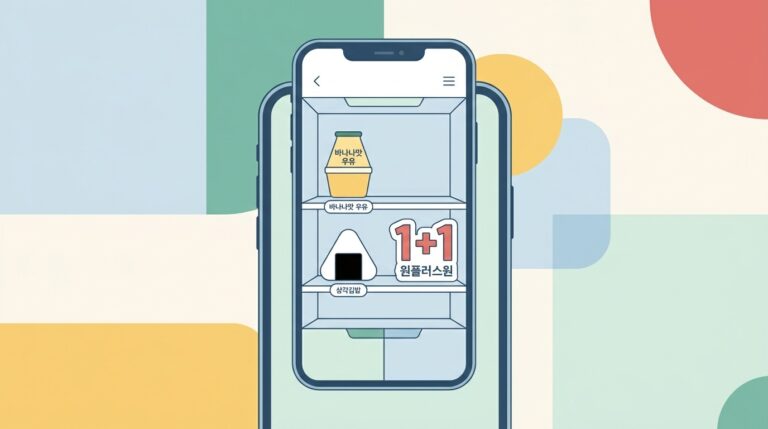
Phase 1: Empathy – The Late-Night Hangover Cure Dilemma
Hello! I am the Senior Editor of Daily Hangul.
Let’s set the scene: It’s 11:30 PM on a Friday in Gangnam. You’ve just survived an intense hoesik (company dinner) with your Korean colleagues. You slip into a brightly lit convenience store (CVS) to buy a hangover-cure drink (상쾌환 or 컨디션) before heading to the subway. You grab one bottle, but the cashier points to the shelf and says, “원 플러스 원인데, 하나 더 안 가져가세요?” (It’s 1+1, aren’t you going to take another one?).
You don’t want to carry an extra bottle. You don’t have a bag. But giving up a free item feels like a loss. In a K-Drama, this is the exact moment the cool, independent protagonist taps their phone and says something casually to the cashier, saving the day.
What did they do? They used a “Virtual Fridge” (나만의 냉장고).
Welcome to C2-level Korean survival. This isn’t just about buying things; it’s about navigating the hyper-efficient, tech-integrated urban lifestyle of Seoul. If you don’t know how to navigate the 1+1 Keeping system, you’re missing out on the ultimate insider perk. This guide is crafted from real questions asked by advanced learners who wanted to shop exactly like a local. Let’s dive in!
Phase 2: Core Expressions Deep Analysis
To master the CVS “Virtual Fridge” (where you buy 1+1 but store the free item in the store’s app to claim later, even at a different branch), you need these advanced expressions.
1. 나머지 하나는 키핑할게요.
- Pronunciation: nameoji hananeun kipinghalgeyo. [nah-muh-jee ha-na-neun keep-ping-hal-gge-yo]
- Sound-alike guide: ‘키핑’ sounds exactly like the English “keeping,” but with a sharp, crisp ‘k’ and ‘p’.
- Meaning: I’ll keep/store the other one (in the app).
- K-Culture Moment: You’re buying a 2+1 Haagen-Dazs. You only want to eat one right now. Saying this while nonchalantly opening your CVS app makes you look like a seasoned Seoulite who has their life completely organized.
- Editor’s Insight: Yes, “keeping” is Konglish! But in the context of bars (keeping a bottle of whiskey) and convenience stores, it is the most natural verb to use. It implies, “Hold onto this for me under my account.”
- Situation Spectrum:
- Casual / CVS Cashier: ✅ (Perfectly natural)
- Semi-formal: ✅
- Formal/Traditional contexts: 🚫 (Don’t use Konglish in a traditional market)
- 🤔 Think About It: Why do Koreans love using English loanwords like “keeping” for tech/service features? Does Konglish serve as a marker of modernity in consumer culture?
2. 이거 교차 증정 되나요?
- Pronunciation: igeo gyocha jeungjeong doenayo? [ee-guh gyo-cha jeung-jung dweh-na-yo?]
- Sound-alike guide: ‘교차’ sounds like “gyo-cha” (like gyoza but with a ‘ch’).
- Meaning: Literal: Is cross-promotion available for this? / Real nuance: Can I mix and match flavors for the +1 item?
- K-Culture Moment: You see a 2+1 sign for cup noodles. You want two spicy chicken flavors and one carbonara flavor. If you just bring them to the counter and they aren’t mix-and-match eligible, the POS machine will beep aggressively, and the line behind you will sigh. Asking this first saves everyone’s nunchi.
- Editor’s Insight: This is a high-level retail vocabulary word. “교차” means intersect/cross, and “증정” means presentation/gift. Using this phrase instantly signals to the cashier that you understand Korean promotion mechanics.
- Situation Spectrum:
- Any CVS/Mart Cashier: ✅ (Highly polite and efficient)
- 🤔 Think About It: Korean promotions rarely lock you into one flavor. How does this reflect the Korean consumer’s desire for variety (다양성) within efficiency?
3. 바코드 여기요 / 앱에 넣어주세요.
- Pronunciation: bakodeu yeogiyo / aebe neoeojuseyo. [ba-ko-deu yuh-gee-yo / aeb-eh nuh-uh-joo-seh-yo]
- Meaning: Here is the barcode / Please put it in the app.
- K-Culture Moment: The cashier scans your single item. Before they can even ask what you want to do with the +1, you present your smartphone screen like a badge of honor.
- Editor’s Insight: In Korea, speed is kindness. You don’t need a long sentence. Handing over the phone with the app barcode open while saying “앱에 넣어주세요” (Please put it in the app) is the peak of consideration for the cashier and the people behind you.
- Situation Spectrum:
- Casual / CVS Cashier: ✅
- 🤔 Think About It: Why is “putting it in the app” (앱에 넣다) used instead of “saving it to my account”? Notice how Koreans spatialize digital platforms—treating the app like a physical container.
Phase 3: Textbook vs. Real Korean
Here’s why your textbook Korean might get awkward stares at the GS25 counter.
[When storing a 1+1 item]
* 📖 Textbook Korean: 나머지 한 개는 나중에 가져가겠습니다. (I will take the remaining one later.)
* 🗣️ Real Korean: 하나는 키핑할게요. / 앱에 넣어주세요.
* 💡 Why the difference?: The textbook phrase sounds like you’re going to physically leave it behind the counter and come back for it. “키핑” or “앱에” clarifies you are using the digital system.
[When asking about flavors]
* 📖 Textbook Korean: 다른 맛으로 골라도 됩니까? (May I choose a different flavor?)
* 🗣️ Real Korean: 이거 교차(증정) 되죠?
* 💡 Why the difference?: Retail uses specific jargon. “교차 증정” is the exact phrase printed on the price tags. Using it is faster and leaves zero room for misinterpretation.
[When paying and earning points]
* 📖 Textbook Korean: 포인트 적립을 원합니다. (I desire point accumulation.)
* 🗣️ Real Korean: 적립해주세요. (Please accumulate.) While already holding the barcode out.
* 💡 Why the difference?: In the palli-palli (hurry up) culture, dropping the object and just using the verb + “해주세요” with a physical gesture is the ultimate form of efficiency.
Phase 4: Cultural Context — K-Culture Deep Dive
4-1. The Non-Verbal Language of “Nunchi” at the Counter
Language isn’t just words; it’s timing. In a Korean convenience store, Nunchi (눈치 – the ability to gauge the mood and situation) is physicalized by having your app open before you reach the register. If you wait until the cashier asks, then unlock your phone, find the app, wait for it to load, and pull up the barcode… the collective silent judgment from the queue behind you will be palpable. Have your screen brightness up and the barcode ready. That is true fluency.
4-2. K-Culture Connection: Modern Romance and Virtual Milk
How does this connect to K-Dramas and idol culture? The “Virtual Fridge” isn’t just for saving space; it’s a social tool. Many CVS apps allow you to “gift” (선물하기) the item you kept to a friend’s phone number.
Imagine a K-Drama scene: The male lead knows the female lead is working late. Instead of physically bringing her a drink (which might be too burdensome), he buys a 2+1 Banana Milk, drinks one, keeps the others, and sends her the barcode via KakaoTalk with a simple message: “먹고 해” (Eat while you work). It’s the modern-day digital equivalent of “오다 주웠다” (I picked this up on the way – a classic tsundere way of giving a gift). K-Pop fans also frequently do this, doing Twitter giveaways of their “kept” snacks to fellow fans!
Phase 5: Real-Life Roleplay Scenario
Setting: It’s 2:00 PM on a scorching summer Sunday. You and your Korean friend, Minsoo, just finished a hike and walked into a CU convenience store. The AC hits you like a blessing. You grab a premium matcha ice cream. The tag says “2+1”.
Characters:
– YOU: An expat who loves Korean CVS culture but usually avoids 1+1 if you can’t carry it.
– Minsoo (29, energetic friend): A tech-savvy Seoulite who never misses a discount.
Dialogue:
Minsoo: 오, 그거 투쁠원이다! 세 개 가져가자. 🍦
(o, geugeo tuppeulwonida! se gae gajeogaja.)
[Oh, that’s 2+1! Let’s take three.]
YOU: 나 지금 하나만 먹고 싶은데? 다 녹잖아.
(na jigeum hanaman meokgo sipeunde? da nokjana.)
[I only want to eat one right now though? They’ll all melt.]
Minsoo: 에이, 키핑하면 되지! 일단 세 개 바코드 다 찍어.
(ei, kipinghamyeon doeji! ildan se gae bakodeu da jjigeo.)
[Hey, we can just keep them! Just scan all three barcodes for now.]
(🎭 Stage Direction: You walk to the counter. The cashier scans one ice cream, then looks at you expectantly because the POS machine is waiting for the promotion to be fulfilled.)
Cashier: 손님, 이거 2+1 행사 상품인데 더 안 가져오세요?
(sonnim, igeo 2+1 haengsa sangpuminde deo an gajeo-oseyo?)
[Customer, this is a 2+1 event item, aren’t you going to bring the others?]
🔀 Your Turn! How do you respond?
– A) “괜찮아요. 하나만 살게요.” (I’m fine. I’ll just buy one.)
– B) “나머지 두 개는 앱에 키핑할게요. 바코드 여기요.”
– C) “저기 냉장고에 보관해 주세요.”✅ Best Choice: B — You acknowledge the promotion, use the exact jargon (키핑할게요), and present the barcode seamlessly.
⚠️ Choice A Analysis: You lose out on the promotion. You pay full price for one, missing the “Korean efficiency” experience.
⚠️ Choice C Analysis: This sounds like you want the cashier to physically take the ice cream and hide it in the store’s actual backroom fridge. They will be very confused!
Phase 6: 10-Second Shadowing Drill
Let’s practice the rhythm. In Korean, pacing and pauses (/) are just as important as pronunciation.
😊 저기요, / 이거 교차 증정 / 되죠? (jeogiyo, / igeo gyocha jeungjeong / doejo?)
(Tone: Friendly but confirming. Slight upward inflection at the end.)
📱 나머지 하나는 / 앱에 키핑할게요. / 바코드 찍어주세요. (nameoji hananeun / aebe kipinghalgeyo. / bakodeu jjigeojuseyo.)
(Tone: Smooth, efficient, polite. Hand the phone over on the last phrase.)
Phase 7: K-Culture Mini Dictionary
1. 나만의 냉장고 (Virtual Fridge)
* Romanization: namanui naengjanggo
* English: My Own Refrigerator (GS25’s famous app feature)
* Context: Originally GS25’s app name (now integrated into ‘우리동네GS’). It became the cultural shorthand for storing any 1+1 item digitally, much like “Googling” means searching.
2. 눈치 (Nunchi)
* Romanization: nunchi
* English: Situational awareness / Reading the room
* Context: At the CVS, nunchi means knowing exactly when to pull out your card, app barcode, and reusable bag so the transaction takes less than 15 seconds.
3. 원쁠원 / 투쁠원 (1+1 / 2+1)
* Romanization: won-ppeul-won / tu-ppeul-won
* English: Buy One Get One / Buy Two Get One
* Context: Koreans rarely say “일 플러스 일”. The Konglish pronunciation “원쁠원” is the standard vernacular.
4. 교차 증정 (Cross-promotion / Mix & Match)
* Romanization: gyocha jeungjeong
* English: Mix and Match eligibility
* Context: The holy grail of 2+1 events. It allows you to buy one Strawberry, one Banana, and get one Melon milk for free, provided they are the same brand and price tier.
Phase 8: Traveler Survival Kit
Even if you are just visiting Seoul for a week, you can download the apps (some require Korean phone numbers, but if you have a tourist SIM, you can often register).
🆘 Survival Expressions for the Convenience Store
– 🇰🇷 “이거 원쁠원 행사 상품 맞아요?” (igeo wonppeulwon haengsa sangpum majayo?)
– 🗣️ Meaning: Is this item really part of the 1+1 event?
– 📍 Where to use: Sometimes tags are left on the shelf after the promotion month ends (e.g., on the 1st of a new month). Always double-check!
– 💡 Pro Tip: Point to the price tag when asking.📌 Editor’s Travel Note
– The Apps: GS25 (우리동네GS), CU (포켓CU), 7-Eleven (세븐앱).
– Redemption: You can keep an item in Busan and redeem it in Seoul! The inventory is tracked digitally. However, always check if the specific store you walk into has the item in stock (재고) before trying to redeem your coupon.
Phase 9: Critical Thinking — “A Step Deeper”
Global Era & Space Efficiency: Why did the “Virtual Fridge” invent itself in Korea?
🧠 Think Deeper:
Look closely at the concept of 나만의 냉장고 (My Fridge). Why did this app feature become a massive phenomenon in Korea compared to other countries? The answer lies in Seoul’s urban geography and real estate. Many young Koreans live in one-room officetels (studio apartments) where physical space is a premium and refrigerators are tiny built-in units. They simply do not have the pantry space to stockpile a 12-pack of toilet paper or six bottles of 2-liter water just because it’s on sale.The convenience store app essentially transforms the 50,000+ CVS branches across the country into the individual’s extended, decentralized pantry. It is a brilliant technological solution to a spatial sociological problem.
💬 Your Turn: Does your country have a technological solution that perfectly matches its unique urban or geographic challenges? Share it in the comments!
Phase 10: FAQ & Mistake Prevention
Q: Do these kept items ever expire?
Yes! Usually, you have 30 to 60 days to redeem your kept item. The app will send you push notifications when it’s about to expire.
Q: Can I use “키핑할게요” with older cashiers or in traditional markets?
In a convenience store, even an elderly owner understands “키핑” or “앱 보관” because it’s part of the POS system. But do not use “키핑할게요” in a traditional market (전통시장). There, you deal in cash, warmth (jeong), and physical goods. There are no apps in a vegetable stall at Gwangjang Market!
❌ Common Mistake #1: Bringing only ONE item to the counter for a 1+1.
✅ Do this instead: Even if you plan to keep the +1 item in your app, you must bring only the one you are buying now IF you are keeping the rest. Wait, let me clarify: If you want to walk out with 1 and keep 1, just bring 1 to the counter and say “하나는 키핑할게요”. The cashier will adjust it on the machine.❌ Common Mistake #2: Trying to redeem a kept item without checking inventory.
✅ Do this instead: Not every branch carries every flavor. Before scanning your coupon to redeem a kept item, make sure you physically locate it on the shelf first!
Phase 11: Summary & Action Items
One-Liner Summary: Use “하나는 앱에 키핑할게요” to store your extra 1+1 items like a tech-savvy local, saving both physical space and social nunchi.
Action Mission:
– 🥉 Bronze: Say “이거 교차 증정 되죠?” out loud 3 times right now, focusing on the intonation.
– 🥈 Silver: Search YouTube for “편의점 1+1 꿀팁” (CVS 1+1 tips) and try to catch when they say “앱” or “보관”.
– 🥇 Gold: Download Pocket CU or GS25 app, register, and try “키핑할게요” on your next trip to Korea!
K-Culture Mission:
The next time you watch a modern K-Drama, pay attention to scenes set in convenience stores. Look at how the characters pay—notice how they rarely speak, just scan a barcode on their phone? You now know they are probably redeeming a kept banana milk!
Phase 12: Quiz — Interactive Challenge
1. Situational Judgment: You want to buy a 2+1 promotion of protein bars. You want 1 Chocolate, 1 Peanut, and 1 Berry flavor. What is the smartest thing to ask the cashier before paying?
– A) “초콜릿 맛 맛있어요?”
– B) “이거 세 개 다 살게요.”
– C) “이거 교차 증정 되나요?”
2. True or False – K-Culture Edition:
– “If you ‘keep’ an item in your CVS app in Seoul, you can only redeem it at that exact same store branch.”
3. Fill in the Blank:
– Cashier: 손님, 이거 1+1인데 하나 더 안 가져가세요?
– You: 아, 가방이 없어서요. 나머지 하나는 앱에 _______할게요. (Hint: Konglish word for storing).
(Answers: 1. C – To make sure you can mix flavors. 2. False – You can redeem it at almost any branch nationwide! 3. 키핑/보관)
Frequently Asked Questions (FAQ)
Q: What does "나머지 하나는 키핑할게요." mean in Korean and how do you pronounce it?
A: In Korean, "나머지 하나는 키핑할게요." is pronounced [nameoji hananeun kipinghalgeyo. [nah-muh-jee ha-na-neun keep-ping-hal-gge-yo] and means: I'll keep/store the other one (in the app).
Q: What does "이거 교차 증정 되나요?" mean in Korean and how do you pronounce it?
A: In Korean, "이거 교차 증정 되나요?" is pronounced [igeo gyocha jeungjeong doenayo? [ee-guh gyo-cha jeung-jung dweh-na-yo?] and means: Literal: Is cross-promotion available for this? / Real nuance: Can I mix and match flavors for the +1 item?
Q: What does "바코드 여기요 / 앱에 넣어주세요." mean in Korean and how do you pronounce it?
A: In Korean, "바코드 여기요 / 앱에 넣어주세요." is pronounced [bakodeu yeogiyo / aebe neoeojuseyo. [ba-ko-deu yuh-gee-yo / aeb-eh nuh-uh-joo-seh-yo] and means: Here is the barcode / Please put it in the app.







