

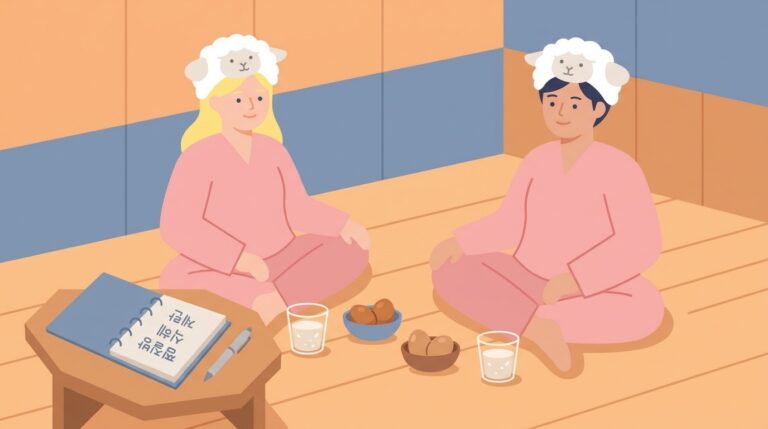
Hello! I am the Lead Editor of Daily Hangul. Have you ever watched a K-Drama where the main character gets kicked out of their house and ends up sleeping on a wooden floor in a massive public bathhouse? They always have a funny towel folded like sheep horns on their head, cracking roasted eggs on their friend’s forehead. That magical place is called a 찜질방 (Jjimjilbang)!
Today, we are going to learn about the word 찜질하다 (jjimjilhada), which is the heart of this unique Korean culture. For absolute beginners (A1), stepping into a Korean sauna might feel intimidating. What do you wear? Where do you go? And why are people saying “It’s so cool!” while sitting in an 80°C (176°F) oven?
Don’t worry! This guide is based on real questions from my foreign students who successfully survived—and loved—their first Jjimjilbang experience. Let’s dive right in!
Phase 2: Core Expressions Deep Dive
1. 찜질하다
- Pronunciation: [jjimjilhada] 🗣️ ‘jj’ sounds like a very tense, squeezed ‘j’. Try saying ‘jump’ but tighten your throat. ‘il’ sounds like ‘eel’.
- Meaning: (Literal) To apply a hot/cold compress (Real nuance) To sweat and relax in a hot sauna room.
- K-Culture Moment: In dramas, when someone is tired from work or has body aches, their friends will say, “Let’s go do jjimjil!” It’s the ultimate Korean remedy for stress.
- Editor’s Insight: You won’t just hear this in saunas! If a Korean friend has a sore shoulder, they might put a hot pack on it and say they are “jjimjilhada-ing”.
- Situation Spectrum:
- Casual with friends: ✅ (찜질하자! – Let’s do jjimjil!)
- Semi-formal: ✅ (찜질하러 갈까요? – Shall we go do jjimjil?)
- Formal/Elders: ✅ (찜질방 가실래요? – Would you like to go to the jjimjilbang?)
- 🤔 Think About It: Why is there a specific verb just for resting in a hot room? How does the climate or traditional lifestyle of your country influence its vocabulary for relaxation?
2. 땀(을) 빼다
- Pronunciation: [ttam(eul) ppaeda] 🗣️ ‘tt’ is a sharp, hard ‘t’. ‘pp’ is like the ‘p’ in ‘spa’ but stronger.
- Meaning: (Literal) To take out sweat (Real nuance) To sweat it out (in a sauna or through exercise).
- K-Culture Moment: Picture an older Korean man sitting in a scorching hot charcoal room. He wipes his forehead and says with a satisfied smile, “Ah, 땀 빼니까 좋다 (Ah, sweating it out feels good).”
- Editor’s Insight: Koreans believe sweating releases toxins and stress. It’s not seen as gross; it’s seen as healthy and purifying!
- Situation Spectrum:
- Casual with friends: ✅
- Semi-formal: ⚠️ (Okay for casual chat, but a bit too relaxed for a business meeting)
- Formal/Elders: 🚫
- 🤔 Think About It: In many cultures, sweating is just an uncomfortable bodily function. Why do Koreans actively try to “take out” sweat together as a social activity?
3. 시원하다
- Pronunciation: [siwonhada] 🗣️ ‘si’ sounds like ‘she’, ‘won’ sounds like ‘one’.
- Meaning: (Literal) To be cool/refreshing (Real nuance) “This hot thing is releasing the tension in my body, and I feel refreshed!”
- K-Culture Moment: This is the biggest mystery for foreigners! You sit in a 70°C sauna room, and a Korean person sighs deeply and says, “아~ 시원하다 (Ah~ siwonhada).” Wait, cool? No! It means their tight muscles are relaxing.
- Editor’s Insight: You will also hear this when Koreans drink hot soup or get a deep tissue massage. It’s about the feeling of relief, not the actual temperature.
- Situation Spectrum:
- Casual with friends: ✅
- Semi-formal: ✅
- Formal/Elders: ✅
- 🤔 Think About It: Does your language have a word that describes the feeling of pain/heat turning into pleasure and relief?
Phase 3: Textbook vs Real Korean
[Suggesting to go to the Sauna]
* 📖 Textbook: 찜질방에 갈까요? (jjimjilbange galkkayo? – Shall we go to the jjimjilbang?)
* 🗣️ Real Korean: 몸 좀 지지러 가자! (mom jom jijireo gaja! – Let’s go toast our bodies!)
* 💡 Why is it different?: ‘지지다 (jijida)’ means to pan-fry or apply heat. Koreans affectionately use it to mean warming up their tired bodies on a hot floor.
[Expressing how hot it is]
* 📖 Textbook: 날씨가 덥습니다. (nalssiga deopseumnida. – The weather is hot.)
* 🗣️ Real Korean: 와, 쪄 죽겠다! (wa, jjyeo jukgetda! – Wow, I’m going to steam to death!)
* 💡 Why is it different?: Koreans love using “죽겠다 (to death)” for emphasis. Starving to death, full to death, and steaming to death!
Bottom Note: For A1 learners, stick to “너무 더워요 (It’s too hot)” or “시원해요 (It’s refreshing)”. They are safe, polite, and universally understood!
Phase 4: Cultural Context — K-Culture Deep Dive
4-1. Non-verbal Cue: The Magical Wristband
When you pay at a Jjimjilbang, you are given a locker key on an elastic wristband. Do not lose this! It’s not just a key; it’s your credit card inside the sauna. When you buy eggs, drinks, or ramen, you just tap the wristband on the scanner. You pay the total bill when you leave. Also, remember the Korean “Nunchi” (social awareness): keep your voice down inside the sleeping caves and hot rooms!
4-2. K-Food Connection: The Jjimjilbang Combo
You cannot say you’ve been to a Jjimjilbang if you haven’t had the holy trinity of sauna food: 식혜 (Sikhye – sweet rice punch) and 맥반석 계란 (Maekbanseok Gyeran – roasted eggs).
* Why do Koreans crack the eggs on their heads? It started as a joke on TV variety shows and became a national habit! Just be careful—roasted eggs have much harder shells than boiled ones. Don’t hit your friend too hard!
Phase 5: Real-life Roleplay Scenario
Setting: Saturday afternoon at a massive Jjimjilbang in Seoul. You and your Korean friend are wearing matching pink t-shirts and shorts provided by the sauna. You are standing in front of a door that says ‘Himalayan Salt Room – 75°C’.
Characters:
– YOU: A beginner Korean learner, slightly nervous about the heat.
– Min-su: Your Korean friend, a sauna enthusiast.
Dialogue:
Min-su: 우리 저기 들어가자. (uri jeogi deureogaja.)
[Translation] Let’s go in there.
YOU: 저기요? 너무 뜨거워 보여요. (jeogiyo? neomu tteugeowo boyeoyo.)
[Translation] In there? It looks too hot.
Min-su: 에이, 괜찮아. 딱 좋아. (ei, gwaenchana. ttak joa.)
[Translation] Hey, it’s fine. It’s just right.
(🎭 Stage Direction: Min-su opens the door. A blast of hot air hits your face. You both sit on the salty floor.)
Min-su: 와~ 시원하다! 땀 빼니까 좋지? (wa~ siwonhada! ttam ppaenikka jokji?)
[Translation] Wow~ So refreshing! Sweating feels good, right?
🔀 Your Turn! How will you answer?
– A) “네, 시원해요!” (ne, siwonhaeyo! – Yes, it’s refreshing!)
– B) “아니요, 더워요! 살려주세요!” (aniyo, deowoyo! sallyeojuseyo! – No, it’s hot! Save me!)
– C) “저 갈래요.” (jeo gallaeyo. – I want to leave.)✅ Best Choice: A or B! Option A will make Min-su treat you like a true local (an honorary Korean!). Option B is hilarious and natural for a foreigner, using cute exaggeration (“Save me!”).
⚠️ Choice C Analysis: It’s correct Korean, but a bit abrupt. If you really need to leave, say “저 먼저 나갈게요 (I’ll go out first).”
YOU: 네, 시원해요! 그런데 목말라요. (ne, siwonhaeyo! geureonde mongmallayo.)
[Translation] Yes, it’s refreshing! But I’m thirsty.
Min-su: 매점 가자! 식혜 먹을래? (maejeom gaja! sikhye meogeullae?)
[Translation] Let’s go to the snack bar! Do you want to drink Sikhye?
YOU: 네! 계란도 사주세요! (ne! gyerando sajuseyo!)
[Translation] Yes! Please buy me eggs too!
Bonus Roleplay: At the Snack Bar
Clerk: 열쇠 주세요. (yeolsoe juseyo – Please give me your key.)
YOU: (Tapping your wristband) 여기요. (yeogiyo – Here you go.)
Clerk: 식혜 두 잔 나왔습니다. (sikhye du jan nawasseumnida – Here are your two glasses of Sikhye.)
YOU: 감사합니다! (gamsahamnida – Thank you!)
Phase 6: 10-Second Shadowing Drill
Read this out loud to sound like a K-Drama main character!
😊 아~ / 땀 빼니까 / 정~~~말 / 시원해요! (a~ / ttam ppaenikka / jeong~~~mal / siwonhaeyo!)
(Ah~ / since I sweat out / it’s reeeally / refreshing!)
Phase 7: K-Culture Mini Dictionary
1. 양머리 (Yangmeori)
* Romanization: yangmeori
* English: Sheep Head (Towel)
* Context: A way of folding a sauna towel to look like Princess Leia’s buns or sheep horns. Perfect for Instagram selfies!
2. 매점 (Maejeom)
* Romanization: maejeom
* English: Snack Bar / Kiosk
* Context: The most important place in the Jjimjilbang. Where you buy Sikhye, eggs, and cup ramen.
3. 눈치 (Nunchi)
* Romanization: nunchi
* English: Social sense / Reading the room
* Context: Using your Nunchi in the sauna means not taking up too much space in the sleeping hall and not being loud in the relaxing zones.
4. 식혜 (Sikhye)
* Romanization: sikhye
* English: Sweet Rice Punch
* Context: A traditional Korean sweet drink made with fermented malt and rice. Served ice cold—the perfect contrast to a hot sauna.
Phase 8: Traveler Survival Kit
If you are visiting a Korean Jjimjilbang, memorize these 3 lifesavers!
🆘 Survival Phrases TOP 3
1. 🇰🇷 매점 어디예요? (maejeom eodiyeyo?)
– 🗣️ Pronunciation: [mae-jeom uh-dee-yeh-yo?]
– 💡 Meaning: Where is the snack bar?
2. 🇰🇷 이거 얼마예요? (igeo eolmayeyo?)
– 🗣️ Pronunciation: [ee-guh ull-mah-yeh-yo?]
– 💡 Meaning: How much is this?
3. 🇰🇷 수건 한 장 더 주세요. (sugeon han jang deo juseyo.)
– 🗣️ Pronunciation: [soo-geon han jang duh joo-seh-yo.]
– 💡 Meaning: Please give me one more towel.📌 Editor’s Travel Note
– Cash or Card?: When you enter, you pay the admission fee with a real card. Inside, you only use your locker key wristband.
– Gender Rules: The Jjimjilbang (sauna and sleeping areas) is unisex, and everyone wears the provided T-shirt and shorts. However, the 목욕탕 (Mogyoktang – Bathhouse) where the lockers and showers are located is strictly gender-segregated and requires you to be fully naked. Don’t be shy; everyone is in the same boat!
Phase 9: Critical Thinking — “One Step Deeper”
🧠 Think Deeper: Community and Vulnerability
Why do Koreans love going to public bathhouses and saunas with their friends, families, and even co-workers? In many Western cultures, bathing and sweating are strictly private activities. However, in Korea, sharing a hot space, eating together on the floor, and showing your ‘bare’ self without makeup or fancy clothes is a powerful way to break down social barriers. It builds trust and a deep sense of Jeong (정 – emotional bonding/affection). By sweating together, you become closer.💬 Your Turn: Does your culture have a space where people gather to relax collectively, like a public bath or a specific type of park? Share your thoughts in the comments!
Phase 10: FAQ & Avoiding Misunderstandings
Q: I have a tattoo. Can I enter a Jjimjilbang?
Yes! Unlike hot springs in Japan where tattoos are strictly banned, Korean Jjimjilbangs generally do not restrict entry for tattoos. However, if you have a massive, full-body tattoo, older Koreans might stare out of curiosity. Just ignore them and enjoy!
Q: Can I wear a swimsuit in the bathhouse?
No. In the gender-segregated wet bath area, swimsuits or underwear are completely banned for hygiene reasons. You must be completely nude. In the unisex Jjimjilbang area, you must wear the provided uniform.
❌ Common Mistake #1: Losing your locker key.
✅ Do this instead: Wear the key band securely around your wrist or ankle at all times. If you lose it, you will have to pay a hefty penalty fee!
Phase 11: Summary & Action Items
One-Liner Summary: A Jjimjilbang is where Koreans go to 찜질하다 (sweat it out), drink Sikhye, and bond over the heat!
Action Mission:
– 🥉 Bronze (Solo): Stand in your bathroom while taking a hot shower and say “아~ 시원하다!” (Ah~ siwonhada!)
– 🥈 Silver (Online): Comment below with your favorite K-Drama scene that takes place in a sauna.
– 🥇 Gold (Real World): Visit a Korean grocery store, buy Sikhye, and try saying “식혜 먹을래?” to a friend.
K-Culture Mission:
Go to YouTube and search for “How to make Yangmeori (Korean sheep head towel)”. Try folding it with your towel at home and take a selfie!
Phase 12: Quiz — Interactive Challenge
1. Situational Judgment: You are in a 75°C sauna with your Korean friend. They wipe their sweat, look at you, and say “와, 시원하다!”. What do they actually mean?
– A) Can you turn on the AC?
– B) My muscles are relaxing, and this feels great!
– C) Let’s go get ice cream.
2. Fill in the Blank:
“Let’s go to the snack bar. Where is the ________?”
– A) 양머리 (Yangmeori)
– B) 매점 (Maejeom)
– C) 수건 (Sugeon)
3. True or False – K-Culture Edition:
You must wear a swimsuit in the gender-segregated wet bathhouse area before entering the dry saunas.
– (True / False)
Click to see answers!
1. B (They feel refreshed and relaxed, even though it’s physically hot!)
2. B (Maejeom is the snack bar.)
3. False (You must be fully nude in the wet bathhouse area, and you wear the provided uniform in the dry sauna area.)
Frequently Asked Questions (FAQ)
Q: What does "찜질하다" mean in Korean and how do you pronounce it?
A: In Korean, "찜질하다" is pronounced [jjimjilhada] and means: (Literal) To apply a hot/cold compress (Real nuance) To sweat and relax in a hot sauna room.
Q: What does "땀(을) 빼다" mean in Korean and how do you pronounce it?
A: In Korean, "땀(을) 빼다" is pronounced [ttam(eul] and means: (Literal) To take out sweat (Real nuance) To sweat it out (in a sauna or through exercise).
Q: What does "시원하다" mean in Korean and how do you pronounce it?
A: In Korean, "시원하다" is pronounced [siwonhada] and means: (Literal) To be cool/refreshing (Real nuance) "This hot thing is releasing the tension in my body, and I feel refreshed!"







