

Phase 1: Empathy (Immersive Open)
Hello! I’m your lead editor at Daily Hangul. Imagine this: You’ve finally done it. You signed your real estate contract, got your digital door lock passcode, and successfully moved your boxes into your new cozy Korean Officetel (studio apartment). You are officially a resident of Seoul! 🎉
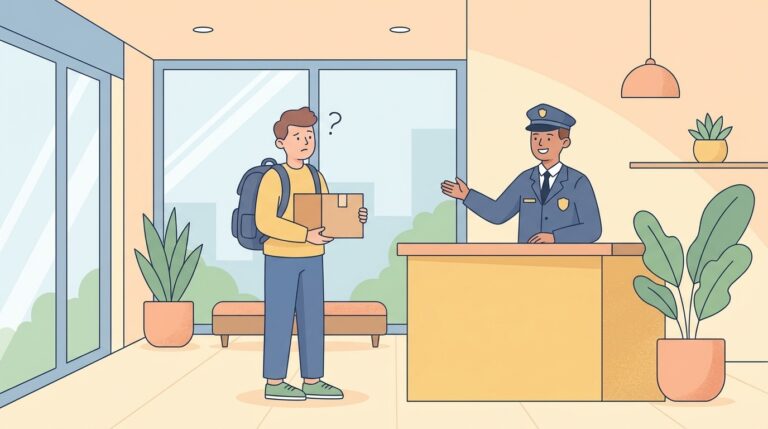
But wait… you’ve finished unpacking, and you have a mountain of cardboard boxes. You also need to register your car for parking. In a K-Drama, this is the exact moment the protagonist wanders down to the lobby, bumps into the friendly neighborhood Gyeongbi ahjussi (security guard), and instantly gets all their problems solved (while maybe also getting a warm cup of mixed coffee).
But in reality? You are standing in the lobby, staring at a directory completely in Korean, wondering, “Where on earth is the management office?”
If you don’t know how to find the ‘Gwallisil’ (관리실, Management Office), your life in a Korean apartment will be very complicated. You won’t know where to throw out your trash, how to pay your maintenance bills, or what to do when your boiler suddenly breaks down in the middle of winter.
Don’t worry! This guide is built from the exact panic moments my real expat students faced during their first week in Korea. Let’s make sure you can confidently find the help you need, K-Drama style!
Phase 2: Core Expressions Deep Dive
Let’s look at the top 3 survival phrases you need immediately after signing your lease.
1. 관리실이 어디에 있어요? (Where is the management office?)
- Pronunciation: gwallisiri eodie isseoyo? [Gwal-lee-sheel-ee / uh-dee-eh / ee-so-yo?]
(Tip: ‘gwal’ sounds like the start of ‘swallow’ but with a G. ‘shil’ sounds like ‘shield’ without the d.)*- Meaning: Literal: Where is the management room? / Real nuance: Excuse me, where can I find the building manager’s office?
- K-Culture Moment: You will hear this a lot in slice-of-life K-Dramas when detectives come to an apartment complex to ask for CCTV footage! For you, it’s the magical phrase to find the people who hold the answers to all your housing questions.
- Editor’s Insight: This is the most polite, standard, and safest way to ask for directions inside a building.
- Situation Spectrum:
- Friendly neighbor (Casual): ✅
- Security Guard (Semi-formal): ✅
- Real Estate Agent (Formal): ✅
- 🤔 Think About It: In Korea, almost every apartment or officetel building has a dedicated management office. Why do you think centralized building management is so common in Korea compared to standalone houses in other countries?
2. 쓰레기는 어디에 버려요? (Where do I throw away the trash?)
- Pronunciation: sseuregineun eodie beoryeoyo? [Sseu-reh-gee-neun / uh-dee-eh / buh-ryuh-yo?]
(Tip: ‘sseu’ sounds like the slight hissing sound of a snake ‘sss’ combined with the ‘uh’ from ‘uh-oh’.)*- Meaning: Literal: As for the trash, where do I throw it? / Real nuance: Where is the garbage disposal/recycling area?
- K-Culture Moment: Remember those K-Drama scenes where the male lead takes out the recycling at night in his sweatpants and bumps into his crush? The Bunrisugeojang (recycling area) is a hot spot for neighborhood socializing!
- Editor’s Insight: Korea’s recycling system is notoriously strict. You must know where the designated area is, or you might get a warning sticker on your door!
- Situation Spectrum:
- Friendly neighbor (Casual): ✅
- Security Guard (Semi-formal): ✅
- Your Boss (Formal): 🚫 (Why would you ask your boss about your house trash?)
- 🤔 Think About It: Korean trash bags cost money and are specific to each district. How does your home country handle garbage collection? Is it an individual task or a community effort?
3. 주차 등록 하려고 하는데요. (I would like to register for parking.)
- Pronunciation: jucha deungnok haryeogo haneundeyo. [Joo-cha / deung-nohk / ha-ryuh-go / ha-neun-deh-yo]
- Meaning: Literal: I am intending to do parking registration… / Real nuance: Hi, I’m a new resident and I need to register my car.
- K-Culture Moment: In Korea, parking space is highly competitive. If your car isn’t registered with the management office, the security guard might put a giant, hard-to-remove yellow warning sticker right on your windshield!
- Editor’s Insight: Ending the sentence with ‘~는데요 (…neundeyo)’ is a classic Korean conversational tactic. It softens the statement and invites the listener to respond. It sounds much more natural and polite than a blunt “Register my car!”
- Situation Spectrum:
- Friendly neighbor (Casual): 🚫
- Security Guard / Management Staff (Semi-formal): ✅
- Real Estate Agent (Formal): ✅
Phase 3: Textbook vs. Real Korean
Let’s look at how textbooks teach building terminology versus how real Koreans speak in the lobby.
[Asking for the Office Location]
* 📖 Textbook Korean: 관리사무소가 어디에 위치해 있습니까? (Where is the management office located? – Very robotic!)
* 🗣️ Real Korean: 관리실이 몇 층이에요? (What floor is the management office on?)
* 💡 Why the difference?: Koreans love efficiency. Since almost all management offices are inside the building, asking “what floor” (몇 층) directly gets you a faster answer than asking for its general location.
[Asking about Recycling]
* 📖 Textbook Korean: 재활용 쓰레기장은 어디에 있습니까? (Where is the recyclable garbage area?)
* 🗣️ Real Korean: 분리수거장 어딘지 아세요? (Do you know where the recycling area is?)
* 💡 Why the difference?: Koreans rarely say “recyclable garbage.” They use the specific term 분리수거 (bunrisugeo), which literally means “separated collection.”
Bottom Note: For an A2 (Beginner) level, sticking to “~어디에 있어요?” (Where is ~?) is absolutely perfect. It’s polite, grammatically correct, and totally natural!
Phase 4: Cultural Context — K-Culture Deep Dive
4-1. Non-verbal Cues: The Art of the Slight Bow
When you approach the management office or the security guard’s desk, do not just walk up and start speaking. Make eye contact, give a slight head bow (about 15 degrees), and say “안녕하세요 (Hello).”
The Gyeongbi ahjussi (security guards) are usually older gentlemen. Showing respect for their age and position will instantly make them more willing to help you, even if your Korean isn’t perfect. This is where Korean Nunchi (reading the room) comes in—if they look busy organizing packages, wait a brief second before interrupting!
4-2. K-Culture Link: The K-Drama Omniscient Security Guard
If you’ve watched any slice-of-life K-Dramas (like Reply 1988 or Hospital Playlist), you know that the neighborhood ahjumma and the building security guard hold all the community secrets.
In real life, the management office and security desk function as the heart of the building. They accept your missed delivery packages, hold onto lost keys, and mediate noise complaints between floors. Building a good relationship with the Gwallisil staff is the ultimate “Life Hack” for living in Korea.
Critical Viewpoint: While dramas often show guards casually chatting and eating with residents, in modern Seoul officetels, the relationship is much more professional and distant. A polite greeting is enough; you don’t need to share your life story!
Phase 5: Real-World Roleplay Scenario
Setting: Saturday morning, 10:00 AM. You are standing in the lobby of your newly rented Officetel in Gangnam. You have two huge bags of cardboard boxes that need to be recycled, but you have no idea where to go. You see a friendly-looking resident waiting for the elevator.
Characters:
– YOU: A newly arrived expat, slightly overwhelmed by the boxes.
– Jimin (지민): A Korean resident in her 20s, holding an iced americano.
Dialogue:
YOU: 저기요… (Jeogiyo…)
(Excuse me…)
Jimin: 네? (Ne?)
(Yes?)
YOU: 안녕하세요. 제가 오늘 이사 왔어요.
(Annyeonghaseyo. Jega oneul isa wasseoyo.)
(Hello. I moved in today.)
(🎭 Stage Direction: You gesture awkwardly to your pile of boxes)
Jimin: 아, 네! 안녕하세요.
(A, ne! Annyeonghaseyo.)
(Ah, yes! Hello.)
YOU: 관리실이 어디에 있어요?
(Gwallisiri eodie isseoyo?)
(Where is the management office?)
Jimin: 아, 관리실요? 지하 1층에 있어요.
(A, gwallisiryo? Jiha il-cheunge isseoyo.)
(Ah, the management office? It’s on the basement 1st floor.)
YOU: 지하 1층이요?
(Jiha il-cheung-iyo?)
(Basement 1st floor?)
Jimin: 네. 저기 엘리베이터 타고 내려가시면 바로 보여요.
(Ne. Jeogi ellibeiteo tago naeryeogasimyeon baro boyeoyo.)
(Yes. If you take that elevator down over there, you’ll see it right away.)
🔀 YOUR TURN! How do you wrap up this conversation?
– A) “오케이, 바이!” (Okay, bye!)
– B) “아, 감사합니다! 좋은 하루 보내세요!” (Ah, thank you! Have a good day!)
– C) “대박!” (Awesome!)✅ Best Choice: B. It’s polite, expresses gratitude, and leaves a great impression on your new neighbor.
⚠️ Choice A & C Analysis: Saying “Okay, bye!” or “Daebak” to a stranger in Korea sounds very abrupt and a bit rude, even if they look your age.
YOU: 아, 감사합니다! 좋은 하루 보내세요!
(A, gamsahamnida! Joeun haru bonaeseyo!)
(Ah, thank you! Have a good day!)
Jimin: 네~ 수고하세요!
(Ne~ Sugohaseyo!)
(Yes~ Take care!)
Phase 6: 10-Second Shadowing Drill
Practice this sentence out loud. Follow the slashes for natural pauses!
🥺 저기요, / 관리실이 / 어디에 있어요? (jeogiyo, / gwallisiri / eodie isseoyo?)
Emotion Tag: 🥺 Slightly lost and politely asking for help.
Intonation Check: Raise your pitch slightly at the end of “있어요?” to make it a clear question.
Phase 7: K-Culture Mini Dictionary
Here are 4 keywords related to moving and living in Korea:
1. 오피스텔 (Opiseutel)
* Romanization: opiseutel
* English: Officetel (Studio Apartment)
* Context: A portmanteau of ‘Office’ and ‘Hotel’. It’s the most common type of housing for single expats and young professionals in Korea, featuring built-in appliances.
2. 관리실 (Gwallisil)
* Romanization: gwallisil
* English: Management Office
* Context: The administrative hub of a residential building. They handle maintenance fees, parking, and building complaints.
3. 경비 아저씨 (Gyeongbi Ajeossi)
* Romanization: gyeongbi ajeossi
* English: Security Guard
* Context: The older gentlemen who guard the building, accept packages, and patrol the recycling areas. Being on their good side is highly recommended!
4. 분리수거 (Bullisugeo)
* Romanization: bullisugeo
* English: Waste sorting / Recycling
* Context: Korea has one of the highest recycling rates in the world. You must separate paper, plastics, vinyl, glass, and food waste very strictly.
Phase 8: Traveler / Expat Survival Kit
Even if you’re just staying at an Airbnb or visiting a friend’s apartment, you need to know how to navigate a Korean building.
🆘 Survival Phrases: Navigating a Building
– 🇰🇷 “여기 몇 층이에요?” (yeogi myeot cheung-ieyo?) – What floor is this?
– 🇰🇷 “엘리베이터 어디에 있어요?” (ellibeiteo eodie isseoyo?) – Where is the elevator?
– 🇰🇷 “비밀번호가 뭐예요?” (bimilbeonhoga mwoyeyo?) – What is the password/passcode?💡 Pro Tip: In Korea, “1st Floor” (1층) is the ground floor. If you go down one level, it’s “B1” (지하 1층 – jiha il-cheung).
📌 Editor’s Real Estate Note
– Helpful Apps: Papago (for translating housing documents by taking a photo).
– Trash Bags: You CANNOT use regular plastic bags for trash in Korea. You must buy 종량제 봉투 (Jongnyangje bongtu – standard volume-based garbage bags) from the local convenience store.
– Tipping: Do I tip the management staff or security guard? NO. Korea has no tipping culture. Offering cash can actually cause embarrassment. A polite bow is the best currency!
Phase 9: Critical Thinking — “One Step Deeper”
Community vs. Privacy: High-Density Living in Korea
🧠 Think Deeper:
The existence of the Gwallisil highlights a unique aspect of Korean society: collective living. Because over 60% of South Koreans live in high-rise apartments or officetels, personal housing is heavily intertwined with community rules. The management office enforces shared standards—like designated days for throwing out cardboard or rules against making noise after 10 PM. While some Westerners might feel this infringes on personal privacy, in Korea, these strict systems are viewed as necessary for maintaining social harmony and cleanliness in high-density environments.💬 Your Turn: In your home country, who do you call when something breaks in your apartment? Is trash disposal managed collectively or individually? Let me know in the comments!
Phase 10: FAQ & Mistake Prevention
Q: “Can I call the management office late at night if my heater breaks?”
A: Maybe. Most Gwallisil offices close around 6 PM for administrative tasks, but there is usually a security guard on duty 24/7 for absolute emergencies (like a bursting water pipe). If it’s a minor issue, wait until morning!
Q: “My Korean isn’t good. Can I just speak English to them?”
A: It’s risky. Most management staff in local buildings do not speak English. Use Papago to translate your problem, and start by politely asking “관리실이 어디에 있어요?” to find them first.
❌ Common Mistake #1: Calling the security guard “저기요” (Jeogiyo – Excuse me) in a demanding tone.
✅ Do this instead: Address them respectfully as “기사님” (Gisanim – Technician/Driver) or “경비 아저씨” (Gyeongbi ajeossi – Security Uncle) with a warm tone, or simply start with “안녕하세요” (Hello).
Phase 11: Summary & Action Items
One-Liner Summary: To survive in a Korean building, politely ask “관리실이 어디에 있어요?” (Where is the management office?) to unlock all the answers you need.
Action Mission:
– 🥉 Bronze (Solo): Stand in your room and practice saying “관리실이 어디에 있어요?” three times out loud.
– 🥈 Silver (Online): Post a picture of your favorite K-Drama apartment scene in a study group and write the phrase underneath.
– 🥇 Gold (Real World): The next time you are in a large building or your own officetel, confidently ask someone for the location of the Gwallisil or the elevator!
K-Culture Mission:
Go on Google Street View or KakaoMap and drop a pin in a residential area in Seoul (like Gangnam or Mapo). Look at the huge apartment complexes and imagine where the management office might be hidden!
What was your biggest culture shock when moving or traveling? Tell me in the comments below! 👇
Phase 12: Quiz — Interactive Challenge
Test your new survival skills!
1. Situational Judgment: You need to throw away empty delivery boxes, but you don’t know where the recycling area is. You see a neighbor. What do you say?
– A) 분리수거장 어딘지 아세요? (Do you know where the recycling area is?)
– B) 내 쓰레기 어디 있어요? (Where is my trash?)
– C) 주차 등록 하려고 하는데요. (I want to register for parking.)
2. True or False – K-Culture Edition:
If the security guard helps you carry a heavy box to your door, you should give him a $5 tip as a thank you.
3. Fill in the blank:
“________이/가 어디에 있어요?” (Where is the management office?)
(Answers: 1. A / 2. False! Korea has no tipping culture. A polite “감사합니다” is perfect. / 3. 관리실)
Frequently Asked Questions (FAQ)
Q: What does "관리실이 어디에 있어요? (Where is the management office?)" mean in Korean and how do you pronounce it?
A: In Korean, "관리실이 어디에 있어요? (Where is the management office?)" is pronounced [gwallisiri eodie isseoyo? [Gwal-lee-sheel-ee / uh-dee-eh / ee-so-yo?] and means: Literal: Where is the management room? / Real nuance: Excuse me, where can I find the building manager's office?
Q: What does "쓰레기는 어디에 버려요? (Where do I throw away the trash?)" mean in Korean and how do you pronounce it?
A: In Korean, "쓰레기는 어디에 버려요? (Where do I throw away the trash?)" is pronounced [sseuregineun eodie beoryeoyo? [Sseu-reh-gee-neun / uh-dee-eh / buh-ryuh-yo?] and means: Literal: As for the trash, where do I throw it? / Real nuance: Where is the garbage disposal/recycling area?
Q: What does "주차 등록 하려고 하는데요. (I would like to register for parking.)" mean in Korean and how do you pronounce it?
A: In Korean, "주차 등록 하려고 하는데요. (I would like to register for parking.)" is pronounced [jucha deungnok haryeogo haneundeyo. [Joo-cha / deung-nohk / ha-ryuh-go / ha-neun-deh-yo] and means: Literal: I am intending to do parking registration... / Real nuance: Hi, I'm a new resident and I need to register my car.







