

Phase 1: Empathy & K-Culture Cold Open
Hello! I’m your Daily Hangul Editor.
Imagine this: You’re wearing that perfect, K-drama-inspired wool coat you just bought in Hongdae. You are at a cozy neighborhood Pocha (tent bar), the soju is flowing, and the vibe is immaculate. But then… disaster strikes. A giant drop of spicy red Tteokbokki sauce lands right on your sleeve. Panic!
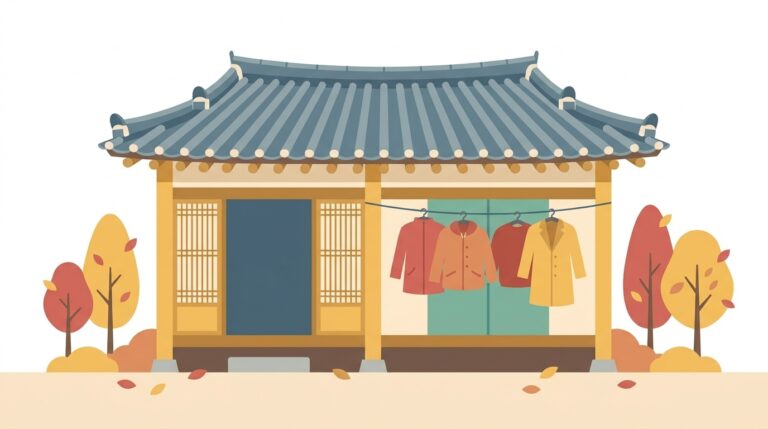
You can’t just toss a wool coat into a hostel washing machine. You need to find a local Korean dry cleaner (세탁소, Setakso), and you need to explain what happened without accidentally giving them permission to shrink your favorite coat to doll-size.
Navigating a Korean dry cleaner can feel intimidating. The friendly Ahjussi (older man) or Ahjumma (older woman) usually speaks lightning-fast, and textbook Korean won’t save you here. But don’t worry! This guide is based on real questions from learners who have successfully saved their wardrobes in Korea. Let’s turn you into an insider!
Phase 2: Core Expressions Deep Dive
Here are the top three expressions you need to survive the Setakso.
1. 이거 드라이 맡길게요. (Igeo deurai matgilgeyo.)
- Pronunciation: [i-geo deu-ra-i mat-gil-ge-yo] / ‘mat’ sounds like ‘mat’, and ‘gil’ sounds like fish ‘gills’.
- Meaning: Literal: ‘I will entrust this to dry.’ / Real nuance: ‘I’d like to drop this off for dry cleaning.’
- K-Culture Moment: In K-Dramas, you often see characters rushing into the neighborhood Setakso before work to drop off their suits. They don’t say long, formal sentences; they just hand over the clothes and say, ‘드라이 맡길게요.’
- Editor’s Insight: The verb 맡기다 (to entrust/leave something with someone) is a magical B1-level word! You use it for dry cleaning, leaving your luggage at a hotel, or even leaving your kids at daycare. It implies trust.
- Situation Spectrum:
- Casual with friends: 🚫 (You wouldn’t say this to a friend)
- Neighborhood Dry Cleaner: ✅ (Perfect and natural)
- High-end Hotel Laundry Service: ⚠️ (They might prefer more formal language)
- 🤔 Think About It: Why do Koreans use ‘맡기다’ (to entrust) instead of just ‘세탁하다’ (to wash)? What does this say about the relationship between local business owners and customers in Korea?
2. 이거 언제 찾을 수 있어요? (Igeo eonje chajeul su isseoyo?)
- Pronunciation: [i-geo eon-je cha-jeul su i-sseo-yo] / ‘cha-jeul’ sounds like ‘cha-jewel’.
- Meaning: Literal: ‘When can I find this?’ / Real nuance: ‘When can I pick this up?’
- K-Culture Moment: You’ve probably heard the verb ‘찾다’ used when looking for a lost item. But in Korea, you also ‘find’ your dry cleaning, ‘find’ your money at the ATM (withdraw), and ‘find’ your luggage.
- Editor’s Insight: Beginners often try to translate ‘pick up’ and use words like ‘가져가다’ (to take). But ‘찾다’ is the most natural way to ask when you can retrieve something you entrusted to a service.
- Situation Spectrum:
- Casual: ✅
- Semi-formal: ✅
- Formal: 🚫
- 🤔 Think About It: Why do you think the Korean language uses the same verb for ‘searching for something’ and ‘retrieving your own property’?
3. 여기 얼룩 좀 빼주세요. (Yeogi eolluk jom ppaejuseyo.)
- Pronunciation: [yeo-gi eol-luk jom ppae-ju-se-yo] / ‘ppae’ sounds like a sharp, tense ‘pay’.
- Meaning: Literal: ‘Please take out the stain here a little.’ / Real nuance: ‘Please remove this stain here.’
- K-Culture Moment: The moment of truth. You point to the Tteokbokki or Kimchi Jiggae stain. Adding ‘좀’ (a little/please) softens the request, making you sound polite rather than demanding.
- Editor’s Insight: The verb ‘빼다’ means to extract or remove. You use it for stains, taking out ingredients you don’t like (like onions in a burger), or even losing weight (살을 빼다).
- Situation Spectrum:
- Casual: ✅
- Semi-formal: ✅
- Formal: ⚠️
- 🤔 Think About It: Koreans love adding ‘좀’ to sentences. It softens the command. Does your language have a filler word that makes requests sound less aggressive?
Phase 3: Textbook vs. Real Korean
[Situation 1: Asking for dry cleaning]
* 📖 Textbook Korean: 이 코트를 세탁해 주시겠습니까? (Would you please wash this coat?)
* 🗣️ Real Korean: 코트 드라이 맡길게요. (I’ll leave this coat for dry cleaning.)
* 💡 Why the difference?: ‘세탁’ usually implies water-washing. If you say this, they might ruin your wool coat! Also, ‘-시겠습니까’ is way too formal for a neighborhood shop.
[Situation 2: Getting it done fast]
* 📖 Textbook Korean: 빨리 해 주실 수 있나요? (Can you do it quickly?)
* 🗣️ Real Korean: 급행으로 돼요? (Can it be done as an express service?)
* 💡 Why the difference?: Efficiency is key in Korea! ‘급행’ (Express) is the magic keyword for when you need that K-Pop concert outfit ready by tomorrow.
Phase 4: Cultural Context — K-Culture Deep Dive
4-1. Non-Verbal Nuances
When you hand over your clothes, try to use two hands if the owner is older than you (which is almost always the case in a traditional Setakso). Also, a little Nunchi goes a long way. If the shop is overflowing with clothes and the owner looks super busy, asking for a next-day express service might require a very polite tone and an apologetic smile.
4-2. The ‘Ahjussi’ Magic in Media vs. Reality
In Korean dramas like Reply 1988, the neighborhood dry cleaner is the hub of town gossip. The owner knows everyone’s business because they see everyone’s clothes! While modern Seoul has many app-based laundry services now (like Laundrygo), the local Setakso still holds a lot of Jeong (정, emotional connection). Often, the owner will sew a loose button for free just because you’re a regular.
Phase 5: Real-Life Roleplay Scenario
Setting: Saturday morning, 10:00 AM. A tiny, steam-filled Setakso in Yeonnam-dong. Racks of plastic-wrapped clothes hang from the ceiling.
Characters:
– YOU: A foreign resident who spilled coffee on a silk blouse right before a big job interview next week.
– Ahjussi (60s): The veteran dry cleaner owner. Fast-talking, highly skilled, wearing an apron.
Dialogue:
YOU: 안녕하세요! 이거 드라이 맡길게요.
(Annyeonghaseyo! Igeo deurai matgilgeyo.)
[Hello! I’d like to drop this off for dry cleaning.]
(🎭 Stage Direction: You carefully hand over the silk blouse with two hands.)
Ahjussi: 네, 봅시다. 아이고, 이거 커피 쏟았네?
(Ne, bopsida. Aigo, igeo keopi ssodanne?)
[Yes, let’s see. Oh my, did you spill coffee on this?]
YOU: 네… 여기 얼룩 좀 빼주세요.
(Ne… yeogi eolluk jom ppaejuseyo.)
[Yes… please remove the stain here.]
Ahjussi: 실크라서 조심해야 돼. 언제 필요해요?
(Silkeuraseo josimhaeya dwae. Eonje piryohaeyo?)
[It’s silk so I have to be careful. When do you need it?]
🔀 Your Turn! How do you reply?
– A) 다음 주 화요일까지요. (By next week Tuesday.)
– B) 빨리 줘. (Give it fast.)
– C) 언제 찾을 수 있어요? (When can I pick it up?)✅ Best Choice: A or C. C is great to throw the question back to him.
⚠️ Choice B Analysis: NEVER use ‘빨리 줘’. It is informal (반말) and incredibly rude to an older person.
(Assuming you chose C)
YOU: 언제 찾을 수 있어요?
(Eonje chajeul su isseoyo?)
[When can I pick it up?]
Ahjussi: 수요일 오후에 오세요.
(Suyo-il ohue oseyo.)
[Come on Wednesday afternoon.]
YOU: 네, 감사합니다!
(Ne, gamsahamnida!)
[Yes, thank you!]
Phase 6: 10-Second Shadowing Drill
Read this out loud, focusing on the pauses (/) and the emotion!
🥺 아저씨, / 이거 드라이 맡길게요. / 얼룩 좀 / 빼주세요~
(Ajeossi, / igeo deurai matgilgeyo. / eolluk jom / ppaejuseyo~)
[Mister, I’ll leave this for dry cleaning. Please remove the stain~]
Phase 7: K-Culture Mini Dictionary
1. 세탁소
* Romanization: Setakso
* English: Dry cleaner / Laundromat
* Context: The local hero of Korean neighborhoods. They do dry cleaning, ironing, and alterations.
2. 수선
* Romanization: Suseon
* English: Alterations / Repairs
* Context: If your pants are too long or your zipper is broken, you look for a place that says ‘수선’. Most Setakso do this too!
3. 드라이
* Romanization: Deurai
* English: Dry cleaning
* Context: A Konglish word. Koreans rarely say the full ‘dry cleaning’; they just shorten it to ‘dry’.
4. 코인 세탁방
* Romanization: Koin setakbang
* English: Coin laundromat
* Context: Very popular for university students living in tiny one-room apartments to wash huge winter blankets.
Phase 8: Traveler Survival Kit
Even if you are just visiting Korea for a week, you might need emergency laundry services!
🆘 Survival Phrases TOP 3
– 🇰🇷 “이거 얼마예요?” (Igeo eolmayeyo?) – How much is this?
– 🇰🇷 “내일까지 돼요?” (Naeilkkaji dwaeyo?) – Can it be done by tomorrow?
– 🇰🇷 “수선도 되나요?” (Suseondo doenayo?) – Do you do alterations too?📌 Editor’s Travel Note
– Map App Magic: Just type ‘세탁소’ into KakaoMap or Naver Map.
– Payment: Most small dry cleaners prefer you to pay when you pick up the clothes, not when you drop them off. But always ask! Also, very old shops might prefer cash or bank transfer (계좌이체), though cards are widely accepted now.
– No Tips: Do not leave a tip! Just a warm “감사합니다” (Thank you) is perfect.
Phase 9: Critical Thinking — “One Step Deeper”
Media vs Reality: The Evolution of the Korean Laundry
🧠 Think Deeper:
In K-Dramas, the Setakso is a romanticized place full of neighborhood warmth (Jeong). However, in modern globalized Seoul, young professionals increasingly rely on non-face-to-face app services like ‘Laundrygo’, where you leave a bin outside your door at night and get clean clothes the next day. This shift reflects Korea’s intense Palli-palli (hurry-hurry) culture and a desire for hyper-efficiency, sometimes at the cost of traditional neighborhood interactions.💬 Your Turn: How do people in your culture handle dry cleaning? Is it a quick errand, or do you know your dry cleaner by name? Let us know in the comments!
Phase 10: FAQ & Avoiding Common Mistakes
Q: Can I just say ‘씻어 주세요’ (Please wash it) for my clothes?
No! ‘씻다’ is strictly for washing your body or hands. If you want clothes washed with water, it’s ‘세탁하다’ or ‘빨래하다’. For dry cleaning, you must use ‘드라이’ (Dry).
Q: Do I need to use formal language with the owner?
Yes. Always use the ‘-요’ form. Using casual language (반말) to an older shop owner is considered incredibly rude.
❌ Common Mistake #1: Trying to use direct translations like ‘가져가다’ (to take) when picking up clothes.
✅ Do this instead: Always use ‘찾다’ (to find/retrieve) for picking up laundry, luggage, or reservations.
Phase 11: Summary & Action Items
One-Liner Summary: Use “드라이 맡길게요” to drop off clothes, and “언제 찾을 수 있어요?” to ask when they’ll be ready!
Action Mission 3 Steps:
– 🥉 Bronze: Say “이거 드라이 맡길게요” out loud 3 times in front of your mirror.
– 🥈 Silver: Open your closet, pick your favorite coat, and pretend to show the ‘stain’ (얼룩) to an imaginary Ahjussi.
– 🥇 Gold: Open KakaoMap, search for ‘세탁소’ near your favorite Seoul neighborhood, and see what the storefronts look like!
K-Culture Mission:
Next time you watch a K-Drama, look closely at the street scenes. I guarantee you will spot a sign that says “세탁” or “수선” in the background!
Phase 12: Interactive Quiz
1. Situational Judgment: You dropped off your K-pop concert outfit. It’s Friday, and you need to pick it up. What do you say to the owner?
– A) 이거 언제 씻어요? (When do you wash this?)
– B) 제 옷 내놔요. (Hand over my clothes.)
– C) 옷 찾으러 왔어요. (I came to pick up my clothes.)
2. Fill in the Blank:
“아저씨, 여기 커피 ( _____ ) 좀 빼주세요!”
Hint: The Korean word for ‘stain’.
3. True or False — K-Culture Edition:
In Korea, it is customary to tip your neighborhood dry cleaner if they remove a really tough stain. (T/F)
(Scroll down for answers!)
Click here for Answers
1. C (‘찾으러 왔어요’ uses the magic verb 찾다!). A is wrong because 씻다 is for bodies. B is aggressively demanding.
2. 얼룩 (eolluk)
3. False. There is no tipping culture in Korea! A polite bow and “감사합니다” is all you need.
Frequently Asked Questions (FAQ)
Q: What does "이거 드라이 맡길게요. (Igeo deurai matgilgeyo.)" mean in Korean and how do you pronounce it?
A: In Korean, "이거 드라이 맡길게요. (Igeo deurai matgilgeyo.)" is pronounced [i-geo deu-ra-i mat-gil-ge-yo] and means: Literal: 'I will entrust this to dry.' / Real nuance: 'I'd like to drop this off for dry cleaning.'
Q: What does "이거 언제 찾을 수 있어요? (Igeo eonje chajeul su isseoyo?)" mean in Korean and how do you pronounce it?
A: In Korean, "이거 언제 찾을 수 있어요? (Igeo eonje chajeul su isseoyo?)" is pronounced [i-geo eon-je cha-jeul su i-sseo-yo] and means: Literal: 'When can I find this?' / Real nuance: 'When can I pick this up?'
Q: What does "여기 얼룩 좀 빼주세요. (Yeogi eolluk jom ppaejuseyo.)" mean in Korean and how do you pronounce it?
A: In Korean, "여기 얼룩 좀 빼주세요. (Yeogi eolluk jom ppaejuseyo.)" is pronounced [yeo-gi eol-luk jom ppae-ju-se-yo] and means: Literal: 'Please take out the stain here a little.' / Real nuance: 'Please remove this stain here.'







