

Phase 1: Empathy (The K-Culture Cold Open)
Hello! This is your Daily Hangul Editor.
Picture this: You are at a bustling chicken and beer (chimaek) place in Seoul on a Friday night with your Korean male friends. The conversation is flowing, and suddenly, someone mentions their military days. The table instantly erupts. They start talking passionately about a legendary, mouth-watering burger they used to eat. You might be thinking, “Are they talking about Shake Shack? A Michelin-star burger?”
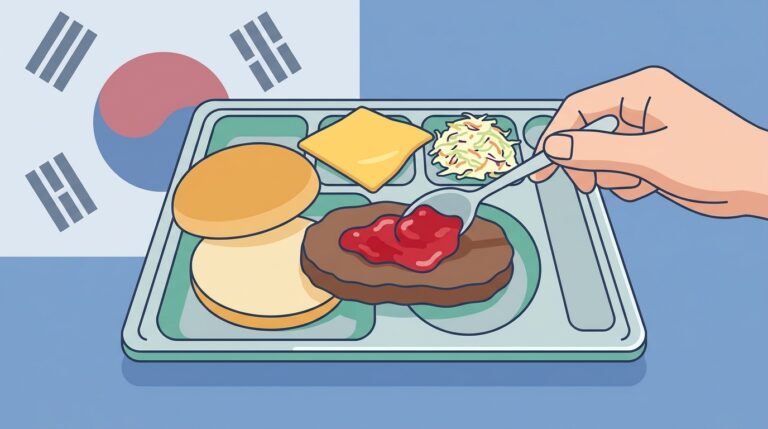
Nope. They are talking about ‘Gundae-ria’ (군대리아)—the DIY burger served in the Korean military.
If you’ve watched K-dramas like D.P. or Crash Landing on You, or if you’re waiting for your favorite K-Pop idols to finish their mandatory military service, you know that the military is a massive part of Korean culture. But why do grown men get so emotional over a soggy bun, a dubious meat patty, and… strawberry jam?
Understanding the taste and culture of Gundae-ria is the ultimate cheat code to bonding with Korean men. If you know how to talk about this, you won’t just be a foreign friend; you’ll be an absolute insider. Let’s dive into the fascinating world of military food!
Phase 2: Core Expressions Deep Dive
1. 추억의 맛 (Taste of nostalgia)
- Pronunciation: chu-eo-ge mat [choo-uh-geh mat] (The ‘eo’ sounds like the ‘u’ in ‘run’)
- Meaning: Literal: Taste of memories / Real nuance: Nostalgic flavor (food that might not be objectively gourmet, but tastes amazing because of the memories attached to it).
- K-Culture Moment: When a K-Pop idol visits their old neighborhood tteokbokki spot on a vlog and takes the first bite, they’ll close their eyes and say, “Ah… 진짜 추억의 맛이에요” (Ah… this is truly the taste of nostalgia).
- Editor’s Insight: This expression is heavily used for Gundae-ria. Korean men know the burger itself isn’t a culinary masterpiece, but the memory of eating it after an exhausting morning run makes it a “chu-eo-ge mat.”
- Situation Spectrum:
- Casual with friends: ✅
- Semi-formal with coworkers: ✅
- Formal with bosses/elders: ✅ (It’s universally relatable!)
- 🤔 Think About It: Why does nostalgia make food taste better? Do you have a “chu-eo-ge mat” from your high school cafeteria or hometown?
2. 빵에 딸기잼을 발라 먹다 (To spread strawberry jam on bread)
- Pronunciation: ppang-e ttal-gi-jae-meul bal-la meok-tta [ppang-eh ttal-ghee-jaem-eul bahl-lah muk-tta] (For ‘pp’, tense your lips like you’re about to pop a balloon!)
- Meaning: Literal: To spread strawberry jam on bread and eat it / Real nuance: The absolute core secret to eating a Gundae-ria burger.
- K-Culture Moment: The defining feature of Gundae-ria is mixing savory (meat, mac and cheese salad) with sweet (strawberry or grape jam). It sounds bizarre, but don’t knock it until you try it!
- Editor’s Insight: The verb 바르다 (to spread/apply) is very versatile! You use it for jam, butter, and even applying skincare or sunscreen (K-Beauty tip: 선크림을 바르다!).
- Situation Spectrum:
- Casual with friends: ✅
- Semi-formal with coworkers: ✅
- Formal with bosses/elders: ⚠️ (Fine to say, but use the polite ending: 발라 먹어요)
- 🤔 Think About It: Combining sweet and savory (단짠단짠 – sweet and salty) is a huge trend in K-Food. Why do Koreans love mixing these contrasting flavors?
3. 짬밥 (Military ration / Seniority)
- Pronunciation: jjam-ppap [jjam-ppap] (Sounds like ‘jam’ and ‘bop’, but squeeze your throat tight on both syllables!)
- Meaning: Literal: Leftover rice (archaic) / Real nuance: 1. Military food in general. 2. Slang for ‘seniority’ or ‘years of experience’ in the real world.
- K-Culture Moment: In a workplace drama, a veteran detective might say to a rookie, “내가 이 바닥에서 먹은 짬밥이 몇 년인데!” (Do you know how many years of ‘jjam-ppap’ I’ve eaten in this field?! = Do you know how much experience I have?!)
- Editor’s Insight: This is a very casual, masculine slang term derived from the military. Use it with caution, but understanding it will make you a K-Drama master.
- Situation Spectrum:
- Casual with friends: ✅
- Semi-formal with coworkers: ⚠️ (Only if you are very close)
- Formal with bosses/elders: 🚫 (Never use it to your boss!)
- 🤔 Think About It: Why did a word for “military food” become a metaphor for “work experience”? What does this tell us about the hierarchical nature of Korean society?
Phase 3: Textbook vs. Real Korean
[Describing Military Food]
* 📖 Textbook Korean: 군대 햄버거는 맛있습니다. (Military hamburgers are delicious.)
* 🗣️ Real Korean: 군대리아는 완전 추억 보정이죠. (Gundae-ria is totally a ‘nostalgia filter/bias’.)
* 💡 Why the difference?: ‘추억 보정’ (Memory filter/bias) is a trendy internet slang used to admit that something might not actually be great, but our fond memories make it seem flawless.
[Asking about the recipe]
* 📖 Textbook Korean: 햄버거에 잼을 넣습니까? (Do you put jam in the hamburger?)
* 🗣️ Real Korean: 고기 패티에 딸기잼 바르는 거 실화예요? (Spreading strawberry jam on a meat patty, is that for real?)
* 💡 Why the difference?: ‘실화예요?’ (Is this a true story? / Is this for real?) is widely used to express mild shock or disbelief, perfectly capturing a foreigner’s reaction to the Gundae-ria recipe!
Bottom Note: For B2 level learners, using words like 추억 보정 (Nostalgia bias) and 실화예요 (Is that for real?) will make you sound incredibly fluent and culturally tuned in.
Phase 4: Cultural Context — K-Culture Deep Dive
4-1. Non-verbal Cues: The Nostalgia Sigh
When Korean men talk about Gundae-ria or Jjam-ppap, they rarely just say “It was good.” They usually lean back, let out a deep, dramatic sigh (often staring into the distance), and say, “하아… 그때 진짜 맛있었는데” (Haa… it was really delicious back then). To match their energy, you should act highly curious and slightly shocked!
4-2. K-Drama & Variety Shows
If you watch military variety shows like Real Men (진짜 사나이), the Gundae-ria eating scene is a staple trope. The exhausted recruits take their first bite of the jam-infused burger, and CGI fireworks explode behind their heads. It highlights the stark contrast between the harsh reality of military training and the small joy of a sweet meal.
Critical View: In reality, not everyone loves Gundae-ria. Many soldiers complain about it because the bread can be dry or soggy. The media romantizes it, but for many, the love for Gundae-ria only begins after they are discharged!
Phase 5: Real-Life Roleplay Scenario
Setting: Friday, 8:00 PM. A lively Galbi (Korean BBQ) restaurant in Hongdae. The smell of grilling meat is in the air. You are having dinner with your Korean coworker, Minsu, who just finished grilling a piece of meat.
Characters:
– YOU: A foreign professional working in Korea, curious about local culture.
– Minsu (30): Your friendly, slightly dramatic Korean colleague who served in the Army 8 years ago.
Dialogue:
Minsu: 아, 상추에 고기 싸 먹으니까 진짜 맛있네요! 🥬
(Ah, sangchue gogi ssa meogeunikka jinjja masinneyo!)
[Ah, eating the meat wrapped in lettuce is so delicious!]
YOU: 맞아요. 그런데 민수 씨, 제가 인터넷에서 ‘군대리아’라는 걸 봤어요.
(Majayo. Geureonde Minsu ssi, jega internet-eseo ‘Gundae-ria’raneun geol bwasseoyo.)
[Right. By the way, Minsu, I saw something called ‘Gundae-ria’ on the internet.]
Minsu: (🎭 Stage Direction: Minsu’s eyes widen and he drops his tongs) 헐! 군대리아를 알아요?
(Heol! Gundae-riareul arayo?)
[Gasp! You know Gundae-ria?]
YOU: 네, 햄버거에 딸기잼을 바른다고 들었어요. 그거 진짜예요?
(Ne, haembeogeoe ttal-gi-jaemeul bareundago deureosseoyo. Geugeo jinjjayeyo?)
[Yes, I heard you spread strawberry jam on a hamburger. Is that real?]
Minsu: 그럼요! 빵에 딸기잼 바르고, 패티 넣고, 우유랑 같이 먹으면… 하아, 완전 추억의 맛이죠.
(Geureomyo! Ppange ttal-gi-jaem bareugo, paeti neogo, uyurang gachi meogeumyeon… ha-a, wanjeon chu-eo-ge masijyo.)
[Of course! Spread strawberry jam on the bread, add the patty, and eat it with milk… haa, it’s totally the taste of nostalgia.]
🔀 Your Turn! How should you respond?
– A) 윽… 너무 이상할 것 같아요. (Ew… that sounds too weird.)
– B) 우와, 무슨 맛일지 궁금해요! 저도 먹어보고 싶어요. (Wow, I wonder what it tastes like! I want to try it too.)
– C) 민수 씨 짬밥 많이 먹었네요! (You’ve eaten a lot of Jjam-ppap, Minsu!)✅ Best Choice: B — Showing curiosity about their military experience is a great way to bond. Koreans love when foreigners show open-mindedness toward unique Korean combinations!
⚠️ Choice A & C Analysis: Choice A might sound a bit rude to something they cherish. Choice C uses ‘짬밥’ (Jjam-ppap), which is funny but might be too informal or jarring coming from a coworker in a casual chat unless you are very close bros.
Phase 6: 10-Second Shadowing Drill
Listen to the rhythm and try to copy the emotion! Notice how the voice goes up at the end to express disbelief.
😲 햄버거에 / 딸기잼을 / 바른다고요? / 실화예요?
(haembeogeo-e / ttal-gi-jaem-eul / ba-reun-da-go-yo? / sil-hwa-ye-yo?)
You put strawberry jam / in a hamburger? / Is that for real?
Phase 7: K-Culture Mini Dictionary
1. 군대리아 (Gundae-ria)
* Romanization: Gundae-ria
* English: Military Burger
* Context: A portmanteau of ‘Gundae’ (Military) and ‘Lotteria’ (a popular Korean fast-food chain). The DIY burger served on weekends in the Korean military.
2. 짬밥 (Jjam-ppap)
* Romanization: Jjam-ppap
* English: Military ration / Seniority
* Context: Originally meaning military food, now widely used in society to denote how many years of experience someone has in a specific field.
3. 추억 보정 (Chu-eok Bo-jeong)
* Romanization: Chu-eok bo-jeong
* English: Nostalgia bias / Memory filter
* Context: When something (like a movie, game, or military food) is remembered as being much better than it actually was because of sentimental value.
4. 단짠단짠 (Dan-jjan-dan-jjan)
* Romanization: Dan-jjan-dan-jjan
* English: Sweet and salty
* Context: The ultimate Korean flavor profile. The reason why Gundae-ria (salty patty + sweet jam) actually works for the Korean palate.
Phase 8: Traveler Survival Kit
As a traveler, you won’t be enlisting in the Korean military anytime soon! But you will meet Korean men, and knowing how to ask about their service respectfully is a great conversation starter.
🆘 Survival Expressions
– 🇰🇷 “군대 다녀오셨어요?” (Gundae danyeo-osyeosseoyo?)
– 🗣️ Pronunciation Guide: [goon-dae dan-nyo-oh-shus-uh-yo?]
– 📍 Where to use: Making small talk with male Korean friends or language exchange partners.
– 💡 Pro Tip: Almost all able-bodied Korean men go to the military in their early 20s. Asking this shows you understand Korean culture!📌 Editor’s Travel Note
– Want to taste Gundae-ria? Occasionally, Korean fast-food chains like Lotteria will release a “Military Burger” meal for a limited time. Keep an eye out for it!
– Convenience Stores: You can often find “military-style” dry rations (건빵 – hardtack) or combat rations (전투식량 – just add hot water!) in large marts or online. They make fun souvenirs!
Phase 9: Critical Thinking — “One Step Deeper”
Food & Identity (음식과 정체성): The Brotherhood of Taste
🧠 Think Deeper:
Why is Gundae-ria so famous? It’s not because of a secret gourmet recipe. In Korea, eating together is a profound act of community (the word for family, ‘식구/Sik-gu’, literally means ‘mouths that eat together’). In the military, young men from entirely different backgrounds suffer through extreme physical training and then sit down to eat the exact same strange, jam-filled burger. This shared culinary experience builds a lifelong brotherhood and identity among Korean men. The taste of Gundae-ria is essentially the taste of camaraderie.💬 Your Turn: Does your culture have a specific food that isn’t considered “high-class,” but everyone loves it because of a shared struggle or school memory? Let me know in the comments!
Phase 10: FAQ & Avoiding Mistakes
Q: Can I ask an older Korean man about his military service?
Yes! Most Korean men are very proud of their service and love talking about it. Just use the polite form: “군대 생활은 어떠셨어요?” (How was your military life?).
Q: Do K-Pop idols eat Gundae-ria too?
Yes! Regardless of their fame and wealth, all enlisted soldiers eat the same jjam-ppap. It’s a great equalizer in Korean society.
❌ Common Mistake #1: Saying “The military sounds like a fun summer camp!”
✅ Do this instead: Acknowledge their hard work. Say, “정말 고생하셨네요” (You really went through a lot of trouble/worked hard). The military is physically and mentally taxing, and minimizing it can be offensive.❌ Common Mistake #2: Assuming women know nothing about it.
✅ Do this instead: While women don’t have mandatory service, they often have boyfriends, brothers, or friends who served. They are very familiar with terms like Gundae-ria and Jjam-ppap!
Phase 11: Summary & Action Items
- One-Liner Summary: Gundae-ria is more than a burger with jam; it’s the “taste of nostalgia” (추억의 맛) that unites Korean men through shared military memories.
-
Action Mission 3 Steps:
- 🥉 Bronze (Solo): Read aloud: “햄버거에 딸기잼을 바른다고요?”
- 🥈 Silver (Online): Go to YouTube, search “군대리아 먹방” (Gundae-ria Mukbang) and leave a comment: “진짜 추억의 맛일 것 같아요!”
- 🥇 Gold (Real Life): Ask your Korean guy friend, “군대리아 먹어봤어요? 진짜 잼 발라 먹어요?”
- K-Culture Mission:
Next time you eat a burger, try putting a little bit of strawberry jam on the bun. See if you can understand the “Dan-jjan-dan-jjan” (sweet and salty) magic!
Phase 12: Quiz — Interactive Challenge
1. Fill in the blank:
“Wow, this tteokbokki tastes just like the one I had in high school! It’s totally the taste of ________.”
A) 짬밥 (Jjam-ppap)
B) 추억의 맛 (Chu-eo-ge mat)
C) 실화 (Sil-hwa)
2. True or False — K-Culture Edition:
In Korea, ‘Jjam-ppap (짬밥)’ only refers to military food and is never used in regular office settings. (T/F)
3. Situational Judgment:
Your 50-year-old boss is talking about his military days and says the food was the best in the world. Which response makes you look like a K-Culture genius?
A) 거짓말하지 마세요! (Don’t lie!)
B) 에이~ 부장님, 그거 완전 추억 보정 아니에요? ㅎㅎ (Ay~ Boss, isn’t that totally nostalgia bias? Haha)
C) 짬밥이 맛있군요. (Jjam-ppap is delicious.)
(Answers: 1. B / 2. False – It means ‘seniority’ in the workplace too / 3. B – It’s cheeky, witty, and perfectly uses the slang ‘추억 보정’ while keeping the polite ‘부장님’ title!)
Frequently Asked Questions (FAQ)
Q: What does "추억의 맛 (Taste of nostalgia)" mean in Korean and how do you pronounce it?
A: In Korean, "추억의 맛 (Taste of nostalgia)" is pronounced [chu-eo-ge mat [choo-uh-geh mat] and means: Literal: Taste of memories / Real nuance: Nostalgic flavor (food that might not be objectively gourmet, but tastes amazing because of the memories attached to it).
Q: What does "빵에 딸기잼을 발라 먹다 (To spread strawberry jam on bread)" mean in Korean and how do you pronounce it?
A: In Korean, "빵에 딸기잼을 발라 먹다 (To spread strawberry jam on bread)" is pronounced [ppang-e ttal-gi-jae-meul bal-la meok-tta [ppang-eh ttal-ghee-jaem-eul bahl-lah muk-tta] and means: Literal: To spread strawberry jam on bread and eat it / Real nuance: The absolute core secret to eating a Gundae-ria burger.
Q: What does "짬밥 (Military ration / Seniority)" mean in Korean and how do you pronounce it?
A: In Korean, "짬밥 (Military ration / Seniority)" is pronounced [jjam-ppap [jjam-ppap] and means: Literal: Leftover rice (archaic) / Real nuance: 1. Military food in general. 2. Slang for 'seniority' or 'years of experience' in the real world.







