

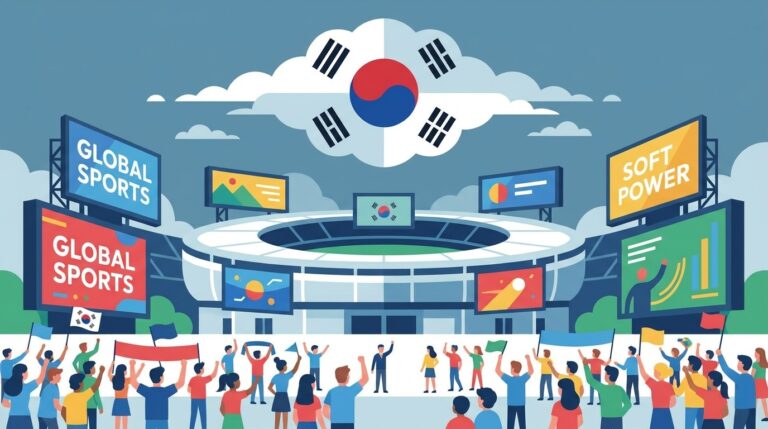
Beyond “We Won”: How Korea Uses Sports to Build a Global Empire 🏆
Phase 1: Empathy (Immersive Opening)
안녕하세요! 매일한글 (Daily Hangul) 에디터입니다.
Imagine this: You are watching the League of Legends World Championship, or perhaps the World Cup. Son Heung-min scores a spectacular goal, or Faker lifts the trophy. The Korean commentators aren’t just screaming “We won!” They are using words that sound like they belong in a UN summit. “국위 선양을 했습니다!” (They have enhanced our national prestige!)
If you’ve ever watched a Korean sports broadcast or read a Korean news article about an international sporting event, you might have noticed that sports here are rarely just sports. They are high-stakes diplomatic missions. For advanced (C2) learners, understanding how Koreans discuss the intersection of sports, marketing, and national image is crucial. It reveals how a nation that rapidly developed over the past few decades uses “Soft Power” to establish its global footprint.
Today, we are diving deep into the sophisticated language of sports marketing and national branding. This article is built on real discussions held in Seoul’s boardrooms and PR agencies. By the end of this, you won’t just sound fluent; you’ll sound like a local industry expert.
Phase 2: Core Expressions Deep Dive
Here are the most critical expressions used when discussing sports marketing and its effect on national image.
1. 국위 선양 (Enhancing National Prestige)
- Pronunciation: gungwi seonyang [goong-wee sun-yang]
- Meaning: Literal: Promoting national prestige / Real nuance: Elevating the country’s status on the global stage through outstanding achievements.
- K-Culture Moment: This is the ultimate compliment for any Korean athlete or artist (like BTS). When an athlete wins an Olympic gold medal, news anchors tearfully declare that they have achieved “국위 선양.” It’s historically tied to military exemption policies for athletes.
- Editor’s Insight: This isn’t a phrase you use for minor victories. It carries a heavy, patriotic weight. It implies that the individual’s success is a direct contribution to the nation’s geopolitical value.
- Situation Spectrum:
- Casual with friends: ⚠️ (Used sarcastically or playfully, e.g., “Wow, your TikTok went viral globally? 국위 선양이네!”)
- Semi-formal (Co-workers): ✅
- Formal (Boss/News/Presentations): ✅
- 🤔 Think About It: Why does Korea place such heavy emphasis on individual athletes bringing glory to the nation? How does this reflect the collective mindset (집단주의) versus the individualistic mindset of Western sports cultures?
2. 위상을 드높이다 (To Elevate the Status)
- Pronunciation: wisangeul deunopida [wee-sang-eul deu-no-pi-da]
- Meaning: Literal: To highly raise the phase/status / Real nuance: To boost the brand value and global standing of the country or a specific brand.
- K-Culture Moment: Corporate PR teams love this phrase. When a Korean conglomerate sponsors a major European football club, the press release will inevitably state: “글로벌 시장에서 브랜드 위상을 드높일 계획입니다” (We plan to elevate our brand status in the global market).
- Editor’s Insight: ‘위상’ (status/stature) is a C2-level keyword. You can pair it with ‘국가’ (nation) or ‘브랜드’ (brand). It sounds incredibly professional and is perfect for high-level business meetings or TOPIK II writing.
- Situation Spectrum:
- Casual with friends: 🚫 (Too stiff)
- Semi-formal (Co-workers): ✅
- Formal (Boss/News/Presentations): ✅
- 🤔 Think About It: How does the language of corporate marketing blur with the language of patriotism in Korea?
3. 파급 효과 (Ripple Effect / Spillover Effect)
- Pronunciation: pageup hyogwa [pa-geup hyo-gwa]
- Meaning: The economic or social impact that spreads from a single event.
- K-Culture Moment: When discussing why a city fought so hard to host the Olympics or why a company paid millions for a stadium naming right, analysts discuss the “경제적 파급 효과” (economic ripple effect).
- Editor’s Insight: When you want to sound incredibly smart during a debate about sports marketing ROI (Return on Investment), drop this word.
- Situation Spectrum:
- Casual with friends: ⚠️ (A bit academic, but usable in serious debates)
- Semi-formal (Co-workers): ✅
- Formal (Boss/News/Presentations): ✅
Phase 3: Textbook vs. Real Korean
Let’s see how textbook terminology translates into actual boardroom and internet slang.
[Situation 1: Describing an athlete’s global impact]
* 📖 Textbook Korean: 그는 훌륭한 선수로서 국가의 이미지를 좋게 만듭니다. (He is a great athlete who makes the country’s image good.)
* 🗣️ Real Korean: 캬, 완전 월클이네. 국위 선양 제대로 한다! (Wow, total World Class. He’s really elevating national prestige!)
* 💡 Why the difference?: “월클” (World Class) is a widely accepted slang term born from sports fandoms but now used everywhere to denote top-tier global success.
[Situation 2: Discussing the ROI of a sports sponsorship]
* 📖 Textbook Korean: 스포츠 후원을 통해 회사의 인지도가 높아졌습니다. (Through sports sponsorship, the company’s awareness has increased.)
* 🗣️ Real Korean: 스폰서십 덕분에 글로벌 브랜드 가치가 떡상했죠. 낙수 효과도 장난 아니고요. (Thanks to the sponsorship, our global brand value skyrocketed. The trickle-down effect is no joke either.)
* 💡 Why the difference?: “떡상” (skyrocketing/going straight up) comes from stock market slang but is heavily used in marketing. “낙수 효과” (trickle-down effect) adds a layer of economic savvy to the conversation.
Phase 4: Cultural Context — K-Culture Deep Dive
4-1. Non-Verbal Elements
When presenting on “국위 선양” or national image in a corporate setting, posture matters. Koreans often use a modest, slightly downward gaze when speaking about their own achievements, but when speaking about national achievements through sports, the tone becomes remarkably confident, with strong eye contact and upright posture. It’s collective pride.
4-2. K-Culture Connection: E-Sports & The New National Image
If you watch a Korean drama about the corporate world (like Search: WWW or Agency), you’ll often see scenes where executives fiercely debate where to allocate their marketing budgets.
Historically, this was about putting logos on baseball caps. Today, it’s about E-sports. Korea has successfully marketed itself as the Mecca of E-sports. When a company sponsors a team like T1, they aren’t just buying ad space; they are buying into Korea’s modern “Soft Power.”
Critical Viewpoint: While media portrays this synergy as universally beneficial, it places immense pressure on athletes to not just win, but to be flawless moral ambassadors for the country. One scandal doesn’t just ruin the athlete; it’s often framed as “tarnishing the national image” (국가 망신).
Phase 5: Real-World Roleplay Scenario
Setting: Friday afternoon, 3 PM. A sleek meeting room in a Gangnam PR agency. You are discussing the aftermath of the recent Asian Games with your PR Team Leader, Ji-hoon.
Characters:
– YOU (Expat Marketing Director): You need to decide whether to renew a multi-million dollar sponsorship for a national fencing team.
– Ji-hoon (38, PR Team Leader): Highly strategic, focused on data and national sentiment.
Dialogue:
지훈: 디렉터님, 이번 아시안 게임 스폰서십 결과 보고서 보셨나요? 파급 효과가 기대 이상입니다.
(direkteonim, ibeon asian geim seuponseosip gyeolgwa bogoseo bosyeonnayo? pageup hyogwaga gidae isang-imnida.)
[Director, have you seen the results report for the Asian Games sponsorship? The ripple effect exceeded expectations.]
YOU: 네, 봤습니다. 브랜드 인지도가 글로벌 시장에서 많이 올랐더군요.
(ne, bwatseumnida. beuraendeu injidoga geullobeol sijang-eseo mani ollatteogunyo.)
[Yes, I saw it. Our brand awareness rose significantly in the global market.]
지훈: 맞습니다. 특히 해당 선수들이 금메달을 따면서 국위 선양을 했다는 여론이 형성됐고, 그게 저희 브랜드 이미지에 그대로 긍정적으로 작용했습니다.
(matseumnida. teuki haedang seonsudeuri geummedareul ttamyeonseo gungwi seonyang-eul haetdaneun yeoroni hyeongseongdwaetgo, geuge jeohoi beuraendeu imijie geudaero geungjeongjeogeuro jagyonghaetseumnida.)
[Exactly. Especially as the athletes won gold medals, public opinion formed that they enhanced national prestige, which directly and positively impacted our brand image.]
🔀 Your Turn! How do you respond?
– A) “그래요? 그럼 계약을 연장합시다. 돈이 최고죠!” (Is that so? Let’s extend the contract. Money is the best!)
– B) “단순한 노출을 넘어, 국가 브랜드 위상 제고에 기여했다는 점을 다음 PR 포인트로 잡으면 좋겠네요.” (Beyond simple exposure, it would be good to set our next PR point on the fact that we contributed to elevating the national brand status.)
– C) “아, 진짜 대박이네요. 국뽕 차오릅니다!” (Ah, truly a jackpot. I’m filled with national pride!)✅ Best Choice: B — Reason: At a C2 level in a corporate environment, using terms like “위상 제고” (elevating status) shows a profound understanding of Korean corporate PR strategy.
⚠️ Choice C Analysis: “국뽕” (Gukppong) is a very common internet slang for extreme national pride. While funny and showing cultural fluency, using it in a formal boardroom with a team leader might be too casual, though acceptable at the after-work dinner (회식).
지훈: 정확하십니다. ‘한국을 대표하는 기업’이라는 프레임으로 다음 캠페인 기획안을 준비해 보겠습니다.
(jeonghwakhasimnida. ‘hangugeul daepyohaneun gieop’iraneun peureimeuro daeum kaempein gihoeganeul junbihae bogetseumnida.)
[Spot on. I will prepare the next campaign proposal using the frame of ‘a company representing Korea.’]
Phase 6: 10-Second Shadowing Drill
Let’s practice the intonation of a high-level corporate statement.
😤 단호하고 전문적으로 (Firmly and professionally):
스포츠 마케팅은 / 단순한 광고가 아니라, / 국가의 위상을 드높이는 / 핵심 전략입니다.
(seupocheu maketing-eun / dansunhan gwang-goga anira, / guggaui wisang-eul deunopineun / haegsim jeonlyag-ibnida.)
Phase 7: K-Culture Mini-Dictionary
Here are advanced vocabulary words surrounding sports and national identity:
1. 국뽕
* Romanization: gukppong
* English: Nationalistic pride / Patriotism (Slang)
* Context: A portmanteau of 국가 (Nation) and 히로뽕 (Philopon/Methamphetamine). It means being “intoxicated” with national pride. Used often when a Korean athlete dominates a foreign league.
2. 월클
* Romanization: wolkeul
* English: World Class
* Context: Short for World Class. Used to describe individuals (like Son Heung-min, Faker, or BTS) who have surpassed domestic standards and are globally recognized.
3. 국가 대표 (국대)
* Romanization: gukga daepyo (gukdae)
* English: National Team Player
* Context: Being called a “Gukdae” is an immense honor. Brands often use “Gukdae” metaphorically to describe their products (e.g., “The National Team of Skincare”).
4. 낙수 효과
* Romanization: naksu hyogwa
* English: Trickle-down effect
* Context: Economic terminology heavily used in sports marketing to describe how a mega-event benefits local small businesses and national tourism.
Phase 8: Traveler Survival Kit
Even as a C2 learner, applying advanced concepts to real-life travel (like attending a World Cup qualifier in Seoul) is essential.
🆘 Survival Phrases for the Stadium
– 🇰🇷 “기념품 샵에서 국가대표 유니폼 마킹 되나요?” (ginyeompum syab-eseo gukgadaepyo yunipom making doenayo?)
– 🗣️ English: Can I get the national team uniform customized (names/numbers marked) at the souvenir shop?
– 📍 Where to use: Seoul World Cup Stadium, E-sports arenas.
– 💡 Pro Tip: Koreans use the Konglish word “마킹” (Marking) instead of “customization” or “printing” for sports jerseys.📌 Editor’s Travel Note
– Ticketing: Getting tickets for a major sporting event in Korea (like a Son Heung-min match or LoL finals) is a bloodbath known as “피켓팅” (Blood + Ticketing). You must use Korean platforms like Interpark Ticket, and having a fast internet connection (PC Bang) is practically mandatory.
– Cheering Culture: Korean sports are loud. Baseball and football matches have designated cheerleaders and specific songs (응원가) for every single player. Join in!
Phase 9: Critical Thinking Corner — “A Step Deeper”
🧠 Think Deeper: Media vs Reality & The Weight of the Flag
In Western sports, athletes primarily represent their clubs, themselves, and their personal brands. However, in Korea, the media framework constantly ties an athlete’s success to the nation’s “Soft Power” (소프트 파워). When a Korean athlete signs with a major European team, the news focuses on how many tourists this will bring to Korea or how it boosts the sales of Korean cars in Europe.
This creates a double-edged sword. On one hand, athletes receive unparalleled, passionate support from the entire nation (the good side of 국뽕). On the other hand, a personal slump or mistake is heavily criticized as “bringing shame to the country” (국가 망신). As Korea continues to expand its global influence, there is an ongoing sociological debate about whether it’s time to decouple individual sporting success from the heavy burden of national prestige.
💬 Your Turn: Does your home country connect sports success to national brand value as tightly as Korea does? Or is it viewed purely as entertainment? Share your thoughts in the comments!
Phase 10: FAQ & Common Mistakes
Q: Can I use ‘국위 선양’ to compliment my Korean friend who got a job overseas?
A: Yes, but only as a joke! It’s a very grandiose term. Using it for personal, everyday achievements is a common form of Korean sarcastic humor.
Q: What is the difference between ‘자랑스럽다’ (to be proud) and ‘위상을 드높이다’ (to elevate status)?
A: ‘자랑스럽다’ is an emotional state. ‘위상을 드높이다’ is an objective, strategic outcome. You feel ‘자랑스럽다’ because the athlete ‘위상을 드높였기 때문에’.
❌ Common Mistake #1: Translating “Marketing ROI” directly as “마케팅 알오아이.”
✅ Do this instead: In formal Korean sports business, use “마케팅 파급 효과” (Marketing ripple effect) or “투자 대비 효용” to sound like a true native executive.❌ Common Mistake #2: Confusing “국위 선양” with nationalism in a negative sense.
✅ Do this instead: Remember that “국위 선양” has a very positive, respectful connotation in Korea, completely detached from the negative historical baggage that “nationalism” might carry in some Western contexts.
Phase 11: Summary & Action Items
One-Liner Summary: Korean sports marketing isn’t just about selling products; it’s about executing “국위 선양” (enhancing national prestige) and elevating the country’s global “위상” (status).
Action Mission:
– 🥉 Bronze (Solo): Read a Korean news article about an international sporting event and find the words ‘위상’, ‘국위 선양’, or ‘파급 효과’.
– 🥈 Silver (Online): Write a comment on a YouTube highlight of a Korean athlete using the phrase “완전 월클이네요! 국위 선양 제대로 하네요!”
– 🥇 Gold (Real World): The next time you discuss business or marketing with Korean colleagues, use the term “브랜드 위상을 드높이다” to describe a goal.
K-Culture Mission:
Go to YouTube and search for “손흥민 국위 선양” or “페이커 국위 선양” (Son Heung-min / Faker enhancing national prestige). Listen to how the newscasters pitch their voices when they say it. It’s a masterclass in Korean public speaking tone!
Phase 12: Quiz — Interactive Challenge
1. Situational Judgment: You are presenting a new sports sponsorship strategy to the CEO. Which sentence is the most appropriate?
– A) 이번 스폰서십으로 우리 회사가 떡상할 것입니다.
– B) 이번 스폰서십은 글로벌 시장에서 당사의 위상을 드높일 핵심 전략입니다.
– C) 이번 기회에 저희도 국뽕을 한번 느껴봅시다.
Answer: B. (A uses slang “떡상”, C uses slang “국뽕”, neither is appropriate for a CEO presentation).
2. Fill in the Blank:
“올림픽 개최는 단순한 스포츠 행사를 넘어, 엄청난 경제적 ( _______ )를/을 가져옵니다.”
Hint: The ripple effect.
Answer: 파급 효과
3. True or False – K-Culture Edition:
In Korea, an athlete’s success in a foreign country is often reported by the media as a contribution to the nation’s diplomatic and economic status. (T/F)
Answer: True! This is the core concept of “국위 선양”.
훌륭합니다! (Excellent!) You’ve just leveled up your professional Korean vocabulary.
💬 What sports team or athlete is the biggest “Soft Power” asset for your country? Let us know below!
Frequently Asked Questions (FAQ)
Q: What does "국위 선양 (Enhancing National Prestige)" mean in Korean and how do you pronounce it?
A: In Korean, "국위 선양 (Enhancing National Prestige)" is pronounced [gungwi seonyang [goong-wee sun-yang] and means: Literal: Promoting national prestige / Real nuance: Elevating the country's status on the global stage through outstanding achievements.
Q: What does "위상을 드높이다 (To Elevate the Status)" mean in Korean and how do you pronounce it?
A: In Korean, "위상을 드높이다 (To Elevate the Status)" is pronounced [wisangeul deunopida [wee-sang-eul deu-no-pi-da] and means: Literal: To highly raise the phase/status / Real nuance: To boost the brand value and global standing of the country or a specific brand.
Q: What does "파급 효과 (Ripple Effect / Spillover Effect)" mean in Korean and how do you pronounce it?
A: In Korean, "파급 효과 (Ripple Effect / Spillover Effect)" is pronounced [pageup hyogwa [pa-geup hyo-gwa] and means: The economic or social impact that spreads from a single event.






