

Phase 1: Empathy & Immersion
안녕하세요! (Hello!) I’m your Daily Hangul editor.
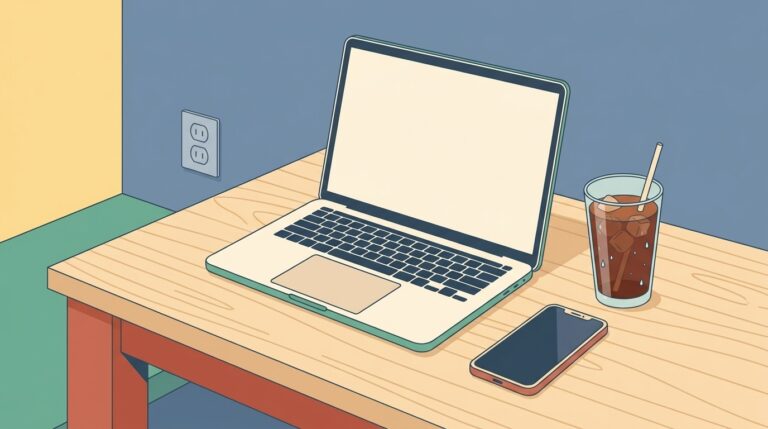
Imagine this: You walk into a trendy cafe in Seongsu-dong, Seoul. It’s packed. You finally spot an empty table, but wait… there is a shiny new MacBook and a leather wallet just sitting there. There is absolutely no owner in sight. Did someone forget their belongings? Should you tell the staff?
If you’ve watched any modern K-Drama, you might have seen the main character furiously typing on a laptop, then casually leaving all their expensive gear on the table just to order another Iced Americano.
Welcome to Korea’s extreme ‘trust culture’ and the intense world of 카공 (Ka-gong: Cafe Studying/Working). As a digital nomad or a traveler wanting to rest your feet and upload photos, using a laptop in a Korean cafe is an absolute must-experience. But to do it right—finding an outlet, getting the Wi-Fi, and surviving the unspoken cafe rules—you need a few survival phrases.
Don’t worry! This guide is built from the real panics and victories of my foreign students. Let’s make you look like a total Seoul local!
Phase 2: Deep Dive into Core Expressions
1. 콘센트 어디 있어요?
- Pronunciation: konsenteu eodi isseoyo? [kon-sen-teu uh-dee ee-suh-yo?]
- Sound-alike guide: ‘kon-sen-teu’ sounds like you’re saying the English word ‘consent’ with a tiny ‘eu’ (like the ‘oo’ in ‘book’) at the end.
- Meaning: Where is the electrical outlet?
- K-Culture Moment: You are down to 5% battery, about to secure tickets for a K-Pop concert. You frantically look around the cafe. You ask the barista this exact phrase, and they point to a hidden spot right under your chair. Saved!
- Editor’s Insight: Do NOT ask for an ‘outlet’. In Korea, an ‘아울렛’ (outlet) means a giant shopping mall! We use the Konglish word ‘콘센트’ (from concentric plug) for electrical sockets.
- Situation Spectrum:
- Casual with friends: ✅ (콘센트 어딨어?)
- Cafe Staff (Semi-formal): ✅ (콘센트 어디 있어요?)
- Formal business: ⚠️
- 🤔 Think About It: Why do Koreans use so many borrowed and modified English words (Konglish) for modern technology? Does your language do this too?
2. 와이파이 비밀번호 뭐예요?
- Pronunciation: waipai bimilbeonho mwoyeyo? [wa-ee-pa-ee bee-meel-bun-ho mwo-yeh-yo?]
- Sound-alike guide: ‘mwo-ye-yo’ sounds like ‘mwoya’ (what) mixed with a polite ‘yo’ at the end.
- Meaning: What is the Wi-Fi password?
- K-Culture Moment: Fast, free Wi-Fi is considered a basic human right in Korea. Every cafe has it. But sometimes the password is a ridiculously long combination of the cafe’s phone number and symbols!
- Editor’s Insight: Before you ask this, check your receipt! 90% of the time, the password is printed at the very bottom of your 영수증 (receipt).
- Situation Spectrum:
- Casual with friends: ✅
- Cafe Staff (Semi-formal): ✅
- Formal business: ⚠️
- 🤔 Think About It: In Korea, passwords are often the cafe’s phone number. How does this show the Korean value of efficiency?
3. 여기 자리 있어요?
- Pronunciation: yeogi jari isseoyo? [yuh-gee ja-ree ee-suh-yo?]
- Sound-alike guide: ‘ja-ri’ sounds like ‘Jolly’ with an R.
- Meaning: Is this seat taken? (Literal: Is there a seat here?)
- K-Culture Moment: You see a table with just a tiny scarf on the chair. You ask the person at the next table, “여기 자리 있어요?” They nod. That scarf is a reservation!
- Editor’s Insight: This is the ultimate polite question to ask when you see a seemingly empty chair next to someone, and you want to pull it to your table.
- Situation Spectrum:
- Strangers in a cafe (Semi-formal): ✅
- Office environment: ✅
- Close friends: 🚫 (Just sit down!)
- 🤔 Think About It: Koreans respect ‘자리’ (one’s spot or place) very much. Why is personal space treated with such unspoken rules in a crowded city like Seoul?
Phase 3: Textbook vs. Real Korean
Let’s upgrade your textbook Korean to what we actually say on the streets of Hongdae!
[Situation 1: Asking for the Wi-Fi Password]
* 📖 Textbook Korean: 와이파이 비밀번호를 알려주시겠습니까? (Could you please inform me of the Wi-Fi password?)
* 🗣️ Real Korean: 와이파이 비번 뭐예요? (waipai bibeon mwoyeyo?)
* 💡 Why is it different?: Koreans love efficiency. “비밀번호” (password) is almost always shortened to “비번” (bi-beon) in casual, daily life.
[Situation 2: Asking someone to watch your stuff]
* 📖 Textbook Korean: 제 물건을 잠시만 지켜봐 주시겠어요? (Would you please guard my belongings for a moment?)
* 🗣️ Real Korean: (Just leave it and go! 🏃♂️) Or if you must: 화장실 다녀올게요. (hwajangsil danyeoolgeyo – I’ll be back from the restroom.)
* 💡 Why is it different?: Because of the CCTV and high social trust, you rarely need to ask someone to watch your laptop. Just go!
Bottom Note: For A2 learners, using ‘비번 뭐예요?’ is the perfect balance—it’s natural but polite enough because it ends in ‘요(yo)’.
Phase 4: Cultural Context — K-Culture Deep Dive
4-1. The Non-Verbal Language of “자리 맡기” (Reserving a Seat)
In Korea, eye contact with strangers is generally kept brief. If you are looking for an outlet and need to peek under someone’s table, a slight bow of the head and a quick “죄송합니다 (Excuse me)” goes a long way. Also, the ultimate non-verbal rule: If there is a jacket, a bag, or even a cheap umbrella on a chair, that seat is claimed. Do not move the item!
4-2. Nunchi & “Ka-gong” (Cafe Studying)
If you sit in a Korean cafe with your laptop for 4 hours, you need to use 눈치 (Nunchi – the subtle art of reading the room). While Korean cafes are very welcoming to laptop users, if the cafe is small and busy, it’s unspoken etiquette to order another drink or a piece of cake if you stay longer than 2-3 hours.
K-Drama Connection: Have you noticed how K-Drama characters often have intense breakups or business meetings in cafes, but there’s always a beautiful untouched slice of cake on the table? The cafe is considered an extension of the living room or office in Korea!
Phase 5: Real-Life Roleplay Scenario
Setting: Saturday afternoon at a sleek, industrial-style cafe in Hapjeong. You found a great window seat to work on your laptop, but your battery is dying. You go to the counter to ask the barista for help.
Characters:
– YOU: A traveler who urgently needs to book a train to Busan, but your laptop is at 2%.
– Barista (바리스타): A busy but polite part-time worker wearing a neat black apron.
The Dialogue:
YOU: 저기요, 아메리카노 한 잔 주세요. ☕
(jeogiyo, amerikano han jan juseyo.)
[Excuse me, one Americano, please.]
Barista: 네, 드시고 가시나요?
(ne, deusigo gasinayo?)
[Yes, are you having it here?]
YOU: 네, 먹고 갈게요. 저… 혹시 콘센트 어디 있어요? 🔌
(ne, meokgo galgeyo. jeo… hoksi konsenteu eodi isseoyo?)
[Yes, I’ll have it here. Um… by any chance, where is the outlet?]
Barista: 아, 콘센트는 창가 자리 아래에 있습니다.
(a, konsenteuneun changga jari araee itseumnida.)
[Ah, the outlets are under the window seats.]
(🎭 Stage Direction: The barista points to the corner.)
YOU: 아, 감사합니다! 그리고 와이파이 비번 뭐예요?
(a, gamsahamnida! geurigo waipai bibeon mwoyeyo?)
[Ah, thank you! And what’s the Wi-Fi password?]
Barista: 영수증 하단에 적혀 있습니다.
(yeongsujeung hadane jeokhyeo itseumnida.)
[It’s written at the bottom of the receipt.]
🔀 Your Turn! You look at the receipt, but the password isn’t working. How do you respond?
– A) “비밀번호가 안 돼요.” (bimilbeonhoga an dwaeyo – The password isn’t working.)
– B) “비밀번호 틀렸어요!” (bimilbeonho teullyeosseoyo! – The password is wrong!)
– C) “인터넷 고장 났어요?” (inteonet gojang nasseoyo? – Is the internet broken?)✅ Best Choice: A — “비밀번호가 안 돼요” is polite and simply states the fact.
⚠️ Choice B & C Analysis: Saying it’s “wrong” or “broken” sounds a bit aggressive or accusatory to the hard-working barista!
Phase 6: 10-Second Shadowing Drill
Practice speaking like a local! Pay attention to the slashes for pausing.
- 😊 저기요, / 콘센트 / 어디 있어요? (jeogiyo, / konsenteu / eodi isseoyo?)
Speak brightly, raising the tone at the end! -
🤔 영수증에 / 와이파이 비번 / 있어요? (yeongsujeunge / waipai bibeon / isseoyo?)
Look confused but polite, like you are genuinely asking for help. -
🥺 저기요… / 여기 / 자리 있어요? (jeogiyo… / yeogi / jari isseoyo?)
Speak softly and gently to the stranger sitting next to the empty seat.
Phase 7: K-Culture Mini Dictionary
1. 카공
* Romanization: ka-gong
* English: Cafe studying
* Context: Short for ‘카페 공부’ (cafe study). It’s a massive culture in Korea. Some cafes even have special ‘Ka-gong zones’ with individual desk lamps!
2. 콘센트
* Romanization: kon-sen-teu
* English: Electrical outlet / socket
* Context: A crucial Konglish word. Don’t say ‘outlet’, say ‘konsenteu’!
3. 눈치
* Romanization: nun-chi
* English: Reading the room / Social sense
* Context: The art of knowing when it’s time to order a second drink or leave the cafe when it gets too crowded.
4. 비번
* Romanization: bi-beon
* English: Password (abbreviation)
* Context: Short for 비밀번호. Used for Wi-Fi, door locks, and restrooms.
Phase 8: Traveler’s Survival Kit
If you’re bringing your laptop to a Korean cafe, keep these handy!
🆘 Survival Expression #1: Restroom Passwords
– 🇰🇷 “화장실 비밀번호 뭐예요?” (hwajangsil bimilbeonho mwoyeyo?)
– 🗣️ English Guide: [hwa-jang-shil bee-meel-bun-ho mwo-yeh-yo?]
– 📍 Where to use: Many city cafes keep restrooms locked for paying customers only.
– 💡 Pro Tip: The restroom code is often written on your receipt right next to the Wi-Fi password!📌 Editor’s Travel Note
– Plugs: Korea uses 220V, Type C/F plugs (like Europe). Bring an adapter for your laptop!
– Leaving stuff: Yes, it is generally very safe to leave your laptop on the table to go to the restroom. However, still take your passport or physical wallet with you just in case!
– Tipping: Do NOT leave a tip for the barista. They will run out of the cafe to give your money back to you!
Phase 9: Critical Thinking — “One Step Deeper”
🧠 Think Deeper: Language & Trust (Media vs Reality)
You often see foreigners on YouTube shocked that Koreans leave their MacBooks unattended in cafes. This extreme social trust stems from a mix of highly dense CCTV surveillance, a collective social mindset, and severe legal consequences for petty theft. However, does this mean crime is zero? Not exactly (bicycles are ironically stolen often!). But it reflects a society where shared public spaces (like cafes) are treated almost like communal living rooms.💬 Your Turn: Would you feel comfortable leaving your laptop on a cafe table in your home country? Tell us in the comments!
Phase 10: FAQ & Avoiding Mistakes
- Q: Can I share a table with a stranger if the cafe is full?
- A: Yes, but only at large communal tables (common in Starbucks or big bakeries). For small 2-person tables, it’s a big No.
- Q: Is it rude to do a Zoom meeting in a cafe?
- A: If you speak quietly, it’s fine. But if it’s a very quiet “study cafe” (스터디카페), even typing loudly on a keyboard can get you dirty looks!
❌ Common Mistake #1: Asking “아울렛 어디 있어요?” (Where is the outlet?)
✅ Do this instead: The barista will give you directions to the nearest shopping mall! Always use “콘센트” (konsenteu) for electrical plugs.
Phase 11: Summary & Action Items
One-Liner Summary: To survive a Korean cafe with your laptop, always check the receipt for the Wi-Fi ‘비번’ and ask for a ‘콘센트’ to charge!
Action Mission 3 Steps:
– 🥉 Bronze (Solo): Look at your laptop charger right now and say “콘센트 어디 있어요?” 3 times aloud.
– 🥈 Silver (Online): Change your phone’s Wi-Fi network name to “비번 뭐예요?” for a day!
– 🥇 Gold (Real-world): Next time you visit a Korean cafe or restaurant, check your receipt (영수증) to find the Wi-Fi password before asking the staff.
🎬 K-Culture Mission: Watch an episode of a modern K-Drama set in an office or city. Spot a scene in a cafe and count how many people have their laptops open on the tables!
Phase 12: Quiz — Interactive Challenge
1. Fill in the Blank:
You need to charge your phone. You ask the barista: “저기요, (________) 어디 있어요?”
* a) 아울렛 (aullet)
* b) 콘센트 (konsenteu)
* c) 비번 (bibeon)
2. True or False – K-Culture Edition:
If you see a small packet of tissues on an empty cafe chair, you can just move it and sit down. (T/F)
3. Situational Judgment:
You want to connect to the internet, but the barista is very busy making 10 drinks. What is the most ‘Korean’ thing to do first?
* a) Yell “비밀번호 뭐예요!”
* b) Check the bottom of your receipt.
* c) Wait until they finish all 10 drinks.
💡 Click here for the Answers!
1. b) 콘센트 (Outlet refers to a mall in Korea!)
2. False. That tissue packet is a legally binding contract of “자리 맡기” (Seat reservation) in Korea. Do not sit there!
3. b) Check your receipt. The password is almost always printed there!
Frequently Asked Questions (FAQ)
Q: What does "콘센트 어디 있어요?" mean in Korean and how do you pronounce it?
A: In Korean, "콘센트 어디 있어요?" is pronounced [konsenteu eodi isseoyo? [kon-sen-teu uh-dee ee-suh-yo?] and means: Where is the electrical outlet?
Q: What does "와이파이 비밀번호 뭐예요?" mean in Korean and how do you pronounce it?
A: In Korean, "와이파이 비밀번호 뭐예요?" is pronounced [waipai bimilbeonho mwoyeyo? [wa-ee-pa-ee bee-meel-bun-ho mwo-yeh-yo?] and means: What is the Wi-Fi password?
Q: What does "여기 자리 있어요?" mean in Korean and how do you pronounce it?
A: In Korean, "여기 자리 있어요?" is pronounced [yeogi jari isseoyo? [yuh-gee ja-ree ee-suh-yo?] and means: Is this seat taken? (Literal: Is there a seat here?)







