

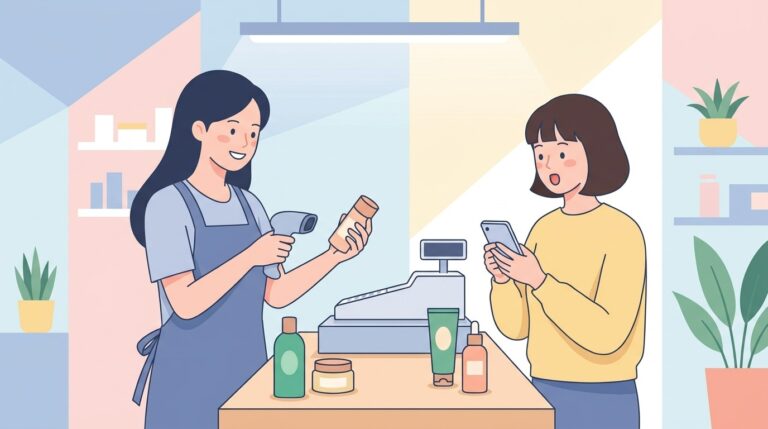
Phase 1: Empathy — The Checkout Counter Panic
Hello! Daily Hangul Editor here.
Picture this: You are in the middle of Myeongdong. Your shopping basket is overflowing with the latest K-Beauty sheet masks and pimple patches. You step up to the Olive Young counter, feeling confident. You hand over your credit card.
Then, the cashier fires off a rapid-fire sentence ending in a melodious but terrifying: “…hasigesseoyo?”
You freeze. The line behind you is getting longer. Did your card decline? Did you do something wrong?
Breathe. You didn’t do anything wrong! They are just asking if you want to earn membership points.
If you have ever panicked at a Korean checkout counter, you are not alone. Almost every one of my students has experienced this exact “checkout freeze.” In this post, we are going to learn the essential phrases you need to survive Korean shopping, cafes, and convenience stores. Let’s turn that checkout panic into an insider flex!
Phase 2: Core Expressions Deep Dive
Let’s break down the most common phrases you will hear when paying for something in Korea.
1. 포인트 적립하시겠어요?
- Pronunciation: [pointeu jeongnipasigesseoyo?] -> po-in-teu jeong-ni-pa-shi-ges-seo-yo?
- Meaning: Would you like to earn points? (Literal: Will you accumulate points?)
- K-Culture Moment: You will hear this everywhere—Olive Young, CU convenience stores, Mega Coffee, and local bakeries. Koreans love their point systems, and cashiers are trained to ask this to every single customer.
- Editor’s Insight: The word jeongnip (accumulation) sounds a bit formal, but it’s the standard retail word. Don’t let the long ending -hasigesseoyo? scare you. It’s just a very polite way to ask “Will you do [action]?”
- Situation Spectrum:
- Casual/Friends: 🚫 (You wouldn’t use this with friends)
- Cashier to Customer: ✅ (Standard everywhere)
- 🤔 Think About It: Why is this asked every time? In Korea’s highly competitive retail market, loyalty programs are huge. Are point cards as common in your home country?
2. 번호 입력해 주세요.
- Pronunciation: [beono imnyeokae juseyo.] -> beon-ho im-nyeo-kae ju-se-yo.
- Meaning: Please enter your number.
- K-Culture Moment: After you say “Yes” to points, the cashier will point to a small keypad on the counter. In Korea, your phone number is your universal ID for almost all point systems.
- Editor’s Insight: Beon-ho means number (specifically phone number in this context). The tone is usually fast and efficient.
- Situation Spectrum:
- Cashier to Customer: ✅
- 🤔 Think About It: Tying everything to a phone number is super convenient, but what about privacy? Korean society often values speed and convenience (palli-palli) over absolute anonymity.
3. 아니요, 괜찮아요.
- Pronunciation: [aniyo, gwaenchanayo.] -> a-ni-yo, gwaen-cha-na-yo.
- Meaning: No, I’m okay. / No, thank you.
- K-Culture Moment: This is your ultimate magic shield! When the cashier asks about points, bags, or receipts, this soft rejection is all you need.
- Editor’s Insight: Simply saying “아니요 (No)” can sound a bit cold or blunt. Adding “괜찮아요 (It’s okay/fine)” makes you sound like a polite, considerate local.
- Situation Spectrum:
- Casual: ✅ (Just drop the ‘yo’)
- Semi-formal/Service: ✅
- Formal/Elders: ⚠️ (Use more formal phrasing for bosses)
- 🤔 Think About It: Notice how Koreans use “It’s okay” to mean “No thank you”? It’s a way to maintain harmony and avoid direct refusal.
Phase 3: Textbook vs. Real Korean
How does real-life checkout Korean differ from your textbook?
[Situation 1: Refusing Points]
* 📖 Textbook Korean: 아니요, 저는 포인트 카드가 없습니다. (No, I do not have a point card.)
* 🗣️ Real Korean: 아니요, 괜찮아요. (No, I’m fine.) OR 없어요. (I don’t have one.)
* 💡 Why is it different?: Efficiency! Retail transactions in Korea are fast. Saying a full 10-syllable sentence takes too long. “괜찮아요” is the fastest polite way out.
[Situation 2: Dealing with Receipts]
* 📖 Textbook Korean: 영수증을 주시겠습니까? (Would you please give me the receipt?)
* 🗣️ Real Korean: 영수증 버려주세요. (Please throw away the receipt.)
* 💡 Why is it different?: Korea is moving towards a paperless society. Most people check their transactions via banking apps, so explicitly asking them to throw it away (beo-ryeo-ju-se-yo) is the norm.
Phase 4: Cultural Context — K-Culture Deep Dive
4-1. Non-Verbal Cues at the Register
When saying “아니요, 괜찮아요” (No, I’m okay), try doing a slight hand wave side-to-side (like you’re fanning away a bad smell, but gently). This is the universal Korean gesture for “No thank you.” Also, you don’t need to make intense eye contact with the cashier; a quick glance and a polite nod are perfectly fine. It’s all about smooth, fast Nunchi (reading the room).
4-2. The “Palli-Palli” Retail Rhythm
If you watch K-Dramas, you might notice that convenience store scenes are incredibly fast. The barcode scanning sounds like a techno song. This is the 빨리빨리 (Palli-Palli / Hurry-Hurry) culture in action.
Cashiers are evaluated on their speed. Therefore, long conversations at the register are a big no-no. Your goal as a customer is to have your card ready, answer the point/bag questions quickly, and step aside.
Phase 5: Real-Life Roleplay Scenario
Setting: Saturday afternoon at a busy Olive Young in Hongdae. The line is 10 people deep. Upbeat K-Pop is blasting. You finally reach the register with your skincare items.
Characters:
– YOU: A traveler trying to buy some sunscreen and sheet masks.
– Cashier (Ji-yoon, 20s): Fast, efficient, with a scanner in one hand and a shopping bag in the other.
Dialogue:
Cashier: 어서 오세요!
(eoseo oseyo!)
[Welcome!]
YOU: 안녕하세요.
(annyeonghaseyo.)
[Hello.]
Cashier: 봉투 필요하세요?
(bongtu piryohaseyo?)
[Do you need a bag?]
YOU: 아니요, 그냥 가져갈게요.
(aniyo, geunyang gajyeogalgeyo.)
[No, I’ll just take it as is.]
Cashier: 포인트 적립하시겠어요?
(pointeu jeongnipasigesseoyo?)
[Would you like to earn points?]
🔀 Your Turn! How should you respond if you don’t have an account?
– A) “무슨 소리예요?” (What are you talking about?)
– B) “아니요, 괜찮아요.” (No, I’m fine.)
– C) “저 외국인이에요.” (I am a foreigner.)✅ Best Choice: B — It’s the most natural, polite, and efficient way to decline.
⚠️ Choice C Analysis: While true, saying “I’m a foreigner” might make the cashier panic and switch to broken English. Just say “It’s okay” to keep things moving smoothly!
(Continuing the scenario…)
YOU: 아니요, 괜찮아요.
(aniyo, gwaenchanayo.)
[No, I’m fine.]
Cashier: 32,000원입니다. 카드 꽂아주세요.
(sam-man-i-cheon-won-imnida. kadeu kkoja-juseyo.)
[It is 32,000 won. Please insert your card.]
YOU: 네.
(ne.)
[Yes. (Inserts card)]
Cashier: 결제되셨습니다. 영수증 드릴까요?
(gyeolje-doesyeotseumnida. yeongsujeung deurilkkayo?)
[Payment is complete. Shall I give you the receipt?]
YOU: 영수증 버려주세요. 감사합니다!
(yeongsujeung beoryeojuseyo. gamsahamnida!)
[Please throw away the receipt. Thank you!]
Phase 6: 10-Second Shadowing Drill
Time to practice! Follow the pacing marks (/) and match the emotion.
😊 Polite & Fast:
아니요, / 괜찮아요. / 영수증은 / 버려주세요.
(a-ni-yo, / gwaen-cha-na-yo. / yeong-su-jeung-eun / beo-ryeo-ju-se-yo.)
Phase 7: K-Culture Mini Dictionary
Here are 4 keywords you need to master Korean shopping:
1. 적립
* Romanization: jeongnip
* English: Accumulation / Saving up
* Context: Used exclusively for points (포인트 적립) or mileage.
2. 영수증
* Romanization: yeongsujeung
* English: Receipt
* Context: Almost always followed by “드릴까요?” (Shall I give it to you?) or “버려드릴까요?” (Shall I throw it away for you?).
3. 봉투
* Romanization: bongtu
* English: Shopping bag (plastic or paper)
* Context: By law, stores in Korea must charge for bags (usually 50 to 100 won). They will always ask if you need one before ringing you up.
4. 올영
* Romanization: ollyeong
* English: Olive Young (Abbreviation)
* Context: Koreans love shortening words. Nobody says “Olive Young” fully in casual text; it’s always “올영세일” (Olive Young Sale).
Phase 8: Traveler Survival Kit
🆘 Survival Phrases for Shopping
– 🇰🇷 “이거 얼마예요?” (igeo eolmayeyo?)
– 🗣️ Sound: ee-geo eol-ma-ye-yo?
– 📍 Where to use: Underground shopping malls, traditional markets.
– 💡 Pro Tip: If you can’t understand the numbers they say, just hand them your phone with the calculator app open!📌 Editor’s Travel Note
– Card vs. Cash: Korea is essentially a cashless society. Your Visa/Mastercard will work 99% of the time, even for a 1,000 won water bottle. However, keep some cash for street food!
– Self-Checkouts: Many convenience stores and Daiso branches now have self-checkout kiosks (무인 계산대). You can switch the language to English, but knowing “포인트 적립” will help you navigate the Korean screens faster.
– Tipping: DO NOT tip! Tipping does not exist in Korea and will only confuse the cashier.
Phase 9: Critical Thinking — One Step Deeper
The Language of Palli-Palli (Hurry-Hurry)
Have you noticed how Korean retail phrases are perfectly optimized for speed? Sentences are shortened, subjects are dropped, and responses like “버려주세요 (Throw it away)” are normalized. This reflects Korea’s hyper-efficient society. In a bustling city like Seoul, saving 10 seconds at the register is a sign of respect for the cashier and the people waiting behind you. Language adapts to the speed of life.
💬 Your Turn: In your culture, is small talk with the cashier expected, or is speed the priority? Let me know in the comments!
Phase 10: FAQ & Avoiding Misunderstandings
Q: Can I just say “No” in English?
Yes! Most Korean cashiers will understand a polite “No, thank you” in English. However, responding in Korean with “괜찮아요” will get you a warm, surprised smile.
Q: Do I need a Korean phone number to earn points?
Usually, yes. Most loyalty programs (like CJ ONE or CU points) require a Korean phone number and resident registration for the initial setup. If you are a short-term tourist, it’s best to just skip the points.
Q: Is it rude to tell them to throw the receipt away?
Not at all! “버려주세요” sounds direct in English (“Throw it away”), but in Korean, it is standard, polite, and helpful to the cashier.
❌ Common Mistake #1: Holding up the line to search for a barcode when you aren’t sure if you even have an account.
✅ Do this instead: If you aren’t sure, just say “없어요 (I don’t have it).” Keep the line moving!
Phase 11: Summary & Action Items
📌 One-Liner Summary: When asked about points (적립) or receipts (영수증), “아니요, 괜찮아요” is your ultimate polite escape button.
Your Missions:
– 🥉 Bronze: Say “아니요, 괜찮아요” out loud 3 times right now.
– 🥈 Silver: Write down “영수증 버려주세요” in your phone’s notes app so you don’t forget it.
– 🥇 Gold: Go to a Korean convenience store (or an Asian supermarket near you), buy a snack, and confidently tell the cashier you don’t need a bag or receipt!
🇰🇷 K-Culture Mission:
Next time you watch a K-Drama, look out for convenience store scenes. Listen closely—can you catch the cashier asking “봉투 필요하세요?” or “포인트 적립하시겠어요?”
Phase 12: Interactive Quiz
Test your new street-smart Korean!
1. You are buying an iced Americano. The barista asks: “포인트 적립하시겠어요?” You don’t have an account. What is the most natural reply?
A) 아니요, 괜찮아요.
B) 저는 외국인입니다.
C) 싫어요. (I hate it.)
Click for Answer
Answer: A. “아니요, 괜찮아요” is the most natural and polite way to decline. B is unnecessary, and C is rude!
2. True or False: You should always take your paper receipt in Korea to be polite.
Click for Answer
Answer: False. Korea is very eco-friendly. Most people ask the cashier to throw it away by saying “영수증 버려주세요.”
3. Fill in the blank: The cashier asks if you need a plastic bag by saying “[ _____ ] 필요하세요?”
Click for Answer
Answer: 봉투 (bongtu)
Great job today! You are now officially ready to shop in Seoul without breaking a sweat. See you in the next lesson!
Frequently Asked Questions (FAQ)
Q: What does "포인트 적립하시겠어요?" mean in Korean and how do you pronounce it?
A: In Korean, "포인트 적립하시겠어요?" is pronounced [pointeu jeongnipasigesseoyo?] and means: Would you like to earn points? (Literal: Will you accumulate points?)
Q: What does "번호 입력해 주세요." mean in Korean and how do you pronounce it?
A: In Korean, "번호 입력해 주세요." is pronounced [beono imnyeokae juseyo.] and means: Please enter your number.
Q: What does "아니요, 괜찮아요." mean in Korean and how do you pronounce it?
A: In Korean, "아니요, 괜찮아요." is pronounced [aniyo, gwaenchanayo.] and means: No, I'm okay. / No, thank you.







