

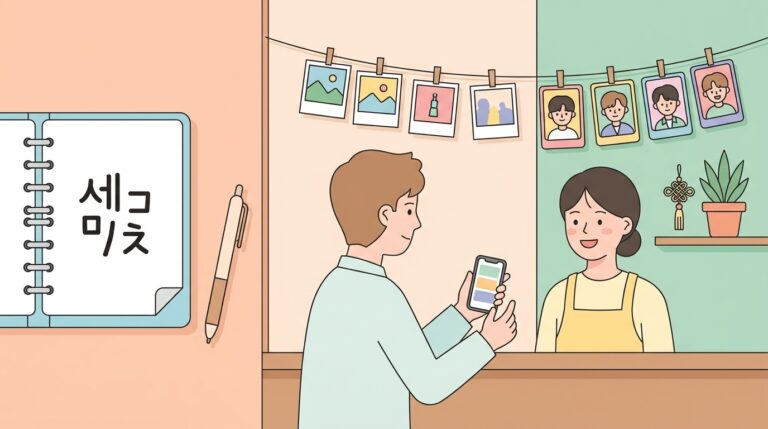
Phase 1: Empathy & K-Culture Cold Open
Hello there! I’m the Lead Editor at Daily Hangul, your personal Korean tutor and local cultural navigator.
Imagine this: You’re watching a K-Drama, and the main couple goes on a cute date to Hongdae. They take pictures in a cozy photo booth, and later, the male lead secretly tucks one of those printed photos behind his clear phone case or into his wallet. Or maybe you’re a K-Pop fan, and you’ve seen fans trading physical ‘Photocards’ (포카) outside a concert venue.
Korea is one of the most digitalized countries in the world, but paradoxically, we are absolutely obsessed with printing physical photos!
You took amazing pictures on your smartphone during your trip to Seoul, or maybe you saved a beautiful picture of your favorite idol, and you want to print it out to keep behind your phone case just like Koreans do. You confidently walk into a local photo studio (사진관) or approach a printing kiosk, but suddenly you freeze. Wait, how do you say “print” for photos? If you say “프린트 (print),” they might point you to a PC cafe to print documents!
Don’t worry. This guide is crafted from real questions my students have asked after awkwardly standing in front of a photo studio counter. Let’s learn how to print your precious memories like a true local!
Phase 2: Core Expressions Deep Dive
Let’s look at the absolute must-know phrases when you visit a photo studio.
1. 사진 좀 뽑으려고요.
- Pronunciation: [sajin jom ppobeuryeogoyo.] (ppob-eu-ryeo-go-yo! The ‘pp’ sounds like a sharp, tense ‘p’.)
- Meaning: Literal: I am intending to pull out some photos. / Real Nuance: I’d like to print some photos.
- K-Culture Moment: You walk into a trendy neighborhood studio. Instead of using complex vocabulary, casually saying this makes you sound incredibly fluent.
- Editor’s Insight: The official word for developing/printing photos is 인화하다 (inhwahada). But in daily life, Koreans love using the verb 뽑다 (ppopda), which means “to pull out.” We use it for printing documents, pulling out tissues, or drawing a random photocard. It has a very natural, everyday feel!
- Situation Spectrum:
- Casual with friends: ✅ (사진 뽑자!)
- Staff at a photo studio (Semi-formal): ✅
- Very formal/Business: ⚠️ (Use 인화하다 instead)
- 🤔 Think About It: Why do Koreans use a physical action verb like “pull out” (뽑다) for a digital process like printing? Does your language have a similar physical metaphor for technology?
2. 핸드폰 사진도 돼요?
- Pronunciation: [haendeupon sajindo dwaeyo?] (haen-deu-pon / sa-jin-do / dwae-yo?)
- Meaning: Literal: Do cellphone photos also become? / Real Nuance: Can I also print photos straight from my phone?
- K-Culture Moment: You see a vintage film camera studio, but you only have your iPhone. You peek your head in and ask this to the owner.
- Editor’s Insight: Koreans use the magical verb 되다 (to become / to work / to be okay) for almost everything. Instead of asking “Is it possible to print digital files from my mobile device?”, just ask “Phone photos, do they work? (돼요?)”
- Situation Spectrum:
- Casual with friends: ✅ (이거 돼?)
- Store clerks (Semi-formal): ✅
- Formal: ⚠️ (가능합니까? is better)
- 🤔 Think About It: “되다” implies things naturally falling into place. It shows how Korean language prefers passive or situational descriptions over direct “I can/You can” statements.
3. 지갑에 들어가는 사이즈로 해주세요.
- Pronunciation: [jigabe deureoganeun saijeuro haejuseyo.]
- Meaning: Literal: Please do it in a size that goes into a wallet. / Real Nuance: Wallet size, please.
- K-Culture Moment: Think of that classic K-Drama scene where a parent opens their wallet to pay, and you see a tiny, perfectly fitted photo of their child or lover.
- Editor’s Insight: Sizes can be tricky (4×6, 5×7). If you don’t know the exact measurements, describing where it will go is the most effective survival skill! You can also say “핸드폰 케이스에 들어가는 사이즈 (A size that fits in a phone case)”!
- Situation Spectrum:
- Store clerks (Semi-formal): ✅
Phase 3: Textbook vs. Real Korean
Here is how you can level up from a textbook learner to a street-smart speaker.
[Asking to Print Photos]
* 📖 Textbook Korean: 사진을 인화해 주시겠습니까? (Would you please develop the photographs?)
* 🗣️ Real Korean: 사진 좀 뽑으려고 하는데요. (I’m trying to print some photos…)
* 💡 Why the difference?: Textbooks teach formal vocabulary (인화), but locals prefer easier, action-based verbs (뽑다) and softer endings (는데요) to sound less demanding.
[Sending the Files]
* 📖 Textbook Korean: 디지털 파일을 어떻게 전송합니까? (How do I transmit the digital files?)
* 🗣️ Real Korean: 사진 어디로 보내면 돼요? (Where should I send the photos?)
* 💡 Why the difference?: Koreans prioritize speed and efficiency. “Where should I send it?” cuts straight to the chase!
Phase 4: Cultural Context — K-Culture Deep Dive
4-1. Non-verbal Cue: The “Nunchi” of File Transfer
When you ask to print phone photos, the staff will usually point to a KakaoTalk ID or a QR code on the counter. In Korea, you rarely need a USB cable. Nunchi (눈치) tip: Have your KakaoTalk app ready, or turn on your Apple AirDrop. Simply nodding and showing that you are opening your messenger app shows you know how the local system works!
4-2. K-Pop & K-Drama Connection: The “Photocard” Obsession
Why are photo studios still booming in Korea? It’s heavily tied to K-Pop and K-Drama culture.
In K-Pop, physical albums come with randomized 포토카드 (Photocards, or ‘포카’). Fans decorate these cards, put them in protective sleeves, and slide them into their clear phone cases. This culture bled into mainstream daily life. Now, best friends, couples, and even pet owners print custom photocards of each other to carry around! If you go to a studio, you might even see an option specifically called “포카 사이즈” (Photocard size). It’s not just a photo; it’s a statement of affection.
Phase 5: Real-Life Roleplay Scenario
Setting: A small, trendy photo studio in Yeonnam-dong. The walls are covered with aesthetic printed photos. You just had a great day at a K-Pop pop-up store and want to print some photos you took on your phone.
Characters:
– YOU: A traveler in Korea, wanting to print 3 photos to give to your friends.
– Studio Owner (사장님): A friendly local in their 30s.
Dialogue:
YOU: 안녕하세요~ 혹시 사진 좀 뽑을 수 있나요?
(annyeonghaseyo~ hoksi sajin jom ppobeul su innayo?)
[Hello~ By any chance, can I print some photos?]
사장님: 네, 가능합니다. 어떤 사진이요? 카메라요?
(ne, ganeunghamnida. eotteon sajiniyo? kamerayo?)
[Yes, it’s possible. What kind of photos? From a camera?]
YOU: 아뇨, 핸드폰 사진도 돼요?
(anyo, haendeupon sajindo dwaeyo?)
[No, do cellphone photos work too?]
사장님: 네! 카카오톡으로 사진 보내주시면 돼요. 여기 QR코드 찍으세요.
(ne! kakaotogeuro sajin bonaejusimyeon dwaeyo. yeogi QRkodeu jjigeuseyo.)
[Yes! You can just send them via KakaoTalk. Scan this QR code here.]
(🎭 Stage Direction: The owner points to a small sign on the desk)
YOU: 네, 보냈어요!
(ne, bonaesseoyo!)
[Yes, I sent them!]
사장님: 확인했습니다. 사이즈는 어떻게 해드릴까요?
(hwaginhetseumnida. saijeuneun eotteoke haedeurilkkayo?)
[Checked. How would you like the size?]
YOU: 지갑에 들어가는 사이즈로 해주세요.
(jigabe deureoganeun saijeuro haejuseyo.)
[Wallet size, please.]
사장님: 네, 알겠습니다. 몇 장 뽑아드릴까요?
(ne, algetseumnida. myeot jang ppobadeurilkkayo?)
[Yes, understood. How many copies should I print for you?]
🔀 Your Turn! How will you answer?
– A) 세 개 주세요. (se gae juseyo.)
– B) 세 장 뽑아주세요. (se jang ppobajuseyo.)
– C) 많이 주세요. (mani juseyo.)✅ Best Choice: B — 장 (jang) is the specific counter for flat, thin objects like paper and photos!
⚠️ Choice A Analysis: “개 (gae)” is the universal counter for items, so they will understand you, but using “장” makes you sound much more natural and fluent.
🌟 Bonus K-Culture Roleplay: The “Life Four Cuts” Booth
(Inside a self-photo booth with your Korean friend)
Friend: 야, 우리 머리띠 뭐 쓸까? (ya, uri meoritti mwo sseulkka? – Hey, which headband should we wear?)
YOU: 이거 어때? (igeo eottae? – How about this one?)
Friend: 좋아! 아, 사진 몇 장 뽑지? (joa! a, sajin myeot jang ppopji? – Good! Ah, how many copies should we print?)
YOU: 두 장 뽑아서 하나씩 갖자! (du jang ppobaseo hanassik gatja! – Let’s print two copies and take one each!)
Phase 6: 10-Second Shadowing Drill
Practice speaking out loud! Pay attention to the pauses (/) and the emotion tags.
- 😊 Friendly: 사장님, / 핸드폰 사진도 / 뽑을 수 있어요?
(sajangnim, / haendeupon sajindo / ppobeul su isseoyo?) - 🥺 Politely requesting: 지갑에 들어가는 사이즈로 / 세 장 / 해주세요.
(jigabe deureoganeun saijeuro / se jang / haejuseyo.) - 😤 Determined (with friends): 우리 / 오늘 / 사진 뽑자!
(uri / oneul / sajin ppopja!)
Phase 7: K-Culture Mini Dictionary
Here are some essential photo-related cultural keywords you must know!
1. 인생네컷
* Romanization: insaengnekeot
* English: “Life Four Cuts” (Self-photo booth)
* Context: A massively popular chain of un-manned photo booths where you take 4 photos in a strip. It’s almost mandatory to do this when hanging out with friends in Korea!
2. 포카
* Romanization: poka
* English: Photocard
* Context: Short for 포토카드. Originally K-Pop merchandise, but now it refers to any wallet-sized photo printed to carry around.
3. 보정
* Romanization: bojeong
* English: Photo retouching / Photoshopping
* Context: Korean studios are famous for their magical “bojeong” skills. If you take a passport or profile photo, they will naturally edit your skin, face shape, and hair.
4. 원본
* Romanization: wonbon
* English: Original file (Digital)
* Context: When you do a photoshoot, you might ask for the “wonbon” to keep the digital copies on your phone, not just the printed ones.
Phase 8: Traveler Survival Kit
If you’re visiting Korea, keep these phrases saved in your phone for your next photo studio visit!
🆘 Survival Phrases for Photo Studios
– 🇰🇷 “언제 나와요?” (eonje nawayo?)
– 🗣️ Meaning: When will it come out? (When will it be ready?)
– 📍 Where to use: After ordering your prints, to know when to pick them up.
- 🇰🇷 “파일도 받을 수 있나요?” (paildo badeul su innayo?)
- 🗣️ Meaning: Can I also receive the digital files?
- 📍 Where to use: When you want the JPEG files sent to your email or messenger.
📌 Editor’s Travel Note
– Sending Photos: 90% of photo studios will ask you to send photos via KakaoTalk. If you don’t have it, they usually offer an email address or an Apple AirDrop option.
– Pricing: Printing smartphone photos is very cheap! Usually around 500 KRW to 1,000 KRW per photo depending on the size.
Phase 9: Critical Thinking Corner — “One Step Deeper”
🧠 Think Deeper: Media vs Reality (The Romance of Analogue in a Digital World)
Korea boasts the fastest internet speeds in the world, and everyone lives on their smartphones. Yet, the streets are lined with analogue photo booths, and people spend money to print photos they already have on their screens. Why? In Korean culture, taking the extra step to physicalize a memory—printing it out, decorating it, and gifting it—shows a deeper level of care and 정 (Jeong, emotional connection). In a hyper-fast digital society, a printed photo becomes a rare, tangible anchor of affection. It’s not just ink on paper; it’s a physical proof of “I cherish this moment with you.”
💬 Your Turn: Do people in your country still print photos often? What do you usually do with the photos taking up space on your phone? Let me know in the comments!
Phase 10: FAQ & Avoiding Mistakes
Q: Is it okay to use “뽑다” (to pull out/print) with older people?
Yes! While “뽑다” sounds a bit casual, if you add “요” at the end (뽑을 수 있어요?), it is perfectly polite to use with store owners or older staff.
Q: Can I ask the studio to Photoshop my smartphone photos before printing?
Usually, if you are just printing photos directly from your phone (인화), they do not edit them. “보정” (editing) is typically reserved for photos taken at the studio by the professional photographer.
❌ Common Mistake #1: Saying “프린트해 주세요” (Please print it) in a photo studio.
✅ Do this instead: Say “인화해 주세요” or “뽑아 주세요”. “프린트” is almost exclusively understood as printing A4 document papers in Korea!❌ Common Mistake #2: Counting photos using “개” (gae – general item counter).
✅ Do this instead: Use “장” (jang – counter for paper). “세 장 뽑아주세요” (Please print 3 copies).
Phase 11: Summary & Action Items
One-Liner Summary: When you want to print photos in Korea, ditch the word “print” and confidently ask: “사진 뽑을 수 있어요?”
Action Mission 3 Steps:
* 🥉 Bronze (Solo): Look at a photo on your phone right now and say out loud: “이 사진 뽑고 싶어요.” (I want to print this photo.)
* 🥈 Silver (Online): Share a photo on your social media that you’d love to print, and write the caption: “사진 뽑으려고요!”
* 🥇 Gold (Real Life): Next time you are in Korea or at a local K-Pop store with a photo kiosk, try selecting the “포카 사이즈” and printing your favorite picture!
K-Culture Mission:
Go watch a vlog of your favorite K-Pop idol or a K-Drama. Spot the moments where they take pictures in a “Life Four Cuts” booth. Notice how they hold the printed photo strips up to the camera to show off!
Did you find this helpful? What photo are you planning to print first? Drop a comment below!
Phase 12: Quiz — Interactive Challenge
Test your new skills!
1. Situational Judgment: You want to print 2 copies of a photo of your dog to put in your wallet. What is the most natural thing to say to the studio staff?
– A) 개 두 개 프린트해 주세요.
– B) 이 사진 두 장 뽑아주세요.
– C) 카메라 사진 인화합니다.
Reveal Answer: B. “장” is the correct counter for photos, and “뽑다” is the natural verb for printing. (A sounds like you are asking to print two literal dogs!)
2. Fill in the Blank:
“( _______ ) 사진도 뽑을 수 있어요?” (Can I also print cellphone photos?)
Reveal Answer: 핸드폰 (haendeupon – cellphone)
3. True or False – K-Culture Edition:
In Korea, it is considered very weird to keep a printed photo of your favorite celebrity in your phone case.
Reveal Answer: False! It is completely normal and a huge trend called “포카” (Photocard) culture. Even non-fans do it with photos of their pets or partners!
Frequently Asked Questions (FAQ)
Q: What does "사진 좀 뽑으려고요." mean in Korean and how do you pronounce it?
A: In Korean, "사진 좀 뽑으려고요." is pronounced [sajin jom ppobeuryeogoyo.] and means: Literal: I am intending to pull out some photos. / Real Nuance: I'd like to print some photos.
Q: What does "핸드폰 사진도 돼요?" mean in Korean and how do you pronounce it?
A: In Korean, "핸드폰 사진도 돼요?" is pronounced [haendeupon sajindo dwaeyo?] and means: Literal: Do cellphone photos also become? / Real Nuance: Can I also print photos straight from my phone?
Q: What does "지갑에 들어가는 사이즈로 해주세요." mean in Korean and how do you pronounce it?
A: In Korean, "지갑에 들어가는 사이즈로 해주세요." is pronounced [jigabe deureoganeun saijeuro haejuseyo.] and means: Literal: Please do it in a size that goes into a wallet. / Real Nuance: Wallet size, please.






