

Phase 1: Empathy (Immersive Opening)
Hello! I’m the senior editor of Daily Hangul, your veteran tutor and local Seoul navigator.
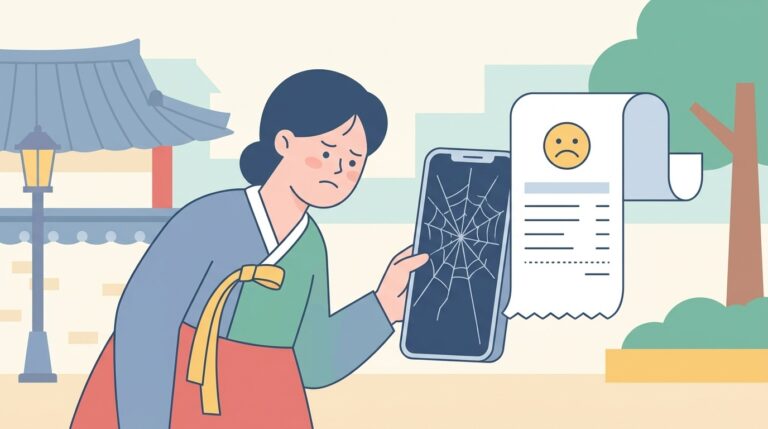
Picture this: You are at a trendy, aesthetic cafe in Seongsu-dong. You’ve just ordered a beautiful matcha latte and you are lifting your phone to get that perfect Instagram shot. Suddenly, someone bumps into you. Time slows down. Your phone slips out of your hand and hits the concrete floor face-down. You pick it up, flip it over, and there it is—the dreaded spiderweb crack across your screen.
Now, you have to go to a Korean service center (which, by the way, is incredibly fast here). But how do you explain what happened? And more importantly, how do you complain to your friends later when you see the massive bill?
If you only rely on textbooks, you might sound like a robot reading a manual. Today, we are going to learn exactly how real Koreans express this painful but common tragedy: “The screen is broken, and the repair fee came out too high.” This guide is based on the actual panicked texts I’ve received from my foreign students over the years. Let’s dive in!
Phase 2: Core Expressions Deep Dive
1. 액정이 깨졌어요 (aekjeongi kkaejyeosseoyo)
- Pronunciation: [ak-jeong-ee kkae-jyeot-sseo-yo]
(Tip: The ‘ㄲ’ in ‘깨’ is a tense, sharp ‘kk’ sound—imagine the sharp sound of glass cracking!)- Meaning:
- Literal: The liquid crystal broke.
- Real Nuance: My phone screen is shattered/broken.
- K-Culture Moment: In K-Dramas, when a character drops their phone and staring at the cracked screen, they always say “아, 액정 깨졌어” (Ah, my screen broke).
- Editor’s Insight: Interestingly, Koreans rarely say “화면이 깨졌어요” (the screen/display broke) when talking about physical phone damage. They specifically use the word 액정 (liquid crystal).
- Situation Spectrum:
- Casual with friends: ✅ (액정 깨졌어!)
- Semi-formal (co-workers/service center): ✅ (액정이 깨졌어요.)
- Formal (Boss/Elders): ✅ (액정이 깨졌습니다.)
- 🤔 Think About It: Why do you think Koreans specifically refer to the hardware material (“liquid crystal”) rather than just the visual “screen”? Does your native language differentiate between the physical glass and the digital display?
2. 수리비가 너무 많이 나왔어요 (suribiga neomu mani nawasseoyo)
- Pronunciation: [soo-ree-bee-ga neo-moo ma-nee na-wa-sseo-yo]
- Meaning:
- Literal: The repair fee came out too much.
- Real Nuance: The repair cost was insanely high. / The bill was a lot.
- K-Culture Moment: You are sitting at a Korean BBQ place. Your friend asks why you look so depressed instead of enjoying the pork belly. You sigh, pull out the receipt from the repair shop, and drop this line.
- Editor’s Insight: Notice the verb 나왔어요 (came out). In English, you’d say “it cost a lot.” In Korean, bills and fees “come out” (나오다). It makes it sound like the bill has a mind of its own and attacked your wallet!
- Situation Spectrum:
- Casual with friends: ✅ (수리비 너무 많이 나왔어.)
- Semi-formal (co-workers): ✅ (수리비가 꽤 많이 나왔네요.)
- Formal (Boss/Elders): ⚠️ (Usually, you wouldn’t complain about personal finances to a boss, but grammatically it’s fine).
- 🤔 Think About It: “The bill came out.” How does this passive phrasing reflect a feeling of helplessness against unexpected expenses?
3. 폰 수리 맡겼어요 (pon suri matgyeosseoyo)
- Pronunciation: [pon soo-ree mat-gyeot-sseo-yo]
- Meaning:
- Literal: I entrusted the phone repair.
- Real Nuance: I dropped my phone off to get it fixed.
- K-Culture Moment: You are using your old spare phone or an iPad to text your friends on KakaoTalk. They ask why you are replying so late, and you use this phrase to explain your situation.
- Editor’s Insight: This is a crucial B1-level grammar point. If you say “내가 폰을 수리했어요” (I repaired my phone), it means you physically opened the phone with a screwdriver and fixed it yourself. To say a professional did it, you use 맡기다 (to entrust/to leave something with someone).
- Situation Spectrum:
- Casual with friends: ✅
- Semi-formal (co-workers): ✅
- Formal (Boss/Elders): ✅
- 🤔 Think About It: The concept of “entrusting” (맡기다) is used for laundry, car repairs, and taking care of pets. It shows a high level of reliance on service workers in Korean society.
Phase 3: Textbook vs. Real Korean
Let’s see how the language evolves when you step out of the classroom and onto the streets of Seoul.
[Explaining the Broken Screen]
* 📖 Textbook Korean: 제 휴대폰 화면이 파손되었습니다. (My mobile phone screen is damaged.)
* 🗣️ Real Korean: 헐, 내 폰 액정 나갔어. (Heol, my phone screen went out.)
* 💡 Why the difference?: “나갔다” (went out/left) is a common slang used when a machine or a part suddenly stops working or breaks, emphasizing the sudden loss of function.
[Complaining About the Huge Bill]
* 📖 Textbook Korean: 수리 비용이 아주 비쌉니다. (The repair cost is very expensive.)
* 🗣️ Real Korean: 아, 수리비 폭탄 맞았어. (Ah, I got hit by a repair fee bomb.)
* 💡 Why the difference?: The dramatic metaphor “폭탄 맞다” (hit by a bomb) is heavily used in Korean internet culture to describe unexpectedly huge bills, like tax bombs or utility bill bombs.
Bottom Note: For B1 learners, using “액정 나갔어” or “수리비 폭탄 맞았어” with your close Korean friends will instantly make you sound like a local insider!
Phase 4: Cultural Context — K-Culture Deep Dive
4-1. Non-Verbal Cues (Nunchi and Sighs)
When talking about a broken phone and lost money, your body language should match the tragedy. A deep, audible sigh (“하아…” or “휴…”) before delivering the bad news is essential. Showing the broken screen to your friend with a subtle pout will evoke their Nunchi (social empathy)—they will immediately know they need to buy you a drink to cheer you up.
4-2. The “A/S” (After Service) Culture in Korea
Korea’s “빨리빨리” (Pali-Pali / Hurry Hurry) culture shines brightest at service centers. In Korea, we don’t call it customer service or repair centers; we call it A/S 센터 (A/S Center), which stands for “After Service.”
If you own a domestic phone (like a Samsung), you can often walk into a center, take a number, grab a complimentary mixed coffee, and have your screen replaced in exactly 30 to 40 minutes. It’s a surreal experience compared to waiting weeks in other countries. Knowing how to say “액정 깨졌어요” will get you in and out of that center at lightning speed.
Phase 5: Real-Life Roleplay Scenario
Let’s put you in the scene.
- Setting: Friday evening, 7 PM. A bustling Korean BBQ restaurant near Gangnam Station. The smell of roasted pork belly fills the air, and soju glasses clink around you. You just arrived from the Apple/Samsung repair center.
- Characters:
- YOU: A foreign expat working in Seoul. You’ve had a rough day because of your phone.
- Minho (32): Your friendly, humorous Korean coworker who invited you to dinner.
**Minho:** 어? 왜 이렇게 표정이 안 좋아요? 무슨 일 있었어요?
(eo? wae ireoke pyojeongi an joayo? museun il isseosseoyo?)
[English] Huh? Why do you look so down? Did something happen?
(🎭 Stage Direction: Minho puts down his tongs, looking concerned.)

**YOU:** 하아... 오다가 폰을 떨어뜨렸거든요.
(haa... odaga poneul tteoreotteuryeotgeodeunyo.)
[English] Sigh... I dropped my phone on the way here.

**Minho:** 헐! 그래서요? 폰 켜져요?
(heol! geuraeseoyo? pon kyeojyeoyo?)
[English] OMG! So? Does the phone turn on?

**YOU:** 켜지긴 하는데... **액정이 다 깨졌어요.**
(kyeojigin haneunde... aekjeongi da kkaejyeosseoyo.)
[English] It turns on, but... the screen is completely shattered.

**Minho:** 아이고... 서비스 센터 다녀왔어요?
(aigo... seobiseu senteo danyeowasseoyo?)
[English] Oh no... Did you go to the service center?

**YOU:** 네, 방금 **폰 수리 맡기고** 오는 길이에요.
(ne, banggeum pon suri matgigo oneun girieyo.)
[English] Yes, I just dropped it off for repair and came here.

**Minho:** 다행이네요. 근데 수리비 비싸지 않아요?
(dahaengineyo. geunde suribi bissaji anayo?)
[English] That's a relief. But isn't the repair fee expensive?

**YOU:** 말도 마세요. **수리비가 너무 많이 나왔어요.**
(maldo maseyo. suribiga neomu mani nawasseoyo.)
[English] Don't even mention it. The repair bill came out way too high.

**Minho:** 아... 폰 보험은 없어요?
(ah... pon boheomeun eopseoyo?)
[English] Ah... Do you not have phone insurance?
🔀 Your Turn! How do you reply to Minho?
– A) “아니요, 보험 없어요.” (No, I don’t have insurance. – Textbook style)
– B) “보험? 그게 뭐예요? 먹는 거예요?” (Insurance? What’s that? Is it something you eat? – Korean slang)
– C) “다행히 보험이 있어서 할인을 좀 받았어요!” (Thankfully I have insurance, so I got a bit of a discount! – Relieved tone)✅ Best Choice: C is great if it’s true! But if you want to make your coworker laugh despite the tragedy, B is an amazing choice. “그게 먹는 거예요?” (Is that something you eat?) is a classic Korean sarcastic joke used when you completely lack something (like luck, money, or in this case, insurance).
Phase 6: 10-Second Shadowing Drill
Let’s practice the rhythm of frustration! Follow the slashes for pauses, and emphasize the bolded parts.
😭 아 진짜... / **액정**이 깨져서 / **수리비**가 / 장난 아니에요.
(ah jinjja… / aekjeongi kkaejyeoseo / suribiga / jangnan anieyo.)
[Meaning: Ah seriously… the screen broke, and the repair fee is no joke.]
Emotion Tag: 😭 Say “아 진짜” with a deep sigh of defeat. Emphasize “장난 아니에요” (no joke) by shaking your head slowly.
Phase 7: K-Culture Mini Dictionary
Here are 4 must-know keywords related to smartphones and customer service in Korea:
1. A/S (에이에스)
* Romanization: ei-e-seu
* English: After Service (Customer Service / Repair Center)
* Context: A Konglish term used universally in Korea. If your electronics break, you don’t look for a repair shop; you ask, “A/S센터가 어디예요?” (Where is the A/S center?).
2. 리퍼 (리퍼브)
* Romanization: ripeo (ripeobeu)
* English: Refurbished / Replacement phone
* Context: Especially common among Apple users in Korea. When a phone is beyond repair, the center gives you a “리퍼폰” (refurbished phone). You often hear people sigh, “리퍼 받아야 한대요” (They said I have to get a replacement).
3. 호갱 (호갱님)
* Romanization: hogaeng (hogaengnim)
* English: A gullible customer / A pushover
* Context: A combination of ‘호구’ (pushover) and ‘고객’ (customer). If you go to a shady, unofficial repair shop and pay double the actual cost, your friends will tease you saying, “너 호갱 당했어” (You got played as a pushover).
4. 사설 수리점
* Romanization: saseol surijeom
* English: Private/Third-party repair shop
* Context: Opposite of ‘공식 서비스 센터’ (Official service center). They are cheaper but void your official warranty. A great place to go if your phone is already old and you don’t want to pay the “repair fee bomb.”
Phase 8: Traveler Survival Kit
If you drop your phone while exploring Myeongdong or hiking Bukhansan, you need to survive the A/S center.
🆘 Survival Phrases at the A/S Center
– 🇰🇷 “화면이 안 켜져요.” (hwamyeoni an kyeojyeoyo.)
– 🗣️ English: The screen won’t turn on.
– 🇰🇷 “얼마나 걸려요?” (eolmana geollyeoyo?)
– 🗣️ English: How long will it take?
– 🇰🇷 “데이터는 그대로 남아있나요?” (deiteoneun geudaero namainnayo?)
– 🗣️ English: Will my data remain exactly as it is?📌 Editor’s Travel Note
– Finding a Center: Type “삼성전자 서비스센터” or “애플스토어” / “위니아에이드” (Apple authorized service) into Naver Map or KakaoMap.
– Reservation: For Apple, always book online in advance! Walk-ins can take hours. For Samsung, walk-ins are usually extremely fast.
– Payment: Don’t try to haggle the price at an official center! Prices are fixed. You can pay with international credit cards.
Phase 9: Critical Thinking Corner — “One Step Deeper”
Language & Power: The “Nim (님)” Culture in Customer Service
When you visit a repair center in Korea, you will notice that the staff treats you with extreme, almost royal politeness. They will call you “고객님” (Customer-nim), adding the honorific suffix ‘-님’ to elevate your status. In Korean society, the dynamic between a service provider and a customer is deeply embedded in the language. The staff uses high formal language (하십시오체 / Hasipsio-che), while sometimes, unfortunately, older customers might use lower forms (반말 / Banmal) to assert dominance.
However, modern Korean culture is pushing back against this. Many shops now have signs saying, “우리 직원에게 반말하지 마세요” (Do not use informal language with our staff).
🧠 Think Deeper:
The linguistic hierarchy in Korea makes customer service exceptionally polite, but it can also create emotional stress for the workers.💬 Your Turn: In your culture, how do service workers and customers address each other? Is there a linguistic difference based on who is paying? Let me know in the comments!
Phase 10: FAQ & Mistake Prevention
Q: “Can I tell my boss ‘액정이 깨졌어요’?”
– Yes! As long as you use the “~요” or “~습니다” ending, the phrase itself is perfectly fine to use with a boss or an elder to explain why you couldn’t answer their call.
Q: “Can I ask for a discount at the service center?”
– No. Official A/S centers have fixed prices. Asking “좀 깎아주세요” (Please give me a discount) will only make the staff sweat and feel uncomfortable.
❌ Common Mistake #1: Saying “내가 수리했어요” (I repaired it) when you mean you got it repaired.
✅ Do This Instead: Say “수리 맡겼어요” (I dropped it off for repair) or “수리 받았어요” (I received the repair). In Korean, unless you literally held the screwdriver, you did not “repair” it!❌ Common Mistake #2: Translating “My phone died” literally to “내 폰이 죽었어요” (My phone died/passed away).
✅ Do This Instead: Say “폰이 꺼졌어요” (The phone turned off – for battery) or “폰이 고장 났어요” (The phone is broken – for hardware). Koreans don’t usually say machines “died” unless it’s a humorous exaggeration.
Phase 11: Summary & Action Items
One-Liner Summary: When your phone meets the floor, use “액정이 깨졌어요” (screen broke) and mentally prepare for when “수리비가 많이 나왔어요” (the bill comes out high)!
Action Mission 3 Steps:
– 🥉 Bronze (Solo): Look at your phone screen right now, sigh dramatically, and say “하아, 액정이 깨졌어요” out loud 3 times.
– 🥈 Silver (Online): Go to a Korean language community or forum, post a broken phone emoji 📱💥, and write: “수리비 폭탄 맞았어요!”
– 🥇 Gold (Real Life): Next time you meet your Korean friend, show them a scratch on your phone and practice the roleplay scenario we learned today.
🎬 K-Culture Mission:
Go into your phone’s settings and change the system language to Korean (한국어) just for 10 minutes! Try to navigate to the ‘Settings’ (설정) and ‘Display’ (디스플레이). It’s a fun way to familiarize yourself with tech vocabulary!
Engagement: Have you ever dropped your phone while traveling? How much did it cost to fix it? Share your tragic (or lucky) stories in the comments below using today’s expressions!
Phase 12: Quiz — Interactive Challenge
1. Fill in the Blank:
Your friend got their phone fixed, but they look like they’re about to cry because of the bill. They would say:
“아… 수리비가 너무 많이 _________.”
A) 갔어요 (went)
B) 나왔어요 (came out)
C) 먹었어요 (ate)
2. True or False — K-Culture Edition:
“If your phone screen breaks in Korea, you should try to negotiate the repair cost at the official Samsung or Apple service center.” (T/F)
3. Situational Judgment:
You want to tell your boss that you couldn’t see their KakaoTalk message because your screen shattered. Which is the MOST appropriate way to say it?
A) 부장님, 내 폰 액정 나갔어. (Boss, my phone screen went out.)
B) 부장님, 제 폰 액정이 깨졌습니다. (Boss, my phone screen broke.)
C) 부장님, 내가 폰을 수리했어요. (Boss, I repaired my phone.)
*
*
*
(Scroll down for answers!)
Click to see the answers!
1. B) 나왔어요. (Bills and fees “come out” in Korean!)
2. False. (Official centers have strict, fixed pricing. Haggle at the market, not at the Apple store!)
3. B) 부장님, 제 폰 액정이 깨졌습니다. (A is too casual/impolite for a boss. C means you physically fixed it yourself!)
Frequently Asked Questions (FAQ)
Q: What does "액정이 깨졌어요 (aekjeongi kkaejyeosseoyo)" mean in Korean and how do you pronounce it?
A: In Korean, "액정이 깨졌어요 (aekjeongi kkaejyeosseoyo)" is pronounced [ak-jeong-ee kkae-jyeot-sseo-yo] and means: Literal: The liquid crystal broke.
Q: What does "수리비가 너무 많이 나왔어요 (suribiga neomu mani nawasseoyo)" mean in Korean and how do you pronounce it?
A: In Korean, "수리비가 너무 많이 나왔어요 (suribiga neomu mani nawasseoyo)" is pronounced [soo-ree-bee-ga neo-moo ma-nee na-wa-sseo-yo] and means: Literal: The repair fee came out too much.
Q: What does "폰 수리 맡겼어요 (pon suri matgyeosseoyo)" mean in Korean and how do you pronounce it?
A: In Korean, "폰 수리 맡겼어요 (pon suri matgyeosseoyo)" is pronounced [pon soo-ree mat-gyeot-sseo-yo] and means: Literal: I entrusted the phone repair.







