

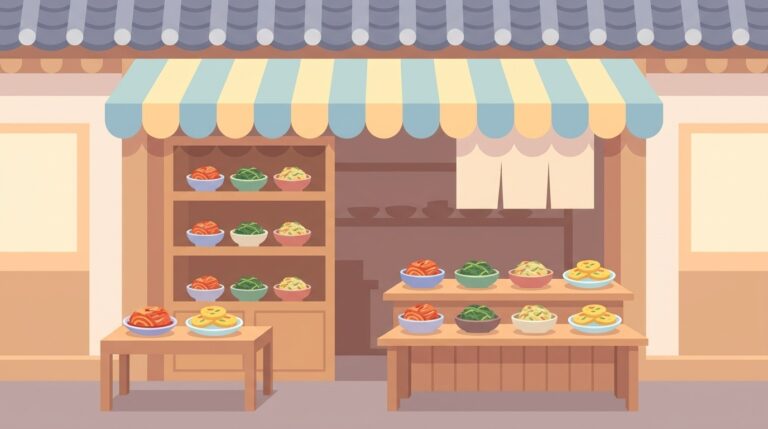
Phase 1: Empathy & The K-Culture Cold Open
Hello there! I’m your Daily Hangul Editor.
Have you ever watched a K-Drama where a family sits down for dinner, and the table is entirely covered with a dozen tiny plates of delicious-looking side dishes? Or perhaps you remember the hit K-Drama Crash Course in Romance (일타 스캔들), where the main character’s entire life revolves around running the ‘National Banchan Shop’ (국가대표 반찬가게).
Those tiny plates are called 반찬 (Banchan), and they are the absolute soul of Korean cuisine. But here’s the problem: if you’re living in Korea, staying at an Airbnb, or just tired of eating out, cooking 5 different Banchan from scratch is impossible. The solution? You go to a local 반찬가게 (Banchan shop)!
However, walking into a traditional market or a neighborhood Banchan shop can be intimidating. The Ajumma (shop owner) might ask you how many grams you want, or you might end up buying something that sets your mouth on fire. Don’t worry! This guide is based on the actual panics and triumphs of my B2-level students who braved the local markets. By the end of this post, you’ll be ordering spicy squid and seasoned spinach like a true Seoulite.
Phase 2: Core Expressions Deep Dive
To survive and thrive in a Banchan shop, you need to move beyond textbook Korean. Let’s look at the top 3 expressions you’ll actually use.
1. 이거 5천 원어치만 담아주세요. (Give me 5,000 won worth of this, please.)
- Pronunciation: [igeo o-cheon woneochi-man dam-a-juseyo]
(Tip: ‘어치’ sounds like a soft sneeze, ‘uh-chi’)- Meaning: Literal = Please put in 5,000 won worth of this. / Real nuance = I don’t know how many grams I need, just give me a standard small batch based on price!
- K-Culture Moment: In Korean markets, asking for things by weight (grams) is usually for meat. For Banchan or street food (like Tteokbokki), locals buy by price. It saves everyone from doing math!
- Editor’s Insight: The word ‘~어치’ (worth of) is a game-changer for B2 learners. It makes you sound instantly fluent. And using ‘담다’ (to put in/pack) instead of ‘주다’ (to give) shows you understand the action of packing food.
- Situation Spectrum:
- Casual (to a friend): 🚫 (Makes no sense)
- Semi-formal (Shop owner / Ajumma): ✅ (Perfect and polite)
- Formal (High-end department store): ✅ (Still works perfectly)
- 🤔 Think About It: Why do Koreans prefer buying by ‘price worth’ rather than exact weight? How does this reflect the fast-paced ‘빨리빨리’ (Ppal-i ppal-i) culture of Korean markets?
2. 이거 신라면보다 매워요? (Is this spicier than Shin Ramyun?)
- Pronunciation: [igeo shin-ramyeon-boda maewoyo?]
(Tip: ‘매’ sounds like ‘meh’, but say it with a slight wince)- Meaning: Literal = Is this spicier than Shin Ramyun? / Real nuance = Please give me an exact, universally understood metric of how much this is going to burn my tongue.
- K-Culture Moment: Shin Ramyun is the ultimate baseline for spiciness in Korea. Even Koreans use this metric when ordering delivery food on apps like Baemin!
- Editor’s Insight: Asking ‘조금 매워요?’ (Is it a little spicy?) is dangerous because a Korean person’s ‘a little spicy’ might be your ‘call an ambulance’. Using a Shin Ramyun comparison gives you a solid factual answer.
- Situation Spectrum:
- Casual (Asking a friend): ✅
- Semi-formal (Shop owner/Restaurant): ✅
- Formal (Business dinner): ⚠️ (A bit too casual, but okay if said playfully)
- 🤔 Think About It: Why does Korea have a standardized ‘spicy scale’ based on a specific brand of instant noodles? What does this say about the integration of corporate products into everyday language?
3. 며칠 정도 두고 먹을 수 있어요? (How many days can I keep this to eat?)
- Pronunciation: [myeo-chil jeong-do du-go meo-geul su i-sseo-yo?]
(Tip: Link the words smoothly: meo-geul-su-i-sseo-yo)- Meaning: Literal = How many days can I leave it and eat it? / Real nuance = What’s the shelf life of this side dish in my fridge?
- K-Culture Moment: Since Banchan is meant to be eaten over several days, knowing the shelf life is crucial. Some dishes (like fresh Namul) go bad in 2 days, while others (like pickled radish) last months.
- Editor’s Insight: The phrase ‘두고 먹다’ (to leave and eat / to keep for eating) is a beautiful, native-sounding expression. Instead of asking ‘언제까지 먹어야 돼요?’ (Until when must I eat it?), ‘두고 먹다’ highlights the culture of storing and rationing food.
- Situation Spectrum:
- Casual: ✅ (며칠 두고 먹을 수 있어?)
- Semi-formal (Shop owner): ✅
- Formal: ⚠️
- 🤔 Think About It: In many Western cultures, leftovers are just ‘leftovers’. In Korea, Banchan is specifically prepared to be ‘두고 먹는’ (kept and eaten). How does this change the way we view the refrigerator?
Phase 3: Textbook vs. Real Korean
Let’s see how your textbook Korean compares to the hustle and bustle of a Mangwon Market Banchan shop.
[Situation 1: Asking the price]
* 📖 Textbook: 이 김치는 얼마입니까? (How much is this Kimchi?)
* 🗣️ Real Korean: 사장님, 이거 한 팩에 얼마예요? (Boss, how much is this for one pack?)
* 💡 Why the difference?: Banchan is usually pre-packed in plastic containers (팩). Asking ‘per pack’ is more practical, and ‘사장님’ (Boss) is the universally polite way to address a shop owner, rather than pointing silently.
[Situation 2: Asking for a recommendation]
* 📖 Textbook: 가장 맛있는 음식을 추천해 주시겠습니까? (Would you please recommend the most delicious food?)
* 🗣️ Real Korean: 오늘 뭐가 제일 잘 나가요? (What’s selling the best today?)
* 💡 Why the difference?: ‘잘 나가다’ (to sell well / go out well) is an essential B2 slang. Koreans trust the crowd—if it’s selling out fast, it means the ingredients for that dish were fresh today!
[Situation 3: Wanting a smaller portion]
* 📖 Textbook: 저는 조금만 사고 싶습니다. (I want to buy only a little.)
* 🗣️ Real Korean: 혼자 먹을 건데, 조금만 덜어서 팔기도 하세요? (I’ll be eating alone, do you also sell smaller portions?)
* 💡 Why the difference?: Explaining why you need less (‘혼자 먹을 건데’ – Since I’m eating alone) appeals to the owner’s empathy (Jeong), making them more likely to accommodate your request.
Bottom Note: At a B2 level, focus on adding contextual filler phrases like ‘혼자 먹을 건데’ (I’m eating alone, so…) or ‘매운 걸 잘 못 먹어서’ (I can’t eat spicy food well, so…). It softens your requests and sounds incredibly natural!
Phase 4: Cultural Context — K-Culture Deep Dive
4-1. Non-verbal Nunchi at the Shop
When pointing at the Banchan you want behind the glass, do not use a single index finger to poke at the glass. Instead, use your open hand, palm facing up, gesturing toward the dish. Also, if the owner is busy packing someone else’s order, use your 눈치 (Nunchi)—wait until they make eye contact before rattling off your order.
4-2. The K-Food Connection: ‘Deom’ (덤) Culture
If you become a regular at a local Banchan shop, or if you simply chat amiably with the owner, you might experience the magic of 덤 (Deom). ‘Deom’ is the concept of giving a little extra for free. You might buy 10,000 won worth of rolled omelet (계란말이), and the owner might slip in a small bag of stir-fried anchovies (멸치볶음) saying, ‘이건 서비스!’ (This is on the house!).
Critical View: While ‘Deom’ is a beautiful display of Korean ‘Jeong’ (affection/warmth), it’s slowly disappearing in modern, gentrified neighborhoods and department stores. It’s mostly kept alive in traditional markets. Never demand Deom—it must be freely given!
Phase 5: Real-Life Roleplay Scenario
Setting: It’s 6 PM on a chilly Tuesday. You are at a bustling traditional market near your Airbnb in Seoul. The smell of sesame oil and spicy gochujang fills the air. You spot a brightly lit Banchan shop with mountains of side dishes.
Characters:
– YOU: A foreigner living in Korea who misses home-cooked meals but hates cooking.
– Sajangnim (사장님): A friendly woman in her 50s wearing a pink apron. She’s moving quickly, packing food for a line of customers.
Dialogue:
YOU: 사장님, 안녕하세요!
(Sajangnim, annyeonghaseyo!)
[Boss, hello!]
(🎭 Stage Direction: You smile and look at the array of side dishes)
Sajangnim: 어서 와요~ 오늘 오징어채 볶음 맛있게 됐는데 좀 줄까?
(Eoseo wayo~ Oneul ojingeo-chae bokkeum masitge dwaenneunde jom julkka?)
[Welcome~ The stir-fried dried squid turned out delicious today, should I give you some?]
YOU: 오, 맛있겠네요! 근데 그거 신라면보다 매워요?
(O, masitgenneyo! Geunde geugeo shin-ramyeon-boda maewoyo?)
[Oh, looks delicious! But is it spicier than Shin Ramyun?]
Sajangnim: 에이, 하나도 안 매워. 달짝지근해.
(Ei, hanado an maewo. Daljjakjigeunhae.)
[Ay, not spicy at all. It’s sweet and savory.]
YOU: 다행이네요. 그럼 그거 5천 원어치만 담아주세요.
(Dahaeng-ineyo. Geureom geugeo o-cheon woneochi-man dam-a-juseyo.)
[That’s a relief. Then please give me 5,000 won worth of that.]
Sajangnim: 알았어요. 혼자 살아? 밥은 잘 챙겨 먹고?
(Arasseoyo. Honja sara? Babeun jal chaenggyeo meokgo?)
[Got it. Do you live alone? Are you eating your meals properly?]
(🎭 Stage Direction: She packs a generous amount of squid into a container)
YOU: 네, 혼자 살아서 반찬 해 먹기가 힘들더라고요. 이거 며칠 정도 두고 먹을 수 있어요?
(Ne, honja saraseo banchan hae meokgiga himdeuldeoragoyo. Igeo myeochil jeongdo dugo meogeul su isseoyo?)
[Yes, living alone makes it hard to cook side dishes. How many days can I keep this to eat?]
Sajangnim: 냉장고에 넣으면 일주일은 거뜬하지! 자, 여기. 깻잎은 내가 덤으로 좀 넣었어.
(Naengjanggo-e noeumyeon ilju-ireun geotteunhaji! Ja, yeogi. Kkaennipeun naega deomeuro jom neoeosseo.)
[If you put it in the fridge, it’ll easily last a week! Here you go. I put in some perilla leaves as an extra.]
🔀 Your Turn! How do you reply to her giving you ‘Deom’ (free extras)?
– A) “아, 저는 깻잎 안 좋아하는데 빼주세요.” (Oh, I don’t like perilla leaves, please take them out.)
– B) “진짜요? 우와, 사장님 최고! 잘 먹겠습니다!” (Really? Wow, Boss you’re the best! I’ll eat it well!)
– C) “이거 얼마 추가로 내야 해요?” (How much extra do I have to pay for this?)✅ Best Choice: B — Acknowledge her generosity with enthusiasm! Saying ‘사장님 최고’ (Boss is the best) will guarantee you VIP treatment next time.
⚠️ Choice A & C Analysis: Choice A is honest but culturally blunt and might hurt her feelings (Jeong). Choice C completely misunderstands the concept of ‘Deom’ (which is always free) and might make the interaction awkward.
YOU: 진짜요? 우와, 사장님 최고! 잘 먹겠습니다!
(Jinjjayo? Uwa, sajangnim choego! Jal meokgetseumnida!)
[Really? Wow, Boss you’re the best! I’ll eat it well!]
Sajangnim: 그래그래, 맛있게 먹고 또 와요!
(Geurae-geurae, masitge meokgo tto wayo!)
[Yes, yes, eat well and come again!]
Phase 6: 10-Second Shadowing Drill
Practice this until it flows out naturally. Pay attention to the pauses (/) and the emotion tags!
😳 (Slightly worried) 사장님, / 이거 / 신라면보다 매워요?
(sajangnim, / igeo / shin-ramyeon-boda maewoyo?)😊 (Polite & clear) 혼자 먹을 건데, / 오천 원어치만 / 담아주세요.
(honja meogeul geonde, / o-cheon woneochi-man / dam-a-juseyo.)🤩 (Grateful) 우와! / 잘 두고 먹겠습니다! / 감사합니다!
(uwa! / jal dugo meokgetseumnida! / gamsahamnida!)
Phase 7: K-Culture Mini Dictionary
1. 반찬 (Banchan)
* Romanization: banchan
* English: Side dishes
* Context: The small dishes served alongside rice in Korean meals. They are meant to be shared and eaten simultaneously with rice, not as appetizers!
2. 밑반찬 (Mit-banchan)
* Romanization: mit-banchan
* English: Staple side dishes / Base side dishes
* Context: ‘Mit’ means ‘base/bottom’. These are long-lasting side dishes (like pickled radish or stir-fried anchovies) that sit in the fridge and form the baseline of every meal.
3. 밥도둑 (Bap-doduk)
* Romanization: bap-doduk
* English: Rice thief
* Context: A highly complimentary slang for a incredibly delicious (often salty or spicy) Banchan, like soy-marinated crab (게장). It’s so good that it ‘steals’ your rice away because you eat so much rice with it!
4. 덤 (Deom)
* Romanization: deom
* English: Extra / On the house
* Context: A cultural concept of giving customers extra goods for free as a sign of affection or good business practice.
Phase 8: Traveler Survival Kit
Even if you’re just visiting Korea for a week, you might want to buy Banchan to eat with instant rice (햇반) at your hotel!
🆘 Survival Phrases for the Market
– 🇰🇷 “이거 한 팩에 얼마예요?” (igeo han paege eolmayeyo? – How much is this for one pack?)
– 🇰🇷 “현금 영수증 해주세요.” (hyeongeum yeongsujeung haejuseyo – Please give me a cash receipt. Useful if you live in Korea for tax purposes!)
– 🇰🇷 “이거 비행기에 가지고 탈 수 있어요?” (igeo bihaenggi-e gajigo tal su isseoyo? – Can I take this on the airplane? Crucial for Kimchi!)
📌 Editor’s Travel Note
– Kimchi on Flights: Liquid-heavy Banchan like Kimchi MUST go in checked baggage, well-sealed. It will explode in the cabin pressure if not sealed properly!
– Card vs. Cash: Traditional markets accept credit cards now, but if you want to negotiate or get ‘Deom’, paying in cash or account transfer (계좌이체) makes the owner much happier.
Phase 9: Critical Thinking Corner — “A Step Deeper”
Food & Identity: The Philosophy of Banchan
Have you ever wondered why Koreans eat so many side dishes instead of one main dish per person? Historically, Korea was an agrarian society with distinct seasons, including harsh winters. To survive, people developed advanced fermentation and preservation techniques (hence, Mit-banchan). Moreover, the Korean table setting is inherently communal. Everyone shares the Banchan placed in the center of the table. This physically manifests the Korean concept of 우리 (Uri – We/Our). You don’t just eat ‘your’ food; you share the communal harvest.
🧠 Think Deeper: As Korea rapidy modernizes and single-person households (1인 가구) increase, the communal sharing of Banchan is shifting towards buying individual packs at stores.
💬 Your Turn: Does your culture have a tradition of communal eating or sharing side dishes? How do you feel about sharing a plate with others? Let us know in the comments!
Phase 10: FAQ & Common Mistakes
Q: Is it okay to ask for a taste (시식) at a Banchan shop?
Yes! If they have open trays, you can politely ask: “이거 조금 맛봐도 돼요?” (Can I taste a little of this?). However, don’t just grab a toothpick and dive in without asking!
Q: Do I need to bring my own containers?
Usually, no. They provide plastic containers or bags. However, ‘Zero Waste’ is trending in Korea, so if you bring your own Tupperware (용기), some owners will be deeply impressed and give you extra ‘Deom’!
❌ Common Mistake #1: Ordering Banchan by the exact gram (e.g., “250 grams of Kimchi please”).
✅ Do this instead: Order by price (“오천 원어치 주세요”) or by the pre-made pack (“이거 한 팩 주세요”).❌ Common Mistake #2: Pointing at something and saying “저거요” (That one) without any other words.
✅ Do this instead: Always soften it! “사장님, 저거 한 팩 주시겠어요?” (Boss, could you give me a pack of that?). It changes you from a rude tourist to a polite local.
Phase 11: Summary & Action Items
One-Liner Summary: Navigate the Korean Banchan shop like a local by ordering ‘by price’ (어치), verifying the spice level with Shin Ramyun, and asking about shelf life (두고 먹다)!
Action Mission 3 Steps:
– 🥉 Bronze (Solo): Stand in front of your fridge, point to your leftovers, and practice saying: “이거 며칠 두고 먹을 수 있지?” (How many days can I keep this?)
– 🥈 Silver (Online): Find a Korean recipe video on YouTube for ‘밑반찬’ and leave a comment: “우와, 밥도둑이네요!” (Wow, it’s a rice thief!)
– 🥇 Gold (Real World): Visit a traditional Korean market or a Korean grocery store (H-Mart works too!), point to a side dish, and ask the staff: “이거 많이 매워요?”
K-Culture Mission:
Next time you watch a K-Drama, look closely at the dining scenes. Can you spot which side dishes are fresh (like egg rolls) and which ones are ‘Mit-banchan’ (like dark, soy-sauce braised beans)?
Phase 12: Quiz — Interactive Challenge
1. Situational Judgment: You want to buy some spicy stir-fried pork (제육볶음) side dish, but you only have a 10,000 won bill and don’t want a huge amount. What is the most natural thing to say?
– A) 제육볶음 200그램 주십시오.
– B) 사장님, 제육볶음 만 원어치만 주세요.
– C) 제육볶음 조금만 담아주세요.
(Answer: B. Asking for ‘만원어치’ is perfectly natural and fits your budget exactly. C is okay but vague, and A is too textbook!)
2. Fill in the Blank:
“이 반찬 너무 맛있어요! 완전 _______이네요!” (This Banchan is so delicious! It’s a total rice thief!)
(Answer: 밥도둑 – Bap-doduk)
3. True or False — K-Culture Edition:
If the Banchan shop owner gives you extra food for free (덤), you should insist on paying for it to be polite.
(Answer: False. Insisting on paying for ‘Deom’ rejects the owner’s ‘Jeong’ (affection) and can make the situation awkward. Just say “감사합니다!” enthusiastically!)
Frequently Asked Questions (FAQ)
Q: What does "이거 5천 원어치만 담아주세요. (Give me 5,000 won worth of this, please.)" mean in Korean and how do you pronounce it?
A: In Korean, "이거 5천 원어치만 담아주세요. (Give me 5,000 won worth of this, please.)" is pronounced [igeo o-cheon woneochi-man dam-a-juseyo] and means: Literal = Please put in 5,000 won worth of this. / Real nuance = I don't know how many grams I need, just give me a standard small batch based on price!
Q: What does "이거 신라면보다 매워요? (Is this spicier than Shin Ramyun?)" mean in Korean and how do you pronounce it?
A: In Korean, "이거 신라면보다 매워요? (Is this spicier than Shin Ramyun?)" is pronounced [igeo shin-ramyeon-boda maewoyo?] and means: Literal = Is this spicier than Shin Ramyun? / Real nuance = Please give me an exact, universally understood metric of how much this is going to burn my tongue.
Q: What does "며칠 정도 두고 먹을 수 있어요? (How many days can I keep this to eat?)" mean in Korean and how do you pronounce it?
A: In Korean, "며칠 정도 두고 먹을 수 있어요? (How many days can I keep this to eat?)" is pronounced [myeo-chil jeong-do du-go meo-geul su i-sseo-yo?] and means: Literal = How many days can I leave it and eat it? / Real nuance = What's the shelf life of this side dish in my fridge?







