

Phase 1: Empathy (Immersive Cold Open)
Hello there! It’s your Daily Hangul Editor.
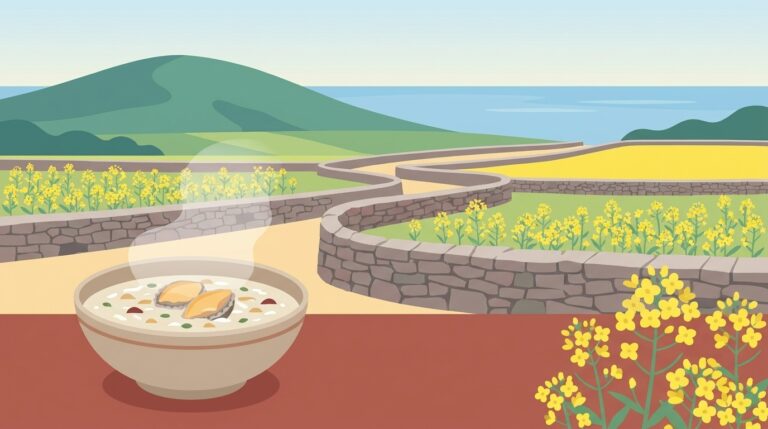
Imagine this: You’re watching a K-Drama. The handsome CEO is stressed out, staring blankly at the chaotic Seoul traffic. The next scene? He’s suddenly standing in a field of bright yellow canola flowers, the wind blowing through his hair, eating a steaming bowl of premium abalone porridge in a tiny, seaside restaurant. The subtitles just say, “This is nice,” but you can feel it in your bones—it’s much deeper than that.
Welcome to the magic of Korea’s southern islands, specifically Wando (the holy grail of abalone) and Cheongsando (Asia’s first designated ‘Slow City’). When you travel here, the survival phrases from your textbook won’t cut it. You’re no longer in the bustling streets of Myeongdong ordering an iced Americano; you are in the heart of Korean healing culture.
If you only know how to say “Give me this” (이거 주세요), you’ll survive. But if you know how to compliment the deep flavors of local seafood or express the poetic beauty of slowing down, the local restaurant owner (이모님, Imo-nim) might just sneak an extra piece of premium abalone onto your plate.
Let’s dive into the real Korean expressions that will make you sound like a true local on your island getaway. (Don’t worry, these insights are drawn directly from my own island-hopping adventures and my advanced students’ real experiences!)
Phase 2: Core Expressions Deep Dive
1. 원기 회복에 최고예요 (Great for restoring stamina)
- Pronunciation: won-gi hoe-bog-e choe-go-ye-yo [won-gee hway-bo-geh chway-go-yay-yo. The ‘g’ in ‘gi’ is a hard G, and ‘choe’ sounds like ‘chway’.]
- Meaning: Literal: “It’s the best for stamina recovery.” / Real nuance: “This food is incredibly nourishing and makes me feel energetic again.”
- K-Culture Moment: In K-Dramas, when someone is sick or working too hard, the wealthy mother-in-law sends a box of live Wando abalone. Eating it isn’t just about taste; it’s a medicinal ritual.
- Editor’s Insight: You say this after taking your first bite of abalone or drinking a rich seafood broth. It shows you don’t just understand the taste, but the purpose of the food. It’s the ultimate compliment to the chef.
- Situation Spectrum:
- Casual with friends: ✅ (Usually shortened to “와, 몸보신 된다!”)
- Semi-formal (Co-workers): ✅
- Formal (Elders/Boss): ✅ (Perfect to say when an elder buys you an expensive meal)
- 🤔 Think About It: Why does Korean culture categorize so many foods by their medicinal benefits (보양식, boyangsik) rather than just their flavor? Does your culture have a specific “stamina” food?
2. 시간이 멈춘 것 같아요 (It feels like time has stopped)
- Pronunciation: si-gan-i meom-chun geot gat-a-yo [shee-gahn-ee mum-choon gut ga-ta-yo. ‘meom’ sounds like ‘mum’ but round your lips slightly.]
- Meaning: Literal: “It seems time has stopped.” / Real nuance: “This place is so peaceful and untouched by the hustle and bustle.”
- K-Culture Moment: Standing on the stone walls (돌담길) of Cheongsando, overlooking the ocean where classic movies like Seopyeonje were filmed. It’s the exact phrase travel vloggers use when they escape Seoul.
- Editor’s Insight: This is a highly poetic yet commonly used travel expression. As a C1 learner, using descriptive, emotional language elevates your Korean from “tourist” to “storyteller.”
- Situation Spectrum:
- Casual with friends: ✅
- Semi-formal (Co-workers): ✅
- Formal (Elders/Boss): ✅
- 🤔 Think About It: Korea is famous for its Ppalli-Ppalli (hurry up) culture. How does the existence of highly celebrated “Slow Cities” reflect the psychological desires of modern Koreans?
3. 멍 때리기 딱 좋은 곳이네요 (It’s the perfect place to zone out)
- Pronunciation: meong ttae-ri-gi ttak jo-eun gos-i-ne-yo [mung ttae-ree-gee ttak jo-eun go-she-nay-yo. For ‘ttae’ and ‘ttak’, tense your throat and spit the sound out sharply!]
- Meaning: Literal: “It’s a perfectly good place to hit a blank stare.” / Real nuance: “It’s the perfect place to relax, empty my mind, and just chill.”
- K-Culture Moment: Think of K-Pop idols on a healing reality show (like In the SOOP). They sit by the water, staring into space. The captions will definitely read: “폭풍 멍때리기” (Stormy zoning out).
- Editor’s Insight: 멍 때릴다 (to space out) used to have a slightly negative connotation (wasting time), but today, it’s considered an essential mental health activity in Korea. There’s even an annual “Space Out Competition” in Seoul!
- Situation Spectrum:
- Casual with friends: ✅
- Semi-formal (Co-workers): ⚠️ (Depends on your closeness)
- Formal (Elders/Boss): 🚫 (Might sound a bit too slangy; use “힐링하기 좋네요” instead)
- 🤔 Think About It: Why has “doing absolutely nothing” become a luxurious and scheduled activity in Korean travel culture?
Phase 3: Textbook vs. Real Korean
Let’s upgrade your textbook Korean to native-level C1 fluency, tailored for an island food trip!
[Situation 1: Ordering Abalone Porridge at a Local Restaurant]
* 📖 Textbook Korean: 전복죽 한 그릇 주세요. (Please give me one bowl of abalone porridge.)
* 🗣️ Real Korean: 사장님, 여기 전복죽 내장 듬뿍 넣어서 쥄하게 부탁드릴게요! (Boss, please make the abalone porridge rich, with plenty of intestines!)
* 💡 Why it’s different: True Korean gourmets know that the deep green color and rich flavor of abalone porridge come from the intestines (내장). Asking for it this way proves you are a food connoisseur, not just a passing tourist.
[Situation 2: Reacting to the Scenic View of Cheongsando]
* 📖 Textbook Korean: 경치가 매우 아름답습니다. (The scenery is very beautiful.)
* 🗣️ Real Korean: 와, 여기 완전 힐링 자체네요. 서울 가기 싫다. (Wow, this place is healing itself. I don’t want to go back to Seoul.)
* 💡 Why it’s different: Modern Koreans frequently use the Konglish word “힐링” (healing) to describe beautiful nature. Adding “I don’t want to go back to Seoul” is the ultimate hyperbole to praise a travel destination.
Bottom Note: For C1 learners, the key isn’t just knowing the vocabulary, but combining sensory words (like 쥄하다 – rich/thick) with polite request forms (부탁드릴게요) to sound sophisticated yet deeply appreciative of the local culture.
Phase 4: Cultural Context — K-Culture Deep Dive
4-1. Non-Verbal Cues on the Island
When you visit a local restaurant in Wando, the owner might come over and start cutting the abalone for you with scissors. Do not politely decline!
In Korea, especially in the countryside, providing this kind of hands-on service (grilling your meat, cutting your seafood) is an expression of Jeong (정 – warm affection). Sit back, say “Ah, gamsahamnida” with a slight bow of the head, and wait for them to place the best piece on your plate. Also, if they offer you the abalone shell with some sauce in it, accept it with both hands—it’s considered a delicacy!
4-2. K-Culture Connection: Food & Identity
Have you ever noticed in K-Dramas how food is used as a tool of negotiation, apology, and affection? Wando abalone is a prime example. In dramas, if a character messes up big time at work, they don’t just say sorry; they show up at the boss’s house with a luxurious, gold-wrapped styrofoam box of live Wando abalone.
Why? Because in Korea, showing that you care about someone’s health (their stamina, their won-gi) is the highest form of respect. By learning how to talk about these medicinal benefits, you tap into a core element of Korean social dynamics: “I care about your survival and strength.”
Phase 5: Practical Roleplay Scenario
Let’s put you in the protagonist’s seat!
- Setting: Friday afternoon, 1:00 PM. A breezy, open-air seafood restaurant in Wando. You can smell the salty ocean air. You and your Korean business partner, Min-su, just finished a big presentation at the local port authority.
- Characters:
- YOU: A foreign professional (C1 Korean speaker) who wants to impress your colleague and the restaurant owner.
- Min-su (35): Your Korean colleague. He’s exhausted from work but excited to eat.
- Imo-nim (60s): The friendly restaurant owner with a thick Southern dialect.
The Dialogue:
Min-su: 아, 드디어 끝났네요. 원기 회복좀 해야겠어요.
(Ah, deudieo kkeutnatneyo. Won-gi hoebok-jom haeyaget-eoyo.)
(Ah, it’s finally over. We need to recover our stamina.)
YOU: 맞아요. 완도에 왔으니 무조건 전복이죠!
(Majayo. Wando-e wasseuni mu-jogeon jeonbok-ijyo!)
(Exactly. Since we’re in Wando, it has to be abalone, no matter what!)
Imo-nim: (🎭 Bringing a huge sizzling plate) 아이고, 서울서 왔는가? 이거 우리 밧에서 오늘 캤 거여. 서비스로 해삼도 좀 넣었어~
(Aigo, seoul-seo wanneunga? Igeo uri bat-eseo oneul kaen geo-yeo. Seobiseu-ro haesam-do jom neoseo~)
(Oh my, did you come from Seoul? We caught these from our farm today. I put in some sea cucumbers as “service” (on the house)!)
Min-su: 와, 사장님 인심 최고! 잘 먹겠습니다.
(Wa, sajangnim insim choego! Jal meokgetseumnida.)
(Wow, your generosity is the best, boss! We will eat well.)
🔀 Your Turn! How do you respond to the owner’s “Service”?
– A) “서비스 감사합니다. 얼마에요?” (Thank you for the service. How much is it?)
– B) “와, 사장님 덕분에 원기 회복 제대로 하겠네요. 정말 감사합니다!” (Wow, thanks to you we will properly recover our stamina. Thank you so much!)
– C) “저 해삼 못 먹는데요?” (I can’t eat sea cucumber though?)✅ Best Choice: B — Reason: In Korea, “Service” (서비스) means it’s free. Offering to pay for it (A) shows a lack of cultural understanding and might offend her generosity. Complimenting her using the advanced expression we learned creates an instant bond.
⚠️ Choice C Analysis: Even if you can’t eat it, bluntly rejecting free food from an elder in the countryside breaks the Jeong (warm vibe). Just say thank you, and let Min-su eat it!
Phase 6: 10-Second Shadowing Drill
Time to practice your rhythm! Pay attention to the pauses (/) and the emotion.
🥺 (Deeply moved)
와… / 여기 경치를 보니까 / 시간이 멈춘 것 같아요.
(Wa… / yeo-gi gyeong-chi-reul bo-ni-kka / si-gan-i meom-chun geot gat-a-yo.)
😋 (Excited and hungry)
사장님! / 전복죽 / 내장 듬~~~뿍 넣어서 / 쥄~하게 부탁드려요!
(Sa-jang-nim! / jeon-bok-juk / nae-jang deum~~~ppeuk neo-eo-seo / jin~ha-ge bu-tak-deu-ryeo-yo!)
Phase 7: K-Culture Mini Dictionary
Expand your C1 vocabulary with these culturally loaded keywords related to island travel:
1. 보양식
* Romanization: boyangsik
* English: Stamina food / Nourishing food
* Context: Foods eaten specifically to restore energy, especially during hot summers or after intense work. Abalone, ginseng chicken soup (Samgyetang), and eel fall into this high-tier category.
2. 슬로시티
* Romanization: seullositi
* English: Slow City (Cittaslow)
* Context: Cheongsando was designated as Asia’s first Slow City. It represents a movement against fast-paced modern life, encouraging traditional farming, walking, and preserving nature.
3. 힐링
* Romanization: hilling
* English: Healing
* Context: A massive buzzword in Korea. It doesn’t just mean medical healing; it refers to anything that relieves mental stress—a quiet island, a cute dog, or a warm cup of coffee.
4. 인심
* Romanization: insim
* English: Generosity / Good-heartedness
* Context: Often used as “시골 인심” (countryside generosity). It refers to the abundant portions and free side dishes given by rural restaurant owners.
Phase 8: Traveler’s Survival Kit
Traveling to remote islands like Wando and Cheongsando requires a different set of logistical phrases compared to riding the Seoul subway.
🏝️ Island Survival Expressions TOP 3
– 🇰🇷 “청산도 들어가는 배편 있나요?” (cheong-san-do deu-reo-ga-neun bae-pyeon in-na-yo?)
– 🗣️ Are there any ferry tickets left going into Cheongsando?
– 🇰🇷 “마지막 배는 몇 시에 끊겨요?” (ma-ji-mak bae-neun myeot si-e kkeun-gyeo-yo?)
– 🗣️ What time is the last ferry cut off? (Crucial! Island ferries stop early!)
– 🇰🇷 “렌트카 / 자전거 대여 되나요?” (ren-teu-ka / ja-jeon-geo dae-yeo doe-na-yo?)
– 🗣️ Can I rent a car / bicycle?📌 Editor’s Travel Note
– Useful Apps: KakaoMap works best, but for ferry times, download the “KaKao T” app or check the “가보고” (Gabogo) ferry ticketing app.
– Weather check: Island ferries get canceled frequently due to wind. Always check the weather warning (풍랑주의보) before driving all the way down to Wando!
Phase 9: Critical Thinking Corner — “One Step Deeper”
🧠 Think Deeper: Media vs. Reality & The Cult of ‘Healing’
For a C1 learner, it’s fascinating to observe the linguistic shift in Korean society. South Korea built its modern economy on the fierce, unyielding culture of Ppalli-Ppalli (빨리빨리 – hurry up). Yet, look at the media today: top-rated TV shows feature celebrities chopping wood on remote islands, and tourists flock to Cheongsando specifically because it’s a “Slow City.”
This reveals a profound societal burnout. The vocabulary of extreme relaxation—멍때릴다 (zoning out), 힐링 (healing), 소확행 (small but certain happiness)—didn’t just emerge naturally; it was created as an antidote to the high-pressure reality of Seoul. When you visit these islands, you aren’t just looking at scenery; you are participating in a modern Korean ritual of psychological detox.
💬 Your Turn: How does your culture deal with societal burnout? Is there a designated “Slow” place or concept you escape to? Share your thoughts in the comments!
Phase 10: FAQ & Avoiding Common Mistakes
Q: “Can I ask for extra abalone if I want a refill?”
No! While side dishes (반찬) like kimchi and beansprouts are infinitely refillable for free in Korea, main ingredients like abalone, meat, or fish must be ordered and paid for additionally (추가 주문).
Q: “How should I address an elderly person on the island?”
In Seoul, you might use 사장님 (Boss) or 선생님 (Teacher). In the rural south, 어르신 (Elder) is very respectful for older folks on the street. In a restaurant, 이모님 (Auntie) is standard, but use a bright, friendly tone!
❌ Common Mistake: Using Seoul slang or speaking too fast in rural areas.
✅ Do This Instead: Speak slightly slower, smile, and use standard polite Korean (요 or 습니다). The island dialect (사투리) might be hard to understand, but your polite standard Korean will be perfectly understood and appreciated.
Phase 11: Summary & Action Items
One-Liner Summary: True Korean island travel isn’t just about escaping; it’s about restoring your energy (원기 회복) and actively doing nothing (멍때릴다) in a Slow City.
Action Mission:
– 🥉 Bronze (Solo): Say “와, 시간이 멈춘 것 같아요” out loud next time you look at a beautiful sunset.
– 🥈 Silver (Online): Look up “Cheongsando” (청산도) on YouTube and leave a comment in Korean on a travel vlog using today’s expressions.
– 🥇 Gold (Real World): Next time you eat at a Korean restaurant, use the word 서비스 or praise their 인심 (generosity) to the owner!
🎬 K-Culture Mission: Watch an episode of a Korean variety show set in the countryside (like Three Meals a Day or Youn’s Stay). Count how many times the cast talks about “stamina” (보양식) when eating dinner!
Phase 12: Interactive Challenge (Quiz)
Test your C1 instincts!
1. Situational Judgment: You are eating a very expensive Wando abalone soup bought by your Korean father-in-law. What is the BEST thing to say?
– A) 값이 비싸 보이네요. (It looks expensive.)
– B) 원기 회복에 최고네요! 감사히 먹겠습니다. (It’s the best for restoring stamina! I’ll eat it gratefully.)
– C) 시간이 멈춘 것 같아요. (It feels like time has stopped.)
2. Fill in the Blank:
“여기 경치가 너무 좋아서, 그냥 ______ 때리기 딱 좋네요.”
(The scenery here is so good, it’s perfect to just zone out.)
3. True or False – K-Culture Edition:
In a Korean seafood restaurant, if the owner gives you a plate of squid and says “이거 서비스예요” (This is service), you must add a 15% tip to your final bill to show gratitude. (T / F)
👉 Click here for the Answers!
1. B. Discussing the health benefits is the highest compliment for expensive Korean food. A is slightly rude, and C is for scenery, not food.
2. 멍 (Meong). 멍 때릴다 means to zone out or space out.
3. False. There is no tipping culture in Korea! “Service” literally means it is a free gift from the owner’s generosity (인심). Tipping might actually confuse them.
Frequently Asked Questions (FAQ)
Q: What does "원기 회복에 최고예요 (Great for restoring stamina)" mean in Korean and how do you pronounce it?
A: In Korean, "원기 회복에 최고예요 (Great for restoring stamina)" is pronounced [won-gi hoe-bog-e choe-go-ye-yo [won-gee hway-bo-geh chway-go-yay-yo. The 'g' in 'gi' is a hard G, and 'choe' sounds like 'chway'.] and means: Literal: "It's the best for stamina recovery." / Real nuance: "This food is incredibly nourishing and makes me feel energetic again."
Q: What does "시간이 멈춘 것 같아요 (It feels like time has stopped)" mean in Korean and how do you pronounce it?
A: In Korean, "시간이 멈춘 것 같아요 (It feels like time has stopped)" is pronounced [si-gan-i meom-chun geot gat-a-yo [shee-gahn-ee mum-choon gut ga-ta-yo. 'meom' sounds like 'mum' but round your lips slightly.] and means: Literal: "It seems time has stopped." / Real nuance: "This place is so peaceful and untouched by the hustle and bustle."
Q: What does "멍 때리기 딱 좋은 곳이네요 (It's the perfect place to zone out)" mean in Korean and how do you pronounce it?
A: In Korean, "멍 때리기 딱 좋은 곳이네요 (It's the perfect place to zone out)" is pronounced [meong ttae-ri-gi ttak jo-eun gos-i-ne-yo [mung ttae-ree-gee ttak jo-eun go-she-nay-yo. For 'ttae' and 'ttak', tense your throat and spit the sound out sharply!] and means: Literal: "It's a perfectly good place to hit a blank stare." / Real nuance: "It's the perfect place to relax, empty my mind, and just chill."







