

Phase 1: Empathy (Welcome to the Real Korean Winter!)
Hello there! I’m your Head Editor at Daily Hangul.
Picture this: You are sitting in a cozy cafe in Seoul, sipping your hot Americano. Suddenly, BEE-BEEP! BEE-BEEP! Every single smartphone in the cafe goes off simultaneously with an aggressive alarm sound. You look around, expecting panic, but everyone casually glances at their screens and goes back to chatting. You look at your phone. It’s a ‘재난문자’ (Emergency Alert) warning you about a 한파 주의보 (Cold Wave Advisory).
If you’ve watched K-Dramas, you might remember scenes where characters exhale thick, white steam into the freezing air, burying their faces in gigantic scarves. But what dramas rarely show you is the absolute panic of waking up the next morning to realize you have no hot water because your pipes froze overnight!
As someone who has survived over a decade of Seoul’s brutal winters, let me tell you: knowing how to talk about the weather and manage your boiler is purely a matter of survival. This guide is crafted from the actual panicked messages my expat students have sent me over the years. Let’s make sure you stay warm, save money, and sound like a true local this winter!
Phase 2: Core Expressions Deep Dive
1. 한파 주의보 (Cold Wave Advisory)
- Pronunciation: han-pa ju-ui-bo [Sounds like: han-pah joo-we-boh]
- Meaning: Cold wave advisory (Official weather warning)
- K-Culture Moment: This is the exact phrase that pops up on those blaring emergency text messages. When this alert hits, you will see a massive shift in Seoul’s street fashion: suddenly, everyone transforms into a black ‘Long Padding’ (puffer coat) caterpillar.
- Editor’s Insight: ‘한파’ (han-pa) literally means ‘cold wave.’ While you might say ‘너무 춥다’ (It’s so cold) to friends, ‘한파’ is the grown-up, news-anchor way to describe the brutal, freezing weather system.
- Situation Spectrum:
- Casual with friends: ✅ (Used when complaining: “오늘 한파 장난 아니야” – The cold wave is no joke today)
- Coworkers (Semi-formal): ✅
- Boss/Elders (Formal): ✅
- ና24 Think About It: Why does the Korean government send emergency alerts for cold weather? How does your country handle extreme temperature warnings?
2. 동파됐어요 (The pipes burst/froze)
- Pronunciation: dong-pa-dwaet-seo-yo [Sounds like: dong-pah-dwet-suh-yo]
- Meaning: Literal: Winter damage/burst. Real nuance: “My pipes are frozen solid and I can’t shower!”
- K-Culture Moment: Every January, local plumbers (설비 아저씨) become the most sought-after VIPs in Korea. If you don’t know this word, you’ll struggle to explain to your landlord why there’s no water coming out of the faucet.
- Editor’s Insight: This word combines ‘동’ (Winter/Freeze) and ‘파’ (Break). It sounds a bit technical, but it’s the exact word you MUST use when calling for help.
- Situation Spectrum:
- Casual with friends: ✅
- Coworkers (Semi-formal): ✅
- Landlord/Plumber (Formal): ✅
- ና24 Think About It: Korean homes rely on water-based underfloor heating (Ondol). If the pipes freeze, you lose both hot water AND your heating. Does your home country use central air or radiators?
3. 보일러 외출 모드 (Boiler ‘Away’ Mode)
- Pronunciation: bo-il-leo oe-chul mo-deu [Sounds like: boy-luh weh-chool moh-deu]
- Meaning: Outing mode / Away mode for the boiler.
- K-Culture Moment: In K-Dramas, when someone leaves the house, they don’t just turn off the lights; they press a button on the little digital box on the wall. That’s the boiler controller!
- Editor’s Insight: This is the most crucial winter survival tip in Korea. NEVER turn your boiler completely off in winter to save money. The pipes will freeze (동파). Instead, set it to ‘외출’ (Going out). It keeps a minimum temperature running to prevent freezing.
- Situation Spectrum:
- Casual with friends: ✅
- Coworkers (Semi-formal): ✅
- Boss/Elders (Formal): ✅
- ና24 Think About It: The concept of ‘외출’ implies you are temporarily stepping out but will return. How does language reflect the way we interact with our living spaces?
Phase 3: Textbook vs. Real Korean
[Situation 1: Complaining about the freezing weather]
* ኂ14 Textbook Korean: 날씨가 매우 춥습니다. (nal-ssi-ga mae-u chup-seum-ni-da.) – The weather is very cold.
* ኄ63攃 Real Korean: 롱패딩 각이다. (rong-pae-ding ga-gi-da.) / 얼어 죽겠다! (eo-reo juk-get-da!)
* ኁ61 Why the difference?: ‘각이다’ is slang meaning ‘It’s the perfect angle/time for something.’ Koreans love using exaggerated expressions like ‘얼어 죽겠다’ (I’m going to freeze to death) to show solidarity in suffering!
[Situation 2: Telling the landlord your water isn’t working]
* ኂ14 Textbook Korean: 수도관이 얼어서 물이 나오지 않습니다. (su-do-gwa-ni eo-reo-seo mu-ri na-o-ji an-seum-ni-da.)
* ኄ63攃 Real Korean: 사장님, 저희 집 보일러 동파됐나 봐요. 온수가 안 나와요. (sa-jang-nim, jeo-hui jip bo-il-leo dong-pa-dwaen-na bwa-yo. on-su-ga an na-wa-yo.)
* ኁ61 Why the difference?: Real conversations use softer guesses like ‘~나 봐요’ (I guess/it seems) to deliver bad news gently, and calling the landlord ‘사장님’ (Boss) builds rapport.
Bottom Note: For B2 learners, using ‘~나 봐요’ or slightly exaggerated phrases like ‘얼어 죽겠다’ perfectly bridges the gap between a student and a seasoned resident.
Phase 4: Cultural Context — K-Culture Deep Dive
4-1. Non-verbal Elements & ‘Nunchi’
When winter hits, Korean indoor etiquette becomes even more important. Because of the Ondol (온돌) system (underfloor heating), the floor is the warmest part of the house.
* Etiquette Tip: Never wear shoes inside! Not only is it dirty, but you’re also disrespecting the sacred, warm floor.
* Nunchi Point: If you visit a Korean friend’s house in winter, they will likely guide you to the “아랫목” (a-raen-mok) — traditionally the warmest spot on the floor near the boiler. Accepting this spot with a gracious “아구, 따뜻하네요” (Ah, it’s so warm) shows great cultural Nunchi.
4-2. K-Drama & K-Food Connection: The Winter Ritual
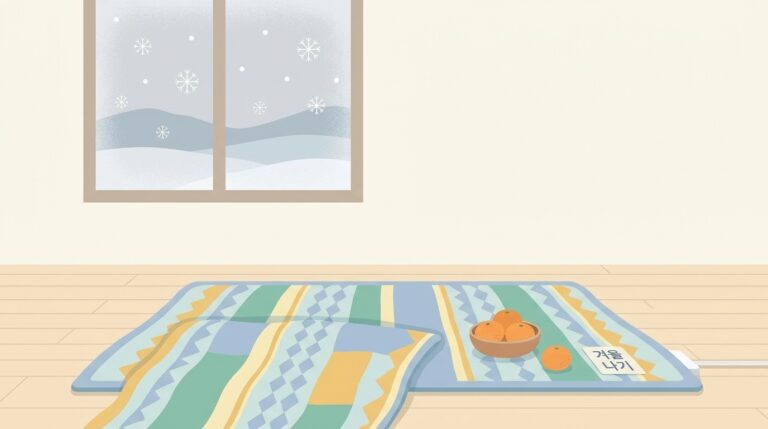
Have you seen that classic drama trope? The main characters are sitting on the floor, legs covered by a thick blanket, peeling a mountain of mandarin oranges (귤 – gyul) while watching TV. This isn’t just a drama set; it’s the quintessential Korean winter weekend!
Because the air gets dry when the Ondol is running, eating hydrating, vitamin-C-packed tangerines while glued to the warm floor (usually with an electric blanket or ‘전기장판’ underneath) is a beloved national pastime.
Phase 5: Real-Life Roleplay Scenario
Setting: A Friday morning in mid-January. Seoul is facing a brutal -15°C cold wave. You wake up, turn on the shower, and… nothing. Not a single drop of water. You grab your phone with freezing hands and call your Korean landlord.
Characters:
– YOU: An expat surviving their second winter in Seoul, B2 level Korean speaker.
– 주인 아주머니 (Landlady): A sweet but busy woman in her 60s who manages the building.
Dialogue:
YOU: 여보세요? 아주머니, 저 302호인데요.
(yeo-bo-se-yo? a-ju-meo-ni, jeo sam-baek-i-ho-in-de-yo.)
[Hello? Ma’am, this is room 302.]
주인 아주머니: 네, 302호 학생~ 아침부터 무슨 일이에요?
(ne, 302-ho hak-saeng~ a-chim-bu-teo mu-seun i-ri-e-yo?)
[Yes, student from 302~ What’s the matter this early in the morning?]
YOU: 저희 집 보일러에서 온수가 안 나와요. 찬물도 안 나오고요.
(jeo-hui jip bo-il-leo-e-seo on-su-ga an na-wa-yo. chan-mul-do an na-o-go-yo.)
[There’s no hot water coming from my boiler. No cold water either.]
주인 아주머니: 아이고, 어젯밤에 한파 주의보 내렸잖아요! 보일러 외출 모드로 해놨어요?
(a-i-go, eo-jet-ba-me han-pa ju-ui-bo nae-ryeot-ja-na-yo! bo-il-leo oe-chul mo-deu-ro hae-nwat-seo-yo?)
[Oh my, there was a cold wave advisory last night! Did you set the boiler to ‘Away’ mode?]
YOU: 아… 외출 모드요? 저 어제 보일러 끄고 잤는데요…
(a… oe-chul mo-deu-yo? jeo eo-je bo-il-leo kkeu-go jat-neun-de-yo…)
[Ah… Away mode? I turned the boiler off before sleeping yesterday…]
주인 아주머니: 맙소사! 완전 동파됐나 보네. 수도꼭지 물은 조금 틀어놨어요?
(map-so-sa! wan-jeon dong-pa-dwaen-na bo-ne. su-do-kkok-ji mu-reun jo-geum teu-reo-nwat-seo-yo?)
[Oh my goodness! It must be completely frozen. Did you leave the faucet dripping?]
ኂ56 Your Turn! How do you answer?
– A) 네? 물을 왜 틀어놔요? (ne? mu-reul wae teu-reo-nwa-yo?) [What? Why would I leave the water running?]
– B) 아차! 깜빡했어요. 설비 기사님 좀 불러주실 수 있나요? (a-cha! kkam-ppak-haet-seo-yo. seol-bi gi-sa-nim jom bul-leo-ju-sil su in-na-yo?) [Oops! I forgot. Could you please call a plumber?]
– C) 아주머니가 고쳐주세요! (a-ju-meo-ni-ga go-chyeo-ju-se-yo!) [You fix it, ma’am!]✅ Best Choice: B — It acknowledges the mistake naturally (‘아차! 깜빡했어요’) and politely asks for the necessary help.
⚠️ Choice C Analysis: Absolutely too demanding and rude for a landlord. Plumbers (설비 기사님) are needed for this job!
(Roleplay Continues based on Choice B)
주인 아주머니: 알았어요. 오늘 동파된 집이 많아서 기사님이 늦게 오실 텐데, 일단 헤어드라이어로 파이프 좀 녹이고 있어요!
(a-rat-seo-yo. o-neul dong-pa-doen ji-bi ma-na-seo gi-sa-ni-mi neut-ge o-sil ten-de, il-dan he-eo-deu-ra-i-eo-ro pa-i-peu jom no-gi-go it-seo-yo!)
[Got it. Many houses have frozen pipes today so the plumber will be late, but for now, try melting the pipes with a hair dryer!]
YOU: 네, 알겠습니다. 감사합니다!
(ne, al-get-seum-ni-da. gam-sa-ham-ni-da!)
[Yes, understood. Thank you!]
ሳ6️ Bonus Scenario: Convenience Store Survival
(You run to the GS25 to buy survival gear)
YOU: 사장님, 혹시 핫팩 어디 있어요? (sa-jang-nim, hok-si hat-paek eo-di it-seo-yo? – Boss, by any chance, where are the hot packs?)
Staff: 아, 핫팩 오늘 다 팔렸어요. 온장고에 따뜻한 꿀물은 있어요. (a, hat-paek o-neul da pal-lyeot-seo-yo. on-jang-go-e tta-tteu-tan kkul-mu-reun it-seo-yo. – Ah, hot packs are all sold out today. We have warm honey water in the heated cabinet.)
Phase 6: 10-Second Shadowing Drill
Read this out loud. Pay attention to the pauses (/) and the emotion tags!
ኅ57 울상 (Crying/Desperate tone)
아주머니! / 저희 집 / 보일러가 / 동파됐나 봐요! / 따뜻한 물이 / 아예 안 나와요!
(a-ju-meo-ni! / jeo-hui jip / bo-il-leo-ga / dong-pa-dwaen-na bwa-yo! / tta-tteu-tan mu-ri / a-ye an na-wa-yo!)
Phase 7: K-Culture Mini Dictionary
1. 롱패딩
* Romanization: rong-pae-ding
* English: Long padded puffer coat
* Context: The unofficial uniform of the Korean winter. When the cold wave hits, 90% of Koreans wear identical black long puffers. It’s more about survival than fashion.
2. 핫팩
* Romanization: hat-paek
* English: Hot pack (Hand warmer)
* Context: A chemical packet you shake to generate heat. Idols hold them between takes on music show sets, and soldiers survive winter with them.
3. 온돌
* Romanization: on-dol
* English: Traditional underfloor heating
* Context: While modern homes use water pipes instead of wood smoke, the concept remains. This is why Koreans sit, eat, and sleep on the floor!
4. 수면양말
* Romanization: su-myeon-yang-mal
* English: Sleeping socks
* Context: Extremely fluffy, thick socks worn indoors to keep feet warm during the dry, freezing winter months.
Phase 8: Traveler’s Survival Kit
Even if you are staying in an Airbnb or Guesthouse, you need to know how to handle the Korean winter!
ሙ8ሙ8 Survival Expressions TOP 3
– ቴ72ቴ77 “방이 너무 추워요. 보일러 좀 틀어주실 수 있나요?”
– (bang-i neo-mu chu-wo-yo. bo-il-leo jom teu-reo-ju-sil su in-na-yo?)
– ኄ63攃 English: The room is too cold. Could you turn on the boiler?
– ቴ72ቴ77 “따뜻한 물이 안 나와요.”
– (tta-tteu-tan mu-ri an na-wa-yo.)
– ኄ63攃 English: Hot water is not coming out.
– ቴ72ቴ77 “혹시 전기장판 있나요?”
– (hok-si jeon-gi-jang-pan in-na-yo?)
– ኄ63攃 English: By any chance, do you have an electric blanket?ኂ04 Editor’s Travel Note
– Emergency Texts (재난문자): Don’t panic when your phone shrieks. You can use translation apps like Papago to translate screenshots of the alert.
– Water Dripping: If your Airbnb host asks you to leave the faucet running slightly (물을 똑똑 떨어지게 틀어주세요), DO IT. It prevents the pipes from bursting.
Phase 9: Critical Thinking — “One Step Deeper”
Media vs. Reality: The K-Drama Winter Illusion
If you watch K-Dramas, you might think Koreans spend winter wearing stylish wool coats, sipping lattes while snowflakes gently fall. But step onto a Seoul subway in January, and reality hits: everyone looks like a walking sleeping bag wrapped in a black ‘롱패딩’ (Long padding).
This stark difference highlights a unique aspect of Korean society. When the weather drops to -15°C, the collective mindset shifts strictly to ‘survival.’ The massive popularity of identical black puffer coats isn’t just about a lack of individuality; it reflects Korea’s intense trend culture where practicality becomes a nationwide uniform.
ኁ72 Your Turn: Does your country have a specific ‘winter uniform’ that everyone wears despite the fashion? Share in the comments!
Phase 10: FAQ & Avoiding Misunderstandings
Q: “Can I turn off the boiler completely while I’m at work to save money?”
NO, NEVER! This is the biggest rookie mistake foreigners make in Korea. If you turn off the boiler (전원 끄기), the water inside the pipes stops moving and freezes solid (동파). Instead, always use ‘외출’ (Away) mode. It runs the boiler just enough to prevent freezing.
Q: “Is it rude to ask a cafe staff to turn down the heater?”
No, but use the indirect phrasing: “히터 좀 줄여주실 수 있나요?” (Could you please lower the heater?).
❌ Common Mistake #1: Trying to translate “Close the water” literally as “물을 닫아주세요” (mu-reul da-da-ju-se-yo).
✅ Do this instead: In Korean, you lock water. Use “물을 잠가주세요” (mu-reul jam-ga-ju-se-yo).
Phase 11: Summary & Action Items
- One-Liner Summary: To survive a Korean winter, respect the Han-pa (Cold wave), never turn off your boiler completely to avoid Dong-pa (Frozen pipes), and embrace the warm Ondol floor!
-
Action Mission 3 Steps:
- ና53 Bronze (Solo): Look up a picture of a Korean boiler control panel and find the ‘외출’ button.
- ና52 Silver (Online): Post a picture of your winter coat in your language exchange group and write “롱패딩 각이다!”
- ና51 Gold (Real Life): Next time you visit a Korean restaurant or house, try sitting on the floor and say, “바닥이 온돌이라서 너무 따뜻하네요!” (The floor is Ondol, so it’s very warm!)
- K-Culture Mission: Watch a winter episode of a Korean variety show or Vlog. Spot the members wearing matching long paddings or sticking hot packs (핫팩) all over their bodies!
Phase 12: Interactive Quiz
1. Situational Judgment:
You are going on a weekend trip to Busan, but it’s -10°C in Seoul. What should you do with your boiler in your Seoul apartment?
A) Turn it completely off to save the planet.
B) Set it to 30°C so it’s warm when you return.
C) Press the ‘외출’ (Away) button.
(Answer: C! If you chose A, you will come home to a flooded or frozen apartment!)
2. Fill in the Blank:
사장님! 보일러가 _______(된/한) 것 같아요! 온수가 안 나와요.
(Hint: The word for burst/frozen pipes)
3. True or False – K-Culture Edition:
In Korea, it is polite to wear your outdoor shoes inside your friend’s house during winter to keep your feet warm. (T/F)
(Answer: FALSE. Take off your shoes! The Ondol floor will warm your feet!)
Frequently Asked Questions (FAQ)
Q: What does "한파 주의보 (Cold Wave Advisory)" mean in Korean and how do you pronounce it?
A: In Korean, "한파 주의보 (Cold Wave Advisory)" is pronounced [han-pa ju-ui-bo [Sounds like: han-pah joo-we-boh] and means: Cold wave advisory (Official weather warning)
Q: What does "동파됐어요 (The pipes burst/froze)" mean in Korean and how do you pronounce it?
A: In Korean, "동파됐어요 (The pipes burst/froze)" is pronounced [dong-pa-dwaet-seo-yo [Sounds like: dong-pah-dwet-suh-yo] and means: Literal: Winter damage/burst. Real nuance: "My pipes are frozen solid and I can't shower!"
Q: What does "보일러 외출 모드 (Boiler 'Away' Mode)" mean in Korean and how do you pronounce it?
A: In Korean, "보일러 외출 모드 (Boiler 'Away' Mode)" is pronounced [bo-il-leo oe-chul mo-deu [Sounds like: boy-luh weh-chool moh-deu] and means: Outing mode / Away mode for the boiler.







