

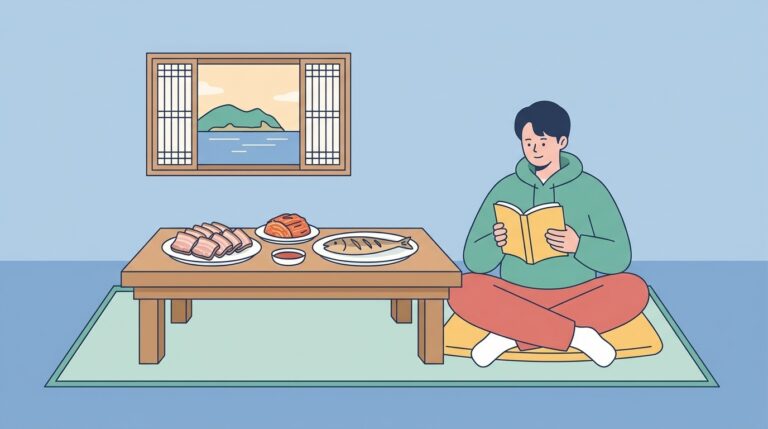
Hello there! I’m your Head Editor at Daily Hangul.
Imagine this: You’ve taken a high-speed KTX train, then a bumpy ferry ride far into the southwestern sea of Korea. You arrive at a rustic island tavern. Before the food even hits the table, an intense, almost eye-watering aroma fills the air. It smells dangerously close to ammonia. Your Korean friends look at you with a mix of mischievous excitement and genuine concern.
“Are you sure you can handle this?” they ask.
Welcome to Heuksando (흑산도), the home of Hongeo (홍어, fermented skate) and a historically famous site of exile (유배지) for Joseon Dynasty scholars.
If you master the vocabulary of this deeply traditional, intense island culture, you don’t just impress locals—you become one of them. Eating Hongeo is like a rite of passage. Furthermore, understanding the “exile culture” unlocks a profound metaphor that modern Koreans use daily. Since you are an advanced (C1) learner, we are going to dive past the basic “It’s spicy” and learn the real, nuanced language of Korean resilience, intense flavors, and self-isolation.
Let’s dive into the deep waters of Korean culture!
Phase 2: Core Expressions Deep Dive
1. 코가 뻥 뚫리는 맛이에요
- Pronunciation: koga ppeong ttullineun masieyo [The ‘ppeong’ sounds like the pop of a bubblegum, while ‘ttullineun’ has a tight double ‘t’ sound]
- Meaning: (Literal) It’s a taste that pops your nose open. / (Real nuance) It’s incredibly pungent; it clears your sinuses!
- K-Culture Moment: You’ll hear this in food documentaries or K-Dramas when middle-aged characters take a bite of deeply fermented Hongeo, grimace for a second, and then let out a satisfied sigh.
- Editor’s Insight: Koreans don’t just say “It’s strong.” They describe the physical sensation. This phrase is the ultimate compliment for fermented skate or extra-strong mustard (겨자).
- Situation Spectrum:
- Friends (Casual): ✅ (코가 뻥 뚫려!)
- Co-workers (Semi-formal): ✅
- Boss/Elders (Formal): ✅ (코가 뻥 뚫리는 맛이네요.)
- 🤔 Think About It: Why do Koreans often describe painful or intense sensations (like a burning hot soup or pungent ammonia) as “refreshing” (시원하다)? Does your language have a similar paradox?
2. 호불호가 극명하게 갈리다
- Pronunciation: hobulhoga geungmyeonghage gallida [‘geung-myeong’ sounds nasal, like humming ‘ng’ twice]
- Meaning: (Literal) Likes and dislikes are starkly divided. / (Real nuance) It’s highly polarizing; it’s a love-it-or-hate-it thing.
- K-Culture Moment: Whenever K-Pop idols are asked about “Mint Chocolate” (민초) or “Hawaiian Pizza,” someone always uses this phrase. But its true origin of food debate belongs to Hongeo.
- Editor’s Insight: At the C1 level, drop the basic “사람마다 달라요” (It depends on the person). Using “극명하게” (starkly/sharply) elevates your Korean to a native intellectual level.
- Situation Spectrum:
- Friends (Casual): ✅ (이건 호불호 완전 갈리지.)
- Co-workers (Semi-formal): ✅
- Boss/Elders (Formal): ✅
- 🤔 Think About It: Hongeo is the ultimate “acquired taste.” How does sharing an exclusive, polarizing experience build a stronger sense of community among those who love it?
3. 방구석 유배를 자처하다
- Pronunciation: bangguseok yubaereul jacheohada [‘jacheo’ sounds like cha-chuh]
- Meaning: (Literal) To volunteer for exile in the corner of one’s room. / (Real nuance) To go into “monk mode”; to purposely isolate oneself at home to rest or focus.
- K-Culture Moment: In the Joseon Dynasty, Heuksando was a dreadful place of exile (유배). Today, modern Koreans, exhausted by intense social lives, jokingly say they are “exiling themselves” for the weekend to binge-watch Netflix.
- Editor’s Insight: This is a brilliant cultural metaphor. You are taking a heavy historical punishment (exile) and turning it into a modern luxury (JOMO – Joy of Missing Out).
- Situation Spectrum:
- Friends (Casual): ✅
- Co-workers (Semi-formal): ⚠️ (Good for small talk, but might sound like you’re avoiding them!)
- Boss/Elders (Formal): 🚫 (Too slangy/dramatic for official reports)
- 🤔 Think About It: In the past, being cut off from society was the worst punishment. Why has isolation become a “healing” concept in modern Korean society?
Phase 3: Textbook vs. Real Korean
[Describing an Overpowering Taste]
* 📖 Textbook: 냄새가 아주 강하고 독특합니다. (The smell is very strong and unique.)
* 🗣️ Real Korean: 와, 이거 완전 코가 뻥 뚫리는데요? 톡 쏘는 맛이 장난 아니에요. (Wow, this totally clears my nose! The stinging taste is no joke.)
* 💡 Why the difference?: Real conversational Korean relies heavily on sensory and exaggerated expressions (“장난 아니다” – is no joke) rather than clinical descriptions.
[Explaining You Need Alone Time This Weekend]
* 📖 Textbook: 이번 주말에는 집에서 혼자 쉴 예정입니다. (I plan to rest alone at home this weekend.)
* 🗣️ Real Korean: 저 이번 주말은 자발적 유배 상태일 예정입니다. 찾지 마세요~ (I’ll be in a state of voluntary exile this weekend. Don’t look for me~)
* 💡 Why the difference?: Koreans love using dramatic, self-deprecating historical metaphors to add wit and humor to everyday boundaries.
Phase 4: Cultural Context — K-Culture Deep Dive
4-1. Non-Verbal Cues: The Art of “Samhap” (삼합)
When you eat Hongeo, you never eat it alone. You eat it as Samhap (삼합, The Holy Trinity): a slice of fermented skate, a slice of boiled pork belly (수육), and aged kimchi (묵은지), all stacked together.
* The Nunchi (눈치) move: If you are the youngest or the guest, do not just eat it! Use your chopsticks to stack the Samhap neatly and offer the first perfectly constructed bite to the oldest person at the table.
4-2. The Scholarly Romanticism of Exile (유배지 문화)
Historically, exiled scholars (Seonbi) sent to islands like Heuksando didn’t just cry about their fate. They mingled with the locals. A famous K-Movie, The Book of Fish (자산어보), shows the exiled scholar Jeong Yak-jeon learning about marine life from a young island fisherman.
* K-Drama/Movie Trope: You’ll often see the “arrogant city person forced to live in a rural village” trope (think Hometown Cha-Cha-Cha). This reflects the old exile culture—finding deep humanity, wisdom, and fantastic local food in isolated places.
Phase 5: Real-Life Roleplay Scenario
Setting: Friday night, 8 PM. A noisy, traditional Makgeolli (rice wine) tavern in Seoul that specializes in southern island cuisine. You are sitting at a round tin table with your Korean coworkers.
Characters:
– YOU: A C1-level Korean learner who wants to prove you are a true Korean food insider.
– Min-su (34): Your friendly but teasing senior colleague who ordered the most hardcore dish on the menu.
Dialogue:
Min-su:
자, 드디어 나왔다! 흑산도산 홍어 삼합! 냄새부터 장난 아니지?
(Ja, deudieo nawatda! Heuksandosan hongeo samhap! Naemsaebuteo jangnan aniji?)
[Here it comes! Heuksando Hongeo Samhap! The smell is no joke, right?]
(🎭 Stage Direction: Min-su rubs his hands together, anticipating your terrified reaction.)
YOU:
와… 진짜 향이 강력하네요. 이게 그 유명한 밥도둑인가요?
(Wa… jinjja hyangi gangnyeokaneunyo. Ige geu yumyeonghan bapdodugingayo?)
[Wow… the aroma is truly powerful. Is this the famous ‘rice thief’?]
Min-su:
이거 호불호가 극명하게 갈리는 음식인데, 먹을 수 있겠어?
(Igeo hobulhoga geungmyeonghage gallineun eumsiginde, meogeul su itgesseo?)
[This is a highly polarizing food, do you think you can eat it?]
YOU:
당연하죠! 저번에 한 번 먹어봤는데, 코가 뻥 뚫리는 게 매력 있던데요.
(Dangyeonhajyo! Jeobeone han beon meogeobwanneunde, koga ppeong ttullineun ge maeryeok itdeondeyo.)
[Of course! I tried it once before, and the way it clears your nose is quite charming.]
Min-su:
오~ 완전 한국인 다 됐는데? 그럼 삼합으로 하나 싸줄게. 자, 아~ 해봐.
(O~ wanjeon hangugin da dwaenneunde? Geureom samhabeuro hana ssajulge. Ja, a~ haebwa.)
[Oh~ You’re practically Korean now! I’ll wrap a Samhap for you. Here, say ah~]
🔀 Your Turn! How do you respond?
– A) “아니요, 냄새나요. 안 먹을래요.” (No, it stinks. I won’t eat it.)
– B) “아, 선배님 먼저 드시죠! 제가 싸드리겠습니다.” (Ah, you should eat first, sunbae-nim! I’ll wrap one for you.)
– C) “대박! 빨리 주세요!” (Awesome! Give it to me quick!)✅ Best Choice: B — Why? At a C1 level, you must master Korean dining etiquette. Offering the first wrapped piece of a delicacy back to the senior (using respectful language) shows impeccable Nunchi and manners.
⚠️ Choice A Analysis: Saying “냄새나요” (It stinks) is considered very rude to the food and the host who ordered it.
Phase 6: 10-Second Shadowing Drill
Repeat after me. Pay attention to the pauses (/) and the emotional tone!
😤 Confidently
이거 / 호불호가 / 극명하게 갈리지만, / 저는 완전 극호예요!
(igeo / hobulhoga / geungmyeonghage gallijiman, / jeoneun wanjeon geukhoyeyo!)
[This is highly polarizing, but I absolutely love it!]
😌 Satisfied
크으~ / 코가 / 뻥 뚫리는 맛이네요!
(keueu~ / koga / ppeong ttullineun masineyo!)
[Kkeu-eu~ It’s a taste that completely clears the nose!]
Phase 7: K-Culture Mini Dictionary
1. 삼합 (Samhap)
* Romanization: samhap
* English: The Holy Trinity of Korean Food (literally: three combinations)
* Context: Usually refers to fermented skate, boiled pork, and aged kimchi. It represents harmony—how strong, opposing flavors balance each other out.
2. 유배 (Yubae)
* Romanization: yubae
* English: Exile / Banishment
* Context: A historical punishment for scholars. Now used metaphorically for isolating oneself (“자발적 유배” – voluntary exile).
3. 삭히다 (Sakhida)
* Romanization: sakhida
* English: To ferment / to age (usually fish or extreme foods)
* Context: Different from “발효하다” (ferment like yeast). “삭히다” implies a deep, sometimes pungent rotting-but-safe process. It’s also used metaphorically: “화를 삭히다” (to suppress/ferment one’s anger).
4. 극호 / 불호 (Geuk-ho / Bul-ho)
* Romanization: geuko / bulho
* English: Extreme Like / Dislike
* Context: Internet slang derived from ‘호불호’. If you love Hongeo, you say “저는 극호입니다!” (I’m an extreme fan!).
Phase 8: Traveler’s Survival Kit
If you actually travel to Heuksando or a deep-south Korean island, you need these phrases!
🆘 Survival Phrases for Island Travel
– 🇰🇷 “오늘 배 뜨나요?” (oneul bae tteunayo?)
– 🗣️ English: Are the ferries running today?
– 📍 Where to use: Ferry terminal (여객선 터미널)
– 💡 Pro Tip: Island travel in Korea is heavily dependent on weather. Always ask this first thing in the morning!📌 Editor’s Travel Note
– Ferry Apps: Download the “가보고 싶은 섬” (Island You Want to Visit) app for ferry schedules.
– Food Warning: If you order Hongeo and find it too strong, do not cook or grill it! Heating fermented skate makes the ammonia smell 100 times stronger. Just wrap it in more pork and kimchi.
Phase 9: Critical Thinking — “One Step Deeper”
Food & Identity (음식과 정체성)
🧠 Think Deeper:
Why did Koreans start eating fermented skate in the first place? In the past, it took up to 15 days by sailboat to transport fish from the remote Heuksando island to the mainland. During this journey, the skate naturally fermented. Instead of throwing it away, the ancestors adapted to the harsh environment and developed a taste for it. Today, eating Hongeo is not just about culinary preference; it is about ingesting history, resilience, and the spirit of survival. When Koreans share this intense dish, they are bonding over a shared cultural endurance.💬 Your Turn: Does your culture have a “survival food” that originated from harsh conditions but is now considered a delicacy? Share it in the comments!
Phase 10: FAQ & Avoiding Mistakes
Q: Can I use “유배를 자처하다” (volunteer for exile) to my boss when taking a vacation?
A: No! While it’s a great metaphor among friends, telling your boss you are going into “exile” might sound cynical or overly dramatic. Stick to “집에서 푹 쉴 예정입니다” (I plan to rest well at home).
Q: If I hate the food, how do I say it politely?
A: Never say “맛없어요” (It tastes bad) or “냄새나요” (It stinks). Instead, say “아직 제 입맛에는 조금 어렵네요” (It’s still a bit difficult for my palate) or “향이 아주 독특하네요” (The aroma is very unique).
❌ Common Mistake: Holding your nose while the food is served.
✅ Do This Instead: Even if the smell of Hongeo shocks you, smile and say “와, 진짜 제대로 삭혔네요!” (Wow, it’s properly fermented!). Koreans will highly respect your cultural appreciation.
Phase 11: Summary & Action Items
One-Liner Summary: Impress locals by describing intense foods with “코가 뻥 뚫리다” and turn your weekend isolation into a witty “자발적 유배.”
Action Mission 3 Steps:
– 🥉 Bronze: Look in the mirror and practice saying “이거 호불호가 극명하게 갈리네요” with a knowing nod.
– 🥈 Silver: Leave a comment in Korean on a YouTube video about Hongeo using today’s vocabulary.
– 🥇 Gold: Next time you eat something incredibly strong (like wasabi or mustard), tell your Korean friends, “코가 뻥 뚫리는 맛이에요!”
🎬 K-Culture Mission:
Watch the beautiful black-and-white Korean movie “The Book of Fish” (자산어보). It perfectly captures the exile culture of Heuksando, the beautiful island scenery, and the historical connection between scholars and locals. Notice how they treat seafood!
Phase 12: Quiz — Interactive Challenge
1. Situational Judgment:
Your Korean friend gives you a piece of Hongeo. You eat it, and the ammonia taste completely clears your sinuses. What is the most natural native-like response?
A) 이거 아주 맵습니다.
B) 진짜 짜증 나는 맛이에요.
C) 와, 코가 뻥 뚫리는데요!
2. True or False — K-Culture Edition:
It is considered polite to grill fermented skate (Hongeo) if you cannot handle the smell raw. (T/F)
3. Fill in the Blank:
나 이번 주말엔 아무도 안 만나고 집에서 ________를 자처할 거야.
(I’m not meeting anyone this weekend; I’m going to volunteer for ______ at home.)
(Answers: 1. C / 2. False – Grilling makes the smell exponentially worse! / 3. 유배)
How did you do? Let me know in the comments if you are Team 극호 (Extreme Love) or Team 불호 (Extreme Hate) when it comes to challenging foods!
Frequently Asked Questions (FAQ)
Q: What does "코가 뻥 뚫리는 맛이에요" mean in Korean and how do you pronounce it?
A: In Korean, "코가 뻥 뚫리는 맛이에요" is pronounced [koga ppeong ttullineun masieyo [The 'ppeong' sounds like the pop of a bubblegum, while 'ttullineun' has a tight double 't' sound] and means: (Literal) It's a taste that pops your nose open. / (Real nuance) It’s incredibly pungent; it clears your sinuses!
Q: What does "호불호가 극명하게 갈리다" mean in Korean and how do you pronounce it?
A: In Korean, "호불호가 극명하게 갈리다" is pronounced [hobulhoga geungmyeonghage gallida ['geung-myeong' sounds nasal, like humming 'ng' twice] and means: (Literal) Likes and dislikes are starkly divided. / (Real nuance) It’s highly polarizing; it’s a love-it-or-hate-it thing.
Q: What does "방구석 유배를 자처하다" mean in Korean and how do you pronounce it?
A: In Korean, "방구석 유배를 자처하다" is pronounced [bangguseok yubaereul jacheohada ['jacheo' sounds like cha-chuh] and means: (Literal) To volunteer for exile in the corner of one's room. / (Real nuance) To go into "monk mode"; to purposely isolate oneself at home to rest or focus.







