

Phase 1: Empathy (Immersion Open)
Hello! I am your Senior Editor at Daily Hangul.
Picture this K-Drama scene: A teenager is standing on the rooftop of their school or looking out over the Han River at night. The air is heavy, and the subtitles simply read, “Please, don’t do this.” But as someone who has counseled students in Seoul for years, I can tell you that textbook phrases rarely pull someone back from the edge.
In a high-pressure society where academic success (like the notorious Suneung exam) often defines a student’s perceived worth, psychological pain is frequently masked by Nunchi (reading the room). When working with Korean youth in crisis—specifically regarding self-harm and suicide prevention—the language you use must strip away societal expectations and reach their raw humanity.
If you use formal, clinical Korean, you might inadvertently sound like another demanding adult. But if you know how to use empathetic, validating Korean, you become a safe harbor. Today, we are diving deep into the C2-level nuances of psychological intervention. This isn’t just about learning Korean; it’s about learning how to save a life in Korean.
Phase 2: Core Expressions Deep Dive
1. 많이 힘들었구나 (I see you’ve been struggling so much)
- Pronunciation: [Manhi himdeureotguna] + [Mahn-hee heem-deul-uht-goo-nah]
- Meaning: Literal: “You were very tired/hard.” vs. Real Nuance: “I am just now realizing the depth of your pain, and I am sitting in this realization with you.”
- K-Culture Moment: You often hear this in healing dramas like Daily Dose of Sunshine (정신병동에도 아침이 와요). A counselor finally stops asking “Why?” and just acknowledges the pain. The
-구나 (-guna)ending is critical here. It signifies a sudden realization or empathy, showing the youth that you finally see their hidden struggle.- Editor’s Insight: This is the ultimate validation tool. It doesn’t judge. It doesn’t offer unsolicited advice. It simply acknowledges that their burden was heavy.
- Situation Spectrum:
- Counseling a teen (Warm/Empathetic): ✅
- Casual friends (Intimate): ✅
- Professional setting/To a boss: 🚫 (Too intimate, use 많이 힘드셨군요 instead)
- 🤔 Think About It: Korean has specific grammatical endings like
-구나just to express emotional resonance and realization. How does your native language grammatically encode the act of “realizing someone else’s feelings”?2. 혼자 감당하기 버거웠지? (It was too much to handle all alone, wasn’t it?)
- Pronunciation: [Honja gamdanghagi beogeowotji?] + [Hohn-jah gahm-dahng-ha-gee buh-guh-wuht-jee?]
- Meaning: Literal: “Was it overwhelming to endure alone?” vs. Real Nuance: “You don’t have to carry this crushing weight by yourself anymore.”
- K-Culture Moment: In Korea, the culture of Jeong (정, deep emotional connection) contrasts sharply with the solitary reality of modern youth studying in isolated Hagwons (cram schools) until midnight. This phrase directly addresses that modern isolation.
- Editor’s Insight: The word 버겁다 (beogeopda) is a C2-level vocabulary word meaning “beyond one’s capacity to manage.” It perfectly describes burnout and mental collapse without sounding clinical.
- Situation Spectrum:
- Mentoring a younger student: ✅
- Peer-to-peer: ✅
- To elders: 🚫
- 🤔 Think About It: The concept of 감당하다 (gamdanghada – to endure/handle) reflects a stoic cultural expectation. Why is relieving someone of the pressure to “endure” such a powerful psychological intervention in Korea?
3. 마음이 너무 아파서 몸에 상처를 냈구나. (Your heart hurt so much, so you made scars on your body.)
- Pronunciation: [Maeumi neomu apaseo mome sangcheoreul naetguna.] + [Mah-eum-ee nuh-moo ah-pah-suh mohm-eh sang-chuh-reul naet-goo-nah]
- Meaning: Literal: “Because your heart hurt, you made a wound on your body.” vs. Real Nuance: “Your self-harm is a symptom of your deep emotional pain, not a misbehavior.”
- K-Culture Moment: When a teen’s self-harm scars are discovered, parents or teachers often react with shock or anger out of fear. A skilled counselor reframes the physical action as an emotional cry for help.
- Editor’s Insight: Notice we don’t use the clinical term 자해 (jahae – self-harm) here. We use 몸에 상처를 내다 (make a wound on the body) to separate the clinical label from the emotional reality.
- Situation Spectrum:
- Therapy/Crisis Intervention: ✅
- General daily life: 🚫
Phase 3: Textbook vs. Real Korean
[Assessing the Risk]
* 📖 Textbook Korean: 자해 충동을 자주 느끼십니까? (Do you often feel the urge to self-harm?)
* 🗣️ Real Korean: 요즘 자꾸 나를 아프게 하고 싶은 생각이 들어? (Lately, do you keep having thoughts of wanting to hurt yourself?)
* 💡 Why the difference?: Clinical terms like 자해 충동 (urge to self-harm) create a barrier. “나를 아프게 하다” (hurting myself) softens the clinical edge and invites vulnerable conversation.
[Promising Support]
* 📖 Textbook Korean: 상담 센터에 방문하는 것을 권장합니다. (I recommend visiting a counseling center.)
* 🗣️ Real Korean: 언제든 숨 막히고 힘들 때 쌤/형/누나한테 연락해. (Whenever you feel suffocated and it’s too hard, contact me [Teacher/Older brother/Older sister].)
* 💡 Why the difference?: Korean culture values familial-style bonds. Using kin terms like 형/누나 (older brother/sister) or 쌤 (short for teacher) builds a safety net rooted in Jeong (정).
Phase 4: Cultural Context — K-Culture Deep Dive
4-1. Non-Verbal Nuances
In a crisis intervention, eye contact is crucial but tricky. In standard Korean etiquette, staring directly into the eyes of a superior is rude. While a counselor isn’t a superior, an overly intense gaze can feel interrogative to a frightened teen.
Pro Tip: Sit side-by-side or at a 45-degree angle rather than directly face-to-face. Let them look at their hands while they speak. This reduces the Nunchi (pressure to read your reaction).
4-2. The “Hagwon” and “Suneung” Pressure Cooker
If you’ve watched K-Dramas like SKY Castle or Crash Course in Romance, you know about Korea’s intense educational zeal. Teens often finish school at 4 PM, go to Hagwons until 10 PM, and study at cafes until 2 AM. When intervening in youth crises, you must understand that their exhaustion isn’t just lack of sleep—it is systemic, existential burnout. Validating that the system is harsh, rather than telling them to simply “manage their stress,” is the key to breaking through.
Phase 5: Real-life Roleplay Scenario
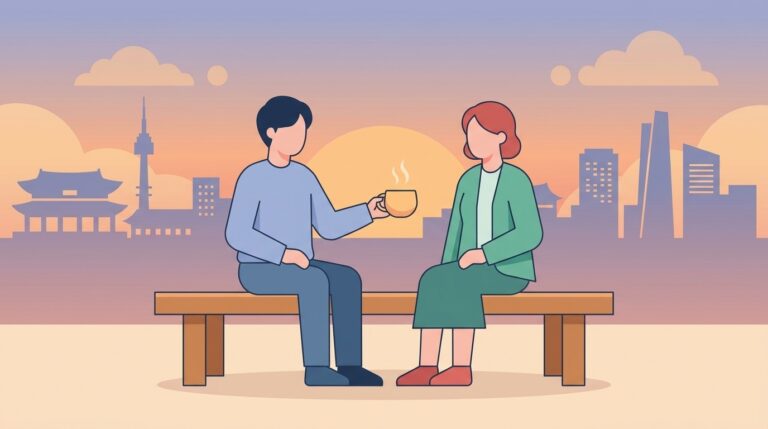
Setting: It’s 10:30 PM. You are sitting on a bench near a bustling Hagwon street in Daechi-dong. Next to you is Min-ji (17), a student you’ve been mentoring. She looks exhausted, staring blankly at her phone. You notice faint scratches on her wrist.
Characters:
– YOU: A foreign mentor who has lived in Korea for years, acting as an empathetic older sibling figure.
– Min-ji (17): Brilliant but completely burned out, feeling like a burden to her parents.
Dialogue:
Min-ji: 쌤… 저 진짜 이번 생은 망한 것 같아요. 😔
(Ssaem… jeo jinjja ibeon saengeun manghan geot gatayo.)
[Teacher… I really think I’m ruined in this lifetime.]
(🎭 Stage Direction: Min-ji forces a self-deprecating laugh, a common defense mechanism.)
YOU: 민지야, 요즘 잠은 좀 자고 있어?
(Minji-ya, yojeum jameun jom jago isseo?)
[Min-ji, have you been getting any sleep lately?]
Min-ji: 아니요. 눈 감으면 부모님 얼굴이 떠올라서 숨이 막혀요. 그래서 자꾸…
(Aniyo. Nun gameumyeon bumonim eolguri tteoollaseo sumi makhyeoyo. Geuraeseo jakku…)
[No. When I close my eyes, I think of my parents’ faces and I can’t breathe. So I keep…]
(🎭 Stage Direction: Min-ji pulls her sleeve down quickly, trying to hide her wrist.)
🔀 Your Turn! How do you respond?
– A) “너 팔에 그거 뭐야? 자해했어?” (What’s that on your arm? Did you self-harm?)
– B) “마음이 너무 아파서 견디기 힘들었구나. 나한테 기대도 괜찮아.” (Your heart hurt so much it was hard to endure. It’s okay to lean on me.)
– C) “부모님을 생각해. 네가 이러면 얼마나 슬프시겠어.” (Think of your parents. Imagine how sad they would be if you do this.)✅ Best Choice: B — Acknowledges the pain without forcing a confrontation about the scars right away. It offers immediate safety.
⚠️ Choice A Analysis: Too abrupt and interrogative. It forces her into defense mode.
🚫 Choice C Analysis: The WORST possible choice. Guilt-tripping suicidal youth about their parents is a common but dangerous mistake in Korea that often accelerates crisis.
YOU: (Gently) 마음이 너무 아파서 견디기 힘들었구나. 혼자 감당하기 버거웠지?
(Maeumi neomu apaseo gyeondigi himdeureotguna. Honja gamdanghagi beogeowotji?)
[Your heart hurt so much it was hard to endure. It was too much to handle alone, wasn’t it?]
Min-ji: (Tearing up) 저 진짜 열심히 했는데… 왜 이렇게 아픈지 모르겠어요.
(Jeo jinjja yeolsimhi haenneunde… wae ireoke apeunji moreugesseoyo.)
[I really tried so hard… I don’t know why it hurts so much.]
Phase 6: 10-Second Shadowing Drill
Practice this crucial C2 empathy phrase. Pay attention to the gentle, falling intonation at the end.
🥺 무너지지 / 않아도 돼. / 언제든 / 나한테 기대도 / 괜찮아.
(muneojiji / anado dwae. / eonjedeun / nahante gidaedo / gwaenchana.)
(You don’t have to collapse. It’s okay to lean on me anytime.)
Phase 7: K-Culture Mini Dictionary
1. 눈치 (Nunchi)
* Romanization: nunchi
* English: Emotional intelligence / Reading the room
* Context: In counseling, teens with trauma often have hyper-vigilant nunchi. They constantly read your face to see if you are disappointed in them.
2. 위로 (Wiro)
* Romanization: wiro
* English: Comfort / Consolation
* Context: Genuine wiro in Korean culture isn’t about giving solutions; it’s about shared presence (같이 있어주는 것).
3. 학원 (Hagwon)
* Romanization: hagwon
* English: Private cram school
* Context: The epicenter of youth stress. For a teen, escaping the Hagwon cycle often feels impossible, contributing to feelings of being trapped.
4. 번아웃 (Beona-ut)
* Romanization: burnout
* English: Burnout
* Context: Widely used as a loanword, but in Korea, it often happens much earlier in life—frequently affecting middle and high school students.
Phase 8: Traveler/Resident Survival Kit
Even if you aren’t a professional counselor, as an expat or traveler in Korea, you might encounter a friend or student in a severe mental health crisis.
🆘 Survival Phrases & Hotlines
– 🇰🇷 “도움이 필요해요. 여기 응급 상황이에요.” (Doumi piryohaeyo. Yeogi eunggeup sanghwangieyo.)
– 🗣️ English: “I need help. It’s an emergency here.”
– 📍 Where to use: Calling 119 (Emergency/Ambulance) or 112 (Police).
– 💡 Pro Tip: Korea has a dedicated Suicide Prevention Hotline. Dial 1393. If there is a language barrier, 119 has interpretation services available.📌 Editor’s Note on Korean Healthcare
– Psychiatric help in Korea is excellent but still carries a slight social stigma (though this is rapidly changing among Gen Z).
– Assure your friend: “정신과 진료 기록은 취업에 불이익을 주지 않아.” (Psychiatric records do not disadvantage you for employment – a common myth you must debunk).
Phase 9: Critical Thinking — “One Step Deeper”
Language & Power (언어와 권력)
In Korea, honorifics (존댓말) and informal speech (반말) define the hierarchy. Usually, an adult speaks banmal to a teen, which can inadvertently reinforce an unequal power dynamic where the teen feels they must obey. However, in counseling, a skilled therapist might blend respectful 존댓말 with warm, familial 반말 (like an older sibling). This intentional bending of linguistic rules strips away authoritarian power and creates a profound emotional safety net.
🧠 Think Deeper:
By choosing when to drop honorifics, a mentor can shift from being a “dictating adult” to a “protective ally.”💬 Your Turn: Does your native language have ways to manipulate formality to create sudden emotional intimacy during a crisis? Share in the comments!
Phase 10: FAQ & Avoiding Mistakes
Q: Can I tell a struggling teen “힘내” (Cheer up / Be strong)?
NO. This is the number one mistake. In a highly competitive society, telling a burned-out teen “힘내” translates to “Try harder / Output more energy.” To someone with nothing left, it induces immense guilt. Use “고생했어” (You’ve worked hard) instead.
Q: Can I promise to keep their self-harm an absolute secret from everyone?
NO. Ethically and legally, if a minor is in immediate danger of suicide or severe self-harm, guardians or professionals must be involved. Say: “네 안전이 제일 중요해서 혼자 비밀로 하긴 어렵지만, 네 곁에서 끝까지 도와줄게.” (Your safety is most important so I can’t keep it a secret alone, but I will help you by your side to the end.)
❌ Common Mistake #1: Saying “왜 그랬어?” (Why did you do that?)
✅ Do this instead: Say “얼마나 힘들었으면 그랬을까…” (I can only imagine how hard it was for you to do that…)
Phase 11: Summary & Action Items
One-Liner Summary: True intervention in Korean doesn’t demand answers; it acknowledges the pain with deep empathetic markers like “-구나” and relieves the pressure to endure.
Action Mission:
– 🥉 Bronze (Solo): Say “혼자 감당하기 버거웠지?” out loud 3 times with a warm, gentle voice.
– 🥈 Silver (Online): Find a Korean K-Pop or K-Drama fan forum and leave a supportive message using “많이 힘들었구나, 무너지지 않아도 돼” for someone having a hard day.
– 🥇 Gold (Real Life): If you have a Korean friend studying or working themselves to exhaustion, text them: “요즘 많이 버겁지? 밥 한번 같이 먹자.” (It’s been overwhelming lately, right? Let’s eat together.)
K-Culture Mission: Watch an episode of Daily Dose of Sunshine (정신병동에도 아침이 와요) and listen closely to how the nurses shift their verb endings when comforting a patient versus talking to a doctor.
Phase 12: Interactive Quiz
1. Situational Judgment: A 16-year-old student confesses they feel like disappearing. What is the most culturally empathetic C2-level response?
– A) “빨리 병원에 가자.” (Let’s go to the hospital quickly.)
– B) “많이 아팠구나. 혼자 견디게 해서 미안해.” (You were hurting so much. I’m sorry for letting you endure it alone.)
– C) “부모님이 알면 슬퍼하실 거야.” (Your parents will be sad if they know.)
2. True or False: In Korea, telling a depressed student “힘내세요” (Cheer up) is the most recommended psychological intervention.
(Answers: 1. B – Taking collective responsibility by saying “sorry I let you endure it alone” is deeply comforting in Korean culture. / 2. False – It can actually make them feel worse due to the pressure to perform wellness.)
What did you think of today’s deep dive? Dealing with mental health vocabulary is heavy, but it is one of the most beautiful ways to use language to heal. Leave a comment below if you have questions!
Frequently Asked Questions (FAQ)
Q: What does "많이 힘들었구나 (I see you've been struggling so much)" mean in Korean and how do you pronounce it?
A: In Korean, "많이 힘들었구나 (I see you've been struggling so much)" is pronounced [Manhi himdeureotguna] and means: Literal: "You were very tired/hard." vs. Real Nuance: "I am just now realizing the depth of your pain, and I am sitting in this realization with you."
Q: What does "혼자 감당하기 버거웠지? (It was too much to handle all alone, wasn't it?)" mean in Korean and how do you pronounce it?
A: In Korean, "혼자 감당하기 버거웠지? (It was too much to handle all alone, wasn't it?)" is pronounced [Honja gamdanghagi beogeowotji?] and means: Literal: "Was it overwhelming to endure alone?" vs. Real Nuance: "You don't have to carry this crushing weight by yourself anymore."
Q: What does "마음이 너무 아파서 몸에 상처를 냈구나. (Your heart hurt so much, so you made scars on your body.)" mean in Korean and how do you pronounce it?
A: In Korean, "마음이 너무 아파서 몸에 상처를 냈구나. (Your heart hurt so much, so you made scars on your body.)" is pronounced [Maeumi neomu apaseo mome sangcheoreul naetguna.] and means: Literal: "Because your heart hurt, you made a wound on your body." vs. Real Nuance: "Your self-harm is a symptom of your deep emotional pain, not a misbehavior."






