

Phase 1: Empathy (Immersion Opening)
Hello! I’m your Daily Hangul Editor.
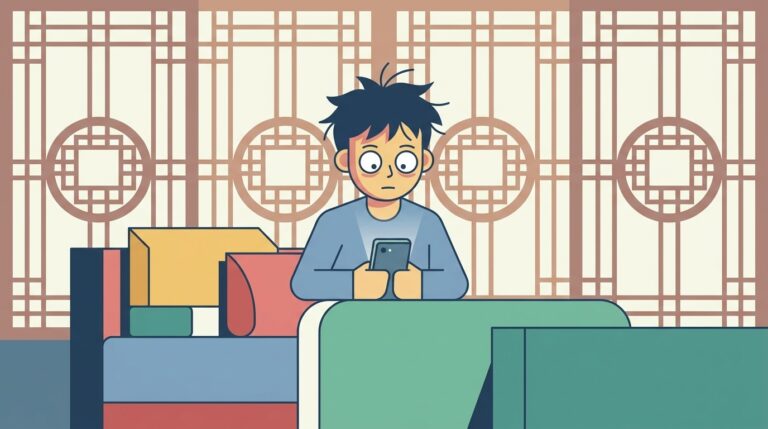
You know that classic K-Drama scene? The protagonist gasps, shoots up from bed, and stares at their phone with wide, terrified eyes. The screen shows “9:30 AM,” and five missed calls from their angry friend. They grab a piece of toast in their mouth and literally sprint out the door.
But wait—what did they actually text their friend before running?
If you simply translate “I’m sorry” into a translator app, your Korean friend might feel a bit disconnected. In Korean culture, being on time is heavily tied to respect, and explaining why you are late (like oversleeping) is a crucial part of the apology. Today, we are going to learn how to confess you overslept without losing your cool (or your friend)! This is a highly requested topic from A2 beginners who want to sound natural when life happens.
Phase 2: Core Expressions Deep Dive
1. ㅎㅎ 늦잠 잠어요. (I overslept.)
- Pronunciation: neuj-jam jas-seo-yo. [The ‘eu’ in 늦 sounds like the disgusted ‘ugh’ sound you make when stepping in gum, plus a ‘j’.]
- Meaning: Literal: I slept a late sleep. / Real: I overslept.
- K-Culture Moment: You’ll hear this a lot on reality shows like I Live Alone (na honja sanda) when a celebrity finally rolls out of bed at 1 PM on a weekend.
- Editor’s Insight: This is your go-to standard phrase. It’s honest but polite. It ends in ‘-yo’, making it safe for most everyday situations.
- Situation Spectrum:
- Casual (Friends): ✅ (Drop the ‘yo’ → 늦잠 잠어)
- Semi-formal (Coworkers): ✅
- Formal (Boss/Elders): ⚠️ (Better to use a more formal apology first)
- 🤔 Think About It: In English, “I overslept” is a verb. In Korean, “늦잠” (late-sleep) is a noun, and you “sleep” it (잠어요). Can you think of other Korean actions that repeat the noun and verb? (Hint: 꾸을 꾸다 – to dream a dream).
2. 진짜 미안해, 방금 일어났어. (I’m so sorry, I just woke up.)
- Pronunciation: jin-jja mi-an-hae, bang-geum i-reo-nas-seo.
- Meaning: Literal/Real: Really sorry, just woke up.
- K-Culture Moment: Imagine a KakaoTalk chatroom with your best friends. You were supposed to meet at a cafe 10 minutes ago, and you just opened your eyes. You type this furiously with lots of ㅠㅠ (crying eyes).
- Editor’s Insight: The word 방금 (just now) shows urgency. It tells the listener, “I literally opened my eyes right this second.”
- Situation Spectrum:
- Casual (Friends): ✅
- Semi-formal (Coworkers): 🚫 (Too casual)
- Formal (Boss/Elders): 🚫
- 🤔 Think About It: Why do we say “I just woke up” instead of just “I’m late”? It’s about transparency. Showing you are actively in the process of fixing the mistake builds trust.
3. 알람을 못 들었어요. (I couldn’t hear the alarm.)
- Pronunciation: al-ram-eul mot deu-reos-seo-yo. [Link the sounds: mot deu-reos-seo-yo]
- Meaning: Literal/Real: I couldn’t hear the alarm.
- K-Culture Moment: This is the universal excuse of K-Pop idols during early morning music show recordings when the manager asks why they didn’t come out of their dorm rooms.
- Editor’s Insight: In A2 grammar, you learn ‘못’ (cannot/could not). It implies, “I tried, but an external force stopped me.” It softens the blame.
- Situation Spectrum:
- Casual (Friends): ✅ (Drop the ‘yo’)
- Semi-formal (Coworkers): ✅
- Formal (Boss/Elders): ⚠️ (Might sound like making excuses to a strict boss)
- 🤔 Think About It: Do you use objects to deflect blame in your culture? “The alarm didn’t ring” vs “I didn’t hear it.”
Phase 3: Textbook vs. Real Korean
[Texting a friend that you just woke up]
* 📖 Textbook Korean: 미안합니다. 제가 늦잠을 잠습니다. (I am sorry. I overslept.)
* 🗣️ Real Korean: 헐 미안ㅠㅠ 나 지금 일어났어! (Omg sorry TT I just woke up!)
* 💡 Why the difference?: Textbooks teach formal language first for safety, but friends use “헐” (OMG) and consonants/vowels like “ㅠㅠ” (tears) to show raw, immediate emotion over KakaoTalk.
[Telling someone you are rushing out]
* 📖 Textbook Korean: 지금 집에서 출발합니다. (I am departing from home now.)
* 🗣️ Real Korean: 지금 빛의 속도로 가고 있어요! (I’m going at the speed of light right now!)
* 💡 Why the difference?: Koreans love speed (the “Pali-Pali” culture). Exaggerating your speed shows you are truly sorry and doing your absolute best.
Bottom Note: For A2 level, you don’t need to memorize complex slang. Just adding “헐” (heol – oh my god) or “진짜” (jinjja – really) makes a huge difference in sounding like a local!
Phase 4: Cultural Context — K-Culture Deep Dive
4-1. Non-Verbal Elements
When you finally arrive after oversleeping, your body language matters as much as your words.
– The Scurry: Walk slightly faster than normal with a slight hunch. It physically demonstrates your rush.
– The KakaoTalk Nunchi: If you text “I overslept,” gauge their reaction. If they reply with “ㅎㅎㅎ 천천히 와” (lol come slowly), you’re safe. If they just reply “ㅇㅇ” (ok), you better run!
4-2. K-Culture Connections
K-Drama Trope: The Apology Coffee
Have you noticed in K-Dramas, when a character is late for a meeting, they almost always walk in holding iced Americanos for everyone? It’s the ultimate “I’m sorry” peace offering. In Korea, buying coffee is a quick, inexpensive way to show you value the other person’s time. If you oversleep and make your friend wait, stopping by a quick cafe to grab them a drink is the ultimate “Insider” move!
K-Travel Connection: The Subway Panic
If you oversleep while traveling in Seoul, taking a taxi isn’t always the fastest option due to traffic. It’s often better to tell your friend: “지하철 탔어요” (I got on the subway) so they can exactly calculate when you’ll arrive using their subway apps!
Phase 5: Real-Life Roleplay Scenario
Scenario A: The Hongdae Meetup Panic
- Setting: Saturday morning, 10:15 AM. You were supposed to meet at Hongdae Exit 9 at 10:00 AM for brunch. Your eyes just fluttered open in your hotel bed.
- Characters:
- YOU: An exchange student who partied a bit too hard last night.
- Minsu (25): Your Korean friend who is currently waiting near the very crowded subway exit.
Minsu: 야, 어디야? 나 도착했어.
(Ya, eodiya? Na dochakaesseo.)
[Hey, where are you? I arrived.]
( 🎭 Stage Direction: Minsu is looking around the busy exit )
YOU: 헐… 미안해 민수야. 나 방금 일어났어!
(Heol… mianhae Minsuya. Na banggeum ireonasseo!)
[OMG… sorry Minsu. I just woke up!]
Minsu: 아니, 지금 시간이 몇 시인대! 늦잠 잠어?
(Ani, jigeum sigani myeot si-inde! Neujjam jasseo?)
[No way, look at the time! Did you oversleep?]
YOU: 응… 알람을 못 들었어. 진짜 미안.
(Eung… alrameul mot deureosseo. Jinjja mian.)
[Yeah… I couldn’t hear the alarm. Really sorry.]
Minsu: 하하, 알았어. 얼마나 걸려?
(Haha, arasseo. Eolmana geollyeo?)
[Haha, okay. How long will you take?]
YOU: 지금 빨리 준비할게! 30분 정도 걸릴 것 같아.
(Jigeum ppalli junbihalge! Samsipbun jeongdo geollil geot gata.)
[I’ll get ready quickly! I think it will take about 30 minutes.]
Minsu: 그럼 나 근처 카페에 있을게. 천천히 와~
(Geureom na geuncheo kape-e isseulge. Cheoncheonhi wa~)
[Then I’ll be at a cafe nearby. Take your time~]
🔀 Your Turn! When you finally arrive at the cafe, what should you do?
– A) Just sit down and say “Hi!”
– B) Say “미안해!” and offer to buy the coffee.
– C) Complain about the traffic.✅ Best Choice: B — Reason: In Korea, taking action (buying the coffee) is the best way to smooth over being late.
⚠️ Choice C Analysis: Complaining makes it sound like you are dodging responsibility for oversleeping!
Phase 6: 10-Second Shadowing Drill
Repeat these sentences out loud. Pay attention to the pauses (/) and the mood!
😭 헐, 진짜 미안해요. / 제가 / 늦잠을 잠어요.
(Heol, jinjja mianhaeyo. / jeo-ga / neuj-jameul jas-seo-yo.)
Vibe: Panic and genuine regret.
🙋♂️ 지금 / 빨리 / 가고 있어요!
(Ji-geum / ppal-li / ga-go is-seo-yo!)
Vibe: Energetic rushing, letting them know you are moving fast.
Phase 7: K-Culture Mini Dictionary
1. 늦잠
* Romanization: neujjam
* English: Oversleeping (late + sleep)
* Context: Used when you unintentionally sleep past your alarm. Not to be confused with 낮잠 (nap).
2. 지각
* Romanization: jigak
* English: Being late / Tardiness
* Context: A formal word usually used for school or work. (e.g., “오늘 학교 지각했어요” – I was late for school today).
3. 멘붕
* Romanization: menbung
* English: Mental breakdown / Panic
* Context: A very common slang term. Waking up 2 hours late gives you an absolute 멘붕.
4. 눈치
* Romanization: nunchi
* English: Reading the room / Social sense
* Context: When you arrive late, you must use your nunchi to see how annoyed your friend is before making jokes.
Phase 8: Traveler’s Survival Kit
If you oversleep for a tour, a K-Pop concert queue, or a train, you need these rapid-fire phrases!
🆘 Survival Expression #1: “I’m on my way!”
– 🇰🇷 “지금 가고 있어요!” (jigeum gago isseoyo!)
– 🗣️ Usage: The moment you step out the door, send this text.🆘 Survival Expression #2: “I think I’ll be 10 minutes late.”
– 🇰🇷 “10분 정도 늦을 것 같아요.” (sipbun jeongdo neujeul geot gatayo.)
– 🗣️ Usage: Koreans love exact time frames. Give them an estimate!📌 Editor’s Travel Note
– Useful App: If you oversleep, download Kakao T. It works just like Uber and you can grab a taxi immediately without trying to hail one on the street in a panic.
– Subway is King: During Seoul rush hour (8-9 AM, 6-7 PM), a taxi will get stuck. Run to the subway instead!
Phase 9: Critical Thinking — “One Step Deeper”
Language and Power: How You Apologize Matters
In Korean culture, the severity of your apology must match the hierarchy. If you oversleep and are late to meet a friend, “미안해” (Sorry) and a coffee will fix it. But if you oversleep for work, you cannot just use informal language or cute emojis. You must use formal language (“제가 늦잠을 잠습니다. 죄송합니다.”) and physically bow slightly when you enter the office. Language in Korea doesn’t just convey information; it actively manages social status and respect.
💬 Your Turn: How does hierarchy affect apologies in your culture? Do you use different words for your boss versus your friend when you are late? Share in the comments!
Phase 10: FAQ & Avoiding Misunderstandings
- Q: Can I use “미안해” to my teacher or boss?
- A: NO! 미안해 is only for close friends of the same age or younger. Always use “죄송합니다” (joe-song-ham-ni-da) for teachers and bosses.
- Q: Should I over-explain why I was late?
- A: Maybe not. Saying you overslept is honest, but adding a 5-minute story about why you overslept can sound like a 핑계 (pinggye – excuse). Keep it brief!
❌ Common Mistake #1: Saying “안녕!” (Hello!) brightly when you arrive late.
✅ Do This Instead: Walk up quickly and immediately say “완전 미안해!” (I’m so sorry!) before saying hello.
Phase 11: Summary & Action Items
- One-Liner Summary: When you oversleep, use “늦잠 잠어요” with a sincere tone, give an ETA, and maybe buy them a coffee!
-
Action Mission 3 Steps:
- 🥉 Bronze (Solo): Look at your phone alarm right now and say “알람을 못 들었어요!” out loud 3 times.
- 🥈 Silver (Online): Drop a comment below using the word 늦잠.
- 🥇 Gold (Real Life): Next time you are running slightly late with a language partner, text them: “지금 가고 있어요!”
- K-Culture Mission: Watch any episode of a K-Drama today. I guarantee you will see someone running late. Notice their body language! Do they bow? Run? Buy coffee?
Phase 12: Quiz — Interactive Challenge
1. Situational Judgment:
You overslept and are 15 minutes late to meet your Korean language professor. What should you say?
– A) 교수님, 늦잠 잠어!
– B) 교수님, 죄송합니다. 제가 늦잠을 잠습니다.
– C) 헐 ㅠㅠ 방금 일어났어요.
Click for Answer
Answer: B! You must use formal language (죄송합니다) with a professor. A and C are too casual or use slang (헐).
2. Fill in the Blank:
진짜 미안해요. ________을 못 들었어요. (I couldn’t hear the alarm.)
Click for Answer
Answer: 알람 (al-ram)
3. True or False:
In Korea, it’s polite to pretend you weren’t late and just ignore it to save face.
Click for Answer
Answer: False! Acknowledging your lateness and apologizing immediately shows good nunchi and respect.
Frequently Asked Questions (FAQ)
Q: What does "ㅎㅎ 늦잠 잠어요. (I overslept.)" mean in Korean and how do you pronounce it?
A: In Korean, "ㅎㅎ 늦잠 잠어요. (I overslept.)" is pronounced [neuj-jam jas-seo-yo. [The 'eu' in 늦 sounds like the disgusted 'ugh' sound you make when stepping in gum, plus a 'j'.] and means: Literal: I slept a late sleep. / Real: I overslept.
Q: What does "진짜 미안해, 방금 일어났어. (I'm so sorry, I just woke up.)" mean in Korean and how do you pronounce it?
A: In Korean, "진짜 미안해, 방금 일어났어. (I'm so sorry, I just woke up.)" is pronounced [jin-jja mi-an-hae, bang-geum i-reo-nas-seo.] and means: Literal/Real: Really sorry, just woke up.
Q: What does "알람을 못 들었어요. (I couldn't hear the alarm.)" mean in Korean and how do you pronounce it?
A: In Korean, "알람을 못 들었어요. (I couldn't hear the alarm.)" is pronounced [al-ram-eul mot deu-reos-seo-yo. [Link the sounds: mot deu-reos-seo-yo] and means: Literal/Real: I couldn't hear the alarm.







