

Phase 1: Empathy (Immersive Opening)
Hello! I’m the Senior Editor at Daily Hangul, your personal guide to all things Korean.
Picture this: You are sitting at a trendy cafe in Seongsu-dong, or maybe at a bustling, smoke-filled K-BBQ joint. The waiter sets down a plate of sizzling pork belly or a perfectly crafted, cloud-like matcha cake. Your Korean friend reaches out with their chopsticks or fork.
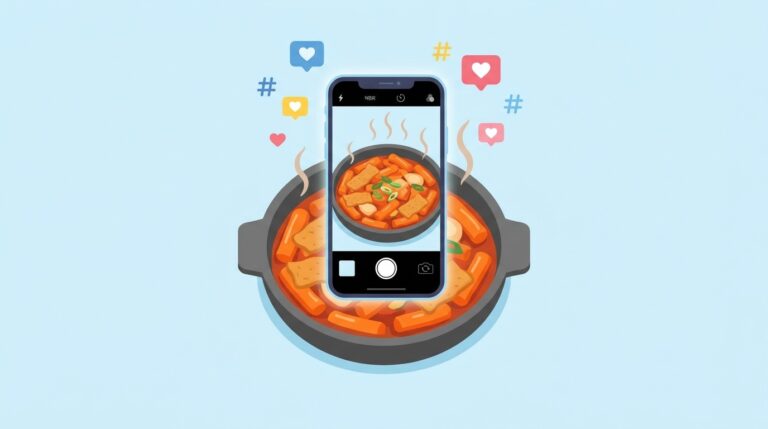
Suddenly, you slap their hand away and shout, “Wait! Don’t touch it!” You whip out your smartphone, adjust the lighting, and snap 20 pictures from different angles.
We’ve all been there, right? In Korea, the rule is strict: The camera eats first.
But after taking that perfect shot, what happens next? You want to post it on Instagram. If you just write “Delicious!” or use a basic translation app, you’re missing out on the rich, trendy world of Korean SNS (Social Networking Service) culture. Knowing the right hashtags and slang doesn’t just get you ‘likes’; it proves you are an absolute insider in Korea.
This guide is built from the real struggles of my students who wanted to flex their K-Food adventures online but didn’t know how to sound natural. Let’s upgrade your Instagram game from textbook-stiff to local-level cool!
Phase 2: Core Expressions Deep Dive
Here are the top 3 expressions you need for the ultimate Instagram food post.
1. 비주얼 미쳤다 (The visual is crazy)
- Pronunciation: [bi-ju-eol mi-chyeot-da]
Sound guide: ‘bi-ju-eol’ is just the English word “visual” spoken with a Korean accent. ‘mi-chyeot-da’ sounds like “mee-chut-dah” (the ‘eo’ sounds like the ‘u’ in “but”).- Meaning: Literal: The visual went crazy. / Real nuance: This looks absolutely incredible/out of this world.
- K-Culture Moment: You see this all the time on K-Variety shows or Instagram Reels. When a giant seafood tower is served, the cast members’ jaws drop, and the giant flashy subtitles pop up: “비주얼 미쳤다!”
- Editor’s Insight: We don’t just say “It looks good.” In modern Korean slang, saying something “went crazy” (미쳤다) is the highest form of a compliment. It means it exceeds all expectations.
- Situation Spectrum:
- Friends (Casual): ✅
- Co-workers (Semi-formal): ⚠️ (Only if you are close!)
- Boss/Elders (Formal): 🚫
- 🤔 Think About It: Why do Koreans use the English word “visual” instead of a native Korean word for “appearance”? How does mixing English into slang make a phrase feel more trendy in your culture?
2. 입에서 녹아요 (It melts in my mouth)
- Pronunciation: [i-be-seo no-ga-yo]
Sound guide: ‘i’ (like the ‘ee’ in “see”) + ‘be’ (beh) + ‘seo’ (suh) / ‘no-ga-yo’ (no-gah-yo).- Meaning: Literal: It melts in the mouth. / Real nuance: The texture is incredibly soft and delicious.
- K-Culture Moment: Picture a K-Drama scene where the rich CEO takes the female lead to a high-end Hanwoo (Korean premium beef) restaurant. She takes one bite, her eyes widen, and she says, “Wow, 입에서 녹아요!”
- Editor’s Insight: This is a classic, polite, yet deeply expressive way to describe premium food like good beef, sushi, or a soft dessert. It shows you really appreciate the quality.
- Situation Spectrum:
- Friends (Casual): ✅ (Change to: 입에서 녹아!)
- Co-workers (Semi-formal): ✅
- Boss/Elders (Formal): ✅
- 🤔 Think About It: Food texture is incredibly important in Korea. Does your language have specific phrases just to describe how food feels in your mouth?
3. 찐맛집 (An authentic/real good restaurant)
- Pronunciation: [jjin-mat-jip]
Sound guide: ‘jjin’ sounds like ‘jeen’ but with a very tight, tense tongue. ‘mat’ sounds like ‘maht’, and ‘jip’ sounds like ‘jeep’ (but cut off sharply at the end).- Meaning: Literal: Steamed restaurant. / Real nuance: A truly authentic, highly recommended local eatery.
- K-Culture Moment: You are scrolling through Instagram looking for a place to eat in Hongdae. You ignore the sponsored posts and search specifically for the hashtag #홍대찐맛집 (Hongdae jjin-matjip) to find the places locals actually swear by.
- Editor’s Insight: ‘찐’ (jjin) comes from ‘진짜’ (really/authentic). When attached to ‘맛집’ (delicious place), it means “No BS, this place is actually amazing.” It’s the ultimate stamp of approval.
- Situation Spectrum:
- Friends (Casual): ✅
- Co-workers (Semi-formal): ✅ (Great for team lunch recommendations!)
- Boss/Elders (Formal): 🚫 (Too slangy for the CEO)
- 🤔 Think About It: Koreans love categorizing places as “mat-jip” (taste-houses). Why is finding the “real” spot so important in modern SNS culture?
Phase 3: Textbook vs. Real Korean
Let’s see how textbook Korean compares to the cool Korean you actually need for your feed.
[Describing how good the food is on Instagram]
* 📖 Textbook Korean: 이 식당의 음식은 매우 맛있습니다. (The food at this restaurant is very delicious.)
* 🗣️ Real Korean: 여기 완전 찐맛집! 비주얼 대박 😭 (This place is a total jjin-matjip! Visuals are epic 😭)
* 💡 Why is it different?: SNS is about raw emotion and brevity. “매우” (very) sounds like a news anchor; “완전” (totally) or “대박” (epic) sounds like a real person.
[When your friend tries to eat before you take a photo]
* 📖 Textbook Korean: 제가 사진을 찍을 때까지 잠시만 기다려 주세요. (Please wait a moment until I take a picture.)
* 🗣️ Real Korean: 아 잠깐! 인증샷 먼저! 📸 (Ah wait! Proof-shot first! 📸)
* 💡 Why is it different?: In urgent, funny situations among friends, short noun-phrases are more impactful than full grammatical sentences.
Bottom Note: For B1 (lower-intermediate) learners, using words like “완전” (completely/totally) and “대박” (jackpot/amazing) will instantly make your Korean sound 10x more natural without being too rude or risky!
Phase 4: Cultural Context — K-Culture Deep Dive
4-1. Non-verbal Elements: The Art of the Angle
When you say “비주얼 미쳤다” (The visual is crazy) and take a photo, body language matters! In Korea, there’s a trend called “항공샷” (Hangong-syat / Aviation shot) — standing up slightly to take a picture of the table from directly above. Also, don’t forget the 눈치 (Nunchi)! If you are eating with a senior or boss, taking 5 minutes to photograph your food is bad nunchi. Take one quick snap and put the phone away!
4-2. The “Injeungsyat” (인증샷) Culture
Why do Koreans care so much about taking photos of cafes and food? It’s deeply tied to 인증샷 (Proof-shot) culture. Whether it’s a K-Pop fan taking a photo of a cafe event celebrating their idol’s birthday, or a couple visiting a famous dessert spot, taking a picture is “proof” that you participated in the trend. It’s not just about eating; it’s about sharing the experience with your community.
Phase 5: Real-Life Roleplay Scenario
Setting: Saturday afternoon at a highly aesthetic, minimalist cafe in Yeonnam-dong. The sunlight is hitting your table perfectly. You and your Korean friend, Minji, just received a beautiful strawberry croffle (croissant-waffle).
Characters:
– YOU: An international student living in Seoul, trying to grow your aesthetic Instagram account.
– Minji (24): Your trendy Korean friend who knows all the best cafes.
Dialogue:
Minji: 와, 드디어 나왔다! 나 먼저 먹어도 돼? 🍓
(Wa, deudieo nawatda! Na meonjeo meogeodo dwae?)
[Wow, it’s finally out! Can I eat first?]
(🎭 Stage Direction: Minji picks up her fork, aiming straight for the strawberry)
YOU: 안 돼! 잠깐만! 나 인증샷 먼저 찍을게. 📸
(An dwae! Jamkkanman! Na injeungsyat meonjeo jjigeulge.)
[No! Wait a second! Let me take a proof-shot first.]
Minji: 아 맞다! 미안미안. 빨리 찍어.
(A matda! Mian-mian. Ppalli jjigeo.)
[Ah right! Sorry sorry. Take it quickly.]
YOU: 우와… 이거 진짜 비주얼 미쳤다!
(Uwa… Igeo jinjja bijueol michyeotda!)
[Whoa… This visual is seriously crazy!]
Minji: 그치? 여기 완전 찐맛집이야. 인스타에 올릴 거야?
(Geuchi? Yeogi wanjeon jjin-matjibiya. Instae ollil geoya?)
[Right? This place is a total authentic spot. Are you going to post it on Insta?]
🔀 Your Turn! How should you respond?
– A) 네, 저는 인스타그램에 사진을 올릴 것입니다.
– B) 당연하지! 해시태그 뭐라고 쓸까?
– C) 싫어. 안 해.✅ Best Choice: B (“Of course! What hashtag should I use?”) — It’s natural, casual, and keeps the conversation flowing.
⚠️ Choice A Analysis: Grammatically perfect, but sounds like a robot reading a textbook.
⚠️ Choice C Analysis: This means “I hate it. I won’t.” Very unnatural and aggressive!
Minji: 음… #연남동카페 하고 #크로플맛집 어때?
(Eum… #Yeonnamdong-kape hago #Keuropeul-matjip eottae?)
[Hmm… How about #YeonnamdongCafe and #CroffleMatjip?]
YOU: 오, 좋다! 당장 올려야지.
(O, jota! Dangjang ollyeoyaji.)
[Oh, nice! I should upload it right now.]
K-Culture Bonus Roleplay: The Wi-Fi Struggle
You want to upload the photo, but your data is slow. You go to the cafe counter.
YOU: 저기요, 와이파이 비밀번호가 뭐예요?
(Jeogiyo, waipai bimilbeonhoga mwoyeyo?)
[Excuse me, what is the Wi-Fi password?]
Staff: 영수증 하단에 적혀 있습니다~
(Yeongsujeung hadane jeokhyeo itseumnida~)
[It is written at the bottom of your receipt~]
Phase 6: 10-Second Shadowing Drill
Practice these lines out loud. Pay attention to the pauses (/) and the emotions!
- 😤 단호하게 (Firmly): 잠깐! / 먹지 마! / 인증샷 찍을 거야.
(Jamkkan! / meokji ma! / injeungsyat jjigeul geoya.) - 🥺 감탄하며 (In awe): 와… / 비주얼 / 미.쳤.다!
(Wa… / bijueol / mi.chyeot.da!) - 😊 기쁘게 (Happily): 여기 / 완전 / 찐맛집 인정!
(Yeogi / wanjeon / jjin-matjip injeong!)
(Note: ‘인정’ means ‘acknowledged/agreed’!)
Phase 7: K-Culture Mini Dictionary
1. 인증샷
* Romanization: injeung-syat
* English: Proof-shot
* Context: Taking a photo to prove you went somewhere trendy or did something special (like voting, working out, or eating at a famous place).
2. 먹방 / 먹스타그램
* Romanization: meokbang / meok-seuta-geuraem
* English: Eating broadcast / Food Instagram
* Context: ‘Mukbang’ is globally famous now, but combining ‘먹다’ (to eat) with ‘Instagram’ creates ‘Meokstagram’ — the ultimate hashtag for food lovers.
3. 감성
* Romanization: gamseong
* English: Aesthetic / Vibe
* Context: Literally means “sensitivity,” but in SNS culture, an #인스타감성 (Insta-gamseong) cafe means it has a trendy, moody, highly photogenic aesthetic.
4. 인생샷
* Romanization: insaeng-syat
* English: Shot of a lifetime
* Context: When your friend takes such a good photo of you at the cafe that it becomes your profile picture for the next year.
Phase 8: Traveler Survival Kit
Since uploading photos requires being at the spot, here are the top phrases you need when cafe-hopping in Korea!
🆘 Survival Phrases for Cafe Travelers
– 🇰🇷 “와이파이 비밀번호가 뭐예요?” (waipai bimilbeonhoga mwoyeyo?)
– 🗣️ English: What’s the Wi-Fi password?
– 🇰🇷 “여기 시그니처 메뉴가 뭐예요?” (yeogi sigeunicheo menyuga mwoyeyo?)
– 🗣️ English: What is your signature menu here?
– 🇰🇷 “사진 한 장만 찍어주시겠어요?” (sajin han jangman jjigeojusigesseoyo?)
– 🗣️ English: Could you take a picture for me?
– 📍 Where to use: Cafes, Restaurants, Tourist spots
– 💡 Pro Tip: In Korean cafes, the Wi-Fi password is almost ALWAYS the cafe’s phone number or written at the bottom of your receipt (영수증)! Always keep your receipt.📌 Editor’s Travel Note
– Useful Apps: Never use Google Maps in Korea for finding local cafes. Use Naver Map or KakaoMap. You can even search hashtags on Naver!
– Ordering: Many trendy cafes now use “Kiosks” (키오스크). Don’t panic, there’s usually an English button at the top right corner.
Phase 9: Critical Thinking Corner — “A Step Deeper”
🧠 Think Deeper: Food & Identity (음식과 정체성)
Historically in Korea, eating was a highly communal activity. You share a large pot of stew (jjigae) and share side dishes (banchan). It was about ‘Jeong’ (정) — warmth and community. However, the rise of Instagram and “cafe hopping” shows a shift in modern Korean identity. Now, food is not just for sustenance or sharing with family; it’s a tool for self-expression. Young Koreans express their personal tastes, social status, and aesthetic (감성) through the perfectly curated single slice of cake they post online. The communal dining table has expanded into a digital dining table.
💬 Your Turn: Does your culture value taking photos of food, or is it considered rude? How do people in your country express their identity through food online? Share in the comments!
Phase 10: FAQ & Mistake Prevention
Q: Can I comment “비주얼 미쳤다” on my boss’s Instagram post?
A: NO! ⚠️ Unless your boss is very young and you are close friends, using “미쳤다” (crazy) to a senior is considered disrespectful. Say “정말 맛있어 보여요!” (It looks really delicious!) instead.
Q: What are the best hashtags to use for a Korean food post?
A: Try these: #맛집 (matjip – tasty place), #먹스타그램 (mukstagram), #카페투어 (cafe tour), and #[Neighborhood Name]맛집 (e.g., #강남맛집).
❌ Common Mistake #1: Typing English slang directly into a translator.
If you translate “This food slaps,” the translator might say “이 음식은 때린다” (This food hits people). Do not use this! Use “찐맛집” instead.❌ Common Mistake #2: Taking a photo of people without their permission.
Privacy is very strict in Korea. If you take a picture of your cafe table and strangers are in the background, you MUST blur their faces before uploading it to Instagram!
Phase 11: Summary & Action Items
One-Liner Summary: Upgrade your K-Food Instagram posts by using authentic slang like “비주얼 미쳤다” and “찐맛집” instead of boring textbook words!
Action Mission 3 Steps:
– 🥉 Bronze (Solo): Look at your last food photo on your phone and say “입에서 녹아요” out loud 3 times.
– 🥈 Silver (Online): Go to Instagram, search the hashtag #먹스타그램, and leave a comment saying “비주얼 대박!” on a picture you like.
– 🥇 Gold (Real-world): Next time you eat at a Korean restaurant, tell the staff “여기 정말 찐맛집이에요!” (This place is a real matjip!) as you pay. Watch them smile!
K-Culture Mission:
Go to your favorite K-Pop idol’s Instagram or Weverse. Find a post where they are eating food. Can you spot any of the slang or hashtags we learned today?
Phase 12: Quiz — Interactive Challenge
Test your new SNS skills!
1. Situational Judgment:
Your Korean friend takes you to a hidden alleyway restaurant. The food arrives and it looks incredible. You want to compliment it casually. What do you say?
– A) 이 식당은 매우 아름답습니다.
– B) 우와, 비주얼 미쳤다!
– C) 사장님, 와이파이 뭐예요?
(Answer: B. A is too robotic, and C is asking for Wi-Fi!)
2. Fill in the Blank:
When you want your friends to wait so you can take a photo for Instagram, you shout:
“잠깐! [ _____ ] 먼저 찍을게!” (Wait! I’ll take a [ proof-shot ] first!)
(Answer: 인증샷)
3. True or False — K-Culture Edition:
“In Korean cafes, it is considered extremely rude to take pictures of your food.”
(Answer: False! It is completely normal and expected, as long as you don’t bother other customers or photograph strangers’ faces.)
Did you get them all right? Now go out there and flex your K-Food adventures! 화이팅! (Fighting!)
Frequently Asked Questions (FAQ)
Q: What does "비주얼 미쳤다 (The visual is crazy)" mean in Korean and how do you pronounce it?
A: In Korean, "비주얼 미쳤다 (The visual is crazy)" is pronounced [bi-ju-eol mi-chyeot-da] and means: Literal: The visual went crazy. / Real nuance: This looks absolutely incredible/out of this world.
Q: What does "입에서 녹아요 (It melts in my mouth)" mean in Korean and how do you pronounce it?
A: In Korean, "입에서 녹아요 (It melts in my mouth)" is pronounced [i-be-seo no-ga-yo] and means: Literal: It melts in the mouth. / Real nuance: The texture is incredibly soft and delicious.
Q: What does "찐맛집 (An authentic/real good restaurant)" mean in Korean and how do you pronounce it?
A: In Korean, "찐맛집 (An authentic/real good restaurant)" is pronounced [jjin-mat-jip] and means: Literal: Steamed restaurant. / Real nuance: A truly authentic, highly recommended local eatery.







