

Phase 1: Empathy & The K-Culture Cold Open
Hello there! I’m your Daily Hangul Editor.
Picture this: You are watching a K-Drama. The lead characters are at a wedding. The bride looks stunning, they take a quick group photo, and suddenly… cut to the next scene where everyone is fiercely piling food onto their plates at a massive buffet.
But wait, where is the mountain of blenders and toasters? Where are the wrapped gifts?
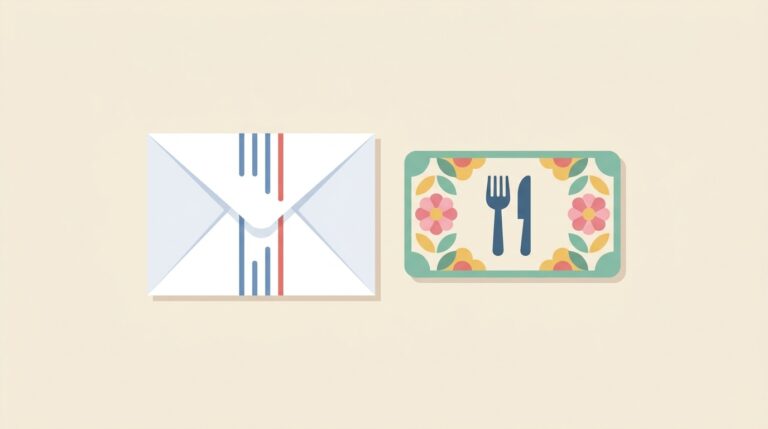
If you ever get invited to a Korean wedding, you might panic when you realize there is no gift registry. In Korea, the absolute golden rule of attending a wedding is the white envelope: Chug-ui-geum (축의금, Congratulatory Money). If you don’t know how this works, you’ll be standing awkwardly in the lobby, and worse—you might not get your ticket to the legendary Korean wedding buffet!
Don’t worry. This guide is built from the real panicked messages my absolute beginner students have sent me from wedding hall lobbies. Let’s make sure you walk in like a confident local.
Phase 2: Core Expressions Deep Dive
Here are the absolute basics you need to survive the wedding lobby.
1. 축하합니다 (Congratulations!)
- Pronunciation: chuka-hamnida [chu-KAH-hahm-nee-dah]
- Sound Analogy: The ‘KAH’ should sound like a sharp exhale when you blow out a candle.
- Meaning: Congratulations.
- K-Culture Moment: You will say this to the bride when you visit her in the Sinbu-daegisil (Bridal waiting room)—a beautiful room where the bride sits like a princess for photos before the ceremony.
- Editor’s Insight: This is the magic word for any celebration in Korea. It’s safe, polite, and perfect for an A1 learner.
- Situation Spectrum:
- Casual with friends: ✅ (Say Chuka-hae! instead)
- Semi-formal with coworkers: ✅
- Formal with elders: ✅
- 🤔 Think About It: In English, we say “Happy Wedding” or “Happy Birthday.” In Korean, we use “Chuka-hamnida” (I congratulate you) for everything. Why do you think Korean focuses on the action of congratulating rather than the emotion of happiness?
2. 축의금은 어디에 내요? (Where do I give the wedding money?)
- Pronunciation: chuguigeumeun eodie naeyo? [choog-wee-geum-eun oh-dee-eh nae-yo?]
- Meaning: (Lit.) Where do I submit the congratulatory money?
- K-Culture Moment: The wedding lobby is pure chaos. There are two long desks: one for the Groom’s side (신랑측) and one for the Bride’s side (신부측). You need to ask someone where to drop your envelope!
- Editor’s Insight: At A1 level, “Eodie… yo?” (Where is…?) is your best survival tool.
- Situation Spectrum:
- Casual with friends: ⚠️ (Ask politely to the staff/relatives at the desk)
- Semi-formal with coworkers: ✅
- Formal with elders: ✅
- 🤔 Think About It: Giving money instead of gifts is highly practical. How does your culture view giving cash as a wedding gift? Is it considered rude or helpful?
3. 식권 주세요 (Please give me a meal ticket.)
- Pronunciation: sikgwon juseyo [shik-gwon joo-seh-yo]
- Meaning: Meal ticket, please.
- K-Culture Moment: This is the most important transaction! You hand over your envelope of money to the person at the desk, and in return, they give you a small paper card. This is your golden ticket to the buffet downstairs. No ticket, no food!
- Editor’s Insight: Just say the noun + juseyo (please give me). It works everywhere in Korea.
- Situation Spectrum:
- Casual with friends: ✅
- Semi-formal with coworkers: ✅
- Formal with elders: ✅ (Perfectly polite at the reception desk)
- 🤔 Think About It: An immediate exchange: money for a meal ticket. It feels like buying a ticket to a restaurant, doesn’t it? But historically, it’s the host’s way of saying, “Thank you for your financial support, please let us feed you well in return.”
Phase 3: Textbook vs. Real Korean
[Handing the envelope to the busy relatives at the desk]
* 📖 Textbook Korean: 결혼을 진심으로 축하드립니다. 여기 제 축의금입니다. (I sincerely congratulate you on your marriage. Here is my congratulatory money.)
* 🗣️ Real Korean: (Simply bowing slightly, handing the envelope) 안녕하세요. 식권 한 장 부탁드립니다. (Hello. One meal ticket, please.)
* 💡 Why the difference?: The relatives at the reception desk are acting as accountants. They are stressed, counting cash, and logging names in a ledger. They appreciate a quick hello and a fast transaction over a long speech!
[Saying goodbye after eating]
* 📖 Textbook Korean: 식사에 초대해 주셔서 감사합니다. (Thank you for inviting me to this meal.)
* 🗣️ Real Korean: 뷔페 진짜 맛있네요! 축하해요! (The buffet is really delicious! Congratulations!)
* 💡 Why the difference?: A Korean wedding is 30% ceremony and 70% food. Complimenting the buffet is the highest form of praise you can give the couple’s family!
Phase 4: Cultural Context — K-Culture Deep Dive
4-1. Non-Verbal Nunchi (눈치) at the Reception Desk
When you give your envelope, use two hands. This shows respect. Also, make sure you write your name vertically on the back left side of the white envelope. The people at the desk need to read your name to write it in their guestbook. If you use one hand or forget your name, they might judge your Nunchi (social awareness)!
4-2. The K-Food Connection: The “Gyulhon-sik Buffet”
If K-Dramas show you the romance of a wedding, K-Reality is all about the Buffet (뷔페).
Korean wedding buffets are legendary. You’ll find everything from sushi to LA Galbi (BBQ ribs), to traditional Janchi-guksu (Banquet Noodles).
Fun fact: Why noodles? The long noodles symbolize a long, happy marriage! When you get your Sikgwon (meal ticket), you are partaking in a community ritual of sharing a massive feast to bless the couple’s future.
Phase 5: Real-Life Roleplay Scenario
Setting: A bustling wedding hall lobby in Gangnam. It’s loud, crowded, and people are rushing around in dark suits. You are attending your Korean coworker’s wedding.
Characters:
– YOU: A foreigner in Korea, a bit nervous but holding your crisp white envelope.
– UNCLE (50s): The groom’s uncle. He is sitting behind a desk with a huge stack of cash, a ledger, and a pile of meal tickets.
Dialogue:
YOU: 안녕하세요!
(Annyeonghaseyo!)
[Hello!]
(🎭 Stage Direction: You bow slightly and approach the desk.)
UNCLE: 네, 안녕하세요. 신랑측이신가요?
(Ne, annyeonghaseyo. Sillang-cheug-isingayo?)
[Yes, hello. Are you on the groom’s side?]
YOU: 네!
(Ne!)
[Yes!]
UNCLE: 축의금 여기 놓으시면 됩니다.
(Chuguigeum yeogi noeusimyeon doemnida.)
[You can place the congratulatory money here.]
(🎭 Stage Direction: He points to a wooden box with a slot.)
YOU: 아, 네.
(A, ne.)
[Ah, okay.]
(🎭 Stage Direction: You slide your envelope into the box with both hands.)
UNCLE: 네, 확인했습니다. 감사합니다.
(Ne, hwagin-haetseumnida. Gamsahamnida.)
[Yes, confirmed. Thank you.]
🔀 YOUR TURN! The Uncle is looking down at his ledger. How do you ask for your buffet ticket?
– A) 밥 어디 있어요? (Where is food?)
– B) 식권 한 장 주세요. (One meal ticket, please.)
– C) 축하합니다! (Congratulations!)✅ Best Choice: B — Reason: You need to explicitly ask for the ticket! If you just say congratulations and walk away (C), you won’t get to eat. Asking “Where is food?” (A) is a bit too direct and casual for an older relative.
[Bonus Scenario: Greeting the Bride]
You step into the stunning Sinbu-daegisil (Bridal waiting room). Your coworker is sitting on a sofa surrounded by flowers.
YOU: 너무 예뻐요! 축하합니다! (Neomu yeppeoyo! Chukahamnida! / You are so pretty! Congratulations!)
BRIDE: 와주셔서 감사합니다! 같이 사진 찍어요! (Wajusyeoseo gamsahamnida! Gachi sajin jjigeoyo! / Thank you for coming! Let’s take a photo together!)
Phase 6: 10-Second Shadowing Drill
Practice out loud with me! Pay attention to the pauses (/) and the emotion.
- 🥺 A bit confused: 축의금은 / 어디에 / 내요?
(chuguigeumeun / eodie / naeyo?) - 😊 Polite but eager for food: 식권 / 한 장 / 주세요!
(sikgwon / han jang / juseyo!) - 😍 Amazed at the bride: 너무 예뻐요! / 축하합니다!
(neomu yeppeoyo! / chukahamnida!)
Phase 7: K-Culture Mini Dictionary
1. 축의금 (Chuguigeum)
* English: Congratulatory money
* Context: The standard wedding gift in Korea. Never buy a blender; bring an envelope of cash.
2. 식권 (Sikgwon)
* English: Meal ticket
* Context: The paper ticket you receive in exchange for your envelope. Don’t lose it before you reach the buffet hall!
3. 신부대기실 (Sinbu-daegisil)
* English: Bridal waiting room
* Context: A highly decorated room where the bride waits for an hour before the ceremony. Guests line up here to take photos with her.
4. 하객룩 (Hagaek-look)
* English: Wedding guest outfit (lit. Guest Look)
* Context: The unwritten dress code. You must wear neat, usually dark or neutral colors. NEVER wear a white dress, as only the bride should stand out in white.
Phase 8: Traveler Survival Kit
Even if you aren’t attending a wedding, you might be invited to a Korean friend’s ceremony during your travels! Here are survival phrases for finding your way around a massive wedding hall.
🆘 Survival Phrases for the Wedding Hall
– 🇰🇷 “ATM 어디 있어요?” (ATM eodi isseoyo? / Where is the ATM?)
– Why you need it: You CANNOT pay wedding money with a credit card. You need cash! Wedding halls always have ATMs on the first floor.
– 🇰🇷 “예식장 어디예요?” (Yesikjang eodiyeyo? / Where is the wedding hall?)
– 🇰🇷 “이름 어떻게 써요?” (Ireum eotteoke sseoyo? / How do I write my name?)📌 Editor’s Travel Note: The Rule of Cash
– How much to give? For a basic acquaintance or coworker, 50,000 KRW is standard. For a close friend, 100,000 KRW. If the wedding is at an expensive 5-star hotel, 100,000 to 150,000 KRW is polite.
– Odd numbers are lucky! Give 50k, 150k, etc. (100k is an exception because 10 is seen as a “complete” number). Never give 40,000 KRW, as the number 4 sounds like the word for “death” in Korean.
Phase 9: Critical Thinking — “A Step Deeper”
Food & Identity (음식과 정체성)
In many Western cultures, a wedding is a deeply personal, romantic event where close friends bring highly personalized gifts from a registry. In Korea, a wedding has traditionally been a grand community festival (Janchi). The act of giving Chuguigeum (cash) might feel cold or transactional to a foreigner.
However, this stems from a deeply communal mindset. A wedding is expensive, so the community chips in financially to help the couple start their life with zero debt. In return, the parents’ biggest duty is to feed the guests abundantly at the buffet. It’s an unspoken social contract: “You supported our family, so we will feed you well.”
💬 Your Turn: Does your culture prefer practical cash gifts or sentimental physical gifts for weddings? Let me know in the comments!
Phase 10: FAQ & Avoiding Misunderstandings
- Q: Can I just give my envelope directly to the Bride or Groom?
- A: NO. They are completely distracted and have no pockets! Always give it to the reception desk (or a designated family member holding a bag).
- Q: What if I don’t want to eat the buffet?
- A: If you skip the meal, tell the desk person: “식권 안 주셔도 돼요” (You don’t have to give me a meal ticket). Sometimes, they will give you a small return gift (답례품) instead, like a bottle of wine or traditional sweets!
❌ Common Mistake #1: Wearing a white dress or a flashy suit.
✅ How to fix it: Stick to navy, black, beige, or grey. You want to blend in so the couple shines in their photos.❌ Common Mistake #2: Putting old, wrinkled cash in the envelope.
✅ How to fix it: Koreans try to withdraw crisp, brand-new bills from the bank for wedding envelopes. It symbolizes a fresh start.
Phase 11: Summary & Action Items
- One-Liner Summary: At a Korean wedding, hand over your white envelope with both hands, and don’t forget to ask, “Sikgwon juseyo!” for your buffet ticket!
Action Mission 3 Steps:
– 🥉 Bronze: Say “Sikgwon juseyo” out loud 3 times right now.
– 🥈 Silver: Write your name vertically on a piece of paper, just like you would on the back of a wedding envelope.
– 🥇 Gold: Next time you attend a party or event, try giving a gift card in a white envelope with both hands!
K-Culture Mission:
Go to YouTube and search “Korean Wedding Buffet” (한국 결혼식 뷔페). Look at the scale of the food—now you understand why the meal ticket is so important!
Phase 12: Quiz — Interactive Challenge
1. Situational Judgment: You arrive at the wedding hall, but you forgot to bring cash. What is the very first thing you should ask the staff in the lobby?
* A) 식권 주세요 (Meal ticket please)
* B) 축하합니다 (Congratulations)
* C) ATM 어디 있어요? (Where is the ATM?)
2. True or False — K-Culture Edition:
* Giving 40,000 KRW in your wedding envelope is a perfectly polite amount. (T/F)
3. Fill in the Blank:
* To politely ask for your buffet pass, say: “_______ 한 장 주세요.”
(Answers: 1: C, 2: False – avoid the number 4! 50k is standard. 3: 식권/Sikgwon)
Frequently Asked Questions (FAQ)
Q: What does "축하합니다 (Congratulations!)" mean in Korean and how do you pronounce it?
A: In Korean, "축하합니다 (Congratulations!)" is pronounced [chuka-hamnida [chu-KAH-hahm-nee-dah] and means: Congratulations.
Q: What does "축의금은 어디에 내요? (Where do I give the wedding money?)" mean in Korean and how do you pronounce it?
A: In Korean, "축의금은 어디에 내요? (Where do I give the wedding money?)" is pronounced [chuguigeumeun eodie naeyo? [choog-wee-geum-eun oh-dee-eh nae-yo?] and means: (Lit.) Where do I submit the congratulatory money?
Q: What does "식권 주세요 (Please give me a meal ticket.)" mean in Korean and how do you pronounce it?
A: In Korean, "식권 주세요 (Please give me a meal ticket.)" is pronounced [sikgwon juseyo [shik-gwon joo-seh-yo] and means: Meal ticket, please.







