

Phase 1: Empathy (The K-Culture Cold Open)
안녕하세요! 매일한글 에디터입니다.
Picture this: You are watching a classic K-Drama. The handsome Chaebol heir finishes his espresso, throws a crisp 50,000 won bill on the cafe table, and strides out, leaving the change as a generous tip.
Now, cut to reality. If you try to leave a tip on a table in Seoul, there is a 99% chance the waiter will literally sprint down the street after you, waving your cash and yelling, “Customer! You forgot your change!”
On the flip side, you might join a highly discounted package tour in Korea (or across Asia with a Korean travel agency), only to find yourself locked inside a ginseng or amethyst factory, facing immense pressure to buy something.
At the C2 level, you aren’t just learning how to say “hello” and “thank you.” You need the sophisticated socio-linguistic tools to gracefully navigate these uniquely Korean travel dilemmas—specifically, how to firmly reject 강매 (gangmae: forced sales) without losing face, and how to understand the absolute zero-tolerance policy on tipping. Let’s dive into the real, unfiltered Korean travel nuances.
Phase 2: Core Expressions Deep Dive
1. “저희는 밖에서 기다릴게요.”
- Pronunciation: jeohuineun bakkeseo gidarilgeyo. (juh-hee-neun bah-keh-suh gee-dah-ril-ggeh-yo.)
- Meaning: Literal: “We will wait outside.” / Real nuance: “We have absolutely zero intention of shopping here, so we will politely remove ourselves from this high-pressure environment.”
- K-Culture Moment: This is the ultimate ‘Nunchi’ (눈치) move. In a package tour, when the guide leads everyone into a mandatory souvenir shop, explicitly saying “I won’t buy anything” can disrupt the group harmony (기분 – gibun). By offering to wait outside, you establish a firm boundary while maintaining a polite, non-confrontational facade.
- Editor’s Insight: This expression is pure gold for introverts and seasoned travelers alike. It uses the humble “저희” (we) instead of “우리” to sound more respectful to the guide, while physically escaping the sales pitch.
- Situation Spectrum:
- Casual Tour Guide: ✅
- Formal Tour Guide/Agency: ✅
- Aggressive Salesperson: ✅
- 🤔 Think About It: Why do Koreans prefer situational excuses (like waiting outside) rather than direct rejections (like “I don’t want this”)? How does this relate to the concept of ‘기분’ (Gibun – social face/mood)?
2. “잔돈은 괜찮습니다 / 팁 문화가 없어서요.”
- Pronunciation: jandoneun gwaenchanseumnida / tip munhwaga eopseoseoyo. (jahn-don-eun gwen-chan-seum-ni-da / tip moon-hwa-ga up-suh-suh-yo.)
- Meaning: “Keep the change” / “Because there is no tipping culture.”
- K-Culture Moment: You hand a taxi driver a 10,000 won bill for an 8,500 won ride. In New York, you’d walk away. In Seoul, the driver expects to give you 1,500 won back. If you want to let them keep it, you say “잔돈은 괜찮습니다.” However, if you are working in Korea and a foreign tourist tries to tip you, you politely decline by explaining, “한국은 팁 문화가 없어서요.”
- Editor’s Insight: Tipping in Korea can actually cause discomfort. It disrupts the egalitarian nature of the transaction. If you must leave change (e.g., in a taxi), phrase it as “잔돈은 괜찮습니다” (The change is fine/unnecessary) rather than “이거 팁이에요” (This is a tip), which can sound patronizing.
- Situation Spectrum:
- Taxi drivers (small change): ✅
- High-end Restaurants: 🚫 (They will strictly refuse)
- Hair salons/Cafes: 🚫 (Do not tip)
- 🤔 Think About It: In many Western countries, tipping ensures good service. In Korea, exceptional service is expected as a baseline. What does this say about the Korean work ethic and the value of labor?
3. “이건 일정에 없던 옵션 아닌가요?”
- Pronunciation: igeon iljeonge eopdeon opsyeon aningayo? (ee-gun eel-jung-eh up-dun op-shun ah-nin-ga-yo?)
- Meaning: “Isn’t this an option that wasn’t on the itinerary?”
- K-Culture Moment: You booked a cheap travel package, but suddenly the guide says everyone must pay $50 for a scenic boat ride.
- Editor’s Insight: This is a high-level, assertive question. By framing it as a question ending in “~아닌가요?” (Isn’t it?), you avoid outright accusing the guide of a scam, but you let them know you are fully aware of the original contract. It’s a velvet glove over an iron fist.
- Situation Spectrum:
- Friends: 🚫
- Questionable Tour Guides: ✅
- Official Customer Service: ✅
- 🤔 Think About It: Notice the use of English loanwords like ‘옵션’ (Option). In Korean travel jargon, ‘Option’ usually implies a hidden cost or forced excursion. How do loanwords change their meaning when adopted into a new culture?
Phase 3: Textbook vs. Real Korean
[Refusing an aggressive salesperson in a tourist shop]
* 📖 Textbook Korean: 저는 이 물건을 사지 않겠습니다. (I will not buy this item. – Sounds like a robot declaring war.)
* 🗣️ Real Korean: 아, 제가 수하물 무게가 간당간당해서요. (Ah, my luggage weight is right on the edge. – The ultimate traveler’s white lie!)
* 💡 Why the difference?: Koreans deeply value ‘체면’ (Chemyon – face). Giving a logistical excuse (luggage weight) saves the salesperson’s face while providing an indisputable reason for not buying.
[Dealing with a tip request from an unscrupulous guide abroad]
* 📖 Textbook Korean: 당신에게 팁을 줄 수 없습니다. (I cannot give you a tip.)
* 🗣️ Real Korean: 여기 가이드 경비 다 포함된 조건으로 예약했는데요? (I booked this under the condition that all guide expenses are included, didn’t I?)
* 💡 Why the difference?: At an advanced level, stating the contractual facts using the “~는데요?” ending shows you are not a ‘호갱’ (Hogaeng – easy mark/sucker), effectively shutting down the demand.
Phase 4: Cultural Context — K-Culture Deep Dive
4-1. The Non-Verbal “No”: 손사래 (Son-sa-rae)
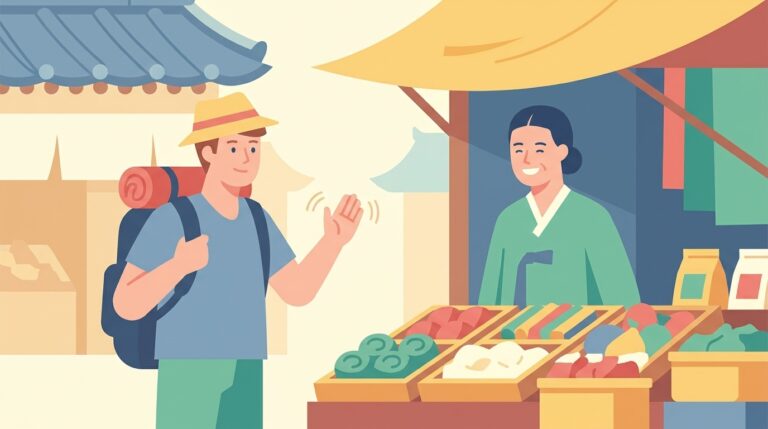
When refusing forced shopping or declining a tip, words are only half the battle. The quintessential Korean gesture for “No thank you” is the 손사래 (Son-sa-rae). You raise one or both hands to chest level, palms facing outward, and wave them side-to-side (like wiping a window). Couple this with a slight bow of the head and an awkward smile, and you have executed the perfect, culturally appropriate rejection. It softens the blow of a verbal “No.”
4-2. The Economy of the “Zero-Dollar Tour” (마이너스 투어)
Why does forced shopping happen? In K-Travel industry terms, these are often “Minus Tours” (마이너스 투어). Travel agencies sell packages below cost to attract tourists, expecting to make up the margins through commissions from mandatory shopping stops (쇼핑 센터) and optional excursions (선택 관광). While illegal in many forms now, the remnants of this culture still exist. Understanding this macro-economic context explains why guides can become so desperate—and why your firm but polite boundary-setting is essential.
Phase 5: Interactive Roleplay Scenario
Setting:
Friday afternoon. You are on a 3-day guided tour of Jeju Island. The tour was suspiciously cheap. Right now, the guide has brought the group to a “Traditional Health Supplement Center.” The doors are closed, and a salesperson is aggressively placing boxes of expensive extract in front of you.
Characters:
– YOU: A savvy foreign expat who speaks C2-level Korean, well-aware of your rights.
– Guide Kim (45, M): The slightly desperate tour guide who needs commission.
– Salesperson (50, F): High-energy, relentless.
Dialogue:
Salesperson: 고객님~ 이거 외국에서는 못 구하는 특효약이에요! 오늘만 50% 할인해서 세 박스에 50만 원! 카드 되니까 빨리 결제하세요!
(gogaengnim~ igeo oegugeseoneun mot guhaneun teukhyoyagieyo! oneulman 50% harinhaeseo se bakseue 50man won! kadeu doenikka ppalli gyeoljehaseyo!)
[Customer~ You can’t get this miracle medicine abroad! Only for today, it’s 500,000 won for three boxes at a 50% discount! We take cards, so pay quickly!]
(🎭 Stage Direction: She physically pushes the card reader toward you.)
YOU: 아, 좋은 물건 같네요. 하지만 저는 필요 없어서요.
(a, joeun mulgeon gatneyo. hajiman jeoneun piryo eopseoseoyo.)
[Ah, it looks like a good product. But I don’t need it.]
Guide Kim: 에이~ 여기까지 오셨는데 하나 사시죠! 부모님 선물로 최고예요. 저도 실적이 좀 있어야 해서… 부탁 좀 드릴게요.
(ei~ yeogikkaji osyeonneunde hana sasijyo! bumonim seonmullo choegoyeyo. jeodo siljeogi jom isseoya haeseo… butak jom deurilgeyo.)
[Come on~ You came all this way, just buy one! It’s the best gift for parents. I also need some sales quota, so… I’m begging you.]
🔀 Your Turn! How do you respond?
– A) “절대 안 사요! 강매하지 마세요!” (Absolutely not buying! Stop forcing sales!)
– B) “아, 죄송해요. 제가 한약 알레르기가 있어서요. 밖에 바람 좀 쐬고 올게요.”
– C) “진짜요? 그럼 가이드님 체면 봐서 한 박스만 살게요.”✅ Best Choice: B — Reason: Choice B uses the brilliant ‘medical excuse’ (white lie) combined with the ‘removing oneself from the situation’ tactic. It completely neutralizes the pressure without starting a fight.
⚠️ Choice A Analysis: While technically accurate, using words like ‘강매’ (forced sales) to their face is extremely confrontational and will destroy the group’s atmosphere for the rest of the trip. At C2, we aim for diplomatic dominance.
Phase 6: 10-Second Shadowing Drill
Practice setting boundaries like a sophisticated local. Pay attention to the pauses and the firm, yet polite tone.
- 😤 단호하지만 정중하게 (Firmly but politely):
아, / 저희는 / 쇼핑 계획이 전혀 없어서요. / 밖에서 / 기다리겠습니다.
(a, / jeohuineun / syoping gyehoegi jeonhyeo eopseoseoyo. / bakkeseo / gidarigetseumnida.)
[Ah, / we / have absolutely no plans to shop. / We will wait / outside.]
Phase 7: K-Culture Mini Dictionary
1. 바가지 (Bagaji)
* Romanization: bagaji
* English: Rip-off / Overcharging
* Context: Originally meaning a ‘gourd’ bowl, it evolved into a slang term for being overcharged. “바가지를 씌우다” means “to put a gourd over someone’s head” (to rip them off).
2. 호갱 (Hogaeng)
* Romanization: hogaeng
* English: A gullible customer / Sucker
* Context: A portmanteau of ‘호구’ (Hogu: pushover) and ‘고객’ (Gogaek: customer). Knowing how to say “저 호갱 아니에요” (I’m not a sucker) mentally prepares you to negotiate.
3. 눈치 (Nunchi)
* Romanization: nunchi
* English: Social situational awareness
* Context: The unspoken art of reading the room. Using excuses to leave a forced shopping situation is an execution of high-level Nunchi.
4. 봉사료 (Bongsa-ryo)
* Romanization: bongsa-ryo
* English: Service charge
* Context: In Korea, the 10% VAT and any service fees are legally required to be included in the final menu price. There is no line for a tip on a Korean credit card receipt.
Phase 8: Traveler’s Survival Kit
Navigating prices and inclusions is crucial for avoiding tourist traps.
🆘 Survival Phrases TOP 3
– 🇰🇷 “여기 봉사료 다 포함된 가격이죠?” (yeogi bongsaryo da pohamdoen gagyeogijyo?)
– 🗣️ Meaning: The service charge is fully included in this price, right?
– 📍 Where to use: High-end restaurants, questionable tour packages.
- 🇰🇷 “결제 영수증 좀 챙겨주세요.”
- 🗣️ Meaning: Please give me the payment receipt.
- 📍 Pro Tip: Always ask for the receipt (영수증). It prevents ‘바가지’ because the vendor must officially record the transaction.
🇰🇷 “아, 저희끼리 먼저 둘러볼게요.”
- 🗣️ Meaning: Ah, we will just look around by ourselves first.
- 📍 Where to use: When a salesperson is shadowing you too aggressively in a cosmetic shop or market.
📌 Editor’s Travel Note
– The Tip Jar Myth: You might occasionally see a tip jar in a trendy, Western-style cafe in Itaewon or Hongdae. Even then, it is highly controversial among Koreans and completely optional. Do not feel pressured.
– Card is King: Korea is a cashless society. Trying to pay with cash to “make it easier” actually makes it harder for the cashier and requires them to dig for coins.
Phase 9: Critical Thinking Corner — “Going One Step Deeper”
🧠 Think Deeper: Language & Power / Service Culture
Why does the absolute “No Tipping” culture exist in Korea? It comes down to a fundamental view of labor and service. In Korean society, providing good service is considered a professional duty and a point of pride, not a favor that requires charitable compensation from the customer. Historically, introducing tips was seen as an insult to the worker’s dignity or akin to a bribe. When you understand this, you realize that trying to force a tip onto a Korean server isn’t generous; it’s an imposition of a foreign power dynamic that disrupts their professional boundaries.
💬 Your Turn: Does your home country have a tipping culture? How do you feel about the Korean perspective that service is a duty rather than an extra favor? Let me know in the comments!
Phase 10: FAQ & Avoiding Common Mistakes
Q: “If the taxi driver helps me with heavy luggage, can I tip them then?”
Yes and no. While generally refused, if a driver goes way above and beyond (like carrying 3 heavy suitcases up a flight of stairs), you can offer a small bill and say “시원한 음료수라도 한 잔 드세요” (Please have a cool drink with this). Framing it as “drink money” rather than a “tip” saves their pride.
Q: “Is bargaining (깎아주세요) considered rude?”
In a department store, convenience store, or restaurant? Absolutely NO. Do not negotiate. In a traditional market (like Namdaemun) buying clothes or souvenirs? YES, it’s expected!
❌ Common Mistake #1: Leaving cash on the restaurant table after a meal.
✅ Do this instead: Pick up your bill from the table, walk to the counter by the door, and hand the cashier your credit card. Say “잘 먹었습니다!” (I ate well!)—verbal appreciation is the Korean equivalent of a tip.
Phase 11: Summary & Action Items
One-Liner Summary: Protect your wallet and your boundaries by understanding Korea’s “No Tipping” rule and mastering polite, face-saving rejections.
Action Mission 3 Steps:
– 🥉 Bronze (Solo): Practice the “손사래” (hand wave) gesture in the mirror while saying “아, 괜찮습니다” naturally.
– 🥈 Silver (Online): Share a story in your Korean study group about a time you experienced a culture clash over tipping.
– 🥇 Gold (Real-world): Next time a salesperson aggressively approaches you in Myeongdong, use “저희끼리 먼저 둘러볼게요” to smoothly exit the situation.
K-Culture Mission:
Next time you watch a K-Drama featuring a traditional market or a tourist spot, pay close attention to how the characters physically use their hands to refuse something. Can you spot the ‘Son-sa-rae’?
Phase 12: Quiz — Interactive Challenge
1. Situational Judgment: You are eating at an amazing Korean BBQ place. The server was incredibly attentive, grilling the meat perfectly. You want to show your appreciation. What is the most culturally appropriate action?
– A) Leave a 10,000 won bill on the grill table.
– B) Hand the server cash secretly and wink.
– C) Pay at the counter and enthusiastically say, “사장님, 고기가 진짜 맛있어요! 잘 먹었습니다!”
2. Fill in the Blank:
To politely decline a forced shopping tour activity without being rude, you say:
“저희는 _________ 기다릴게요.” (Hint: We will wait outside.)
3. True or False – K-Culture Edition:
In Korea, it is customary to tip the hotel maid by leaving cash on the pillow. (T/F)
💡 Click here for Answers!
1. C – Verbal praise and a polite bow upon leaving is the ultimate tip in Korea. Leaving cash on the table (A) will cause confusion, and secret cash (B) feels like a bribe.
2. 밖에서 (bakkeseo) – Meaning ‘outside’.
3. False – While some international chains might have foreign guests who do this, generally, tipping housekeeping is not expected or required in Korea.
Frequently Asked Questions (FAQ)
Q: What does ""저희는 밖에서 기다릴게요."" mean in Korean and how do you pronounce it?
A: In Korean, ""저희는 밖에서 기다릴게요."" is pronounced [jeohuineun bakkeseo gidarilgeyo. (juh-hee-neun bah-keh-suh gee-dah-ril-ggeh-yo.] and means: Literal: "We will wait outside." / Real nuance: "We have absolutely zero intention of shopping here, so we will politely remove ourselves from this high-pressure environment."
Q: What does ""잔돈은 괜찮습니다 / 팁 문화가 없어서요."" mean in Korean and how do you pronounce it?
A: In Korean, ""잔돈은 괜찮습니다 / 팁 문화가 없어서요."" is pronounced [jandoneun gwaenchanseumnida / tip munhwaga eopseoseoyo. (jahn-don-eun gwen-chan-seum-ni-da / tip moon-hwa-ga up-suh-suh-yo.] and means: "Keep the change" / "Because there is no tipping culture."
Q: What does ""이건 일정에 없던 옵션 아닌가요?"" mean in Korean and how do you pronounce it?
A: In Korean, ""이건 일정에 없던 옵션 아닌가요?"" is pronounced [igeon iljeonge eopdeon opsyeon aningayo? (ee-gun eel-jung-eh up-dun op-shun ah-nin-ga-yo?] and means: "Isn't this an option that wasn't on the itinerary?"







