

Phase 1: Empathy (Immersive Opening)
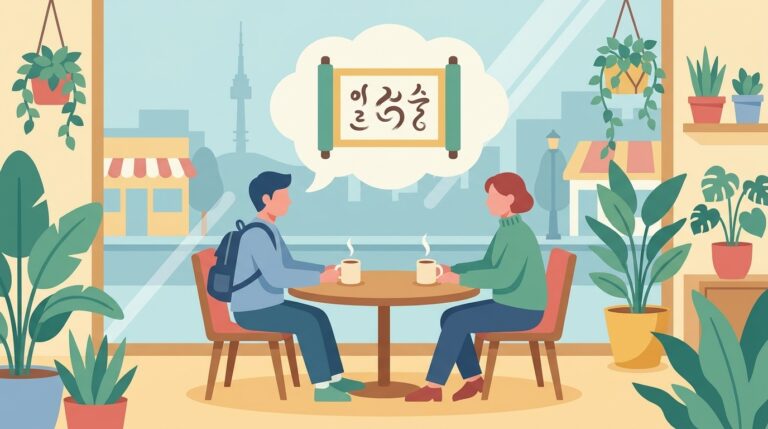
Hello there! It’s your Daily Hangul Editor. Grab a cup of coffee, and let’s take a little trip to Seoul.
Picture this: You’re watching a modern office K-Drama. The protagonist just lost a huge deal. They are drinking soju in a smoky Pojangmacha (street tent) with their mentor. The mentor pours them a shot, looks off into the distance, and mutters a profound, four-syllable phrase. Suddenly, the protagonist looks deeply comforted. The English subtitles just say, “Life is unpredictable.” But wait… what was that magical four-syllable spell?
If you’ve studied Korean for a while, you’ve probably noticed that sometimes, Koreans drop these four-syllable “codes” into their conversations. These are called 사자성어 (Saja-seongeo)—four-character idioms originating from ancient Chinese tales.
At the B2 level, you already know your basics. But throwing in a well-timed Saja-seongeo? That’s the ultimate insider flex. It elevates your Korean from “Oh, you speak Korean well!” to “Wait, how long have you lived here?!” Today, we’re going to unpack the fascinating stories behind three of the most commonly used idioms in modern Korea. Trust me, knowing the backstory makes them unforgettable!
Phase 2: Core Expressions Deep Dive
1. 새옹지마 (Life is an Old Man’s Horse)
- Pronunciation: [sae-ong-ji-ma] – Sae sounds like “say”, ong like “song” without the ‘s’, ji like “jeep” without the ‘p’, ma like “mama”.
- Meaning:
- Literal: An old man on the frontier’s horse.
- Real Nuance: A blessing in disguise; life’s fortunes are unpredictable, so don’t get too high on the highs or too low on the lows.
- K-Culture Moment: Remember when your favorite K-Pop idol failed to make the final lineup in a survival show, but then debuted in an even more successful group later? Fans will comment: “진짜 인생은 새옹지마야!” (Life really is Saeongjima!)
- Editor’s Insight: This isn’t just an idiom; it’s a cultural coping mechanism. Koreans use this to comfort someone going through a tough time, reminding them that today’s bad luck might be the seed for tomorrow’s good luck.
- Situation Spectrum:
- Friends (Casual): ✅
- Co-workers (Semi-formal): ✅
- Boss/Elders (Formal): ✅ (Actually makes you look very mature!)
- 🤔 Think About It: Why does Korean culture value this kind of stoic resilience? Does your native language have a phrase that tells people to accept the unpredictability of fate so calmly?
2. 대기만성 (Great Vessels Mature Late)
- Pronunciation: [dae-gi-man-seong] – Dae (day) + gi (gee) + man (mahn) + seong (sung).
- Meaning:
- Literal: A large vessel takes a long time to complete.
- Real Nuance: A late bloomer; great talent takes time to realize its full potential.
- K-Culture Moment: Think of that indie K-Drama actor who played minor supporting roles for 15 years and finally wins the Best Actor award in their 40s. The news headlines will definitely read: “대기만성의 아이콘” (The icon of Daegimanseong).
- Editor’s Insight: In a fast-paced society like Korea, where “빨리빨리 (Ppal-li Ppal-li / Hurry, hurry)” is the norm, this idiom provides a beautiful, warm contrast. It’s a gentle reminder that not everyone needs to succeed in their twenties.
- Situation Spectrum:
- Friends (Casual): ✅
- Co-workers (Semi-formal): ✅
- Boss/Elders (Formal): ✅
- 🤔 Think About It: In a highly competitive educational system like Korea’s, how might hearing “You are a Daegimanseong” affect a student who is falling behind?
3. 다다익선 (The More, The Better)
- Pronunciation: [da-da-ik-seon] – Da (dah) + da (dah) + ik (eek) + seon (sun).
- Meaning:
- Literal: Many, many, beneficial, good.
- Real Nuance: The more, the better!
- K-Culture Moment: You walk into Olive Young (Korea’s biggest drugstore) during their massive “1+1” sale. You’re holding 20 sheet masks, and your friend asks if you really need that many. You confidently reply, “마스크팩은 다다익선이지!” (When it comes to sheet masks, the more the better!)
- Editor’s Insight: This idiom comes from a historical Chinese general who claimed he could command an infinite number of troops. Today? We use it for K-BBQ side dishes (Banchan), vacation days, and extra shots of espresso.
- Situation Spectrum:
- Friends (Casual): ✅
- Co-workers (Semi-formal): ✅
- Boss/Elders (Formal): ⚠️ (Use with caution; might sound a bit greedy if talking about money or favors!)
- 🤔 Think About It: Korea has both a strong minimalist aesthetic (traditional Hanok) and a maximalist consumer culture. Where else do you see “Dadaeikseon” in modern society?
Phase 3: Textbook vs. Real Korean
Let’s see how these idioms replace clunky, textbook sentences in real life!
[Situation 1: Comforting a friend who failed a job interview]
* 📖 Textbook Korean: 이번에 떨어져서 슬프겠지만, 나중에는 더 좋은 일이 생길 거예요. (It must be sad that you failed this time, but better things will happen later.)
* 🗣️ Real Korean: 에이, 속상해하지 마. 인생 다 새옹지마야. 더 좋은 데 가려고 이러나 보지! (Hey, don’t be upset. Life is all Saeongjima. You’re probably meant to go somewhere better!)
* 💡 Why the difference?: Using the idiom turns a long, slightly patronizing lecture into a punchy, culturally deeply-rooted expression of solidarity.
[Situation 2: Getting extra freebies at a K-Beauty shop]
* 📖 Textbook Korean: 샘플을 많이 주시면 정말 좋을 것 같습니다. (It would be very good if you gave me many samples.)
* 🗣️ Real Korean: 사장님, 샘플은 다다익선인 거 아시죠? ㅎㅎ (Boss, you know that for samples, the more the better, right? Haha)
* 💡 Why the difference?: A playful use of an ancient military idiom in a modern shopping context shows wit, making the shop owner much more likely to give you extra goodies!
Bottom Note: At the B2 level, your goal is “wit.” Dropping a historical idiom while discussing sheet masks or K-pop shows you understand the playful irony of the Korean language.
Phase 4: Cultural Context — K-Culture Deep Dive
4-1. The Non-Verbal “Vibe”
When you use a Saja-seongeo, you can’t just blurt it out casually while chewing gum. There is an unspoken rule of Nunchi (social awareness) here. When saying “새옹지마 (Saeongjima),” lower your voice slightly, nod slowly, and maybe take a sip of your drink. You are channeling the wisdom of an ancient scholar! It shows empathy and emotional maturity.
4-2. The K-Pop Connection: “Yeokjuhaeng” & Daegimanseong
In K-Pop, there is a phenomenon called 역주행 (Yeokjuhaeng), which literally means “driving in reverse.” It refers to an old song suddenly climbing back up the music charts years after its release (like EXID’s “Up & Down” or Brave Girls’ “Rollin'”).
When a group achieves a Yeokjuhaeng miracle, Korean fans flood the comment sections with “대기만성” (Daegimanseong – late bloomer).
* Critical Viewpoint: While fans love the “late bloomer” narrative, the brutal reality of the idol industry means that 99% of groups never reach this stage. The idiom Daegimanseong acts as a beacon of hope in an otherwise ruthless market.
Phase 5: Real-Life Roleplay Scenario
Setting: Friday night, 8 PM. A busy K-BBQ restaurant near Gangnam Station. The air is thick with the smell of grilled pork belly (Samgyeopsal). You are having a Hoesik (team dinner) with your Korean coworkers. This week, your team lost a major client, but surprisingly, a different, better client reached out today.
Characters:
* YOU: A foreign employee who has been working in Seoul for a year. You want to impress your boss with your Korean.
* Min-su (32): Your friendly, slightly goofy coworker who is currently grilling the meat.
* Manager Park (45): Your strict but warm-hearted boss.
Dialogue:
Manager Park: 하아… 이번 주 정말 힘들었죠? A회사 계약 취소됐을 땐 눈앞이 캄캄했는데.
(Haa… ibeon ju jeongmal himdeureotjyo? A-hoesa gyeyak chisodwaesseul ttaen nunapi kamkamhaenneunde.)
[Sigh… This week was really tough, right? When Company A canceled the contract, I thought it was the end of the world.]
(🎭 Stage Direction: Manager Park pours a shot of Soju for himself)
Min-su: 부장님, 그래도 B회사가 연락 올 줄 누가 알았겠습니까! 이게 전화위복이죠.
(Bujangnim, geuraedo B-hoesaga yeollak ol jul nuga aratgetseumnikka! Ige jeonhwawibogijyo.)
[Manager, still, who would have known Company B would contact us! This is a blessing in disguise.]
Manager Park: 그래, 참 사람 일은 모르는 거야.
(Geurae, cham saram ireun moreuneun geoya.)
[Yeah, you really never know what will happen with people’s lives.]
🔀 Your Turn! How do you respond?
* A) 네, 정말 운이 좋았습니다! (Yes, we were really lucky!) – Textbook and safe.
* B) 맞습니다 부장님. 인생 다 새옹지마 아니겠습니까? 짠 하시죠! (That’s right, Manager. Isn’t life all Saeongjima? Let’s toast!) – Witty, culturally rich, impressive.
* C) 헐 대박! 기분 짱 좋아요! (Whoa jackpot! I feel awesome!) – Too casual for a boss!
✅ Best Choice: B — Why? You validate your boss’s philosophical mood by using Saeongjima, showing deep cultural fluency. Proposing a toast (짠 하시죠!) seals the deal as a true “insider.”
Manager Park: (Eyes widening) 오? OO씨, 새옹지마라는 말도 알아요? 한국 사람 다 됐네!
(O? OO-ssi, Saeongjimaraneun maldo arayo? Hanguk saram da dwaenne!)
[Oh? You even know the word Saeongjima? You’ve become completely Korean!]
(🎭 Stage Direction: Everyone laughs and clinks their glasses together)
Phase 6: 10-Second Shadowing Drill
Practice saying these like a true K-Drama protagonist! Pay attention to the pauses (/) and emotions.
- 😌 Wise & Comforting:
에이, / 너무 속상해하지 마. / 인생 다 / 새·옹·지·마·야.
(Ei, / neomu soksanghaehaji ma. / insaeng da / sae·ong·ji·ma·ya.)
[Hey, don’t be too upset. Life is all Saeongjima (unpredictable).] -
🤩 Excited & Playful:
사장님~ / 반찬은 / 다·다·익·선인 거 / 아시죠? ㅎㅎ
(Sajangnim~ / banchaneun / da·da·ik·seonin geo / asijyo? hehe)
[Boss~ you know side dishes are Dadaeikseon (the more the better), right? Haha]
Phase 7: K-Culture Mini Dictionary
1. 사자성어 (Saja-seongeo)
* Romanization: sa-ja-seong-eo
* English: Four-character idiom
* Context: Proverbs made of four Chinese characters. Often used in news, literature, and daily conversation to summarize complex philosophical thoughts quickly.
2. 한자 (Hanja)
* Romanization: han-ja
* English: Chinese characters used in Korean
* Context: While modern Korean is written in Hangul, over 50% of the vocabulary is derived from Hanja. Knowing Hanja roots helps B2/C1 learners guess the meaning of new words!
3. 눈치 (Nunchi)
* Romanization: nun-chi
* English: Social sense / reading the room
* Context: Knowing exactly when to drop a heavy four-character idiom and when to use slang. Good nunchi is the secret to surviving in Korean society.
4. 회식 (Hoesik)
* Romanization: hoe-sik
* English: Company dining/drinking
* Context: It’s not just dinner; it’s an extension of work where team bonding happens. A great place to show off your sophisticated Korean idioms to the boss.
Phase 8: Traveler Survival Kit
While idioms are great for deep conversations, let’s look at how “다다익선” (The more, the better) applies to a traveler’s favorite activity: Shopping at traditional markets!
🆘 Survival Phrases for the Market
* 🇰🇷 “조금만 더 주시면 안 돼요?” (Jogeumman deo jusimyeon an dwaeyo?)
* 🗣️ Pronunciation: [Jo-geum-man duh ju-shi-myun ahn dwae-yo?]
* 📍 Where to use: Namdaemun Market, Gwangjang Market (when buying food or souvenirs).
* 💡 Pro Tip: In traditional markets, merchants love “정” (Jeong – warmth/affection). Instead of aggressively haggling the price down, ask for “덤” (Deom – extra items). Remember, Dadaeikseon!📌 Editor’s Travel Note
* To bargain or not to bargain?: You can haggle in traditional street markets (동대문, 남대문), but NEVER in department stores, convenience stores, or chain restaurants.
* Cash is King for “Deom”: If you want extra freebies (덤), paying in cash makes the market vendors much happier!
Phase 9: Critical Thinking Corner — “One Step Deeper”
Language & Power: The Legacy of Hanja
🧠 Think Deeper:
Why do Koreans, who have the perfectly phonetic alphabet Hangul, still use idioms derived from Chinese characters (Hanja)? Historically, knowing Hanja was a status symbol reserved for the Yangban (the noble class). Commoners couldn’t afford the time to learn thousands of characters. Today, Hangul has democratized reading, but the legacy of Hanja remains in the form of Saja-seongeo. When a Korean politician, news anchor, or CEO uses a four-character idiom, they are subconsciously invoking an ancient tone of authority, wisdom, and education. It’s a fascinating blend of modern accessibility and historical hierarchy.💬 Your Turn:
Does your native language have a specific vocabulary (like Latin in English or French in Russian history) that is used to sound more authoritative or educated? Share it in the comments!
Phase 10: FAQ & Common Mistakes
Q: Do I need to memorize the Chinese characters (Hanja) to use these idioms?
* A: Not at all! Just learn how to pronounce them in Hangul and understand the context. Most young Koreans don’t know how to write them in Chinese characters either!
Q: Will I sound like an old grandpa if I use these?
* A: Only if you overuse them! Using one perfectly timed Saja-seongeo in a conversation makes you sound incredibly witty and fluent. Using five in a row makes you sound like a historical drama character.
❌ Common Mistake #1: Saying the literal translation instead of the idiom.
* Foreigner: “인생은 늙은 남자의 말입니다.” (Life is an old man’s horse.) -> Koreans will be incredibly confused.
✅ Do this instead: Always say the four syllables together as one set phrase: “인생은 새옹지마입니다.”
Phase 11: Summary & Action Items
One-Liner Summary: Four-character idioms (Saja-seongeo) are the ultimate cheat codes for sounding witty, philosophical, and culturally fluent in Korean.
Action Mission 3 Steps:
* 🥉 Bronze (Solo): Look in the mirror, sigh dramatically like a K-Drama CEO, and say “인생 다 새옹지마야…” (Life is all Saeongjima…).
* 🥈 Silver (Online): Go to a K-Pop music video of a group that took a long time to become popular, and leave a comment saying “우리 오빠들 완전 대기만성! 💖” (Our boys are totally late bloomers!).
* 🥇 Gold (Real Life): Next time someone offers you extra side dishes or freebies in Korea, playfully reply, “감사합니다! 역시 다다익선이죠!” (Thank you! As expected, the more the better!).
K-Culture Mission:
Watch one episode of any historical K-Drama (사극) on Netflix this week. Listen closely to the old ministers talking to the King. I guarantee you will hear them drop a four-syllable idiom at least once!
Phase 12: Quiz — Interactive Challenge
1. Situational Judgment: Your friend has been studying for the Korean proficiency exam (TOPIK) for 3 years, failing twice, but finally passed with the highest score. What is the BEST phrase to praise them?
* A) 너는 정말 새옹지마구나!
* B) 와, 진짜 대기만성이다! 고생했어!
* C) 토픽 점수는 다다익선이지!
2. True or False – K-Culture Edition:
“When a Korean boss uses a Saja-seongeo during a team dinner, you should immediately ask them to spell it out in Chinese characters to show respect.”
* (T / F)
3. Fill in the Blank:
“사장님! 고기 먹을 때 마늘은 많을수록 좋죠. 마늘은 ( )이니까 많이 주세요!”
(Boss! When eating meat, the more garlic, the better. Garlic is ( ), so please give me a lot!)
👀 Click here for Answers!
1. B (Daegimanseong – Late bloomer / Great things take time.)
2. False. Just nodding wisely and understanding the context is the best way to show “Nunchi”!
3. 다다익선 (Dadaeikseon – The more, the better)
Editor’s Final Word: How did you do? Learning idioms isn’t just about vocabulary; it’s about looking at the world through a Korean lens. Until next time, keep studying, because your Korean skills are definitely Daegimanseong! 😊
Frequently Asked Questions (FAQ)
Q: What does "새옹지마 (Life is an Old Man's Horse)" mean in Korean and how do you pronounce it?
A: In Korean, "새옹지마 (Life is an Old Man's Horse)" is pronounced [sae-ong-ji-ma] and means: Literal: An old man on the frontier's horse.
Q: What does "대기만성 (Great Vessels Mature Late)" mean in Korean and how do you pronounce it?
A: In Korean, "대기만성 (Great Vessels Mature Late)" is pronounced [dae-gi-man-seong] and means: Literal: A large vessel takes a long time to complete.
Q: What does "다다익선 (The More, The Better)" mean in Korean and how do you pronounce it?
A: In Korean, "다다익선 (The More, The Better)" is pronounced [da-da-ik-seon] and means: Literal: Many, many, beneficial, good.







