

Phase 1: Empathy & Immersion (Welcome to the K-BBQ Tent)
Hello! I am the Lead Editor of Daily Hangul, your Korean tutor and local culture navigator.
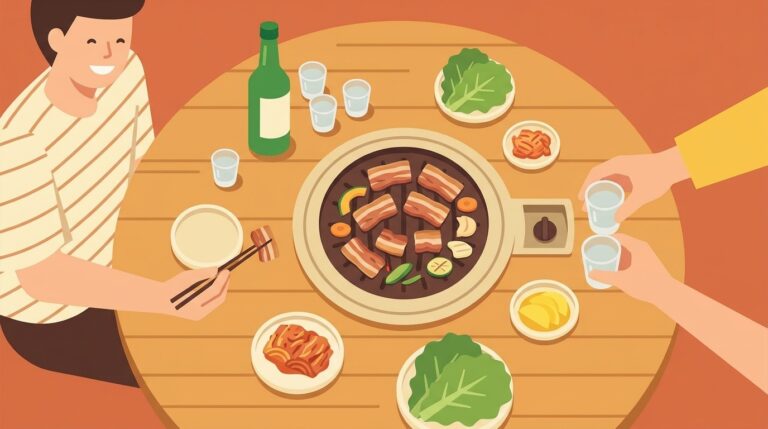
Imagine this: It’s 7:00 PM on a Friday in Seoul. You are sitting at a lively, smoke-filled Korean BBQ restaurant (Samgyeopsal joint) with your Korean friends or colleagues. Green Soju bottles are clinking, the meat is sizzling on the grill, and everyone is shouting “Geonbae!” (Cheers!).
You don’t drink much alcohol, so you quietly eat piece after piece of delicious grilled pork. Suddenly, your Korean friend points at you with a smile and says, “Hey! Are you only doing ‘Anjubal’?”
Wait, what is Anjubal? Did you do something wrong?
If you’ve watched K-Dramas, you know that Korean Drinking Culture (술 문화 – Sul Munhwa) is a huge part of socializing. But what if you are a beginner at drinking, or you just love the food too much? Today, we will learn the magical phrases that will help you survive—and thrive—at any Korean drinking party, even if you are just there for the snacks!
All the tips here come from my real experiences helping expats navigate their first Korean company dinners (Hoesik). Let’s dive in!
Phase 2: Core Expressions Deep Dive
1. 안주 (Drinking Snacks / Food)
- Pronunciation: [an-ju] Sounds like ‘ahn’ + ‘joo’ (like the start of ‘Jewel’)
- Meaning: Food specifically meant to be eaten with alcohol.
- K-Culture Moment: In Korea, you rarely drink alcohol by itself. Whether it’s fried chicken with beer (Chimaek) or pork belly with soju, the pairing is essential. The food is called 안주 (Anju).
- Editor’s Insight: Think of it as “bar snacks,” but much heavier. A full meal can be considered anju if you eat it while drinking!
- Situation Spectrum:
- Casual with friends: ✅
- Semi-formal (Coworkers): ✅
- Formal (Boss/Elders): ✅ (The word itself is a standard noun!)
- 🤔 Think About It: Why do Koreans always pair alcohol with heavy food? (Hint: It’s about sharing and protecting your stomach!)
2. 안주발 세우다 (Eating all the snacks without drinking)
- Pronunciation: [an-ju-bal se-u-da] Sounds like ‘ahn-joo-bahl seh-oo-dah’
- Meaning: To focus only on eating the food (Anju) instead of drinking alcohol.
- K-Culture Moment: At a company dinner (Hoesik), the boss pays for the expensive meat. If someone isn’t drinking but eating all the expensive meat, a close colleague might jokingly say, “안주발 세우지 마!” (Stop eating all the Anju!).
- Editor’s Insight: The suffix ‘-발 (-bal)’ means ‘the effect or power of’. So you are relying on the “power of the food” rather than the alcohol. It’s usually used playfully!
- Situation Spectrum:
- Casual with friends: ✅
- Semi-formal (Coworkers): ⚠️ (Only with close coworkers as a joke)
- Formal (Boss/Elders): 🚫 (Do not say this to your boss!)
- 🤔 Think About It: In your culture, is it acceptable to go to a bar and only eat the food?
3. 저는 술을 잘 못 마셔요 (I can’t drink well)
- Pronunciation: [jeo-neun su-reul jal mon ma-syeo-yo] Note: ‘못 (mot)’ changes to an ‘n’ sound (mon) before ‘마 (ma)’
- Meaning: I am not good at drinking / I have a low alcohol tolerance.
- K-Culture Moment: When a senior offers you a glass of soju, it is considered polite to accept it. But if you can’t drink, this is the perfect, polite excuse.
- Editor’s Insight: Koreans respect this phrase. If you say this, they will usually give you soda or water instead, and tell you to eat more Anju!
- Situation Spectrum:
- Casual with friends: ✅ (You can just say “나 술 못 마셔” to friends)
- Semi-formal (Coworkers): ✅
- Formal (Boss/Elders): ✅ (Very polite and safe!)
Phase 3: Textbook vs. Real Korean
[Situation 1: Refusing alcohol politely]
* 📖 Textbook Korean: 저는 알코올을 마시지 않습니다. (I do not drink alcohol.) -> Sounds like a robot or a medical report!
* 🗣️ Real Korean: 저 오늘 안주만 먹을게요! (I will only eat Anju today!) 😊
* 💡 Why the difference?: Refusing alcohol directly can feel a bit cold. Making a joke about focusing on the food (Anju) keeps the mood light and friendly.
[Situation 2: When someone is eating all the food]
* 📖 Textbook Korean: 음식을 너무 많이 먹지 마세요. (Please do not eat too much food.) -> Very rude!
* 🗣️ Real Korean: 야~ 안주발 장난 아니다! (Wow, your Anjubal is no joke!) 😆
* 💡 Why the difference?: Koreans use indirect, playful slang to tease friends. Using standard verbs to tell someone to stop eating sounds aggressive.
Bottom Note for A2 Learners: You don’t need to use heavy slang. Just remembering the word “안주 (Anju)” and saying “안주가 맛있어요” (The Anju is delicious) will make Koreans smile!
Phase 4: Cultural Context — K-Culture Deep Dive
4-1. The Non-Verbal Korean Drinking Etiquette 🙇♂️
Language is only half the battle! When you are eating Anju and someone older pours you a drink, remember these two golden rules:
1. Two Hands: Always hold your glass with both hands when receiving a drink from someone older or of higher status.
2. The Polite Turn: When you drink the alcohol, turn your head slightly away from the elders at the table. It is a sign of respect!
4-2. K-Drama & K-Food Connection 🍖
Have you noticed in K-Dramas that characters always go to a Pojangmacha (orange street tent) when they are sad? They order Soju and a specific Anju (like spicy chicken feet or udon soup).
In Korea, alcohol and food are soulmates. You cannot have one without the other. This is why restaurant owners will sometimes ask, “안주는 뭘로 드릴까요?” (What Anju would you like?) even before you sit down!
Critical View: While K-Dramas show people drinking 5 bottles of Soju and going to work the next day looking flawless, in reality, Korean hangover cures (Haejang-guk / Hangover soup) are a massive industry because real life isn’t a drama!
Phase 5: Real-Life Roleplay Scenario
Setting: A lively BBQ restaurant in Hongdae. Friday, 8:00 PM. The table is full of side dishes, pork belly, and empty Soju bottles.
Characters:
* YOU: An expat who loves Korean BBQ but gets sleepy after one sip of beer.
* Minsu (32): Your friendly Korean language exchange partner.
Dialogue:
Minsu: 짠~ 합시다! 🍻
(jjahn~ hap-si-da!)
[Let’s cheers!]
YOU: 짠! (You take a tiny sip of beer, then immediately eat a huge wrap of meat.)
(jjahn!)
[Cheers!]
Minsu: (Laughing) 너 진짜 안주발 최고다!
(neo jin-jja an-ju-bal choe-go-da!)
[You are really the best at ‘Anjubal’!]
YOU: 고기가 너무 맛있어요.
(go-gi-ga neo-mu ma-si-sseo-yo.)
[The meat is so delicious.]
Minsu: 술 한 잔 더 줄까?
(sul han jan deo jul-kka?)
[Should I give you another glass of alcohol?]
🔀 Your Turn! How should you respond?
* A) “아니요. 싫어요.” (No. I hate it.)
* B) “저는 술을 잘 못 마셔요. 고기 더 먹을게요!” (I can’t drink well. I’ll eat more meat!)
* C) “당신이나 많이 마시세요.” (You drink a lot yourself.)✅ Best Choice: B — Polite, natural, and explains why you are focusing on the food!
⚠️ Why not A or C?: “싫어요 (I hate it)” is too direct and sounds childish. Option C sounds like you are picking a fight!
Phase 6: 10-Second Shadowing Drill
Practice reading this out loud with the right emotion. Pay attention to the slashes for pauses!
😊 아유~ / 저는 / 술 못 마셔요. / 안주만 / 많이~~ 먹을게요!
(a-yu~ / jeo-neun / sul mon ma-syeo-yo. / an-ju-man / ma-ni~~ meo-geul-ge-yo!)
[Oh my~ / I / can’t drink. / I will just eat / a looooot of / Anju!]
Phase 7: K-Culture Mini Dictionary
1. 회식
* Romanization: hoesik
* English: Company Dinner
* Context: A gathering of coworkers after hours. It is considered an extension of work, heavily involving food and alcohol.
2. 건배 / 짠
* Romanization: geonbae / jjan
* English: Cheers (Geonbae literally means ‘empty glass’)
* Context: ‘Geonbae’ is formal, ‘Jjan’ is the casual sound of glasses clinking, used among friends.
3. 소맥
* Romanization: somaek
* English: Soju + Maekju (Beer) Cocktail
* Context: The most popular drink mix at a Korean BBQ. The golden ratio is usually 30% Soju, 70% Beer.
4. 해장
* Romanization: haejang
* English: Hangover cure (usually a spicy soup)
* Context: What you eat the morning after having too much Anju and alcohol. Haejang-guk (Hangover soup) is a lifesaver!
Phase 8: Traveler’s Survival Kit
Even if you just visit Korea for a short trip, you will likely visit a restaurant or a pub. Here are the survival phrases you need when navigating food and drinks!
🆘 Survival Phrases for K-Pubs & Restaurants
* 🇰🇷 “여기요!” (yeo-gi-yo!)
* 🗣️ Pronunciation: ‘Yuh-gee-yo!’
* 📍 Use: To call the waiter. Do not wait for eye contact; just raise your hand and say this loudly!
* 🇰🇷 “소주 한 병 주세요.” (so-ju han byeong ju-se-yo.)
* 🗣️ Pronunciation: ‘So-joo hahn byung joo-seh-yo.’
* 📍 Use: Asking for one bottle of Soju.
* 🇰🇷 “물 좀 주세요.” (mul jom ju-se-yo.)
* 🗣️ Pronunciation: ‘Mool johm joo-seh-yo.’
* 📍 Use: Asking for water. (Crucial if the Anju is too spicy!)📌 Editor’s Travel Note
* ID Checks: In Korea, if you order alcohol, they check IDs strictly, even if you look 40! Always bring your physical passport or your ARC (Alien Registration Card).
* Tipping: There is NO tipping culture in Korea. Do not leave money on the table; pay at the counter near the exit.
Phase 9: Critical Thinking — “One Step Deeper”
🧠 Think Deeper: Food & Identity (The Culture of Sharing)
Why is Anju so important in Korea? In many Western cultures, people can go to a pub, order a pint of beer, and stand around talking. In Korea, drinking almost always involves sitting down around a shared dish—like a giant bubbling stew or a sizzling grill. This reflects the Korean concept of Jeong (정 – affection/community). Eating from the same pot and pouring drinks for one another builds a sense of “We” (우리) rather than “I”. It’s not just about getting drunk; it’s about sharing life over a warm meal.
💬 Your Turn: Does your culture have a specific food that you must eat when drinking alcohol? Share it in the comments below!
Phase 10: FAQ & Avoiding Misunderstandings
Q: Do I HAVE to drink if someone offers it to me in Korea?
No! The culture has changed a lot. It is perfectly fine to say “저는 술을 잘 못 마셔요” (I can’t drink well). Just accept a glass of water or soda, and clink your glass when everyone else says “Cheers!”
Q: Can I ask for more side dishes?
Yes! Korean side dishes (Banchan) are usually free to refill. Just say, “반찬 좀 더 주세요” (Please give me more side dishes).
❌ Common Mistake #1: Pouring your own drink.
✅ Do This Instead: In Korea, you pour for others, and others pour for you. If your glass is empty, wait for someone to fill it. If your friend’s glass is empty, be a good friend and fill it up for them!
Phase 11: Summary & Action Items
💡 One-Liner Summary: In Korea, alcohol and food are best friends—if you can’t drink, just proudly focus on the Anju (안주) and enjoy the vibe!
🎯 Action Missions:
* 🥉 Bronze (Solo): Look at a mirror and practice saying, “저는 술 못 마셔요!” (I can’t drink!).
* 🥈 Silver (Online): Go to your favorite K-Pop idol’s Weverse or YouTube channel and see if they mention what their favorite Anju is during a live stream!
* 🥇 Gold (Real Life): Next time you are at a Korean restaurant, loudly and confidently call the waiter by saying, “여기요!”
🎬 K-Culture Mission:
Watch one episode of Itaewon Class or Hospital Playlist. Count how many times the characters are eating Anju with Soju. Notice how they hold their glasses!
Phase 12: Quiz — Interactive Challenge
Let’s test your Korean drinking culture knowledge!
1. True or False: If you are at a Korean bar and your glass is empty, you should immediately grab the bottle and pour a drink for yourself.
* (Answer: False. Let someone else pour it for you!)
2. Fill in the blank: The Korean word for ‘drinking snacks/food’ is _______.
* (Answer: 안주 – Anju)
3. Situational Judgment: A senior colleague offers you a shot of Soju, but you are allergic to alcohol. What is the BEST thing to say?
* A) 싫어요. (I hate it.)
* B) 저는 술을 잘 못 마셔요. (I can’t drink well.)
* C) 안주발 세우지 마! (Stop eating the Anju!)
* (Answer: B! It is polite and culturally understood.)
Great job today! Next time you are at a K-BBQ, don’t feel guilty about eating all the meat. Just claim your title as the Anjubal champion! See you in the next lesson.
Frequently Asked Questions (FAQ)
Q: What does "안주 (Drinking Snacks / Food)" mean in Korean and how do you pronounce it?
A: In Korean, "안주 (Drinking Snacks / Food)" is pronounced [an-ju] and means: Food specifically meant to be eaten with alcohol.
Q: What does "안주발 세우다 (Eating all the snacks without drinking)" mean in Korean and how do you pronounce it?
A: In Korean, "안주발 세우다 (Eating all the snacks without drinking)" is pronounced [an-ju-bal se-u-da] and means: To focus only on eating the food (Anju) instead of drinking alcohol.
Q: What does "저는 술을 잘 못 마셔요 (I can't drink well)" mean in Korean and how do you pronounce it?
A: In Korean, "저는 술을 잘 못 마셔요 (I can't drink well)" is pronounced [jeo-neun su-reul jal mon ma-syeo-yo] and means: I am not good at drinking / I have a low alcohol tolerance.







