

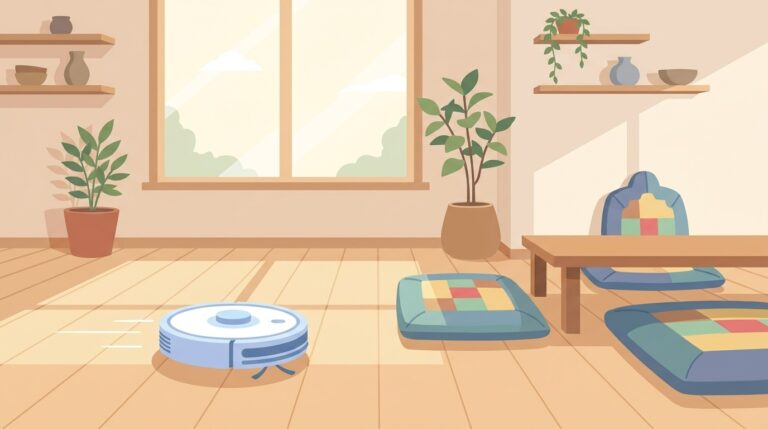
Phase 1: Empathy (The “Wait, Why Are They Sitting on the Floor?” Moment)
Hello there! This is your Senior Editor at Daily Hangul.
Imagine this: You just arrived in Seoul, moved into a beautiful Airbnb or a sharehouse, and walked inside dragging your suitcase. Suddenly, your Korean host or roommate gasps. Their eyes go wide, staring at your shoes. In an instant, you realize you’ve committed the ultimate Korean household sin: wearing shoes indoors.
If you’ve watched K-Dramas, you’ve probably seen families eating dinner on the living room floor, or friends sleeping side-by-side on a heated mat. In Korea, the floor isn’t just a surface you walk on; it’s a bed, a dining chair, and a sofa combined. That’s exactly why Korean chores—especially vacuuming and mopping—are taken so seriously. It’s not just cleaning; it’s protecting the living space!
If you don’t know the vocabulary for these chores, living with Koreans or understanding the daily life depicted in K-Dramas might feel a bit alien. Today, we’re diving into the essential B1-level expressions for vacuuming and mopping, directly from the real, squeaky-clean homes of Seoul.
Phase 2: Core Expressions Deep Dive
Let’s master the true vocabulary behind a spotless Korean home.
1. 청소기를 돌리다
- Pronunciation: cheong-so-gi-reul dol-li-da [chuhng-so-gee-reul dohl-lee-da]
- Meaning: Literal: To turn/spin the vacuum cleaner. | Real nuance: To vacuum the floor.
- K-Culture Moment: It’s Sunday morning in a K-Drama. The angry mom wants her lazy kids to wake up, so what does she do? She aggressively ‘turns on’ the vacuum cleaner right next to their ears.
- Editor’s Insight: Why ‘spin’ (돌리다)? In Korean, we use the verb 돌리다 for operating machines or appliances with motors (like washing machines: 세탁기를 돌리다). Don’t say ‘청소기를 쓰다’ (to use a vacuum); it sounds like you’re reading a manual!
- Situation Spectrum:
- Casual with friends: ✅
- Semi-formal with colleagues: ✅
- Formal with elders: ✅
- 🤔 Think About It: Why do we categorize appliances by their moving parts (spinning)? Does your language use a specific verb for operating household machines?
2. 물걸레질을 하다
- Pronunciation: mul-geol-lae-ji-reul ha-da [mool-guhl-leh-jee-reul ha-da]
- Meaning: Literal: To do wet rag action. | Real nuance: To mop the floor with a wet cloth.
- K-Culture Moment: The classic Cinderella scene in historical dramas (사극), where the servant is on their hands and knees aggressively wiping the wooden floors.
- Editor’s Insight: This word is a fun Lego block. 물 (Water) + 걸레 (Rag/Mop) + 질 (The act of doing something). Because Koreans sit on the floor, dry sweeping is never enough. We must do mul-geol-lae-jil to remove fine dust so our white socks stay white!
- Situation Spectrum:
- Casual with friends: ✅
- Semi-formal with colleagues: ✅
- Formal with elders: ✅
- 🤔 Think About It: The suffix ‘-질’ implies a repetitive physical action (like 가위질 – scissoring). Can you guess why mopping requires this suffix?
3. 바닥 좀 닦아
- Pronunciation: ba-dak jom da-kka [bah-dahk johm dah-kka]
- Meaning: Literal: Wipe the floor a little. | Real nuance: Clean/mop the floor.
- K-Culture Moment: When friends come over for a fried chicken and beer (치맥) party, and someone spills a drop of sauce. The host immediately tosses a wet wipe and says, “바닥 좀 닦아!”
- Editor’s Insight: ‘닦다’ means to wipe, polish, or scrub. We use it for floors, tables, and even brushing teeth (이를 닦다). Notice the word ‘좀’ (a little)? Koreans add ‘jom’ to soften a command, so it doesn’t sound too bossy.
- Situation Spectrum:
- Casual with friends: ✅
- Semi-formal with colleagues: ⚠️ (Only if you add ‘주세요’)
- Formal with elders: 🚫
- 🤔 Think About It: Why is it culturally important to soften commands with words like ‘a little’ (좀) in Korean society?
Phase 3: Textbook vs. Real Korean
Let’s see how these phrases evolve from the classroom to a Seoul sharehouse.
[Situation 1: Asking someone to vacuum]
* 📖 Textbook Korean: 청소기를 사용해 주세요. (Please use the vacuum cleaner.)
* 🗣️ Real Korean: 청소기 좀 돌려줄래? (Can you run the vacuum?)
* 💡 Why is it different?: Using ‘사용하다’ (to use) sounds robotic. ‘돌리다’ (to run/spin) is the natural action verb for appliances, and ‘줄래?’ asks for a favor smoothly.
[Situation 2: The floor feels dirty]
* 📖 Textbook Korean: 바닥이 더럽습니다. 닦으세요. (The floor is dirty. Wipe it.)
* 🗣️ Real Korean: 바닥 끈적거려. 물걸레질 한 번 하자. (The floor is sticky. Let’s do a round of mopping.)
* 💡 Why is it different?: Because Koreans walk barefoot indoors, sensory words like ‘끈적거리다’ (sticky) or ‘푸석하다’ (dusty) are used much more often than just “dirty.”
Bottom Note: For B1 learners, mastering ‘돌리다’ for machines and ‘닦다’ for surfaces will instantly make you sound like a local!
Phase 4: Cultural Context — K-Culture Deep Dive
4-1. The Non-verbal ‘Nunchi’ of Cleaning
When someone is vacuuming or mopping around you, do not just sit there! The ultimate Korean Nunchi (눈치, situational awareness) move is to lift your legs or physically move to another spot so they can clean under you. If you just sit like a statue while someone is doing mul-geol-lae-jil, you might get a gentle tap on the shin with the vacuum head!
4-2. K-Culture Connection: The ‘Ondol’ Lifestyle
Why is the floor so sacred? It dates back to Ondol (온돌), the traditional Korean underfloor heating system. Unlike Western homes where heat comes from radiators or vents, Korean homes are heated from the floor up.
Because the floor is so warm and cozy, it naturally became the center of life. We sleep on it, eat on it, and watch K-Dramas sprawled out on it. That’s why vacuuming is only step one. The true climax of cleaning is the wet mop—because nobody wants to sleep on a sticky, dusty bed!
Phase 5: Real-life Roleplay Scenario
Setting: Saturday, 10:00 AM. You live in a cozy sharehouse in Yeonnam-dong. The morning sunlight is pouring in, but your Korean roommate is standing in the living room with their hands on their hips. It’s ‘Dae-cheong-so’ (Spring cleaning) day.
Characters:
– YOU: A foreigner studying in Korea, still holding your morning iced Americano.
– Ji-hoon (26): Your Korean roommate. Very neat, loves organizing.
Dialogue:
Ji-hoon: 우리 오늘 대청소하기로 한 거 알지? 🧹
(u-ri o-neul dae-cheong-so-ha-gi-ro han geo al-ji?)
[You know we agreed to do a big clean today, right?]
YOU: 아, 맞다! 제가 뭐부터 할까요?
(a, mat-da! je-ga mwo-bu-teo hal-kka-yo?)
[Oh, right! What should I do first?]
Ji-hoon: 바닥에 먼지가 너무 많아. 네가 청소기 먼저 돌릴래?
(ba-da-ge meon-ji-ga neo-mu man-a. ne-ga cheong-so-gi meon-jeo dol-lil-lae?)
[There’s too much dust on the floor. Do you want to run the vacuum first?]
YOU: 네, 좋아요. 제가 청소기 돌릴게요.
(ne, jo-a-yo. je-ga cheong-so-gi dol-lil-ge-yo.)
[Yes, sounds good. I’ll run the vacuum.]
(🎭 Stage Direction: You spend 10 minutes vacuuming the living room.)
YOU: 지훈 씨, 청소기 다 돌렸어요!
(ji-hun ssi, cheong-so-gi da dol-lyeot-seo-yo!)
[Ji-hoon, I’m done vacuuming!]
Ji-hoon: 고마워! 근데 바닥이 좀 끈적거리네.
(go-ma-wo! geun-de ba-da-gi jom kkeun-jeok-geo-ri-ne.)
[Thanks! But the floor is a bit sticky.]
🔀 Your Turn! How do you reply?
– A) “그럼 제가 물걸레질할게요!” (Then I’ll do the wet mopping!)
– B) “슬리퍼 신으세요.” (Wear slippers.)
– C) “제 잘못 아니에요.” (It’s not my fault.)✅ Best Choice: A — Proactive cleaning wins you maximum roommate points! In a Korean household, vacuuming is naturally followed by mopping.
⚠️ Choice B Analysis: While logical, Koreans prefer walking barefoot on a freshly mopped floor rather than wearing slippers inside all day.
Phase 6: 10-Second Shadowing Drill
Practice making your voice sound helpful and energetic! Pay attention to the pauses (/).
😊 제가 / 청소기 돌릴 테니까, / 지훈 씨가 / 물걸레질 할래요?
(je-ga / cheong-so-gi dol-lil te-ni-kka, / ji-hun ssi-ga / mul-geol-lae-jil hal-lae-yo?)
[I will vacuum, so do you want to mop, Ji-hoon?]
Phase 7: K-Culture Mini Dictionary
1. 방바닥
* Romanization: bang-ba-dak
* English: The floor of a room
* Context: A crucial word. It refers specifically to the indoor floor where you sit and sleep, not the street pavement.
2. 대청소
* Romanization: dae-cheong-so
* English: Big cleaning / Spring cleaning
* Context: Usually happens on weekends or when the seasons change. The whole family participates.
3. 이모님 (로봇청소기)
* Romanization: i-mo-nim (ro-bot cheong-so-gi)
* English: Auntie (Robot Vacuum)
* Context: Robot vacuums are so life-changing in Korea that people respectfully call them ‘Imo-nim’ (Auntie/Housekeeper) for doing the hard work!
4. 분리수거
* Romanization: bun-ri-su-geo
* English: Trash separation / Recycling
* Context: The hardest chore for foreigners in Korea! You must separate plastics, paper, vinyl, and food waste perfectly.
Phase 8: Traveler Survival Kit
Even if you’re staying at an Airbnb or a Guesthouse, these “house rule” phrases are essential for your survival.
🆘 Survival Phrases for Accommodations
– 🇰🇷 “신발 벗고 들어가나요?” (sin-bal beot-go deu-reo-ga-na-yo?)
– 🗣️ Pronunciation: [shin-bal buht-go deu-ruh-ga-na-yo?]
– 📍 When to use: Entering a guesthouse, traditional restaurant, or someone’s home.
– 💡 Pro Tip: When in doubt, look at the entrance (현관). If there is a step up and shoes are lined up, TAKE YOURS OFF!📌 Editor’s Travel Note
– Trash Rules: If you rent an Airbnb, the host will likely ask you to do ‘분리수거’ (Recycling). Korea has a very strict recycling system.
– Indoor Slippers: Many places provide bathroom slippers (욕실화). Do not wear these into the living room! They are strictly for the wet bathroom floor.
Phase 9: Critical Thinking — “One Step Deeper”
🧠 Think Deeper: Space & Identity (The Sacred Indoors)
In Korean culture, the boundary between the “dirty outside world” and the “clean inner sanctuary” is absolute. This is perfectly symbolized by the Hyungwan (현관), the entryway where you leave your shoes. Because Koreans historically lived, ate, and slept on the warm Ondol floors, keeping the bang-ba-dak (floor) spotless became a core part of their identity and hygiene. Vacuuming and wet-mopping aren’t just about making things look nice; they are acts of protecting the sanctuary of the family.
💬 Your Turn: Does your culture allow outside shoes indoors? How do you define the boundary between “outside” and “home”? Share your thoughts in the comments!
Phase 10: FAQ & Avoiding Mistakes
Q: If I’m a guest at a Korean house, should I offer to help mop or vacuum?
Yes and No! Offering to help clear the table is polite, but vacuuming/mopping is usually done by the host. Just make sure your socks are clean and you don’t spill anything!
Q: I saw a K-Pop idol wiping the floor with baby wipes on a reality show. Is that normal?
Yes! Using ‘물티슈’ (wet wipes) to quickly clean small spots on the floor is a very common, modern survival tactic for young Koreans living alone.
❌ Common Mistake #1: Using the verb 씻다 (to wash) for the floor.
✅ Do this instead: 씻다 is only used for washing with running water (like hands or apples). For floors and tables, always use 닦다 (to wipe/mop).
Phase 11: Summary & Action Items
One-Liner Summary: Remember to ‘spin’ (돌리다) your machines and ‘wet-wipe’ (물걸레질) your floors to live like a true Korean!
Action Mission:
– 🥉 Bronze (Solo): Look at your vacuum and say “청소기 돌릴 시간이다!” (Time to run the vacuum!) out loud.
– 🥈 Silver (Online): Comment below with what time you usually do chores in Korean.
– 🥇 Gold (Real World): If you live with a Korean friend, surprise them by offering to do the mul-geol-lae-jil today!
📺 K-Culture Mission:
Next time you watch a K-Drama, pay close attention to the characters inside a house. Are they wearing socks? Barefoot? Do you spot an ‘Imo-nim’ (robot vacuum) in the corner?
Phase 12: Interactive Quiz
1. Situation Judgment: You spilled juice on the living room floor. What should you say to your roommate?
A) 바닥 좀 씻을게요.
B) 바닥 좀 닦을게요.
C) 청소기를 돌릴게요.
2. True or False — K-Culture Edition:
In Korea, it is acceptable to wear your bathroom slippers into the living room if your feet are cold. (T/F)
3. Fill in the Blank:
기계가 혼자 청소를 해요. 우리 집 _____ (이) 최고예요!
(The machine cleans by itself. Our house’s [ ] is the best!)
(Answers: 1. B – Use 닦다 for wiping! / 2. False – Bathroom slippers stay in the bathroom! / 3. 이모님 – Auntie/Robot vacuum)
Frequently Asked Questions (FAQ)
Q: What does "청소기를 돌리다" mean in Korean and how do you pronounce it?
A: In Korean, "청소기를 돌리다" is pronounced [cheong-so-gi-reul dol-li-da [chuhng-so-gee-reul dohl-lee-da] and means: Literal: To turn/spin the vacuum cleaner. | Real nuance: To vacuum the floor.
Q: What does "물걸레질을 하다" mean in Korean and how do you pronounce it?
A: In Korean, "물걸레질을 하다" is pronounced [mul-geol-lae-ji-reul ha-da [mool-guhl-leh-jee-reul ha-da] and means: Literal: To do wet rag action. | Real nuance: To mop the floor with a wet cloth.
Q: What does "바닥 좀 닦아" mean in Korean and how do you pronounce it?
A: In Korean, "바닥 좀 닦아" is pronounced [ba-dak jom da-kka [bah-dahk johm dah-kka] and means: Literal: Wipe the floor a little. | Real nuance: Clean/mop the floor.







