

The Secret to Surviving Korean Winters: How to Ask for Eomuk Broth Refills Like a Local
Phase 1: Empathy & The Seoul Winter Vibe
Hello! I am your Daily Hangul Editor.
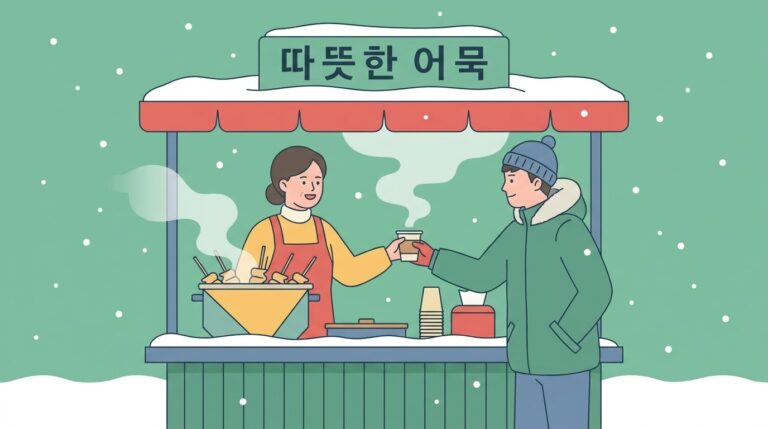
Imagine this: It is late December in Seoul. The temperature has dropped below freezing, and the wind is biting at your cheeks. You duck into a bright orange or red tent on the street corner—a Pojangmacha (street food stall). Steam is rising from a large rectangular pot filled with zigzagged fish cakes on wooden skewers. You take a bite of the hot Eomuk (fish cake) and sip the savory, salty, umami-rich broth from a tiny paper cup. Instantly, your body thaws.
But wait, you have finished your soup. The paper cup is empty, but you are still cold. You want more. In K-Dramas, you always see the main characters casually drinking endless cups of this magical winter elixir while complaining about their bosses. Is it free? Can you just take it? How do you ask without sounding rude?
If you just stand there looking at the empty cup, you are missing out on one of the warmest K-Culture experiences. Do not worry! This guide is based on real questions from my students who successfully conquered the Seoul winter street food scene. Let us learn how to ask for an Eomuk broth refill like a true local!
Phase 2: Core Expressions Deep Dive
Here are the top phrases you need when you are craving that second (or third) cup of warm soup.
1. 국물 좀 더 주실 수 있나요?
- Pronunciation: gukmul jom deo jusil su innayo? [gook-mool johm duh joo-shil soo in-nah-yo?]
- Meaning: (Literal) Can you give me a little more broth? (Real Nuance) Could I please have a refill of the soup?
- Sound-alike guide for English speakers: ‘국’ (guk) sounds like ‘book’ with a G. ‘물’ (mul) rhymes with ‘pool’.
- K-Culture Moment: This is the safest, most polite way to ask. Imagine you are at a neat, slightly formal indoor snack shop (Bunsik-jip) rather than a noisy street cart. You want to be perfectly polite to the staff.
- Editor’s Insight: The word ‘좀’ (jom – a little) is the magic softening word in Korean. Even if you want a giant bowl of soup, adding ‘좀’ makes you sound humble and polite, not demanding.
- Situation Spectrum:
- Casual (Friends): 🚫 (Too stiff!)
- Semi-formal (Clerks/Staff): ✅ (Perfect!)
- Formal (Elders/Bosses): ✅
- Think About It: Why do Koreans almost always insert ‘jom’ (a little) when requesting something? Does your native language have a similar ‘softening’ word to show politeness?
2. 이모님, 국물 리필 되나요?
- Pronunciation: imonim, gukmul ripil doenayo? [ee-mo-neem, gook-mool ree-peel dweh-nah-yo?]
- Meaning: (Literal) Auntie, does broth refill work? (Real Nuance) Excuse me, can I get a refill on the soup?
- Sound-alike guide: ‘으’ (eu) in ‘국’ sounds like the disgusted sound you make when you step in wet gum. ‘이모’ (imo) sounds like ‘emo’ (the music genre) but with an ‘ee’ sound at the start.
- K-Culture Moment: You are standing shoulder-to-shoulder with tired office workers at a busy street food stall in Hongdae. It is loud. You need something short and practical.
- Editor’s Insight: ‘리필’ (Refill) is Konglish (Korean-English), but everybody uses it for food! Asking ‘되나요?’ (Does it work? / Is it possible?) is a very common Korean pattern to check if a service is available without directly commanding the person.
- Situation Spectrum:
- Casual: ⚠️ (Slightly formal, but okay)
- Semi-formal: ✅ (Great for busy stalls)
- Formal: 🚫
- Think About It: How did the English word ‘refill’ become so deeply embedded in Korean dining culture?
3. 여기 국물 좀 더 주세요~
- Pronunciation: yeogi gukmul jom deo juseyo~ [yuh-gee gook-mool johm duh joo-seh-yo~]
- Meaning: (Literal) Here, please give a little more broth. (Real Nuance) Over here! Some more soup, please~
- Sound-alike guide: End the sentence with a slightly drawn-out, friendly tone (~), like a gentle sing-song voice.
- K-Culture Moment: You have been chatting with the stall owner, and you have already eaten three skewers. You are building a rapport. You hold up your cup with a big smile.
- Editor’s Insight: ‘여기’ (Here) is how Koreans get attention in restaurants. It does not mean ‘pour the soup right here on the table’, but rather ‘Hey, look over here at me please!’ Combine it with a warm smile, and you are officially a local.
- Situation Spectrum:
- Casual: ✅
- Semi-formal: ✅ (With a friendly tone)
- Formal: 🚫
- Think About It: In many Western countries, calling out ‘Here!’ to a server is considered rude. Why is it the standard, acceptable way to get attention in Korea?
Phase 3: Textbook vs. Real Korean
Let us look at how the textbook phrases compare to what you will actually hear on the streets of Seoul.
Asking for more soup
* Textbook Korean: 어묵 국물을 더 주시겠습니까? (Extremely formal and robotic)
* Real Korean: 이모님, 국물 좀 더 주세요~ (Friendly and natural)
* Why the difference?: Street food carts are places of Jeong (warm affection), not business boardrooms. A friendly, slightly casual tone builds a better connection than robotic textbook grammar.
Asking how much it is
* Textbook Korean: 이것은 가격이 얼마입니까? (What is the price of this item?)
* Real Korean: 이거 얼마예요? (How much is this?)
* Why the difference?: Efficiency! In the freezing cold, nobody has time for long sentences. Short, polite phrases are the ultimate survival tool.
Phase 4: Cultural Context — K-Culture Deep Dive
Non-verbal Cues: The Two-Handed Cup Rule
In Korea, language is only half the battle. Your body language speaks volumes. When you ask the Imo-nim (stall owner) for a refill, do not just hold your paper cup out with one hand like you are catching rain.
Instead, hold the small paper cup with both hands, or support your right wrist lightly with your left hand as she pours the hot broth from her ladle. This shows respect. Also, make sure to read the Nunchi (the atmosphere). If she is frantically cooking spicy rice cakes (Tteokbokki) for a group of five, wait for a brief pause before asking for your refill!
The K-Food Connection: The Infinite Refill Universe
Korean dining culture is incredibly generous. In a typical restaurant, side dishes (Banchan) are endlessly refilled for free. The same goes for Eomuk broth at a street stall! As long as you buy at least one skewer of fish cake, the savory, steaming broth is complimentary. Drinking the broth is considered essential to washing down the street food. It is not just soup; it is a built-in winter hand warmer!
Phase 5: Real-Life Roleplay Scenario
Setting: A freezing Friday night, 8 PM, right outside Myeongdong Station Exit 4. The wind is howling, but you spot a brightly lit Pojangmacha. Steam is billowing from the food cart.
Characters:
* YOU: A foreign traveler who has been shopping all day. You are freezing.
* Imo-nim (Stall Owner): A warm, energetic Korean lady in her 50s wearing a thick padded jacket and an apron.
Imo-nim: 어서 와요! 날씨가 많이 춥죠?
(eoseo wayo! nalssiga mani chupjyo?)
(English) Welcome! It’s really cold out, right?
(Stage Direction: She smiles warmly and points to the steaming pots)
YOU: 네, 너무 추워요. 어묵 하나 주세요.
(ne, neomu chuwoyo. eomuk hana juseyo.)
(English) Yes, it’s freezing. I’ll have one fish cake skewer, please.
Imo-nim: 자, 여기 있어요. 따뜻할 때 먹어요.
(ja, yeogi isseoyo. ttatteuthal ttae meogeoyo.)
(English) Here you go. Eat it while it’s hot.
(Stage Direction: She hands you a skewer and a paper cup filled with broth)
YOU: 와, 감사합니다. 국물이 진짜 맛있네요!
(wa, gamsahamnida. gukmuri jinjja masinneyo!)
(English) Wow, thank you. The broth is really delicious!
Imo-nim: 우리 집 국물이 최고지! 더 먹어도 돼요.
(uri jip gukmuri choegoji! deo meogeodo dwaeyo.)
(English) Our broth is the best! You can have more.
(Stage Direction: You quickly finish the soup. Your hands are still cold. You want more.)
Decision Point! Your Turn! How do you reply?
* A) 국물이 부족합니다. 더 주십시오. (The broth is insufficient. Give me more.)
* B) 이모님, 여기 국물 좀 더 주세요~
* C) 야, 국물 리필!
Best Choice Analysis:
Choice B is the winner! It is polite, uses the friendly title ‘Imo-nim’, and sounds very natural. Choice A sounds like a military robot reporting a supply shortage. Choice C is incredibly rude and might get you kicked out of the stall!
Let us continue the roleplay assuming you chose B:
YOU: 이모님, 여기 국물 좀 더 주세요~
(imonim, yeogi gukmul jom deo juseyo~)
(English) Imo-nim, could I have a little more broth please~
Imo-nim: 아이고, 당연하지! 컵 이리 줘봐요.
(aigo, dangyeonhaji! keop iri jwobwayo.)
(English) Oh my, of course! Hand me your cup.
(Stage Direction: You hand her the cup with both hands)
YOU: 감사합니다. 몸이 다 녹는 것 같아요.
(gamsahamnida. momi da nongneun geot gatayo.)
(English) Thank you. I feel like my body is melting (warming up).
Imo-nim: 다행이네. 천천히 먹고 가요.
(dahaengine. cheoncheonhi meokgo gayo.)
(English) That’s a relief. Take your time eating before you go.
Phase 6: 10-Second Shadowing Drill
Read this aloud and mimic the natural rhythm. Pay attention to the pauses (/) and the emotion tags!
- 😊 Bright and polite:
이모님, / 여기 국물 / 좀 더 주세요~
(imonim, / yeogi gukmul / jom deo juseyo~) -
🥺 Acting a little cold and eager:
사장님, / 국물 리필 / 되나요?
(sajangnim, / gukmul ripil / doenayo?)
Phase 7: K-Culture Mini Dictionary
Here are 4 essential keywords for your street food adventures.
1. 이모님
* Romanization: imo-nim
* English: Auntie (Respectful)
* Context: Literally means ‘mother’s sister’, but widely used to affectionately and respectfully address middle-aged women working in restaurants or stalls. It builds instant warmth.
2. 포장마차
* Romanization: pojang-macha
* English: Covered street cart / Street food tent
* Context: The iconic orange or red tents seen in countless K-Dramas where characters eat street food or drink Soju. A staple of Korean nightlife.
3. 서비스
* Romanization: seo-bi-seu
* English: Service (On the house / Freebie)
* Context: If a stall owner gives you an extra piece of fried food for free, they will say “이건 서비스예요” (This is service/on the house). It is a pure expression of Korean Jeong.
4. 단골
* Romanization: dan-gol
* English: Regular customer
* Context: If you visit the same stall a few times, you become a ‘Dan-gol’. Stall owners will remember you, give you larger portions, and treat you like family.
Phase 8: Traveler Survival Kit
Are you heading to a Korean street market soon? Keep these phrases in your back pocket!
Survival Phrases for Street Food:
* 🇰🇷 이거 얼마예요? (igeo eolmayeyo?)
* 🗣️ Meaning: How much is this?
* 📍 Where to use: Literally anywhere without a price tag.
* 🇰🇷 계좌이체 되나요? (gyejwa-iche doenayo?)
* 🗣️ Meaning: Can I do a bank transfer?
* 📍 Where to use: Food carts that do not accept foreign credit cards.
* 🇰🇷 너무 매워요? (neomu maewoyo?)
* 🗣️ Meaning: Is it very spicy?
* 📍 Where to use: Before ordering red Tteokbokki!
Editor’s Travel Note:
Most street food stalls in Korea do NOT accept credit cards, especially foreign ones. Always carry around 10,000 to 20,000 KRW in physical cash when exploring areas like Myeongdong, Hongdae, or local markets. And remember, there is absolutely NO tipping culture in Korea. Paying the exact amount is all that is expected!
Phase 9: Critical Thinking Corner — “One Step Deeper”
Food & Identity: The Culture of Jeong (정)
If you think about it from a strict business perspective, giving away unlimited free broth does not make sense. So why do Korean street food vendors do it? It comes down to the Korean concept of Jeong (정)—a deep feeling of affection, warmth, and community bonding. In Korea, sharing food and making sure no one leaves hungry or cold is a profound way of showing care. The free broth is not just water and seasoning; it is a bowl of empathy. When the vendor tells you to “drink up and stay warm,” they are treating you not just as a paying customer, but as a guest in their community.
Think Deeper:
Does your native culture have a specific food or dining habit that prioritizes community and warmth over business logic? Share your thoughts in the comments!
Phase 10: FAQ & Avoiding Misunderstandings
Q: Can I just take the ladle and serve myself?
It depends! At some busy stalls, you will see locals picking up the ladle and pouring broth into their own cups. However, as a visitor, it is always safer and more polite to ask first using the phrases we learned today. Sometimes the owner wants to give you the broth from a specific part of the pot that has the most flavor!
Q: Is the broth really free?
Yes, but there is an unspoken rule: you should buy at least one item (like an Eomuk skewer) to drink the broth. It is generally considered poor manners to just walk up, drink free soup, and leave without buying anything.
Common Mistakes to Avoid:
* ❌ Mistake #1: Calling the owner ‘아줌마’ (Ajumma).
* ✅ Correction: While ‘Ajumma’ means a middle-aged woman, it has taken on a slightly rude or dismissive tone in recent years. Always use ‘이모님’ (Imo-nim) or ‘사장님’ (Sajang-nim / Boss) for a much warmer response.
Phase 11: Summary & Action Items
One-Liner Summary:
To get a warm refill of fish cake broth, politely smile and say “이모님, 국물 좀 더 주세요~” while holding your cup with both hands!
Action Missions:
* 🥉 Bronze: Stand in front of your mirror and practice holding an invisible cup with two hands while saying “국물 좀 더 주세요” three times.
* 🥈 Silver: Leave a comment below using the word “리필” (Refill) in a Korean sentence!
* 🥇 Gold: On your next trip to Korea, visit a Pojangmacha and successfully order an Eomuk skewer and ask for a broth refill in Korean.
K-Culture Mission:
Go to YouTube and search for “Korean Street Food Eomuk”. Watch how the locals interact with the stall owners. Can you catch them saying “여기요” (Over here) or holding their cups with two hands?
Phase 12: Quiz — Interactive Challenge
Test your new winter survival skills!
1. Situational Judgment:
You are at a street stall. The owner is an older woman. You want more soup. What is the BEST thing to call her to get her attention politely?
A) 아줌마 (Ajumma)
B) 이모님 (Imo-nim)
C) 야 (Ya)
2. Fill in the Blank:
국물 ___ 더 주세요. (Please give me a little more broth.)
Hint: It is the magic softening word!
3. True or False:
If the street food is cheap, you should leave a tip to show appreciation.
4. Roleplay Implication:
If you ask “국물 리필 되나요?”, what are you literally asking?
A) Does broth refill work?
B) Where is the broth?
C) How much is the broth?
(Answers: 1: B, 2: 좀 (jom), 3: False – no tipping in Korea!, 4: A)
Stay warm out there, and happy eating! Let me know in the comments what your favorite Korean winter snack is!
Frequently Asked Questions (FAQ)
Q: What does "국물 좀 더 주실 수 있나요?" mean in Korean and how do you pronounce it?
A: In Korean, "국물 좀 더 주실 수 있나요?" is pronounced [gukmul jom deo jusil su innayo? [gook-mool johm duh joo-shil soo in-nah-yo?] and means: (Literal) Can you give me a little more broth? (Real Nuance) Could I please have a refill of the soup?
Q: What does "이모님, 국물 리필 되나요?" mean in Korean and how do you pronounce it?
A: In Korean, "이모님, 국물 리필 되나요?" is pronounced [imonim, gukmul ripil doenayo? [ee-mo-neem, gook-mool ree-peel dweh-nah-yo?] and means: (Literal) Auntie, does broth refill work? (Real Nuance) Excuse me, can I get a refill on the soup?
Q: What does "여기 국물 좀 더 주세요~" mean in Korean and how do you pronounce it?
A: In Korean, "여기 국물 좀 더 주세요~" is pronounced [yeogi gukmul jom deo juseyo~ [yuh-gee gook-mool johm duh joo-seh-yo~] and means: (Literal) Here, please give a little more broth. (Real Nuance) Over here! Some more soup, please~







