

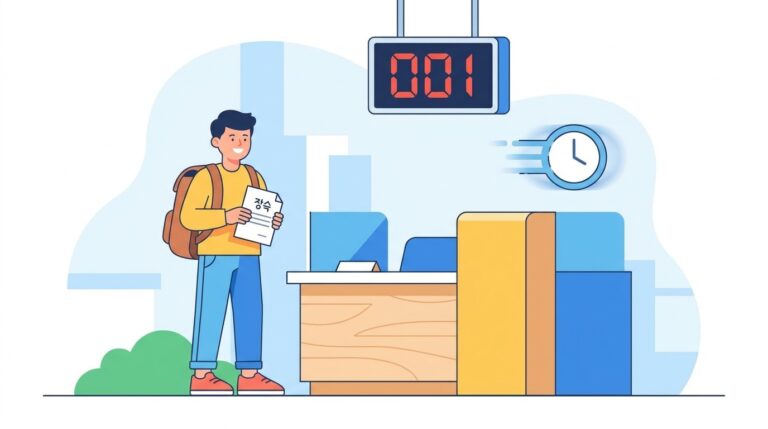
Experience Korean Speed! Essential Phrases for Public Offices and Fast Services
Hello! I am the Lead Editor of Daily Hangul.
Imagine watching a K-Drama. The main character desperately needs a family registry document to prove their identity right this second. They sprint into a local government office, the clerk types at the speed of light, and boom! Three minutes later, they walk out with the paper. As an international viewer, you might have thought, “That is just TV magic. Things like that take weeks in my country!”
But here is the exciting truth: if you live in or visit Korea, you will soon realize that this incredible speed is 100% real. Welcome to the magic of Korean public administration and the legendary 빨리빨리 (Ppalli-ppalli / Hurry, hurry) culture!
However, this fast-paced environment can feel overwhelming if you don’t know the right words. Today, I am going to teach you exactly how to navigate Korean public offices, banks, and fast services like a true local. By the end of this post, you won’t just survive the speed—you will enjoy it!
Core Expressions Deep Dive
1. 얼마나 걸려요?
- Pronunciation: eolmana geollyeoyo? [Sounds like: uhl-ma-na gull-yuh-yo?]
- Meaning: Literal: How much does it hang? / Real nuance: How long does it take?
- K-Culture Moment: You order a new bank card or request a visa document. In many countries, you brace yourself to hear “three to five business days.” In Korea, when you ask this question, you might hear “about five minutes.”
- Editor’s Insight: This is the most magical question in Korea. It is polite, direct, and essential. You can use it anywhere: at a cafe, a public office, or a hospital. It shows you are respectful but mindful of time.
- Situation Spectrum:
- Friends (Casual): ✅ (Drop the ‘yo’ -> 얼마나 걸려?)
- Coworkers (Semi-formal): ✅
- Boss/Elders/Clerks (Formal): ✅
- 🤔 Think About It: Time is treated as a highly valuable shared resource in Korea. By asking “How long does it take?”, you are not rushing them; you are synchronizing your schedule with theirs. Does your culture prioritize exact time estimates as strictly as Korea does?
2. 금방 돼요.
- Pronunciation: geumbang dwaeyo. [Sounds like: geum-bang dway-yo.]
- Meaning: Literal: It becomes right away. / Real nuance: It will be done shortly / It won’t take long.
- K-Culture Moment: You are at the 주민센터 (Jumin Center / Community Service Center) asking for a printed certificate. The clerk smiles and says this phrase. You sit down to check your phone, and before you even open Instagram, they are calling your name.
- Editor’s Insight: When a Korean service worker says “geumbang dwaeyo,” they mean business. It is a promise of extreme efficiency. As a customer, hearing this immediately puts your mind at ease.
- Situation Spectrum:
- Friends (Casual): ✅ (금방 돼)
- Coworkers (Semi-formal): ✅
- Formal settings: ✅ (Service workers will use this to reassure you)
- 🤔 Think About It: The word “soon” can mean 10 minutes in one culture and 2 hours in another. In the Korean service industry, “geumbang” usually means under 5 to 10 minutes. What is the standard for “soon” in your hometown?
3. 번호표 뽑으셨어요?
- Pronunciation: beonhopyo ppobeusyeosseoyo? [Sounds like: bun-ho-pyo ppo-beu-shuh-ssuh-yo?]
- Meaning: Literal: Did you pull a number ticket? / Real nuance: Have you taken a number?
- K-Culture Moment: You walk into a bank or post office and confidently walk straight up to the counter. The clerk gently points to a machine by the door and asks you this. Suddenly, you realize you skipped step one of Korean adulting!
- Editor’s Insight: In Korea, the ticket machine is king. No ticket, no service. If you hear this phrase, don’t panic. Just say “Ah!” smile, and go grab your number.
- Situation Spectrum:
- Casual: 🚫 (Friends don’t issue tickets to each other!)
- Formal/Service situations: ✅
- 🤔 Think About It: Why do almost all Korean service centers use number machines instead of waiting in a physical line? How does this reflect the Korean desire for fairness and efficiency?
Textbook vs. Real Korean
Asking for processing time
* Textbook Korean: 처리 시간이 얼마나 소요됩니까? (How much processing time is required?)
* Real Korean: 이거 얼마나 걸려요? (How long does this take?)
* Why it’s different: Koreans value efficiency in speech just as much as in their services. Long, overly formal vocabulary is often replaced with simple, direct verbs in daily life.
Telling someone to wait
* Textbook Korean: 잠시만 기다려 주시겠습니까? (Would you please wait for a moment?)
* Real Korean: 조금만 기다려 주세요. 금방 돼요! (Please wait a little. It’ll be done shortly!)
* Why it’s different: Adding “금방 돼요” (It will be done shortly) shows empathy toward the customer’s time, making the request to wait feel much more polite and caring.
Bottom Note: For B1 (Intermediate) learners, using “얼마나 걸려요?” instead of complex formal textbook phrases makes you sound much more like a natural resident!
Cultural Context — K-Culture Deep Dive
1. Non-verbal Cues: The Eye Scan
When you enter any public office (like Immigration or a Community Center) in Korea, do not make immediate eye contact with the clerks. Instead, do the “Eye Scan.” Look left and right for the glowing screen of the 번호표 (Number ticket) machine. Taking a number before making eye contact shows you have great 눈치 (Nunchi – social sense).
2. K-Travel Connection: The Legendary Airport Speed
Have you ever arrived at Incheon International Airport? Travelers from all over the world are constantly shocked by how fast the immigration and baggage claim processes are. The expressions we learned today don’t just apply to local offices; they represent the entire infrastructure of Korean travel. When a customs officer at the airport says “금방 끝납니다” (It will finish shortly), they mean you will be out the door in minutes.
Critical View: While this speed is amazing for tourists and customers, remember that it is built on the intense hard work and emotional labor of Korean service workers. A quick “감사합니다” (Thank you) goes a long way in acknowledging their effort!
Real-life Roleplay Scenario
Setting: Tuesday morning, 10 AM. You are at the Gangnam District Office to get an official document for your housing contract. You only have a 30-minute lunch break, so you are a bit nervous about the time. The office is bright, clean, and filled with the sound of rapid keyboard typing.
Characters:
* YOU: An expat who needs their paperwork done fast.
* Officer Kim (35): A highly efficient, friendly public official who types at 200 words per minute.
Dialogue:
Officer Kim: 105번 고객님, 이쪽으로 오세요.
(baek-o-beon gogaengnim, ijjogeuro oseyo.)
[Translation: Customer number 105, please come this way.]
(Stage Direction: Officer Kim waves politely from Counter 3.)
YOU: 안녕하세요. 저 외국인 등록 사실 증명서 필요해서요.
(annyeonghaseyo. jeo oegugin deungnok sasil jeungmyeongseo piryohaeseoyo.)
[Translation: Hello. I need a Certificate of Alien Registration.]
Officer Kim: 네, 신분증 먼저 주시겠어요?
(ne, sinbunjeung meonjeo jusigesseoyo?)
[Translation: Yes, could you give me your ID first?]
YOU: 네, 여기 있습니다. 저기요… 혹시 이거 얼마나 걸려요?
(ne, yeogi itseumnida. jeogiyo… hoksi igeo eolmana geollyeoyo?)
[Translation: Yes, here it is. Excuse me… by the way, how long does this take?]
(Stage Direction: You look at your watch nervously.)
Officer Kim: 아, 서류 발급이요? 금방 돼요. 1분도 안 걸립니다.
(a, seoryu balgeubiyo? geumbang dwaeyo. il-bundo an geollimnida.)
[Translation: Ah, issuing the document? It will be done shortly. It won’t even take 1 minute.]
YOU: 벌써 다 됐어요?
(beolsseo da dwaesseoyo?)
[Translation: Is it already done?]
(Stage Direction: You watch in awe as the printer immediately starts humming.)
Officer Kim: 네, 여기 서명만 한 번 해주세요.
(ne, yeogi seomyeongman han beon haejuseyo.)
[Translation: Yes, just sign here once please.]
🔀 Your Turn! How should you respond?
* A) “너무 빨라요! 무서워요!” (Too fast! It’s scary!)
* B) “우와, 진짜 빠르네요. 감사합니다!” (Wow, that’s really fast. Thank you!)
* C) “더 빨리 안 되나요?” (Can’t you do it faster?)
Best Choice: B — Recognizing their efficiency with a compliment makes Korean service workers very proud.
Why C is bad: Never ask a Korean service worker to go faster when they are already working at lightning speed. It comes off as extremely rude!
10-Second Shadowing Drill
Practice speaking like a local! Pay attention to the pauses (/) and the emotion.
😊 저기요, / 이거 / 얼마나 걸려요?
(jeogiyo, / igeo / eolmana geollyeoyo?)
😲 우와! / 벌써 / 다 됐어요?
(uwa! / beolsseo / da dwaesseoyo?)
K-Culture Mini Dictionary
1. 눈치
* Romanization: nunchi
* English: Social sense / Situational awareness
* Context: The core social skill in Korea. Knowing to take a number ticket without being told is considered having “good nunchi.”
2. 빨리빨리
* Romanization: ppalli-ppalli
* English: Hurry, hurry / Speed culture
* Context: The driving force behind Korea’s economic growth and hyper-efficient public services. Everything from internet installation to food delivery operates on this mindset.
3. 번호표
* Romanization: beonhopyo
* English: Number ticket
* Context: The great equalizer in Korean society. Whether you are a CEO or a student, everyone waits for their number to be called at the bank or government office.
4. 주민센터
* Romanization: juminsenteo
* English: Community Service Center
* Context: The local government office in your neighborhood where you go to get everyday documents, register your address, or ask questions about local living.
Traveler Survival Kit
Are you visiting Korea soon? Whether you are passing through immigration or buying a SIM card, you need these basic survival expressions to match the local speed.
🆘 Survival Expression #1: ID Check
* 🇰🇷 “여권 보여주세요.” (yeogwon boyeojuseyo.)
* 🗣️ English: Please show me your passport.
* 📍 Where you hear it: Airports, tax-free shops, SIM card desks.🆘 Survival Expression #2: Time Check
* 🇰🇷 “얼마나 기다려야 돼요?” (eolmana gidaryeoya dwaeyo?)
* 🗣️ English: How long do I have to wait?
* 📍 Where you use it: Crowded restaurants, hospital waiting rooms.🆘 Survival Expression #3: Confirmation
* 🇰🇷 “여기 사인하면 되나요?” (yeogi sainhamyeon doenayo?)
* 🗣️ English: Do I just sign here?
* 📍 Where you use it: Anywhere you are handed a digital pad or paper document.📌 Editor’s Travel Note
* App to survive: Use Naver Map to find the nearest “주민센터” or “우체국” (Post office).
* Lunch Hour Alert: Public offices in Korea remain open during lunch hours! The staff take turns eating, so you can still get your documents processed at 12:30 PM. True efficiency!
Critical Thinking Corner — “One Step Deeper”
🧠 Think Deeper: Speed and Social Trust
Have you ever wondered why Korea’s public offices can issue highly sensitive personal documents in just 3 minutes? It is not just about typing fast. It is a reflection of a society built on an incredibly advanced IT infrastructure and a unique level of “social trust.” Everything—your phone number, your bank, your ID—is interconnected securely. While this “Ppalli-ppalli” culture provides ultimate convenience, it also puts immense pressure on society to constantly optimize and never slow down. It forces us to ask: at what point does efficiency become stress?
💬 Your Turn: How long does it take to get a simple ID or tax document reissued in your home country? Do you prefer the Korean speed, or a slower, more relaxed pace? Let us know in the comments!
FAQ & Avoiding Misunderstandings
Q: Can I say “빨리빨리 해주세요” (Please do it quickly) to the staff?
No! Never say this. Even though Korea is famous for the “Ppalli-ppalli” culture, telling a service worker to hurry up is considered very rude and demanding. They are already working as fast as they can. Instead, ask politely: “얼마나 걸릴까요?” (How long might it take?).
Q: What if I miss my number at the ticket screen?
If your number passes, do not try to cut in! You usually have to pull a new ticket. However, if you only missed it by a few seconds, you can approach the counter and politely say, “저기요, 제 번호가 지나갔어요” (Excuse me, my number passed).
❌ Common Mistake: Walking directly to the counter in a bank or office without looking around.
✅ Do this instead: The moment you walk through the glass doors, let your eyes search for the ticket machine (번호표 발행기). It is usually right at the entrance!
Summary & Action Items
One-Liner Summary: To master the hyper-speed of Korean public offices, always grab a number ticket and politely ask “얼마나 걸려요?” instead of rushing the staff!
Action Mission 3 Steps:
* 🥉 Bronze (Solo): Look at your watch and ask out loud: “이거 얼마나 걸려요?” 3 times in your room.
* 🥈 Silver (Online): Go to your language exchange app and ask a Korean partner what their fastest public service experience was.
* 🥇 Gold (Real Life): Next time you order coffee or food at a busy Korean spot, try asking the staff “얼마나 걸려요?” with a friendly smile.
K-Culture Mission:
Search “주민센터” on Google Street View or Naver Maps near a famous Seoul landmark (like Gangnam Station or Hongdae). Zoom in on the entrance and try to spot where the automated document machines or ticket dispensers are located!
Engagement: Have you ever experienced reverse culture shock when returning home after experiencing Korea’s fast services? Share your funniest stories below!
Interactive Quiz Challenge
1. Situational Judgment: You are at the immigration office to renew your visa. You see an empty counter with a clerk sitting there. What should you do?
* A) Walk straight up and say “안녕하세요!”
* B) Look for the machine, pull a number ticket, and wait for your number to appear on the screen.
* C) Yell “빨리빨리!”
(Answer: B. Even if the counter looks empty, the system relies strictly on the number tickets!)
2. Fill in the Blank:
You are wondering how long the printing will take.
“저기요, 이거 ________ 걸려요?”
(Answer: 얼마나 – eolmana)
3. True or False — K-Culture Edition:
“Korean government offices completely close down for 1 hour during lunchtime, so you cannot get any service.”
(Answer: False. They use a rotating shift system so citizens can visit during their own lunch breaks. Efficiency never sleeps!)
Frequently Asked Questions (FAQ)
Q: What does "얼마나 걸려요?" mean in Korean and how do you pronounce it?
A: In Korean, "얼마나 걸려요?" is pronounced [eolmana geollyeoyo? [Sounds like: uhl-ma-na gull-yuh-yo?] and means: Literal: How much does it hang? / Real nuance: How long does it take?
Q: What does "금방 돼요." mean in Korean and how do you pronounce it?
A: In Korean, "금방 돼요." is pronounced [geumbang dwaeyo. [Sounds like: geum-bang dway-yo.] and means: Literal: It becomes right away. / Real nuance: It will be done shortly / It won't take long.
Q: What does "번호표 뽑으셨어요?" mean in Korean and how do you pronounce it?
A: In Korean, "번호표 뽑으셨어요?" is pronounced [beonhopyo ppobeusyeosseoyo? [Sounds like: bun-ho-pyo ppo-beu-shuh-ssuh-yo?] and means: Literal: Did you pull a number ticket? / Real nuance: Have you taken a number?







