

Phase 1: Empathy (Immersive Opening)
Hello! I am your Daily Hangul editor.
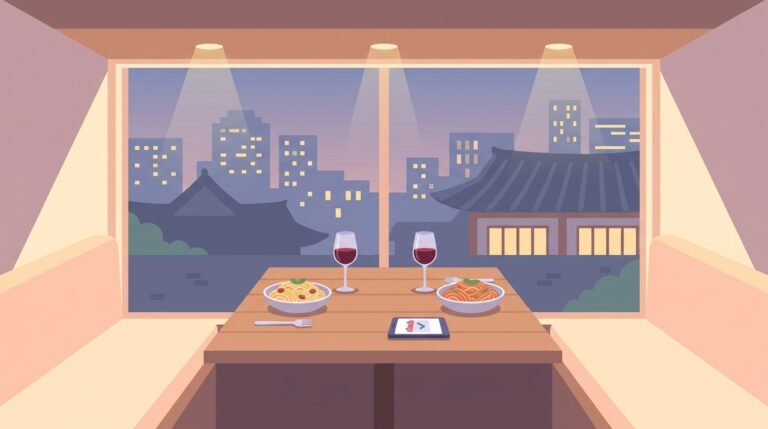
Picture this: It is a Friday evening in Gangnam. You are watching a K-Drama, and the main lead is nervously adjusting his collar at a dimly lit, upscale Italian restaurant. The music is soft, wine is poured, and his blind date (소개팅 – Sogaeting) walks in. They smile, and everything seems perfect.
But wait… why is it always a pasta place?
In Korea, booking a nice Italian restaurant is considered the ultimate green flag for a first date. If you don’t know how to navigate this cultural nuance, you might end up taking your date to a noisy BBQ joint. While pork belly is delicious, smelling like roasted garlic on a first meeting might not be the best strategy!
This guide is designed to help you book a romantic spot seamlessly, based on real questions from expats who wanted to impress their Korean dates. Let’s dive in!
Phase 2: Core Expressions Deep Dive
1. 창가 자리로 예약할 수 있을까요?
- Pronunciation: changga jariro yeyakhal su isseulkkayo? (chang-ga ja-ri-ro ye-yak-hal su iss-eul-kka-yo?)
- Meaning: Literal: Can I reserve a window seat? / Real Nuance: I want the best romantic spot you have.
- K-Culture Moment: Window seats in high-rise Seoul restaurants offer stunning city views. Reserving this specific table shows your date that you planned ahead and care about the ambiance.
- Editor’s Insight: This phrase sounds hopeful and polite, not demanding. The ending ~을까요? softens the request.
- Situation Spectrum:
- 친구 사이(Casual): ⚠️
- 직장 동료(Semi-formal): ✅
- 식당 직원(Formal): ✅
- 🤔 Think About It: Why are window seats so coveted in Korean dating culture? How does the city skyline affect the romantic mood?
2. 조용한 자리로 부탁드립니다.
- Pronunciation: joyonghan jariro butakdeurimnida. (jo-yong-han ja-ri-ro bu-tak-deu-rim-ni-da.)
- Meaning: Please give us a quiet table.
- K-Culture Moment: Korean restaurants can get very loud. In a 소개팅 (blind date), conversation is key. Asking for a quiet table shows great Nunchi (social awareness).
- Editor’s Insight: 부탁드립니다 is the magic word for polite requests in Korea. It means “I am entrusting this favor to you.”
- Situation Spectrum:
- 친구 사이(Casual): 🚫
- 직장 동료(Semi-formal): ✅
- 식당 직원(Formal): ✅
- 🤔 Think About It: In your culture, do people prefer lively and loud restaurants for a first date, or quiet and private ones?
3. 소개팅하기 좋은 분위기인가요?
- Pronunciation: sogaetinghagi jo-eun bunwigi-ingayo? (so-gae-ting-ha-gi jo-eun bun-wi-gi-in-ga-yo?)
- Meaning: Is the atmosphere good for a blind date?
- K-Culture Moment: You can use this phrase when calling a restaurant or asking a Korean friend for recommendations. Koreans heavily rely on the word 분위기 (vibe/atmosphere).
- Editor’s Insight: It is perfectly normal to directly ask if a place is good for a blind date. Restaurant staff will usually give you an honest answer!
- Situation Spectrum:
- 친구 사이(Casual): ✅
- 식당 직원(Formal): ✅
- 🤔 Think About It: How would you define a “good vibe” for a date in your home country?
Phase 3: Textbook vs. Real Korean
[Situation 1: Making the Reservation]
* 📖 교과서 한국어: 예약을 하고 싶습니다. (I want to make a reservation.)
* 🗣️ 진짜 한국어: 금요일 저녁 두 명 예약되나요? (Friday evening, two people, is a reservation possible?)
* 💡 왜 다를까?: Koreans prefer the indirect and softer “Is it possible?” (되나요?) over the direct “I want to” (하고 싶다) to sound more considerate.
[Situation 2: Asking about the vibe]
* 📖 교과서 한국어: 그 식당은 조용합니까? (Is that restaurant quiet?)
* 🗣️ 진짜 한국어: 거기 분위기 괜찮아요? (Is the vibe good there?)
* 💡 왜 다를까?: “분위기” (vibe) is a catch-all term in Korea that implies good lighting, appropriate noise levels, and aesthetic interior design.
Phase 4: Cultural Context — K-Culture Deep Dive
Non-verbal Elements: The Art of Nunchi
Booking the restaurant is just step one. In a Korean blind date, your 눈치 (Nunchi – the ability to read the room) is tested. Did you pour water for your date? Did you place a napkin under their cutlery? These small actions speak louder than words in Korea.
K-Food Connection: Why Pasta?
Have you noticed in K-Dramas that first dates rarely happen at a Korean BBQ place? This is intentional! Korean food is heavily based on sharing stews (찌개) and grilling meat together. This level of sharing implies intimacy. For a first meeting (소개팅), Koreans prefer Western food like pasta because each person gets their own individual plate. It creates a safe, polite, and formal boundary. Once you become a couple, you will graduate to sharing a bubbling pot of Kimchi Jjigae together!
Phase 5: Real-Life Roleplay Scenario
Setting: You are calling “Bistro Seoul,” a highly-rated pasta restaurant in Yeonnam-dong. You want to book a table for your upcoming blind date this Friday.
Characters:
– YOU: A nervous but prepared expat going on your first Korean blind date.
– Staff (직원): A friendly but busy restaurant employee.
Dialogue:
Staff: 네, 비스트로 서울입니다.
(Ne, biseuteuro seou-rimnida.)
[Translation: Yes, this is Bistro Seoul.]
YOU: 안녕하세요, 이번 주 금요일 저녁 예약되나요?
(Annyeonghaseyo, ibeon ju geumyoil jeonyeok yeyakdoenayo?)
[Translation: Hello, is it possible to book a table for this Friday evening?]
Staff: 네, 몇 분이신가요?
(Ne, myeot bunisingayo?)
[Translation: Yes, for how many people?]
YOU: 두 명입니다. 혹시 창가 자리로 예약할 수 있을까요?
(Du myeong-imnida. Hoksi changga jariro yeyakhal su isseulkkayo?)
[Translation: Two people. By any chance, can I reserve a window seat?]
Staff: 잠시만요… 아, 창가 자리는 마감되었습니다. 홀 안쪽 조용한 자리는 어떠신가요?
(Jamsimanyo… Ah, changga jarineun magamdoeeotseumnida. Hol anjjok joyonghan jarineun eotteosingayo?)
[Translation: Just a moment… Ah, the window seats are fully booked. How about a quiet table inside the hall?]
🔀 Your Turn! How will you answer?
– A) “아, 싫어요. 안 갈게요.” (Ah, I hate it. I won’t go.)
– B) “네, 소개팅이라서 조용한 자리로 부탁드립니다.”
– C) “창가 자리 내놔요!” (Give me the window seat!)✅ Best Choice: B — “Yes, it’s for a blind date, so please give us a quiet table.” Giving the context (소개팅) helps the staff understand exactly what kind of table you need!
⚠️ Choice C Analysis: Highly inappropriate and rude! Never demand things aggressively in Korea.
Staff: 네, 소개팅이시군요! 가장 분위기 좋은 자리로 빼드릴게요.
(Ne, sogaeting-isigunyo! Gajang bunwigi jo-eun jariro ppaedeurilkkeyo.)
[Translation: Ah, a blind date! I will set aside the table with the best vibe for you.]
YOU: 감사합니다!
(Gamsahamnida!)
[Translation: Thank you!]
Phase 6: 10-Second Shadowing Drill
Read this out loud, focusing on the pauses (/) and the emotion tags!
😊 혹시 / 이번 주 금요일 / 두 명 / 예약되나요?
(Hoksi / ibeon ju geumyoil / du myeong / yeyakdoenayo?)
🥺 창가 자리로 / 부탁드립니다!
(Changga jariro / butakdeurimnida!)
Phase 7: K-Culture Mini Dictionary
1. 소개팅
* Romanization: sogaeting
* English: Blind date
* Context: A combination of “Sogae” (introduction) and the English word “meeting.” Usually arranged by a mutual friend.
2. 분위기 깡패
* Romanization: bunwigi kkangpae
* English: Atmosphere gangster (A place with an amazing vibe)
* Context: A fun slang term to describe a restaurant or cafe that looks incredibly aesthetic and beautiful.
3. 애프터
* Romanization: aepeuteo
* English: The second date
* Context: If the blind date goes well, you ask for an “After” (애프터 신청). If they accept, it means they like you!
4. 캐치테이블
* Romanization: kaechiteibeul
* English: CatchTable
* Context: The most popular restaurant reservation app in Korea. Essential for booking trendy spots.
Phase 8: Traveler Survival Kit
🆘 Survival Phrases for Dining Out
– 🇰🇷 “메뉴판 좀 주시겠어요?” (menyupan jom jusigesseoyo?)
– 🗣️ Pronunciation: me-nyu-pan jom ju-si-gess-eo-yo?
– 📍 Where to use: As soon as you sit down at the restaurant.
– 💡 Pro Tip: Many modern Korean restaurants now have tablets on the table for ordering. If you don’t see a menu, look for a screen!📌 Editor’s Travel Note
– Useful Apps: CatchTable for reservations, Naver Maps for finding the restaurant (Google Maps does not work well for walking directions in Korea).
– Payment: Korea is a cashless society. You can pay with your card almost everywhere.
– Tipping: There is absolutely NO tipping culture in Korea! If you leave cash on the table, the waiter might chase you down the street thinking you forgot your money.
Phase 9: Critical Thinking Corner — “A Step Deeper”
Food & Identity: Intimacy and Distance on the Dining Table
Have you ever wondered why Koreans eat pasta on a first date, but transition to sharing Korean stews later on? In Korean food culture, sharing food from the same central pot is a profound symbol of community and intimacy (often called 정 – Jeong). Eating Western food like pasta, where each person has their own individual plate, provides a comfortable, formal distance for strangers meeting for the first time. It is a fascinating example of how food choices reflect the progression of human relationships in Korean society.
💬 Your Turn: In your culture, what is the ultimate “first date” food? Does sharing food symbolize intimacy where you live? Let us know in the comments!
Phase 10: FAQ & Avoiding Misunderstandings
Q: Do I really need to make a reservation for a blind date?
A: YES! Showing up without a reservation and making your date wait in line is considered a major fail. It shows a lack of preparation.
Q: Can I book a table through Instagram DMs?
A: Maybe. Many trendy “hot places” accept reservations via Instagram DM, but using apps like Naver or CatchTable is much faster and more reliable.
❌ Common Mistake: Demanding a seat by saying “창가 자리 주세요” (Give me a window seat).
✅ Do This Instead: Always use “~부탁드립니다” (Please give/I request) or “~예약할 수 있을까요?” (Is it possible to reserve…).
Phase 11: Summary & Action Items
One-Liner Summary: To impress your Korean date, secure a quiet, aesthetic restaurant by politely asking “예약되나요?” (Is a reservation possible?).
Action Mission 3 Steps:
– 🥉 Bronze (Solo): Stand in front of a mirror and practice asking for a window seat out loud 3 times.
– 🥈 Silver (Online): Download the Naver Map app and search for “파스타 맛집” (Pasta hot places) in Seoul.
– 🥇 Gold (Real Life): Use the phrase “조용한 자리로 부탁드립니다” the next time you visit a cafe or restaurant in Korea!
K-Culture Mission: Watch an episode of a Korean romantic comedy tonight. Try to spot a scene where the characters are on a blind date (소개팅). What are they eating? What is the atmosphere like?
Phase 12: Quiz — Interactive Challenge
1. Situational Judgment: You want to ask the restaurant staff if their venue is suitable for a romantic date. What should you say?
– A) 여기 시끄러워요? (Is it loud here?)
– B) 밥 맛있어요? (Is the rice delicious?)
– C) 소개팅하기 좋은 분위기인가요? (Is the atmosphere good for a blind date?)
2. True or False: Leaving a 15% tip at a nice Italian restaurant in Seoul will impress your date and the staff.
– A) True
– B) False
(Answers: 1: C, 2: False – Tipping does not exist in Korea and might cause confusion!)
Frequently Asked Questions (FAQ)
Q: What does "창가 자리로 예약할 수 있을까요?" mean in Korean and how do you pronounce it?
A: In Korean, "창가 자리로 예약할 수 있을까요?" is pronounced [changga jariro yeyakhal su isseulkkayo? (chang-ga ja-ri-ro ye-yak-hal su iss-eul-kka-yo?] and means: Literal: Can I reserve a window seat? / Real Nuance: I want the best romantic spot you have.
Q: What does "조용한 자리로 부탁드립니다." mean in Korean and how do you pronounce it?
A: In Korean, "조용한 자리로 부탁드립니다." is pronounced [joyonghan jariro butakdeurimnida. (jo-yong-han ja-ri-ro bu-tak-deu-rim-ni-da.] and means: Please give us a quiet table.
Q: What does "소개팅하기 좋은 분위기인가요?" mean in Korean and how do you pronounce it?
A: In Korean, "소개팅하기 좋은 분위기인가요?" is pronounced [sogaetinghagi jo-eun bunwigi-ingayo? (so-gae-ting-ha-gi jo-eun bun-wi-gi-in-ga-yo?] and means: Is the atmosphere good for a blind date?







