

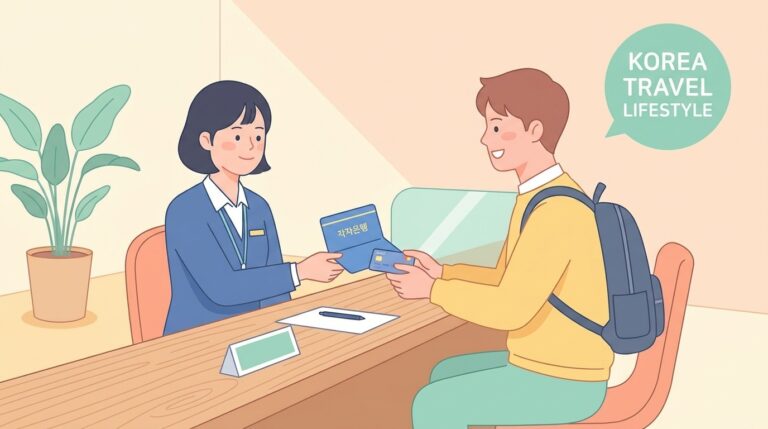
Hello! I am the Senior Editor at Daily Hangul. Have you ever stepped into a brightly lit Korean bank, clutching your queue ticket? Ding-dong! Your number flashes on the screen. You sit down, and the smartly dressed teller smiles, firing off a string of extremely polite, rapid-fire Korean. Suddenly, you feel like the protagonist in a K-Drama who is about to sign away their family company, when all you really want is a simple debit card to buy a midnight snack at the convenience store!
Opening a bank account in a foreign country can be terrifying. But do not worry! Today, I am going to teach you exactly what to say to get your account opened smoothly. Let us turn that stressful bank visit into a breeze!
Phase 2: Core Expressions Deep Dive
1. 통장 만들러 왔어요.
* Pronunciation: [tongjang mandeulleo wasseoyo] (tong-jang man-deul-leo wa-sseo-yo)
* Meaning: I came to open a bank account. (Literal: I came to make a bankbook.)
* K-Culture Moment: In K-Dramas, you often see a mother handing over a worn-out bankbook to her child, saying, I saved this for you. In Korea, the physical bankbook (통장, tongjang) is highly symbolic of saving money. So, even though you are opening an account, Koreans say they are making a bankbook!
* Editor’s Insight: This phrase is perfectly natural and polite. It tells the teller exactly what you need without sounding overly robotic.
* Situation Spectrum:
* Casual with friends: 🚫 (You wouldn’t say this to a friend)
* To a bank teller: ✅ (Perfect!)
* To a boss: ⚠️ (Depends on the context)
* 🤔 Think About It: Why do you think Koreans still use the word ‘bankbook’ even in the age of mobile banking? Does your culture have a similar nostalgic item for saving money?
2. 외국인 등록증 있어요?
* Pronunciation: [oegugin deungnokjeung isseoyo?] (weh-goo-gin deung-nok-jeung ee-sseo-yo?)
* Meaning: Do you have your Alien Registration Card (ARC)?
* K-Culture Moment: This is the magic card that proves you are a resident in Korea! Without it, getting a Korean phone number or signing up for food delivery apps like Baedal Minjok is super hard. When the teller asks this, it is your time to shine.
* Editor’s Insight: If you hear the word 등록증 (deungnokjeung), just hand over your ARC!
* Situation Spectrum:
* Bank teller to you: ✅
* You to a teller: 🚫
* 🤔 Think About It: In Korea, having a physical ID is crucial for almost every official task. How does this compare to how you prove your identity in your home country?
3. 여기에 서명해 주세요.
* Pronunciation: [yeogie seomyeonghae juseyo] (yeo-gi-e seo-myeong-hae ju-se-yo)
* Meaning: Please sign here.
* K-Culture Moment: K-Pop fans, listen up! You might know the word 사인 (sain) from fan signing events (팬사인회, paen-sa-in-hoe). While everyday Koreans use the English word sign, in official places like banks, they use the formal Korean word 서명 (seomyeong).
* Editor’s Insight: You will hear this phrase a lot! Just grab the electronic pen and sign your name on the little tablet.
* Situation Spectrum:
* Bank teller to you: ✅
* 🤔 Think About It: Notice how formal situations prefer native or Sino-Korean words (서명) over English loanwords (사인)?
Phase 3: Textbook vs. Real Korean
[Saying what you want to do]
* 📖 Textbook Korean: 은행 계좌를 개설하고 싶습니다. (I would like to open a bank account. – Very robotic!)
* 🗣️ Real Korean: 통장 하나 만들어 주세요. (Please make one bankbook for me.)
* 💡 Why the difference?: Koreans prefer tangible, everyday words (bankbook) over abstract, formal terms (opening an account) in daily conversation.
[Asking to sign]
* 📖 Textbook Korean: 이곳에 귀하의 성명을 기재하십시오. (Please record your name in this place.)
* 🗣️ Real Korean: 여기에 사인해 주세요. (Please sign here. – Using English loanwords makes it friendlier!)
* 💡 Why the difference?: English loanwords soften the tone, making the interaction feel less intimidating.
Bottom Note: For an A2 level, do not worry about memorizing the super formal textbook terms. Just stick to the ‘Real Korean’ phrases, and the tellers will perfectly understand you!
Phase 4: Cultural Context — K-Culture Deep Dive
4-1. Non-verbal Elements
When the teller asks for your ID, do not just toss it on the counter with one hand! In Korea, handing things over with two hands is a huge sign of respect. Hold the card with both hands, or use your right hand to give the card while your left hand lightly supports your right elbow. It is a tiny gesture, but the teller will immediately think, Wow, this person really understands Korean culture!
4-2. The Bankbook in K-Dramas
Have you ever noticed that K-Drama characters rarely just transfer money on their phones when they want to make a dramatic point? Instead, a wealthy grandmother will slide a physical bankbook across the table to the main character to tell them to break up with her grandson! The 통장 (tongjang) holds emotional weight in Korea. It is a record of hard work, a gift from parents, or a secret stash of concert ticket money for K-Pop fans. Getting your first Korean bankbook is a true milestone!
Phase 5: Real-Life Roleplay Scenario
Setting: A bright, quiet bank branch in Myeongdong. It is 2:00 PM on a Friday. You finally hear your ticket number being called. You walk up to the counter, taking a deep breath.
Characters:
* YOU: An expat who just got their ARC and desperately needs a debit card to order spicy fried chicken tonight.
* Teller: A polite and fast-working bank employee who wants to help you quickly.
Teller: 어서 오세요. 어떤 업무 도와드릴까요?
(eoseo oseyo. eotteon eommu dowadeurilkkayo?)
[Welcome. How can I help you today?]
YOU: 안녕하세요. 통장 만들러 왔어요.
(annyeonghaseyo. tongjang mandeulleo wasseoyo.)
[Hello. I came to open a bank account.]
Teller: 네, 신분증이나 외국인 등록증 있으신가요?
(ne, sinbunjeung-ina oegugin deungnokjeung isseusingayo?)
[Yes, do you have an ID or an Alien Registration Card?]
🔀 Your Turn! How do you hand over your card?
* A) Slide it across the table with one hand while looking at your phone.
* B) Hand it over with two hands, making soft eye contact and saying 여기 있습니다 (yeogi itseumnida – Here it is).
* C) Throw it on the desk and shout 카드! (kadeu! – Card!)
✅ Best Choice: B — Giving your ID with two hands and a polite phrase shows excellent manners!
⚠️ Choice A & C Analysis: Choice A might seem rude. Choice C will definitely make the teller think you are angry!
Teller: 감사합니다. 비밀번호 네 자리 입력해 주세요.
(gamsahamnida. bimilbeonho ne jari imnyeokhae juseyo.)
[Thank you. Please enter a 4-digit PIN password.]
YOU: (Typing…) 다 했어요.
(da haesseoyo.)
[I am done.]
Teller: 여기에 서명해 주시면 끝납니다. 수고하셨습니다!
(yeogie seomyeonghae jusimyeon kkeunnamnida. sugohasyeotseumnida!)
[Just sign here and we are done. Thank you for your effort!]
Phase 6: 10-Second Shadowing Drill
Practice reading this aloud. Pay attention to the pauses!
😊 안녕하세요! / 통장 / 만들러 왔어요.
(an-nyeong-ha-se-yo! / tong-jang / man-deul-leo / wa-sseo-yo.)
[Brightly and politely: Hello! I came to open a bank account.]
Phase 7: K-Culture Mini Dictionary
1. 통장
* Romanization: tongjang
* English: Bankbook
* Context: A physical booklet recording bank transactions. A nostalgic symbol of saving wealth.
2. 체크카드
* Romanization: chekeukadeu
* English: Debit card
* Context: Koreans say ‘check card’ instead of debit card. It is what you use to pay at restaurants and cafes!
3. 외국인 등록증
* Romanization: oegugin deungnokjeung
* English: Alien Registration Card (ARC)
* Context: Your Korean lifeline. You need it for banking, renting, and even online shopping.
4. 눈치
* Romanization: nunchi
* English: Social awareness / Reading the room
* Context: When waiting in the bank, using your nunchi means knowing when to approach the counter as soon as your number is called so you do not hold up the line!
Phase 8: Traveler’s Survival Kit
Even if you are just a traveler who cannot open a bank account yet, these tips are gold!
🆘 Survival Phrases for the Bank & Money
* 🇰🇷 환전해 주세요. (hwanjeonhae juseyo.)
* 🗣️ English Guide: Please exchange my money.
* 📍 Where to use: Bank counters, airport exchange booths.
* 💡 Pro Tip: Need to find a bank? Open Naver Map and type 은행 (eunhaeng). It will show you the closest branches!📌 Editor’s Travel Note
* Cash vs. Card: Korea is a card-heavy society! However, traditional markets (like Gwangjang Market) often prefer cash. Always keep a 10,000 won bill handy.
* Tipping: There is absolutely NO tipping in Korea. If you leave money on the table, the waiter might chase you down the street to return it!
Phase 9: Critical Thinking Corner — A Step Deeper
Language & Power (언어와 권력)
When you go to a Korean bank, you will notice the teller uses the highest, most polite form of Korean (Honorifics / 높임말). They might even elevate the objects belonging to you! This reflects the deep-rooted Customer is King culture in Korean service industries. The language clearly defines the roles: the service provider shows ultimate respect, while the customer is elevated.
🧠 Think Deeper:
Does the language change in your country when someone provides a service to a customer? Or is the communication more equal and casual?💬 Your Turn: How do you treat service workers in your culture? Do you use formal titles? Share your thoughts in the comments!
Phase 10: FAQ & Avoiding Mistakes
Q: Can I open a bank account with just my passport?
Yes, but it will be a highly restricted account (limit on how much you can transfer daily). To get a fully functioning account, you need an ARC!
Q: Can I use my English signature, or do I need a Korean name stamp?
Your English signature is perfectly fine! Just make sure it matches the signature on your passport.
Q: Should I bow to the bank teller?
A slight nod of the head when saying hello and thank you is polite and highly appreciated!
❌ Common Mistake #1: Translating ‘I want to open an account’ literally into English-Korean.
✅ Do this instead: Just use 통장 만들러 왔어요 (I came to make a bankbook). It sounds 100 times more natural!
Phase 11: Summary & Action Items
One-Liner Summary: To open an account like a local, smile, hand your ID with two hands, and say, Tongjang mandeulleo wasseoyo!
Action Mission:
* 🥉 Bronze (Solo): Stand in front of your mirror and practice handing over an imaginary ID card with two hands while saying 여기 있습니다.
* 🥈 Silver (Online): Find a picture of a Korean bank on Google Images and whisper today’s core phrase to yourself.
* 🥇 Gold (Real World): The next time you buy a coffee or go to the bank, hand your card over with two hands!
K-Culture Mission:
Next time you watch a K-Drama, look closely at the scenes where characters are at a café or office. Notice how they hand over documents or credit cards to each other. Spot the two-handed gesture!
Did you ever have a funny misunderstanding at a bank? Tell me your story in the comments below! 👇
Phase 12: Interactive Quiz
1. Situational Judgment: The bank teller says 여기에 서명해 주세요. What should you do?
* A) Sing a K-Pop song.
* B) Sign your name on the tablet.
* C) Hand over your passport.
(Answer: B – 서명 means signature!)
2. True or False – K-Culture Edition:
If you leave a tip for the bank teller because they were so kind, they will be very happy. (T/F)
(Answer: False! Tipping is not a part of Korean culture and will cause confusion!)
3. Fill in the Blank:
통장 ________ 왔어요. (I came to make a bankbook.)
(Answer: 만들러)







