

Phase 1: Empathy
Hello! I am the Senior Editor of Daily Hangul.
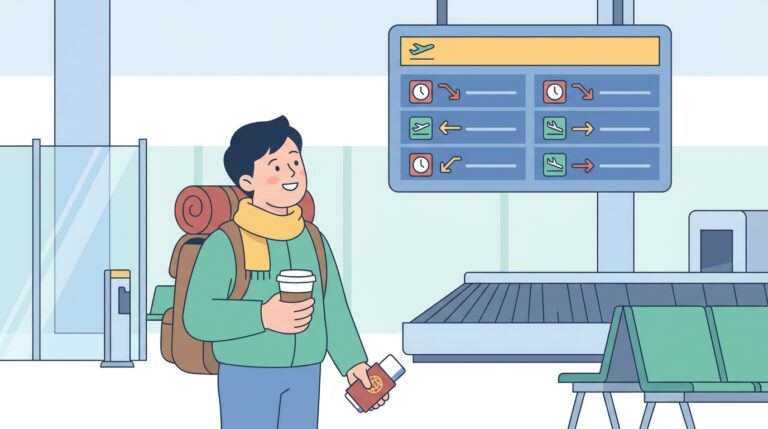
Picture this: You are at Incheon International Airport. Your bags are packed with K-Beauty masks and snacks, you just finished your last bowl of spicy airport Ramyeon, and you are ready to head home. You look up at the departure board, and instead of ‘Boarding’, you see a red blinking sign. People around you let out a collective sigh, ‘A-휴…’
Your flight is delayed.
In a K-Drama, a flight delay is the perfect moment for the male lead to run through the terminal and confess his love before the heroine leaves. But in reality? It is a confusing moment of trying to figure out what is going on, finding a place to charge your phone, and getting a good Wi-Fi connection to complain to your friends!
If you are an A1 beginner, airport announcements can sound like a fast rap song. But do not panic! Today, we are going to learn exactly what to say and do when you face a flight delay in Korea. Knowing these few simple phrases will not only save you from stress but also make you look like a seasoned traveler who knows exactly how to handle the Korean ‘Ppalli-ppalli’ (hurry up) culture when it hits a wall.
Note: This guide is built from the real panic moments of my past tutoring students at Incheon Airport. You are in safe hands!
Phase 2: Core Expressions Deep Dive
1. 연착됐어요 (It is delayed)
- Pronunciation: yeonchak-dwaesseoyo [yawn-chalk dweh-suh-yo]
- Meaning: It is delayed (Literal: It became delayed)
- K-Culture Moment: You will hear this phrase spreading like a wave among Korean passengers waiting at the gate. As soon as the announcement chimes, someone will pull out their phone and say to their family, ‘Ah, yeonchak-dwaesseoyo.’
- Editor’s Insight: This phrase sounds a bit passive, like ‘Oh well, the delay happened to us.’ It is the most natural way to state the fact without sounding angry.
- Situation Spectrum:
- Friends (Casual): ✅ (Say: 연착됐어 yeonchak-dwaesseo)
- Airport Staff (Semi-formal): ✅
- Formal Announcements: 🚫 (They use different, very formal words)
- 🤔 Think About It: In Korean, we often use passive verbs like ‘became delayed’ rather than ‘the airline delayed it.’ Why do you think Korean culture prefers passive expressions when something goes wrong? Could it be a way to avoid pointing fingers?
2. 언제 출발해요? (When does it depart?)
- Pronunciation: eonje chulbal-haeyo? [on-jay chill-ball heh-yo?]
- Meaning: When do we depart?
- K-Culture Moment: Koreans love speed. The moment a delay happens, the next immediate thought is ‘So, when exactly do we leave?’ You will hear people asking the gate staff this question with a mix of politeness and urgency.
- Editor’s Insight: ‘Eonje’ (When) is a magic word for travelers. You can put it in front of almost any verb to get crucial timing information!
- Situation Spectrum:
- Friends (Casual): ✅ (Say: 언제 출발해? eonje chulbal-hae?)
- Airport Staff (Semi-formal): ✅
- Boss/Elders (Formal): ⚠️ (Needs extra polite markers)
- 🤔 Think About It: Time is incredibly valuable in modern society. Does your culture share this same urgency when traveling, or are people more relaxed about delays?
3. 충전기 있어요? (Do you have a charger?)
- Pronunciation: chungjeon-gi isseoyo? [choong-jeon-ghee ee-suh-yo?]
- Meaning: Do you have a charger? / Is there a charger?
- K-Culture Moment: A delayed flight means a dying phone battery. In Korea, cafes and airports are usually very generous with charging ports, but sometimes you need to ask to borrow a cable from an information desk or a cafe counter.
- Editor’s Insight: The word ‘isseoyo?’ (Do you have…? / Is there…?) is your ultimate survival tool. Just point to your phone and ask this!
- Situation Spectrum:
- Friends (Casual): ✅ (Say: 충전기 있어? chungjeon-gi isseo?)
- Cafe Staff (Semi-formal): ✅
- Formal: 🚫
- 🤔 Think About It: Korea is hyper-connected; losing phone battery feels like losing a lifeline. How important is staying connected in your daily life?
Phase 3: Textbook vs. Real Korean
[Situation 1: Hearing about the delay]
* 📖 Textbook Korean: 비행기가 지연되었습니다. (Bihaenggiga jiyeondoeeotseumnida. – The flight has been delayed.)
* 🗣️ Real Korean: 아, 연착이네. (Ah, yeonchagine. – Ah, it’s delayed.)
* 💡 Why is it different?: The textbook version is what the robotic airport speaker says. ‘Yeonchagine’ is what humans say to themselves, expressing a tiny bit of frustration.
[Situation 2: Figuring out what to do next]
* 📖 Textbook Korean: 우리는 어디에서 기다려야 합니까? (Urineun eodieseo gidaryeoya hamnikka? – Where must we wait?)
* 🗣️ Real Korean: 우리 커피 마실까요? (Uri keopi masilkkayo? – Shall we drink coffee?)
* 💡 Why is it different?: Instead of rigidly asking ‘where to wait,’ Koreans will immediately suggest a shared activity like going to a cafe to pass the time comfortably.
Bottom Note: For A1 beginners, don’t worry about the robotic formal announcements. Focus on the ‘Real Korean’ phrases to connect with people around you!
Phase 4: Cultural Context — K-Culture Deep Dive
4-1. Non-verbal Communication: The Airport Sigh
When a delay is announced, do not be surprised to hear a loud, collective ‘A-휴…’ (A-hyu…) from the Korean passengers. It is not anger; it is just a verbal release of stress. Also, watch out for Nunchi (reading the room). If the airline staff looks completely overwhelmed, it is polite to wait a moment before rushing the desk with questions.
4-2. K-Travel & K-Food Link: The Delay Ritual
What do Koreans do when a flight is delayed? They do not sit on the floor and cry. They immediately execute ‘Plan B’.
Incheon Airport is basically a massive luxury mall. The first step is to find a cafe (like Paris Baguette or a local roastery). The second step is food. If the delay is long, Koreans will go find a food court to eat Kimchi Jjigae (Kimchi stew) or Ramyeon before they leave the country. It is almost a ritual to eat something spicy before flying out, to ‘prepare’ the stomach for foreign food!
Phase 5: Real-Life Roleplay Scenario
Setting: Incheon Airport Gate 45. A 2-hour flight delay has just been announced. You are sitting next to a friendly Korean traveler.
Characters:
* YOU: A tired tourist who just wants to go home, but your phone battery is at 5%.
* Minji (28): A friendly Korean local sitting next to you. She gave you a piece of candy 10 minutes ago.
Dialogue:
Minji: 아휴… 비행기 연착됐어요.
(Ahyu… bihaenggi yeonchak-dwaesseoyo.)
[English] Sigh… The flight is delayed.
YOU: 네, 너무 슬퍼요. 언제 출발해요?
(Ne, neomu seulpeoyo. eonje chulbal-haeyo?)
[English] Yes, so sad. When does it depart?
Minji: 두 시간 뒤에요.
(Du sigan dwieyo.)
[English] In two hours.
YOU: 헐… 혹시, 충전기 있어요?
(Heol… hoksi, chungjeon-gi isseoyo?)
[English] OMG… By any chance, do you have a charger?
Minji: 네, 여기요!
(Ne, yeogiyo!)
[English] Yes, here you go!
(Stage Direction: Minji hands you a power bank.)
YOU: 우와, 진짜 감사합니다!
(Uwa, jinjja gamsahamnida!)
[English] Wow, thank you so much!
Minji: 괜찮아요. 우리 커피 마실까요?
(Gwaenchanayo. Uri keopi masilkkayo?)
[English] It’s okay. Shall we drink coffee?
Your Turn! How do you answer?
* A) 아니요, 싫어요. (Aniyo, sireoyo. – No, I hate it.)
* B) 네! 제가 살게요! (Ne! Jaega salgeyo! – Yes! I will buy it!)
* C) 저는 물 마셔요. (Jeoneun mul masyeoyo. – I drink water.)Best Choice: B — Offering to buy the coffee (‘Jaega salgeyo’) is the absolute best way to show gratitude in Korea for borrowing the charger. It builds instant friendship!
Choice A Analysis: ‘Sireoyo’ is too direct and sounds like you are angry at her. Never use this with a nice stranger!
Phase 6: 10-Second Shadowing Drill
Follow along and read aloud! Pay attention to the pauses (/) and the emotion tags.
😢 아휴… / 비행기가 / 연착됐어요.
(ahyu… / bihaenggiga / yeonchak-dwaesseoyo.)
🥺 저기요… / 혹시 / 충전기 / 있어요?
(jeogiyo… / hoksi / chungjeon-gi / isseoyo?)
😊 제가 / 커피 / 살게요!
(jaega / keopi / salgeyo!)
Phase 7: K-Culture Mini Dictionary
1. 연착
* Romanization: yeonchak
* English: Delay (specifically for transportation)
* Context: The word you pray not to see on the airport or train station display boards.
2. 빨리빨리
* Romanization: ppalli-ppalli
* English: Hurry, hurry / Fast, fast
* Context: The core philosophy of Korean daily life. Delays are the ultimate enemy of the ppalli-ppalli mindset!
3. 눈치
* Romanization: nunchi
* English: Reading the room / Social sense
* Context: Using your nunchi means knowing when to ask the busy staff a question and when to wait patiently.
4. 면세점
* Romanization: myeonsejeom
* English: Duty-free shop
* Context: The best place to kill time during an airport delay. Perfect for last-minute K-Beauty shopping!
Phase 8: Traveler Survival Kit
Here are the top phrases you need when stuck at Incheon Airport!
Survival Phrases
* 🇰🇷 이거 얼마예요? (igeo eolmayeyo?)
* 🗣️ [ee-gaw ol-ma-yeh-yo?]
* 📍 Where to use: Duty-free shops, convenience stores.
* 💡 Meaning: How much is this?
* 🇰🇷 화장실 어디예요? (hwajangsil eodiyeyo?)
* 🗣️ [hwa-jang-shil oh-dee-yeh-yo?]
* 📍 Where to use: Literally everywhere.
* 💡 Meaning: Where is the restroom?
* 🇰🇷 게이트가 몇 번이에요? (geiteuga myeot beonieyo?)
* 🗣️ [gate-eu-ga myot bun-ee-eh-yo?]
* 📍 Where to use: Information desk.
* 💡 Meaning: What is the gate number?Editor’s Travel Note
* Useful Apps: Download Naver Map or KakaoMap for local navigation, but inside the airport, look out for the giant interactive map robots roaming around!
* Card vs. Cash: Incheon Airport is 100% card-friendly. You can buy a single bottle of water with a credit card without any awkwardness.
* Tipping: There is absolutely NO tipping in Korea. Do not try to tip the cafe worker who makes your delay-coffee; it will only confuse them!
Phase 9: Critical Thinking Corner — One Step Deeper
Media vs. Reality: The K-Drama Airport Myth
In K-Dramas, the airport is a place of extreme romantic tension. Someone is always crying, holding a ticket, or running in slow motion while the flight is delayed. However, real Korean airport culture is highly practical. It is less about dramatic tears and more about finding the fastest Wi-Fi, eating a comforting bowl of noodles, and buying duty-free cosmetics. The media romanticizes the space, but for locals, an airport is a masterpiece of efficiency and convenience.
Your Turn: In movies from your country, how are airports usually portrayed? Is it romantic, stressful, or just a background? Share your thoughts in the comments!
Phase 10: FAQ & Misunderstanding Prevention
- Can I use ‘Yeonchak-dwaesseoyo’ to the airport staff?
Yes! It is polite enough to use with staff when asking a question. For example: ‘Yeonchak-dwaesseoyo?’ (Is it delayed?) -
Can I just say ‘Delay-dwaesseoyo?’ using English?
Actually, yes! Many younger Koreans mix the English word ‘delay’ with Korean grammar, saying 딜레이됐어요 (Dillei-dwaesseoyo). Both work perfectly!
Common Mistakes
❌ Mistake #1: Yelling at the staff. In Korea, causing a loud scene is considered extremely rude and a failure of nunchi.
✅ Do this instead: Calmly ask, ‘언제 출발해요?’ (When does it depart?) with a polite smile.
Phase 11: Summary & Action Items
One-Liner Summary: When your flight is delayed, stay calm, ask for a charger (chungjeon-gi isseoyo?), and go buy a coffee!
Action Mission:
* 🥉 Bronze (Solo): Stand in front of your mirror and practice saying ‘A-hyu… yeonchak-dwaesseoyo’ with a dramatic sigh.
* 🥈 Silver (Online): Post a picture of your favorite travel item online with the hashtag #DailyHangul and write ‘언제 출발해요?’ in the caption!
* 🥇 Gold (Real-Life): The next time you are at a cafe, politely ask the barista ‘충전기 있어요?’ (Do you have a charger?).
K-Culture Mission:
Go to YouTube and search ‘Incheon Airport Vlogs’. Notice how many travelers immediately go to eat Korean food before their flight!
Engagement: Have you ever experienced a crazy flight delay? How did you survive it? Let me know in the comments below!
Phase 12: Quiz — Interactive Challenge
1. Situational Judgment:
You finally found an outlet at the airport, but you need a cable. What do you say to the person next to you?
* A) 어디예요? (Where is it?)
* B) 충전기 있어요? (Do you have a charger?)
* C) 연착됐어요. (It’s delayed.)
2. True or False – K-Culture Edition:
* ‘If a Korean buys you a coffee at the airport during a delay, you must give them a cash tip to say thank you.’ (True / False)
(Answers: 1. B, 2. False – Never tip in Korea! Just offer a polite ‘Gamsahamnida’ or buy them a small snack in return!)
Frequently Asked Questions (FAQ)
Q: What does "연착됐어요 (It is delayed)" mean in Korean and how do you pronounce it?
A: In Korean, "연착됐어요 (It is delayed)" is pronounced [yeonchak-dwaesseoyo [yawn-chalk dweh-suh-yo] and means: It is delayed (Literal: It became delayed)
Q: What does "언제 출발해요? (When does it depart?)" mean in Korean and how do you pronounce it?
A: In Korean, "언제 출발해요? (When does it depart?)" is pronounced [eonje chulbal-haeyo? [on-jay chill-ball heh-yo?] and means: When do we depart?
Q: What does "충전기 있어요? (Do you have a charger?)" mean in Korean and how do you pronounce it?
A: In Korean, "충전기 있어요? (Do you have a charger?)" is pronounced [chungjeon-gi isseoyo? [choong-jeon-ghee ee-suh-yo?] and means: Do you have a charger? / Is there a charger?






