

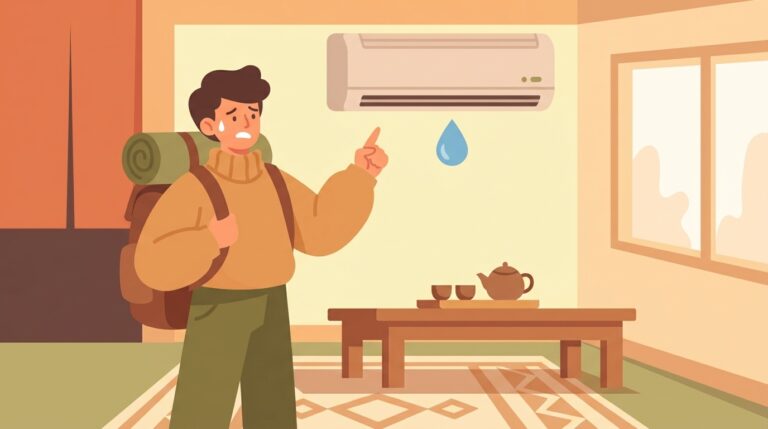
Phase 1: Empathy & K-Culture Cold Open
Hello! I’m your Daily Hangul Editor.
Imagine this classic K-Drama scene: The main character just moved into a charming rooftop room (옥탑방). It’s the middle of winter, freezing cold, and suddenly… the floor heating stops working. They are wrapped in three blankets, shivering, and have to call the handsome/beautiful landlord for help.
Or maybe, this is your actual reality. You just arrived at your lovely Airbnb in Hongdae during the sweltering Korean summer, and the air conditioner is just blowing warm air. The remote control has twenty buttons, all in Korean, and you have no idea what is going on. Panic sets in.
Don’t worry! Knowing how to say “It’s broken” is an absolute lifesaver. This guide is built from the real, panicked midnight messages of my foreign students. By the end of this post, you’ll know exactly how to get help like a local, without stressing out!
Phase 2: Core Expressions Deep Dive
Let’s look at the absolute must-know phrases for when things go wrong.
1. 고장 났어요 (It’s broken)
- Pronunciation: go-jang na-sseo-yo (go sounds like ‘go’, jang sounds like the start of ‘Jungle’, na-sseo-yo sounds like ‘nah-so-yo’)
- Meaning: (Literal) A breakdown occurred vs. (Real nuance) It’s broken / It’s out of order.
- K-Culture Moment: You will see this written on out-of-order public toilets in subway stations or on broken vending machines. If you press a button and nothing happens, this is your go-to phrase.
- Editor’s Insight: This phrase is very direct. You are stating a clear fact that the machine has a mechanical failure.
- Situation Spectrum:
- Friends (Casual): ✅ (Say: 고장 났어 – gojang nasseo)
- Coworkers (Semi-formal): ✅
- Boss/Elders (Formal): ✅ (It’s polite enough for anyone!)
- 🤔 Think About It: In English, we say “It is broken” (an adjective describing the state). In Korean, we say “A breakdown occurred” (an action happened). What does this tell you about how Koreans view situations?
2. 안 돼요 (It’s not working / It doesn’t work)
- Pronunciation: an dwae-yo (an sounds like ‘Ahn’, dwae sounds like ‘dway’)
- Meaning: (Literal) It does not become vs. (Real nuance) It’s not working / I can’t do it.
- K-Culture Moment: Picture a Korean office worker aggressively clicking their mouse because the computer froze, sighing, and saying Ah, an dwaeyo!
- Editor’s Insight: This is actually used MORE often than 고장 났어요. Why? Because sometimes you don’t know if it’s completely broken, or if you just don’t know how to turn it on! It’s a safer, softer way to say “It’s not doing what it’s supposed to do.”
- Situation Spectrum:
- Friends (Casual): ✅
- Coworkers (Semi-formal): ✅
- Boss/Elders (Formal): ✅
- 🤔 Think About It: 안 돼요 is also used to say “No” or “You can’t do that” in Korea. It’s a magic phrase that means “things are not going according to plan.”
3. 이상해요 (It’s acting weird)
- Pronunciation: i-sang-hae-yo (ee-sang-hae-yo)
- Meaning: (Literal) It is strange vs. (Real nuance) It’s making a weird noise / It’s glitching.
- K-Culture Moment: When the washing machine makes a terrifying clunk-clunk noise, or the TV screen turns green. You’re not sure if it’s fully broken, but it’s definitely suspicious.
- Editor’s Insight: Use this when you need someone to come look at the appliance because you are scared to touch it!
- Situation Spectrum:
- Friends (Casual): ✅
- Coworkers (Semi-formal): ✅
- Boss/Elders (Formal): ✅
Phase 3: Textbook vs. Real Korean
Let’s see how real Koreans speak compared to your textbook.
Situation 1: The Air Conditioner won’t turn on
* 📖 Textbook Korean: 에어컨이 작동하지 않습니다. (The air conditioner does not operate.)
* 🗣️ Real Korean: 에어컨이 안 돼요. (The AC isn’t working.)
* 💡 Why the difference?: 작동하지 않습니다 sounds like you are a robot reading a user manual. 안 돼요 is what everyone says in daily life because it’s fast and easy.
Situation 2: Telling the hotel staff the TV is broken
* 📖 Textbook Korean: 텔레비전이 고장 났습니다. (The television has broken down.)
* 🗣️ Real Korean: TV가 고장 났어요. / 이거 이상해요. (The TV is broken. / This is weird.)
* 💡 Why the difference?: Koreans rarely say the full word 텔레비전 (television). We just say 티비 (TV). Pointing at the object and saying 이거 (this) is also much more natural if you don’t know the exact vocabulary!
Bottom Note: For A1 Beginners, simply pointing at the broken item and saying 이거 안 돼요 (This isn’t working) is your ultimate magic spell. No need to memorize complex appliance names yet!
Phase 4: Cultural Context — K-Culture Deep Dive
4-1. Non-Verbal Cues (The Art of Nunchi)
When telling a Korean host or staff that something is broken, do not look angry or aggressive. In Korea, maintaining social harmony (reading the room, or Nunchi) is important. Look slightly apologetic or confused, point to the appliance, and use a soft tone. They will immediately rush to help you.
4-2. The Famous Korean A/S (After Service) Culture
If you watch K-Dramas, you might notice that when something breaks, a repairman arrives almost instantly. In Korea, repair service is called A/S (에이에스, After Service). Thanks to the Korean 빨리빨리 (Ppal-li Ppal-li / Hurry, hurry) culture, if your Airbnb host calls for an A/S, the repair person might literally knock on your door in 30 minutes. It’s shockingly fast compared to many other countries!
Phase 5: Real-Life Roleplay Scenario
Setting: It’s a humid July evening in Seoul. You are staying at an Airbnb in Hongdae. You tried to turn on the AC, but it’s making a weird noise and no cool air is coming out. You call your friendly Airbnb host, Jihoon.
Characters:
* YOU: A traveler who just learned basic Korean but is sweating profusely.
* Jihoon (28): Your helpful Korean Airbnb host.
Dialogue:
Jihoon: 여보세요? 도움이 필요하신가요?
(yeoboseyo? doumi piryohasingayo?)
[Hello? Do you need help?]
YOU: 여보세요, 지훈 씨! 방이 너무 더워요.
(yeoboseyo, jihun ssi! bang-i neomu deowoyo.)
[Hello, Jihoon! The room is too hot.]
Jihoon: 헉, 에어컨 켰어요?
(heok, eeokeon kyeosseoyo?)
[Oh no, did you turn on the AC?]
YOU: 네, 그런데 소리가 나요.
(ne, geureonde soriga nayo.)
[Yes, but it’s making a noise.]
Jihoon: 시원한 바람이 안 나와요?
(siwonhan barami an nawayo?)
[Is cool air not coming out?]
🔀 Your Turn! How should you reply?
* A) 이거 작동하지 않습니다. (igeo jakdonghaji anseumnida.)
* B) 네, 에어컨이 안 돼요. (ne, eeokeoni an dwaeyo.)
* C) 네, 에어컨 나빠요! (ne, eeokeon nappayo!)✅ Best Choice: B — It’s the most natural, everyday way to say it’s not working.
⚠️ Choice A Analysis: Too robotic and formal.
⚠️ Choice C Analysis: This literally means “The AC is a bad person!” which sounds adorable but very funny to a native speaker.
Jihoon: 아, 죄송해요! 제가 지금 바로 갈게요.
(a, joesonghaeyo! jega jigeum baro galgeyo.)
[Ah, I’m sorry! I will go there right now.]
YOU: 네, 감사합니다.
(ne, gamsahamnida.)
[Yes, thank you.]
Phase 6: 10-Second Shadowing Drill
Let’s practice your pronunciation! Pay attention to the pauses (/) and the emotion tags.
🥺 저기요, / 에어컨이 / 고장 났어요.
(jeogiyo, / eeokeoni / gojang nasseoyo.)
Excuse me, the AC is broken. (Look a bit helpless!)
😥 이거 / 이상해요. / 안 돼요.
(igeo / isanghaeyo. / an dwaeyo.)
This is weird. It’s not working. (Point at the machine!)
Phase 7: K-Culture Mini Dictionary
Here are some essential keywords you need when dealing with broken appliances in Korea!
1. 에어컨
* Romanization: ae-eo-keon
* English: Air Conditioner
* Context: Koreans shorten “Air Conditioner” to “Air-con”. If you say the full English word, many locals won’t understand you!
2. 보일러 / 온돌
* Romanization: bo-il-leo / on-dol
* English: Boiler / Floor Heating
* Context: Korea uses traditional floor heating systems called Ondol, powered by a boiler. If the floor is freezing in winter, your “boiler” is broken!
3. 리모컨
* Romanization: ri-mo-keon
* English: Remote Control
* Context: Short for “Remote Controller”. In Korean Airbnbs, one remote often controls the TV, the AC, and the set-top box. It’s a common source of confusion for travelers.
4. 에이에스 (A/S)
* Romanization: ei-e-seu
* English: After Service (Customer repair service)
* Context: If your host says “A/S 부를게요” (I’ll call A/S), it means they are calling the repair center.
Phase 8: Traveler Survival Kit
If you are traveling in Korea, appliances in hotels or Airbnbs are bound to confuse you. Here is your survival card!
🆘 Survival Phrases for Accommodations
* 🇰🇷 이거 어떻게 켜요? (igeo eotteoke kyeyo?)
* 🗣️ English: How do I turn this on?
* 📍 Where to use: When you can’t figure out the Korean remote control.
- 🇰🇷 따뜻한 물이 안 나와요. (ttatteuthan muri an nawayo.)
- 🗣️ English: Warm water isn’t coming out.
- 📍 Where to use: When taking a shower and the water is freezing.
🇰🇷 와이파이가 안 돼요. (waipaiga an dwaeyo.)
- 🗣️ English: The Wi-Fi isn’t working.
- 📍 Where to use: The most important phrase for any modern traveler!
📌 Editor’s Travel Note
Sometimes appliances aren’t broken; you just need a plug adapter! Korea uses 220V with round pins (Type C or F). If you blow a fuse because of the wrong voltage, don’t panic—just find the host and say “고장 났어요!”
Phase 9: Critical Thinking — “One Step Deeper”
Media vs. Reality: The High-Tech Illusion
If you watch K-Dramas, every apartment seems to have a talking refrigerator, a giant smart TV, and an AI speaker that controls the curtains. While Korea is very high-tech, many travelers are surprised when they rent an older Villa (빌라) or a cheap Airbnb. You might find a bulky, yellowing 1990s air conditioner that sounds like a tractor, or a tiny washing machine in the bathroom that you have to fill with a hose!
🧠 Think Deeper:
Media creates an image of a flawless, futuristic Korea. But the real charm of traveling is often found in these slightly older, quirky, everyday homes. Learning to communicate when things aren’t perfect is the true bridge to experiencing real local life.💬 Your Turn: Have you ever been surprised by how different a country was from its movies or TV shows? Share your experience in the comments!
Phase 10: FAQ & Avoiding Misunderstandings
Q: Can I use “고장 났어요” to say I am sick or my body is hurting?
No! This is a very common and funny mistake. 고장 났어요 is ONLY for machines and objects. If you say “제 다리가 고장 났어요” (My leg is broken down), Koreans will laugh and think you are a cyborg. For body parts, use 아파요 (apayo – it hurts) or 다쳤어요 (dachyeosseoyo – I got hurt).
Q: Can I use “안 돼요” to a person?
Yes, but it means “No, you can’t” or “That’s not allowed.” If you point at a machine and say “안 돼요”, it means the machine isn’t working. If a stranger tries to cut in line and you say “안 돼요!”, it means “No! Don’t do that!”
❌ Common Mistake #1: Saying “에어컨 부러졌어요” (The AC is snapped/broken in half).
✅ Do this instead: 부러졌어요 is only for long, thin things like pencils or bones. For appliances, always stick to 고장 났어요.
Phase 11: Summary & Action Items
One-Liner Summary: When a machine ruins your day in Korea, just point at it and say “이거 안 돼요!” (igeo an dwaeyo!)
Action Mission:
* 🥉 Bronze (Solo): Look at 3 appliances in your room right now and say “이거 고장 났어요!” out loud.
* 🥈 Silver (Online): Go to a Korean language forum or comment below: What is an appliance that recently broke in your house? (In English or Korean!)
* 🥇 Gold (Real Life): Next time you stay in a Korean accommodation, if something isn’t working, text the host “안 돼요” instead of using a translator app!
K-Culture Mission:
Next time you watch a K-Drama, look closely at the background. Spot the wall-mounted remote controller (usually near the light switch) that controls the floor heating (Ondol). That little box is the heart of a Korean home!
Phase 12: Quiz — Interactive Challenge
Test your survival skills!
1. Situational Judgment: You are at a self-checkout kiosk in a Korean convenience store. The barcode scanner won’t scan your banana milk. What should you say to the clerk?
* A) 제가 고장 났어요. (I am broken down.)
* B) 이거 안 돼요. (This isn’t working.)
* C) 바나나 우유 나빠요. (Banana milk is bad.)
2. True or False – K-Culture Edition:
In Korea, it usually takes weeks for a repair person to come fix a broken washing machine. (T / F)
3. Fill in the Blank:
Oh no! The hotel room is freezing. I need to tell the front desk that the _____ is broken.
(Hint: Traditional Korean floor heating system)
(Answers: 1. B / 2. False – Korean A/S is super fast due to Ppal-li Ppal-li culture! / 3. 온돌 Ondol or 보일러 Boiler)
Did you survive the broken AC? Leave a comment below if you have any questions about Korean appliances or travel!
Frequently Asked Questions (FAQ)
Q: What does "고장 났어요 (It's broken)" mean in Korean and how do you pronounce it?
A: In Korean, "고장 났어요 (It's broken)" is pronounced [go-jang na-sseo-yo (go sounds like 'go', jang sounds like the start of 'Jungle', na-sseo-yo sounds like 'nah-so-yo'] and means: (Literal) A breakdown occurred vs. (Real nuance) It's broken / It's out of order.
Q: What does "안 돼요 (It's not working / It doesn't work)" mean in Korean and how do you pronounce it?
A: In Korean, "안 돼요 (It's not working / It doesn't work)" is pronounced [an dwae-yo (an sounds like 'Ahn', dwae sounds like 'dway'] and means: (Literal) It does not become vs. (Real nuance) It's not working / I can't do it.
Q: What does "이상해요 (It's acting weird)" mean in Korean and how do you pronounce it?
A: In Korean, "이상해요 (It's acting weird)" is pronounced [i-sang-hae-yo (ee-sang-hae-yo] and means: (Literal) It is strange vs. (Real nuance) It's making a weird noise / It's glitching.







