

Phase 1: Empathy & Immersion (The K-Culture Cold Open)
Hello! I’m your Daily Hangul editor, your veteran tutor and local Korean friend.
Imagine this: You just survived hiking down Bukhansan (Bukhan Mountain). Your legs are shaking like jelly. But instead of going straight home to rest, your Korean friends drag you to a noisy, colorful tent restaurant at the base of the mountain.
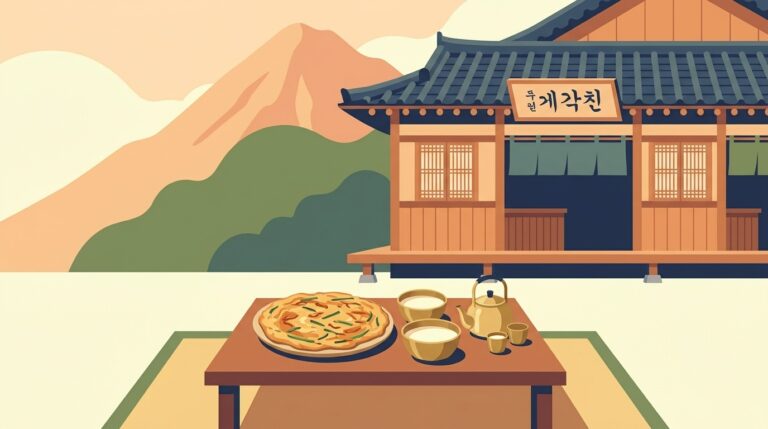
The air smells like savory fried batter. The tables are filled with people in bright outdoor gear, laughing loudly. Someone orders a giant scallion pancake and a rustic white bottle. They shake the bottle, pour a milky drink into a golden brass bowl, and hand it to you with two hands.
What do you do now? How do you cheer? If you just say Thank you in English, it’s fine, but if you drop the perfect Korean phrase here… you instantly become the hero of the table. You will be treated not just as a visitor, but as an absolute Insider (Inssa)!
This guide is based on real questions from my students who successfully survived their first Korean hiking after-party. Let’s dive in!
Phase 2: Core Expressions Deep Dive
1. 수고하셨습니다
- Pronunciation: Sugohasyeotseumnida [Soo-go-ha-syeot-seum-ni-da]
- Sound-alike guide: Imagine saying Soo-go (like ‘Sue goes’) + ha-shot + sum-ni-da.
- Meaning: (Literal) You put in a lot of effort / (Real nuance) Great job today, thanks for your hard work.
- K-Culture Moment: You will hear this everywhere in Korea! At the end of a long workday, when filming wraps up on a K-Drama set, or right after reaching the bottom of the mountain. It’s the ultimate phrase to acknowledge shared struggle.
- Editor’s Insight: This isn’t just Good job. It carries a deep sense of camaraderie. You are saying, I saw you sweat, and I appreciate your effort. Say it with a warm smile and a slight bow.
- Situation Spectrum:
- Casual (Close friends): 수고했어! (Sugohaesseo!) ✅
- Semi-formal (Co-workers): 수고하셨습니다! ✅
- Formal (Boss/Elders): 수고하셨습니다! ✅
- 고 Think About It: Why does Korean have a specific phrase to acknowledge someone’s hard work before even saying goodbye? Does your culture have a similar way to wrap up a shared task?
2. 파전 하나, 막걸리 한 병 주세요
- Pronunciation: Pajeon hana, makgeolli han byeong juseyo
- Sound-alike guide: Pa-jeon (like John) ha-na, mak-gull-lee han byung ju-se-yo.
- Meaning: (Literal) Pajeon one, Makgeolli one bottle give me. / (Real nuance) I’d like one scallion pancake and a bottle of Makgeolli, please.
- K-Culture Moment: The holy trinity of rainy days in Korea or after a hike is Pajeon (Scallion pancake) and Makgeolli (Rice wine). If you go to a traditional Korean tavern, ordering this combo proves you know your K-Food.
- Editor’s Insight: Notice how we put the item first, then the number? It’s like saying Pancake, one. Rice wine, one bottle. It is much easier to order this way in a loud restaurant!
- Situation Spectrum:
- You can use this formal ~주세요 (juseyo) polite form to any restaurant staff. ✅
- 고 Think About It: Koreans love pairing specific foods with specific weather or activities (like chicken and beer for sports). What is your country’s go-to comfort food after a long hike?
3. 짠!
- Pronunciation: Jjan!
- Sound-alike guide: Say Jan but make the J very tight and tense.
- Meaning: (Literal) Sound of glasses clinking / (Real nuance) Cheers!
- K-Culture Moment: In K-Dramas, whenever characters clink their green Soju bottles or Makgeolli bowls, they always say Jjan! It’s cute, universally understood, and instantly brings up the mood.
- Editor’s Insight: Forget the long, formal 건배 (Geonbae). If you’re drinking with friends or friendly colleagues, a bright Jjan! is all you need. Make sure your bowl actually touches the others!
- Situation Spectrum:
- Casual (Close friends): ✅
- Semi-formal (Co-workers): ⚠️ (Usually okay, but follow their lead)
- Formal (Strict Boss/Elders): 🚫 (Use 건배 Geonbae instead)
- 고 Think About It: Sound words (onomatopoeia) are incredibly common in everyday Korean. Can you think of the sound glasses make in your native language?
Phase 3: Textbook vs. Real Korean
Ordering at a busy restaurant
* 📖 Textbook Korean: 우리는 파전과 막걸리를 먹고 싶습니다. (We want to eat Pajeon and Makgeolli.)
* 🗣️ Real Korean: 사장님~ 여기 파전 하나, 막걸리 하나요! (Boss~ One Pajeon and one Makgeolli here!)
* 💡 Why is it different?: In a bustling Korean restaurant, speed is everything. Calling out 사장님 (Sajangnim – Boss/Owner) grabs attention, and dropping the verbs makes the order fast and efficient.
Toasting your drinks
* 📖 Textbook Korean: 우리의 건강을 위하여 건배합시다. (Let us toast for our health.)
* 🗣️ Real Korean: 짠~! 수고하셨습니다! (Jjan~! Great job today!)
* 💡 Why is it different?: Real drinking culture is about the vibe. A simple Jjan creates instant intimacy compared to a stiff, formal toast.
Phase 4: Cultural Context — K-Culture Deep Dive
4-1. The Non-verbal Art of Makgeolli
Language is only half the battle. In Korea, how you pour a drink is a true test of 눈치 (Nunchi), the art of reading the room.
Makgeolli has sediment that settles at the bottom. Before opening, you must gently shake it or turn it upside down a few times. When pouring for someone older or a colleague, hold the bottle with your right hand, and lightly support your right arm with your left hand. It’s a sign of deep respect.
4-2. The K-Food Connection: Why Pancake and Rice Wine?
If you watch K-Dramas, you’ll notice characters rushing to a Makgeolli spot the moment it starts raining. Why? The sound of rain hitting the window sounds exactly like the sizzling sound of Pajeon frying in a pan!
Also, after a tough hike, your body craves quick carbs and energy. Makgeolli is naturally sweet, slightly carbonated, and very filling. Paired with a savory pancake, it’s the ultimate recovery meal. Sharing a massive Pajeon from the same plate also reinforces the Korean concept of 정 (Jeong) – emotional connection and community.
Phase 5: Real-life Roleplay Scenario
Setting: Friday afternoon, 3 PM. You and your Korean coworkers just finished a brutal 4-hour hike up Bukhansan. You are sitting at an outdoor table under a colorful umbrella. Your coworker Min-su shakes a bottle of Makgeolli.
Characters:
– YOU: An expat in Korea, trying to bond with your team.
– Min-su (32): Your friendly coworker who organized this hike.
Dialogue:
Min-su: 아, 진짜 힘들다! (A, jinjja himdeulda!)
[English] Ah, that was really hard!
YOU: 맞아요. 다리가 너무 아파요. (Majayo. Dariga neomu apayo.)
[English] Right. My legs hurt so much.
Min-su: 그래도 공기는 좋죠? (Geuraedo gong-gineun jotjyo?)
[English] But the air is nice, right?
YOU: 네, 너무 좋아요! (Ne, neomu joayo!)
[English] Yes, it’s so good!
Min-su: 이모님! 여기 해물파전 하나, 막걸리 하나 주세요!
(Imonim! Yeogi haemulpajeon hana, makgeolli hana juseyo!)
[English] Auntie! One seafood pajeon and one makgeolli here, please!
(Stage Direction: Min-su opens the Makgeolli and pours it into your golden bowl. You hold the bowl with two hands.)
Min-su: 자, 오늘 수고하셨습니다!
(Ja, oneul sugohasyeotseumnida!)
[English] Here, great job today!
YOU: 민수 씨도 수고하셨습니다! 짠!
(Minsu ssido sugohasyeotseumnida! Jjan!)
[English] Great job to you too, Min-su! Cheers!
(Stage Direction: You both take a drink. A few minutes later, you notice Min-su’s bowl is totally empty.)
🔀 Your Turn! How do you react?
– A) Do nothing. He will pour his own drink when he is thirsty.
– B) Grab the bottle with two hands and say, 제가 드릴게요! (Jega deurilgeyo! – Let me pour for you!)
– C) Shout 이모님! (Imonim!) to order water.
✅ Best Choice: B — Reason: In Korea, you never let your friend’s glass stay empty! Pouring for each other is a major bonding activity.
⚠️ Choice A Analysis: In many Western cultures, pouring your own drink is normal. In Korea, pouring your own drink is called 자작 (Jajak) and can make you look lonely or make your friends feel guilty for not taking care of you!
Phase 6: 10-Second Shadowing Drill
Practice these lines out loud. Pay attention to the pauses (/) and the emotions!
😊 Brightly & Energetically:
사장님! / 여기 파전 하나 / 막걸리 하나 / 주세요!
(Sajangnim! / yeogi pajeon hana / makgeolli hana / juseyo!)
🥹 With sincere appreciation:
오늘 / 정말 / 수고하셨습니다!
(Oneul / jeongmal / sugohasyeotseumnida!)
Phase 7: K-Culture Mini Dictionary
1. 눈치
* Romanization: Nunchi
* English: Social sense / Reading the room
* Context: The essential Korean survival skill. Knowing when to pour a drink, when to laugh, and when to order more food without being told.
2. 안주
* Romanization: Anju
* English: Food eaten with alcohol
* Context: Koreans rarely drink alcohol without food. Pajeon is the ultimate Anju for Makgeolli.
3. 이모님 / 사장님
* Romanization: Imonim / Sajangnim
* English: Auntie / Boss
* Context: How you politely get a server’s attention. Use Imonim for older female staff, and Sajangnim for any owner/staff.
4. 등산복
* Romanization: Deungsanbok
* English: Hiking clothes
* Context: Korean middle-aged folks wear incredibly colorful, high-tech hiking gear even for a small hill. It is practically a fashion runway on the mountain!
Phase 8: Traveler Survival Kit
Here are the top phrases you absolutely need when drinking and dining after a hike or anywhere in Seoul.
🆘 Survival Phrase #1: Ordering
– 🇰🇷 저기요! 주문할게요. (Jeogiyo! Jumanhalgeyo.)
– 🗣️ Pronunciation: Juh-gi-yo! Joo-moon-hal-gae-yo.
– 📍 Where to use: Any restaurant to get the waiter’s attention.
– 💡 Pro Tip: Don’t be shy! You have to speak up loudly, or push the call button on the table (Ding-dong!).
🆘 Survival Phrase #2: Getting more side dishes
– 🇰🇷 반찬 좀 더 주세요. (Banchan jom deo juseyo.)
– 🗣️ Pronunciation: Ban-chan jom duh joo-se-yo.
– 📍 Where to use: When you run out of Kimchi or pickled onions.
– 💡 Pro Tip: Side dishes (Banchan) are always free to refill in Korea! Eat as much as you want.
🆘 Survival Phrase #3: Paying
– 🇰🇷 계산할게요. (Gyesanhalgeyo.)
– 🗣️ Pronunciation: Gye-san-hal-gae-yo.
– 📍 Where to use: At the front counter on your way out.
– 💡 Pro Tip: You don’t leave money on the table. Bring your bill to the front door to pay.
📌 Editor’s Travel Note
– Splitting the bill: Older Koreans usually fight to pay the whole bill (it’s a sign of affection). However, younger generations use Dutch Pay (더치페이) or transfer money to one person using apps like KakaoPay.
– Tipping: DO NOT tip! Tipping does not exist in Korea. If you leave money on the table, the staff might run down the street to return it to you!
Phase 9: Critical Thinking — One Step Deeper
🧠 Think Deeper: Food & Identity (음식과 정체성)
Why do Koreans eat one giant Pajeon together instead of ordering individual smaller pancakes? In Korean culture, eating from the same large plate or sharing a big pot of stew is a profound symbol of unity. It breaks down personal boundaries. The word for family in Korean is 식구 (Sikgu), which literally translates to mouths that eat together. Sharing food and pouring drinks for one another isn’t just about eating; it’s a social ritual that turns strangers into friends, and coworkers into a true team.
💬 Your Turn: Does your culture prefer individual plates or family-style sharing? How do you build relationships through food? Share your thoughts in the comments!
Phase 10: FAQ & Avoiding Misunderstandings
Q: Can I pour my own Makgeolli if I am thirsty?
Normally, it is better to wait. If you pour your own drink (Jajak), it traditionally implies your companions don’t care about you. If you are thirsty, pour a drink for the person next to you first! They will immediately realize your glass is empty and pour for you in return. It’s a beautiful game of Nunchi.
Q: Is it rude to drink with one hand?
If you are with close friends, one hand is totally fine! But if you are drinking with your boss, older in-laws, or a senior colleague, you should hold the cup with your right hand and place your left hand gently under your right wrist or on your chest.
❌ Common Mistake #1: Saying Jjan! to a company director or elder.
✅ Do this instead: Say 건배 (Geonbae) or simply say 감사합니다 (Thank you) and bow your head slightly before taking a sip.
Phase 11: Summary & Action Items
One-Liner Summary: Surviving a Korean hike means celebrating at the bottom with Pajeon, Makgeolli, a cheerful Jjan!, and the warm appreciation of Sugohasyeotseumnida.
Action Mission 3 Steps:
– 🥉 Bronze (Solo): Stand in front of your mirror, pretend to hold a heavy brass bowl, and happily shout, Jjan! Sugohasyeotseumnida! 3 times.
– 🥈 Silver (Online): Drop a comment below using Pajeon, Makgeolli, and Jjan in an English sentence.
– 🥇 Gold (Real Life): Next time you visit a Korean restaurant, use 저기요! (Jeogiyo!) to call the server and order your food with ~주세요 (~juseyo)!
🇰🇷 K-Culture Mission:
Open Google Maps or Naver Map. Zoom into the area around Bukhansan National Park in Seoul. Look for photos of restaurants near the entrance. Can you spot the Pajeon and Makgeolli bowls in the reviews? Imagine yourself sitting there ordering!
Phase 12: Quiz — Interactive Challenge
1. Situational Judgment:
You just finished a huge group project at your Korean company. Everyone is exhausted but happy. What is the BEST phrase to say to your team?
– A) 안녕히 계세요 (Annyeonghi gyeseyo – Goodbye)
– B) 수고하셨습니다 (Sugohasyeotseumnida – Great job / Thanks for your hard work)
– C) 미안합니다 (Mianhamnida – I am sorry)
2. True or False – K-Culture Edition:
In a Korean restaurant, you must wait for the waiter to bring the bill to your table, and then you leave a 15% tip. (T/F)
3. Fill in the blank:
To order one Pajeon, you say: 파전 ______ 주세요! (Pajeon [ ONE ] juseyo!)
(Answers below!)
(Answers: 1. B – It is the perfect phrase for shared effort. 2. False – You take the bill to the front counter to pay, and there is NO tipping! 3. 하나 (hana))
Frequently Asked Questions (FAQ)
Q: What does "수고하셨습니다" mean in Korean and how do you pronounce it?
A: In Korean, "수고하셨습니다" is pronounced [Sugohasyeotseumnida [Soo-go-ha-syeot-seum-ni-da] and means: (Literal) You put in a lot of effort / (Real nuance) Great job today, thanks for your hard work.
Q: What does "파전 하나, 막걸리 한 병 주세요" mean in Korean and how do you pronounce it?
A: In Korean, "파전 하나, 막걸리 한 병 주세요" is pronounced [Pajeon hana, makgeolli han byeong juseyo] and means: (Literal) Pajeon one, Makgeolli one bottle give me. / (Real nuance) I'd like one scallion pancake and a bottle of Makgeolli, please.
Q: What does "짠!" mean in Korean and how do you pronounce it?
A: In Korean, "짠!" is pronounced [Jjan!] and means: (Literal) Sound of glasses clinking / (Real nuance) Cheers!







