

Phase 1: Empathy (Immersive Opening)
Hello! This is your Daily Hangul Editor.
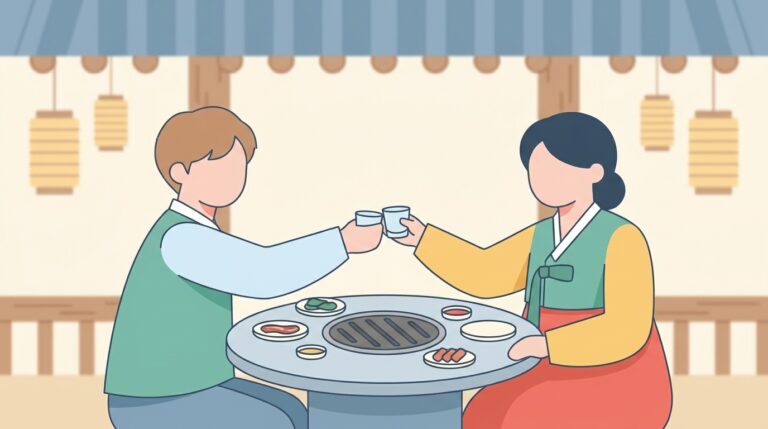
Picture this: You are watching your favorite K-Drama. The main characters are sitting at a green-tented street food stall (Pojangmacha) or a bustling Korean BBQ restaurant. Someone pours a shot of Soju, the other person receives it with two hands, and suddenly, everyone raises their glasses. It looks so natural on screen. But fast forward to your actual trip to Seoul. You are sitting at a table with your new Korean friends or colleagues. The meat is sizzling, the side dishes are endless, and you reach out to pour your own drink because you are thirsty. Suddenly, the table goes quiet. Did you do something wrong?
If you have ever felt confused about when to pick up your chopsticks, who should start eating first, or why the waiter gave you scissors for your noodles, you are not alone! Korean dining etiquette is heavily influenced by history, hierarchy, and a deep-rooted sense of community. Mastering these unspoken rules will not only prevent awkward moments but will instantly elevate you to an ‘insider’ status among your Korean friends.
This guide is packed with real questions and experiences from learners just like you. Let us dive into the delicious and dynamic world of Korean dining etiquette!
Phase 2: Core Expressions Deep Dive
1. 잘 먹겠습니다
- Pronunciation: [Jal meok-get-seum-ni-da] (The ‘meok’ sounds a bit like ‘muck’, but shorter!)
- Meaning: Literal: I will eat well. / Real nuance: Thank you for this food, I appreciate it, and I am ready to dig in!
- K-Culture Moment: Think of any K-Variety show where the cast finally gets to eat after playing grueling games. Before taking that epic first bite, they clap their hands together and loudly declare, “Jal meokgesseumnida!”
- Editor’s Insight: This is not just a phrase; it is an announcement. It shows your gratitude to whoever cooked or bought the food. Saying this cheerfully instantly makes you look polite and cultured.
- Situation Spectrum:
- Casual (Friends): ✅ (You can just say “Jal meogeulge!”)
- Semi-formal (Coworkers): ✅
- Formal (Boss/Elders): ✅
- 🤔 Think About It: Why does Korean have a specific phrase to announce that you are about to eat? How does this reflect the Korean cultural value of acknowledging others’ efforts before enjoying yourself? Do you have a similar phrase in your native language like ‘Bon appétit’?
2. 먼저 드세요
- Pronunciation: [Meon-jeo deu-se-yo] (‘Meon’ rhymes with ‘fun’, and ‘deu’ sounds like the disgust sound ‘ugh’ but with a ‘d’)
- Meaning: Literal: Please eat first. / Real nuance: I respect you, so I will wait for you to take the first bite.
- K-Culture Moment: In a family dinner scene in a drama, the children will not touch their spoons until the grandfather lifts his. If someone younger reaches for the food first, they might get a light scolding!
- Editor’s Insight: In Korea, age and status dictate the flow of the meal. Offering the first bite to the oldest or most senior person is the golden rule of Korean dining.
- Situation Spectrum:
- Casual (Friends): ✅ (Usually “Meonjeo meogeo!”)
- Semi-formal (Coworkers): ✅
- Formal (Boss/Elders): ✅
- 🤔 Think About It: How does waiting for the eldest to eat first reinforce social hierarchy in everyday life? Does your culture have an age-based dining rule?
3. 짠
- Pronunciation: [Jjan] (Make the ‘jj’ sound sharp, like the ‘zz’ in ‘pizza’, and say it with energy!)
- Meaning: Literal: Clink! (Onomatopoeia) / Real nuance: Cheers!
- K-Culture Moment: The camera zooms in on three Soju glasses clinking together while the characters shout “Jjan!” to celebrate a promotion or comfort a heartbroken friend.
- Editor’s Insight: While “Geonbae” (건배) is the formal word for “Cheers,” “Jjan” is what Koreans actually use 90% of the time in casual settings. It is fun, short, and brings energy to the table.
- Situation Spectrum:
- Casual (Friends): ✅
- Semi-formal (Coworkers): ⚠️ (Use ‘Geonbae’ or ‘Wihayeo’ for large company dinners)
- Formal (Boss/Elders): 🚫 (Too playful for serious elders)
- 🤔 Think About It: Why do Koreans clink glasses so often during a meal? It is not just about drinking; it is a tool for building ‘Jeong’ (emotional bond) and keeping the group unified.
Phase 3: Textbook vs. Real Korean
[Giving Thanks After a Meal]
* 📖 Textbook Korean: 식사 감사합니다. (Thank you for the meal.)
* 🗣️ Real Korean: 잘 먹었습니다! (I ate well!) or 진짜 맛있었어요! (It was really delicious!)
* 💡 Why the difference?: “Jal meogeotseumnida” is the perfect paired ending to “Jal meokgesseumnida.” It focuses on your satisfying experience rather than a transactional “thank you.”
[Asking for a Drink Refill]
* 📖 Textbook Korean: 제 잔에 술을 따라 주시겠습니까? (Would you pour alcohol into my glass?)
* 🗣️ Real Korean: (Just holding your glass up slightly with two hands when someone has the bottle)
* 💡 Why the difference?: In Korean drinking etiquette, you rarely ask for a drink verbally. It relies heavily on “Nunchi” (reading the room). Friends constantly monitor each other’s glasses and refill them silently.
[Ordering Food at a Restaurant]
* 📖 Textbook Korean: 저기요, 주문하시겠어요? (Excuse me, I would like to order.)
* 🗣️ Real Korean: 사장님~! (Boss!) or 이모님~! (Auntie!) followed by the order.
* 💡 Why the difference?: Calling staff by familial titles like “Imo-nim” (Auntie) creates an instant bond of ‘Jeong’, making the atmosphere warmer than a stiff, formal request.
Phase 4: Cultural Context — K-Culture Deep Dive
4-1. The Unspoken Rules (Non-verbal Etiquette)
Language is only half the battle! When you are dining in Korea, your body language speaks volumes.
– The Two-Handed Rule: Whether you are pouring a drink, receiving a glass, or accepting a side dish from an elder, ALWAYS use two hands. (Or place your left hand on your chest/elbow while your right hand does the action).
– The Turn-Away Chug: Drinking with your boss or someone much older? It is considered rude to maintain eye contact while drinking alcohol. You should turn your head slightly to the side to hide your glass as you drink.
– Keep the Bowl Grounded: Unlike in Western cultures where you might bring a plate to your chin, or in Japan where lifting the rice bowl is polite, Koreans keep their bowls firmly on the table and bring their spoon to their mouth.
4-2. The Hoesik (Company Dinner) Culture in K-Dramas
If you watch K-Dramas like ‘Misaeng’ or ‘Business Proposal’, you will notice that the team dinner, or 회식 (Hoesik), is practically a battlefield of etiquette. The youngest employee usually takes the tongs to grill the meat. Why? It is an act of service for the seniors.
Editor’s Critical View: Dramas often exaggerate the stress of pouring drinks and grilling meat for comedic effect. In modern Korea, many young companies are ditching these strict hierarchical rules. Still, knowing them shows deep respect for the culture!
Phase 5: Real-World Roleplay Scenario
Setting: It is Friday night, 7:00 PM. A lively K-BBQ restaurant near Gangnam Station. The air is thick with the smell of roasted pork belly, and green Soju bottles line the tables. You are out with your Korean colleagues.
Characters:
– YOU: A foreigner working in Seoul. You want to make a good impression.
– Minsu (32): Your friendly Korean coworker who is managing the grill.
– Manager Kim (45): Your boss, sitting across from you.
Dialogue:
Minsu: 자, 고기 다 익었습니다! 먼저 드시죠, 부장님.
(Ja, gogi da igeotseumnida! Meonjeo deusijo, bujangnim.)
[Translation: Alright, the meat is fully cooked! Please eat first, Manager.]
(Stage Direction: Minsu places a perfect piece of meat on Manager Kim’s plate.)
Manager Kim: 오케이, 수고했어. (Looking at you) 외국에서 왔는데, 삼겹살 입에 맞아요?
(Okei, sugohaesseo. Oegugeseo watneunde, samgyeopsal ibe majayo?)
[Translation: Okay, good job. You came from abroad, does the pork belly suit your taste?]
YOU: 네! 진짜 맛있어요! (Smiles)
(Ne! Jinjja masisseoyo!)
[Translation: Yes! It is really delicious!]
Minsu: 다행이네요! 자, 소주도 한잔 할까요?
(Dahaeng-ineyo! Ja, sojudo hanjan halkkayo?)
[Translation: What a relief! Well, shall we have a glass of Soju?]
(Stage Direction: Minsu grabs the Soju bottle and pours a glass for Manager Kim using two hands.)
Manager Kim: 그래, 짠 하자!
(Geurae, jjan haja!)
[Translation: Sure, let’s say cheers!]
Minsu: (Pours a glass for you) 받으세요!
(Badeuseyo!)
[Translation: Please receive this!]
(Stage Direction: You hold your glass with two hands.)
YOU: 감사합니다!
(Gamsahamnida!)
[Translation: Thank you!]
Manager Kim: 자, 우리 팀의 성공을 위하여! 건배!
(Ja, uri timui seonggong-eul wihayeo! Geonbae!)
[Translation: Now, to our team’s success! Cheers!]
YOU & Minsu: 건배!
(Geonbae!)
[Translation: Cheers!]
Manager Kim: (Drinks his shot, then places his empty glass down) 아, 좋다.
(Ah, jota.)
[Translation: Ah, that’s good.]
🔀 YOUR TURN! Minsu is busy grilling, and Manager Kim’s glass is empty. What should you do?
- A) Ignore it. He will pour it himself when he is thirsty.
- B) Pick up the bottle with two hands and say “부장님, 한 잔 더 받으세요!” (Manager, please receive another glass!)
- C) Pick up the bottle with one hand and casually pour it while saying “짠!” (Cheers!)
✅ Best Choice: B — In Korea, you never let a senior’s glass sit empty. Pouring for them with two hands shows great “Nunchi” (social awareness) and respect!
⚠️ Choice A Analysis: In Western cultures, pouring your own drink is totally normal. In Korea, letting an elder pour their own drink is considered a slight faux pas.
🚫 Choice C Analysis: Pouring with one hand to a boss is a big no-no, and “Jjan” is too casual for this moment.
Phase 6: 10-Second Shadowing Drill
Let us practice ordering like a true local. Pay attention to the pauses (/) and the emotional tags!
😊 이모님! / 여기 / 삼겹살 2인분 / 더 주세요!
(Imonim! / yeogi / samgyeopsal i-inbun / deo juseyo!)
[Auntie! Over here, 2 more portions of pork belly, please!]
🥺 사장님, / 앞접시 / 하나만 / 주시겠어요?
(Sajangnim, / apjeopsi / hanaman / jusigesseoyo?)
[Boss, could I please get one small plate to share?]
😤 (Confidently to friends) 오늘은 / 내가 / 쏠게!
(Oneureun / naega / ssolge!)
[Today, it is my treat! / I am paying today!]
Phase 7: K-Culture Mini Dictionary
1. 눈치
* Romanization: nunchi
* English: Social situational awareness / Reading the room
* Context: The Korean superpower. It is the ability to gauge the mood, know when to pour a drink, or know when to stop talking. Good nunchi makes life in Korea much easier.
2. 회식
* Romanization: hoesik
* English: Company dinner / Team dining
* Context: More than just eating, it is considered an extension of work where team bonding happens. Etiquette is highly observed here.
3. 반찬
* Romanization: banchan
* English: Side dishes
* Context: The small plates of food served with Korean meals (like kimchi, bean sprouts). The best part? They are usually free to refill!
4. 쌈
* Romanization: ssam
* English: Wrapped food (usually meat wrapped in lettuce or perilla leaves)
* Context: You put meat, garlic, and paste in a leaf, wrap it up, and eat it in ONE bite. Biting a Ssam in half is considered bad form!
Phase 8: Traveler Survival Kit
Dining out in Korea? Here are the top survival phrases and tips you absolutely need.
🆘 Survival Expression #1: Asking for Refills
– 🇰🇷 “이모님, 여기 반찬 좀 더 주세요!” (Imonim, yeogi banchan jom deo juseyo!)
– 🗣️ English Pronunciation: Ee-mo-nim, yuh-gee ban-chan jom duh joo-seh-yo!
– 📍 Where to use: Any traditional Korean restaurant with side dishes.
– 💡 Pro Tip: Do not be shy! Refills are expected, but try to only ask for what you will actually finish to avoid food waste.🆘 Survival Expression #2: Asking for Scissors
– 🇰🇷 “가위 좀 주시겠어요?” (Gawi jom jusigesseoyo?)
– 🗣️ English Pronunciation: Gah-wee jom joo-she-geh-suh-yo?
– 📍 Where to use: Naengmyeon (Cold noodle) shops, or if meat chunks are too big.
– 💡 Pro Tip: Scissors are essential Korean dining tools. Do not be shocked when they cut your noodles or pizza with them!🆘 Survival Expression #3: Asking for the Bill
– 🇰🇷 “계산이요!” (Gyesaniyo!)
– 🗣️ English Pronunciation: Gyeh-san-ee-yo!
– 📍 Where to use: At the counter when leaving.
– 💡 Pro Tip: In most Korean restaurants, you do not wait for the check at the table. You bring your table number or bill pad to the front counter to pay.📌 Editor’s Travel Note
– The Call Button: Look at your table. See a small plastic button? Press it! “Ding-dong!” That is how you call the waiter. Do not wave your hands awkwardly.
– Tipping Culture: DO NOT TIP. Korea is a no-tip culture. Leaving money on the table will just cause the waiter to chase you down the street to return your “forgotten” cash.
Phase 9: Critical Thinking Corner — “One Step Deeper”
Food & Identity: The Culture of ‘Jeong’ (정)
🧠 Think Deeper:
In Western dining, individuality is key. You order your own plate, eat your own food, and split the bill exactly by what you ate. However, traditional Korean dining revolves around communal sharing. A massive pot of stew (Jjigae) sits in the middle, and everyone dips their spoons in. One person pays the bill for the whole table today, and someone else pays next time. This isn’t just about food; it represents 정 (Jeong)—a deep, collective bond, warmth, and attachment. Eating together physically breaks down boundaries. While modern times have introduced individual ladles for hygiene, the spirit of sharing remains the core of Korean identity.💬 Your Turn: How is sharing food viewed in your culture? Are people protective of their plates, or is family-style dining the norm? Share in the comments!
Phase 10: FAQ & Avoiding Misunderstandings
Q: “Is it rude to lift my rice bowl off the table?”
Yes! In places like Japan or China, lifting your bowl to eat is proper. But in Korea, lifting the bowl is historically associated with beggars. Keep your bowl flat on the table and use your spoon to bring the rice to your mouth.
Q: “Can I blow my nose at the dining table?”
Definitely no. Eating spicy Kimchi stew will make your nose run, but blowing your nose loudly at the table is considered highly unappetizing and rude. Simply wipe your nose softly with a tissue, or excuse yourself to the restroom for a proper blow.
❌ Common Mistake #1: Pouring your own drink.
✅ How to fix it: If you are thirsty, pour a drink for the person next to you. They will get the hint (using their Nunchi!) and immediately pour yours in return.❌ Common Mistake #2: Sticking your chopsticks vertically into your rice bowl.
✅ How to fix it: NEVER do this. Chopsticks standing upright in rice look exactly like incense sticks burned at funerals for the dead. Always lay your chopsticks flat on the chopstick rest or beside your bowl.
Phase 11: Summary & Action Items
One-Liner Summary: Korean dining is all about communal respect: wait for elders to eat first, use two hands for drinks, and loudly appreciate the meal!
Your Action Missions:
– 🥉 Bronze (Solo): Say “Jal meokgesseumnida” out loud before your next meal today, even if you are eating a sandwich alone.
– 🥈 Silver (Online): Find a scene in a K-Drama where people are dining together. Try to spot who pours the drinks and who eats first!
– 🥇 Gold (Real World): Visit a local Korean restaurant, use the word “Imonim” or “Sajangnim” to call the waiter, and ask for a side dish refill in Korean.
K-Culture Mission:
The next time you watch a K-Pop idol’s live stream (like Weverse) where they are doing a “Mukbang” (eating show), listen closely. I guarantee the first thing they will say to the camera is “Jal meokgesseumnida!”
Did any of these rules surprise you? Let us know in the comments which dining rule is the most different from your home country!
Phase 12: Interactive Quiz
Test your new Nunchi skills!
1. Situational Judgment:
You are at a K-BBQ place with your older Korean manager. He holds out his Soju glass for you to pour. What is the BEST way to pour it?
A) With your right hand while checking your phone with your left.
B) With your right hand, while your left hand lightly supports your right arm/elbow.
C) With both hands gripping the neck of the bottle very tightly.
Answer: B. Supporting your right arm with your left hand is the classic, polite “two-handed” gesture in Korea!
2. True or False — K-Culture Edition:
Statement: “When you finish an amazing meal at a Korean restaurant, leaving a 15% tip will make the staff very happy.”
Answer: False (F). Korea does not have a tipping culture. They will likely think you left your change behind by accident! A bright “Jal meogeotseumnida!” (I ate well) is the only tip they need.
3. Fill in the Blank:
Before taking your first bite of Bibimbap, you clap your hands together and say:
“____ meokgesseumnida!”
Answer: Jal (잘)
Frequently Asked Questions (FAQ)
Q: What does "잘 먹겠습니다" mean in Korean and how do you pronounce it?
A: In Korean, "잘 먹겠습니다" is pronounced [Jal meok-get-seum-ni-da] and means: Literal: I will eat well. / Real nuance: Thank you for this food, I appreciate it, and I am ready to dig in!
Q: What does "먼저 드세요" mean in Korean and how do you pronounce it?
A: In Korean, "먼저 드세요" is pronounced [Meon-jeo deu-se-yo] and means: Literal: Please eat first. / Real nuance: I respect you, so I will wait for you to take the first bite.
Q: What does "짠" mean in Korean and how do you pronounce it?
A: In Korean, "짠" is pronounced [Jjan] and means: Literal: Clink! (Onomatopoeia) / Real nuance: Cheers!







