

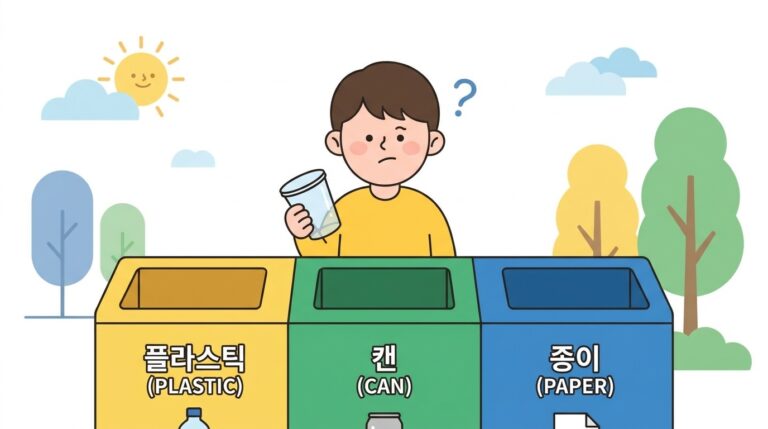
Hello! I am your Daily Hangul editor. As someone who has spent over a decade navigating the bustling streets of Seoul and tutoring hundreds of expats, I know exactly what catches visitors off guard.
Picture this: You just finished a delicious iced Americano while exploring the trendy streets of Hongdae. You spot a small, mysterious pile of bags near a telephone pole and think, ‘Ah, a makeshift trash pile!’ You toss your cup. Suddenly, an angry Ajumma (middle-aged lady) taps your shoulder and unleashes a rapid-fire lecture. In a K-Drama, this is where the quirky comedic music plays. In real life? It is absolutely terrifying.
Welcome to Korea, a country where recycling is almost a national sport, and littering is a huge social taboo. Today, we are diving into the rules of trash disposal and the phrases you need to survive without getting scolded. Everything you read here is based on the real pain points of my past students!
Phase 2: Core Expressions Deep Dive
Here are the life-saving phrases you need when dealing with trash in Korea.
1. 여기 버리면 안 돼요.
- Pronunciation: yeogi beorimyeon an dwaeyo. [The ‘beo’ sounds like the ‘bu’ in ‘butter’, and ‘dwae’ sounds like ‘dweh’.]
- Meaning: Literal (If you throw here, it’s not okay) vs. Real (You can’t throw that away here / No littering).
- K-Culture Moment: A convenience store owner might say this to you if you try to put a ramen cup in the general trash bin without emptying the leftover soup first.
- Editor’s Insight: This phrase does not sound aggressively angry. It sounds more like an urgent warning. The grammar ‘-myeon an dwaeyo’ (if you do X, it is not okay) is a softer, indirect way Koreans tell you NOT to do something.
- Situation Spectrum:
- Casual with friends: ✅ (Just drop the ‘yo’: 여기 버리면 안 돼)
- Semi-formal with coworkers: ⚠️ (Okay, but add ‘죄송하지만’ – I am sorry but…)
- Formal with boss/elders: 🚫 (Let them handle their own trash!)
- 🤔 Think About It: Why does Korean use the indirect ‘if you do this, it becomes bad’ structure instead of a direct ‘Do not do this!’ command? How does your native language handle prohibitions politely?
2. 분리수거 하셔야 돼요.
- Pronunciation: bullisugeo hasyeoya dwaeyo. [Sounds like ‘bool-lee-soo-gaw ha-shya-ya dweh-yo’.]
- Meaning: Literal (You must do separated collection) vs. Real (You have to recycle).
- K-Culture Moment: If you move into a new officetel in Seoul, the friendly but strict security guard (Ahjussi) will definitely tell you this on day one while pointing at five different colored bins.
- Editor’s Insight: ‘Bullisugeo’ is a word you will hear constantly. Korea separates paper, plastic, vinyl, cans, and glass very strictly.
- Situation Spectrum:
- Casual with friends: ✅ (분리수거 해야 돼)
- Semi-formal with coworkers: ✅
- Formal with boss/elders: 🚫
- 🤔 Think About It: Recycling in Korea is a massive communal effort. Have you noticed how even mega-star K-Pop idols are often shown in behind-the-scenes videos diligently sorting their lunchboxes into different recycling bins?
3. 과태료 내야 해요.
- Pronunciation: gwataeryo naeya haeyo. [Sounds like ‘gwa-tay-ryo nay-ya hay-yo’.]
- Meaning: Literal (You have to pay a negligence fine) vs. Real (You will get fined for that).
- K-Culture Moment: You will hear this on the news or from a concerned Korean friend if you try to throw your household trash in a public street bin.
- Editor’s Insight: This is a serious consequence. Korea uses CCTV cameras everywhere to catch illegal dumping (무단 투기)!
- Situation Spectrum:
- Casual with friends: ✅
- Semi-formal with coworkers: ⚠️
- Formal with boss/elders: 🚫
Phase 3: Textbook vs. Real Korean
Let us look at how the textbook warnings differ from what people actually say on the street.
[Public Signage vs. Real Talk]
* 📖 Textbook/Signage: 쓰레기 무단 투기 금지 (sseuregi mudan tugi geumji – Prohibition of unauthorized waste disposal)
* 🗣️ Real Korean: 여기 쓰레기 버리지 마세요 (yeogi sseuregi beoriji maseyo – Please don’t throw trash here)
* 💡 Why the difference?: Official signs use heavy Hanja (Sino-Korean words) like ‘무단’ (unauthorized) to sound authoritative and legal, while spoken Korean uses pure Korean verbs for clarity and approachability.
[Buying Trash Bags at the Mart]
* 📖 Textbook/Signage: 규격 봉투를 사용하십시오 (gyugyeok bongtureul sayonghasipsio – Please use the standardized bag)
* 🗣️ Real Korean: 종량제 봉투 주세요 (jongnyangje bongtu juseyo – Please give me a volume-based trash bag)
* 💡 Why the difference?: ‘Jongnyangje’ is the everyday term everyone uses. In Korea, you must buy specific garbage bags for your district, which serves as a built-in tax for waste management.
Bottom Note: For B1 (Intermediate) learners, understanding the difference between formal written warnings and polite spoken requests is a huge step toward fluency!
Phase 4: Cultural Context — K-Culture Deep Dive
4-1. The Non-verbal ‘Nunchi’ of Trash
When dealing with trash, Nunchi (the ability to read the room) is your best friend. Do not just look at signs; look at what Koreans are doing. If you are at a cafe and see everyone carrying their trays to a specific counter and pouring out the ice before throwing the cup away, do exactly that! Emptying liquids before disposing of cups is a vital unspoken rule.
4-2. K-Food Connection: The Great Chicken Bone Debate
If you love K-Food, you will order Chimaek (Fried Chicken and Beer) or Gamjatang (Pork Bone Soup). But here is the ultimate Korean survival test: Are bones considered Food Waste (음식물 쓰레기) or General Waste (일반 쓰레기)?
The answer: General Waste!
Why? Because food waste in Korea is processed into animal feed or fertilizer. If a pig cannot chew it, it is not food waste! Onion skins, tea bags, eggshells, and hard bones must go into the regular trash bag. Mixing this up is the number one way foreigners get scolded by their Korean roommates or neighbors!
Phase 5: Real-Life Roleplay Scenario
Setting: Friday night, 9:00 PM. Hangang (Han River) Park. You and your Korean colleague are sitting on a picnic mat. The night breeze is perfect, the Seoul skyline is glowing, and you have just finished a delicious box of half-and-half fried chicken and a few cans of beer.
Characters:
– YOU: An expat who has been working in Seoul for 6 months. You want to be polite and helpful.
– Min-su (32): Your friendly Korean coworker who organized this picnic.
Dialogue:
Min-su: 아~ 배부르다! 우리 이제 치울까요?
(a~ baebureuda! uri ije chiulkkayo?)
(English) Ah~ I am so full! Shall we clean up now?
(Stage Direction: Min-su starts crushing the empty beer cans.)
YOU: 네, 제가 쓰레기 버리고 올게요. 다 이 봉투에 넣으면 되죠?
(ne, jega sseuregi beorigo olgeyo. da i bongtue noeumyeon doejo?)
(English) Yes, I will go throw away the trash. I can just put everything in this bag, right?
(Stage Direction: You grab a large plastic bag and start tossing the chicken boxes, bones, and cans inside.)
Min-su: 헉! 안 돼요! 캔이랑 종이는 따로 버려야 돼요.
(heok! an dwaeyo! kaenirang jongineun ttaro beoryeoya dwaeyo.)
(English) Gasp! No you can’t! We have to throw away cans and paper separately.
YOU: 아, 맞다! 분리수거 하셔야 돼요… 아니, 해야 돼요!
(a, matda! bullisugeo hasyeoya dwaeyo… ani, haeya dwaeyo!)
(English) Ah, right! We must do separated collection… I mean, we have to do it!
Min-su: 하하, 맞아요. 그리고 치킨 뼈는 일반 쓰레기예요. 알죠?
(haha, majayo. geurigo chikin ppyeoneun ilban sseuregiyeyo. aljo?)
(English) Haha, right. And chicken bones are general waste. You know that, right?
Your Turn! How do you respond?
– A) 당연하죠! 돼지가 못 먹으니까요! (Of course! Because pigs can’t eat them!)
– B) 아, 뼈는 음식물 쓰레기 아니에요? (Ah, aren’t bones food waste?)
– C) 귀찮아요. 그냥 버려요. (This is annoying. Just throw it away.)Best Choice: A — You will look like a total cultural insider! You understand the logic behind the waste separation.
Choice C Analysis: NEVER say this in Korea. Littering or ignoring recycling rules in a public place like Hangang Park will make you look extremely rude.
Phase 6: 10-Second Shadowing Drill
Let’s practice asking for a trash can politely. Read this aloud, paying attention to the pauses (/) and the emotion!
🥺 저기요, / 쓰레기통은 / 어디에 / 있나요?
(jeogiyo, / sseuregitongeun / eodie / innayo?)
English: Excuse me, where is the trash can?
Pro-tip: Raise your pitch slightly at the end of ‘innayo?’ to sound polite and softly confused.
Phase 7: K-Culture Mini Dictionary
1. 눈치
* Romanization: nunchi
* English: The subtle art of gauging others’ moods and reading the atmosphere.
* Context: Using nunchi means watching how locals separate their cafe trash before you blindly throw your cup away.
2. 분리수거
* Romanization: bullisugeo
* English: Separated collection / Recycling
* Context: The strict system of separating paper, plastics, vinyl, glass, and general waste in South Korea.
3. 종량제 봉투
* Romanization: jongnyangje bongtu
* English: Volume-based garbage bags
* Context: You cannot use random plastic bags for general household waste. You must buy these specific, color-coded bags at the supermarket or convenience store for your specific district.
4. 음식물 쓰레기
* Romanization: eumsingmul sseuregi
* English: Food waste
* Context: Food waste must be collected in its own special bag or electronic bin. Rule of thumb: If an animal can chew it, it is food waste.
Phase 8: Traveler Survival Kit
If you are traveling in Korea, finding a public trash can is notoriously difficult! (A remnant of a policy to stop people from dumping household waste on the streets).
Survival Phrases
– 🇰🇷 이거 어디에 버려요? (igeo eodie beoryeoyo?)
– Meaning: Where do I throw this away?
– 🇰🇷 일반 쓰레기예요? (ilban sseuregiyeyo?)
– Meaning: Is this general waste?
– 🇰🇷 종량제 봉투 10리터 하나 주세요. (jongnyangje bongtu simniteo hana juseyo.)
– Meaning: Please give me one 10-liter standard garbage bag.Editor’s Travel Note
– Finding Bins: Because street bins are rare, your best strategy is to hold onto your trash until you reach a subway station or a restroom. Subway stations always have clearly marked recycling and general bins!
– Convenience Stores: Do NOT bring outside trash to throw away in a convenience store. They will get very annoyed. Only throw away things you consumed there.
Phase 9: Critical Thinking — One Step Deeper
Language & Power: The Collective Mindset
Why does Korea have such intense rules about trash and recycling, and why are locals so strict about enforcing them? In a densely populated country like South Korea, especially in a mega-city like Seoul, individual carelessness immediately impacts the whole community. The phrase ‘분리수거 해야 돼요’ (You must recycle) isn’t just a legal warning; it reflects a deep cultural expectation of shared responsibility. In Korean society, adhering to community rules is a sign of respect for your neighbors. Breaking them doesn’t just mean a fine—it means you lack consideration for the collective group.
Your Turn: How does your home country handle trash and recycling? Is it seen as a personal choice or a strict community duty? Share in the comments!
Phase 10: FAQ & Avoiding Misunderstandings
Q: “Can I just pay the fine if I make a mistake?”
No! Fines (과태료) can be quite expensive (up to 100,000 KRW or more), and security cameras are everywhere. More importantly, it creates a bad reputation for expats. Always try your best to sort correctly!
Q: “What do I do if I can’t read the recycling labels?”
Look for the recycling symbol (♻️) on Korean packaging! It usually has a Korean word inside it, like ‘플라스틱’ (plastic), ‘비닐류’ (vinyl), or ‘종이’ (paper). Just match the word to the bin.
Common Mistakes to Avoid:
❌ Mistake #1: Throwing an iced coffee cup away with liquid and ice still inside.
✅ Do this instead: Pour the leftover ice and liquid into the designated liquid drain (usually marked ‘남은 음료수’ – leftover drinks) before tossing the plastic cup!❌ Mistake #2: Putting fruit pits (like peach or mango pits) into the food waste.
✅ Do this instead: Hard seeds and pits go into the general waste (종량제 봉투).
Phase 11: Summary & Action Items
One-Liner Summary: In Korea, recycling is a serious community duty, so remember to separate your trash and ask ‘여기 버리면 안 돼요?’ if you are unsure!
Action Mission:
– Bronze: Look at your current trash bin and say ‘분리수거 해야 돼요’ (bullisugeo haeya dwaeyo) out loud 3 times.
– Silver: Post a picture of your favorite K-Food online and write in the caption whether the leftovers are ‘음식물 쓰레기’ (Food waste) or ‘일반 쓰레기’ (General waste)!
– Gold: Next time you are at a Korean market or cafe, politely ask ‘이거 어디에 버려요?’ to properly dispose of your item.
K-Culture Mission:
Watch one episode of a modern K-Drama today. I guarantee you will spot a scene where someone is taking out the trash in color-coded bags or arguing near a neighborhood recycling station. Spot the scene and notice how they separate it!
Phase 12: Interactive Quiz
Test your new K-Culture survival skills!
1. Situational Judgment: You finished eating spicy pork ribs (뼈) at your friend’s house. Where do the bones go?
– A) In the food waste bag (음식물 쓰레기).
– B) In the volume-based general waste bag (종량제 봉투).
– C) Out the window.
(Answer: B! Bones are too hard for animals to eat, so they are general waste. If you chose C, we need to talk!)
2. True or False — K-Culture Edition:
“It is perfectly acceptable to throw your home household trash into a public trash bin on the street if your bag at home is full.”
(Answer: False! This is illegal dumping (무단 투기) and will result in a heavy fine. You must buy standard garbage bags for your home.)
3. Fill in the Blank:
To ask “Is it okay to throw this here?” you can say: “여기 버리면 안 ( ______ )?”
(Answer: 돼요 – dwaeyo)
Frequently Asked Questions (FAQ)
Q: What does "여기 버리면 안 돼요." mean in Korean and how do you pronounce it?
A: In Korean, "여기 버리면 안 돼요." is pronounced [yeogi beorimyeon an dwaeyo. [The 'beo' sounds like the 'bu' in 'butter', and 'dwae' sounds like 'dweh'.] and means: Literal (If you throw here, it's not okay) vs. Real (You can't throw that away here / No littering).
Q: What does "분리수거 하셔야 돼요." mean in Korean and how do you pronounce it?
A: In Korean, "분리수거 하셔야 돼요." is pronounced [bullisugeo hasyeoya dwaeyo. [Sounds like 'bool-lee-soo-gaw ha-shya-ya dweh-yo'.] and means: Literal (You must do separated collection) vs. Real (You have to recycle).
Q: What does "과태료 내야 해요." mean in Korean and how do you pronounce it?
A: In Korean, "과태료 내야 해요." is pronounced [gwataeryo naeya haeyo. [Sounds like 'gwa-tay-ryo nay-ya hay-yo'.] and means: Literal (You have to pay a negligence fine) vs. Real (You will get fined for that).







